

Twenty-four million bags went astray in 2025. That’s a 19% improvement over 2024, and it still cost the airline industry $6.3 billion. Meanwhile, only 12 of 256 airlines assessed by IATA had achieved full networkwide compliance with Resolution 753’s baggage tracking requirements by that year’s end. The conversation around emerging technologies in aviation asset tracking keeps accelerating. The deployment reality hasn’t caught up.
The hardware has never been better. The bottleneck is integration, interoperability, and a persistent confusion about what “tracking” should actually accomplish. Below, I break down what’s working, what’s announced but unproven, and what to evaluate before committing budget.
Shipment Tracking Ends at Delivery. Asset Tracking Doesn’t.
Most discussions about aviation tracking conflate two fundamentally different problems.
Shipment tracking follows a bag or cargo consignment from origin to destination. The job ends when the item arrives. A passenger’s suitcase from JFK to Heathrow. A pharma pallet from Brussels to Singapore. Once delivered, the tracking system’s work is done.
Asset tracking follows equipment through its full operational cycle. A ULD that moves from airline to ground handler to another airline, then back for inspection. A fleet of GSE tugs rotating across terminals. MRO tools checked out of a cage and (hopefully) returned. The job never ends because the asset keeps cycling. Similar principles apply in military asset tracking, where equipment accountability across organizations is equally critical.
This distinction determines which technology stack matters. Shipment tracking optimizes for a linear path with defined endpoints. Asset tracking optimizes for cycle time, utilization, dwell, and return. When an airline buys a “tracking solution” without clarifying which problem it’s solving, the investment underperforms. I’ve seen it happen more times than I’d like to admit.
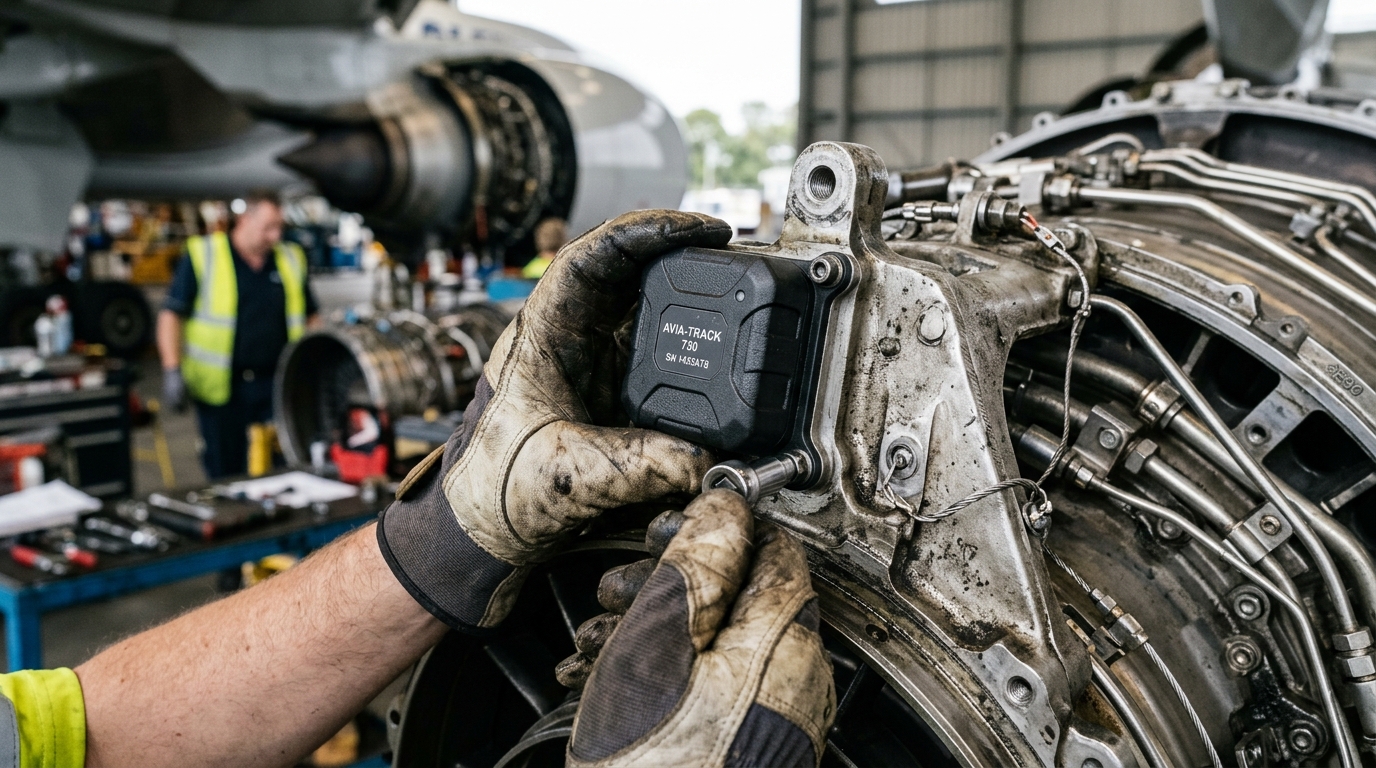
Six Technologies and What They’ve Actually Proven
The label “emerging” gets applied generously in aviation. Some of these technologies have been in production for years. Others are in pilot stages with promising press releases. Here’s where each stands, based on deployments rather than slide decks.
Passive RFID at checkpoints
Delta Air Lines committed $50 million to RFID baggage tracking in 2016. A decade later, passive UHF RFID remains the workhorse for high-volume identification at fixed points. Delta TechOps expanded the approach to maintenance, tagging roughly 5,000 components in Wi-Fi installation kits and using handheld readers to locate approximately $4 million worth of assets that might have otherwise gone missing.
Passive RFID doesn’t give you a GPS dot on a map. It gives you a confirmed read event at a known location: this item passed this reader at this time. For bags at conveyor junctions and parts in a maintenance cage, that’s often enough. For assets that leave the building, it’s not.
BLE and LoRa for ULD visibility
Unilode Aviation Solutions runs the largest digitized ULD network in the industry. In March 2026, it announced Super Sentinel, a Bluetooth and LoRa tag with off-network recovery capability, planned for rollout across more than 220,000 ULDs. Separately, Air Canada, Unilode, and OnAsset Intelligence launched a smart ULD program featuring readers installed on Air Canada’s aircraft.
BLE’s advantage is low power and flexible infrastructure. Its limitation: coverage depends on nearby receivers and their backhaul connections. When a ULD sits in an interline transfer zone with no reader, it goes dark. The Super Sentinel’s LoRa addition is Unilode’s answer to that blind spot.
Cellular IoT with GNSS for ground equipment
An Australian airline deployed GPS trackers across 5,000 ground-support assets using Sigfox-based low-power wide-area connectivity and 4G. Unpowered equipment (dollies, carts) used battery-powered GPS devices. Powered equipment (tugs, loaders) used GPS and cellular. The reported outcomes: up to 10% lower maintenance costs after shifting to engine-hour-based servicing, and up to 10% smaller fleets for certain asset classes.
This is where the asset tracking distinction matters most. GSE moves in cycles, not on shipments. Knowing a tug’s location, hours, and idle time lets you shrink fleet size and schedule maintenance by actual use instead of calendar date. That’s operational dollars, not theoretical value.
Mesh RTLS for constrained indoor areas
Venice Airport needed to keep 2,200 passenger baggage trolleys available across 25 pickup bays. The deployment used active mesh-network tags on trolleys, approximately 500 fixed reference tags, and 25 gateways. After tuning (they started with 1,400 trolleys and expanded), the system delivered reliable bay counts for trolley redistribution.
RTLS works when you need continuous position inside a defined perimeter and can invest in fixed infrastructure. It doesn’t travel with the asset outside that perimeter. Different problem, different tool.
Infrastructure-free cellular positioning
AviusULD takes a different approach entirely. Its SmartULD device uses energy harvesting, LTE, assisted GNSS, and Wi-Fi positioning to report location without any airport-installed reader infrastructure. By April 2026, the company reported over 30,000 devices delivered and geofencing of more than 7,000 off-airport locations across 122 countries.
The trade-off is clear: you avoid infrastructure dependency but accept cellular coverage gaps, power management complexity, and subscription costs. For ULDs that cross dozens of airports and spend significant time off-airport, the infrastructure-free model has compelling logic.
Consumer device integration
This one surprised the industry. SITA integrated Apple’s Find My into its WorldTracer baggage recovery platform, and in early 2026 added Google’s Find Hub. The mechanism: when a bag goes missing, the passenger shares their personal tracker’s location with the airline through a secure, time-limited, revocable link.
SITA reported a 90% reduction in permanently lost luggage in their Apple Find My integration experience. That’s impressive, but there’s a cautionary counterpoint. In late 2024, a United passenger’s AirTag showed his bag sitting at Barcelona airport, yet airline staff couldn’t locate it. He never got it back.
Knowing where something is and being able to retrieve it are two different capabilities.
How they compare
| Technology | Best fit | Main limitation | Proven at scale? |
|---|---|---|---|
| Passive RFID | High-volume ID at fixed points (bags, parts) | No continuous position | Yes (Delta, airlines globally) |
| BLE + LoRa | ULD visibility with reader infrastructure | Gaps between readers | Yes (Unilode, 220K+ ULDs) |
| Cellular IoT + GNSS | Outdoor GSE across large areas | Subscription cost, power management | Yes (5,000+ assets tracked) |
| Mesh RTLS | Indoor constrained areas (terminals, bays) | Requires fixed infrastructure | Yes (Venice, 2,200 trolleys) |
| Infrastructure-free cellular | ULDs across airports and off-airport | Cellular coverage, power | Growing (30,000+ devices) |
| Consumer device integration | Passenger bag recovery | Dependent on passenger opt-in | Deployed (SITA WorldTracer) |
You’ll notice blockchain isn’t on this list. It appears in most “emerging aviation tech” roundups, and there are legitimate theoretical applications for immutable custody records. In practice, I haven’t seen a production-scale aviation asset tracking deployment where blockchain was the enabling technology rather than a feature on a pitch deck. When that changes, I’ll update this article.
A Location Dot Is Not a Recovery
The AirTag case above illustrates the central tension in aviation asset tracking. Technology can tell you where something is. It cannot, by itself, tell you who is responsible for it, what should happen next, or ensure someone acts.
Thai Airways offers the productive counterexample. After deploying SITA’s Bag Manager across nine domestic airports and introducing WorldTracer Auto Reflight at Bangkok, the airline automated reassigning mishandled bags to onward flights. A previously three-minute manual task per bag dropped to one second. The technology here isn’t a more precise sensor. It’s a workflow engine that converts an exception into an action without human delay.
Here’s the framework I use with every deployment: event-to-action traceability. Identify the asset. Record where and when it was observed. Attach the observation to a journey or work order. Assign someone to act on exceptions. Verify closure. IATA’s four Resolution 753 baggage points (acceptance, loading, transfer, arrival) follow exactly this logic. For a comprehensive guide on implementing these principles, see how to improve asset traceability in aviation. The most valuable piece of technology in your stack might not be the tracker. It might be the system that routes the alert.
AI enters the picture as a prioritization layer. A system tracking thousands of bags and hundreds of equipment pieces generates noise. The value of AI is flagging the bag most likely to miss its connection, identifying the loader that’s been idle four hours, or spotting an incomplete cargo record before the customer calls. IATA’s 2026 technology assessment raised its impact rating for AI compared to the prior year. But AI trained on stale, incomplete, or wrongly matched location events will send workers to the wrong place, the same lesson learned by operators building real-time environmental data platforms. The quality of your event data constrains the quality of your AI.
Interoperability Decides Whether Your System Scales
Thirty-nine percent of baggage mishandling in 2025 was transfer-related. On international routes, the mishandling rate hit 9.12 bags per 1,000 passengers, versus 1.65 on domestic. The pattern is obvious: assets get lost at handoff points between organizations.
This is not a sensor problem. It’s a data-sharing problem.
IATA made ONE Record the preferred cargo data-sharing standard effective January 1, 2026. More than 200 companies have participated in pilots and working groups. “Preferred” is not “mandatory,” though, and participation is not implementation. The gap between joining a working group and having your tracking events flow seamlessly to a partner airline’s system at 2 AM during a connection window is significant.
For ULDs, the interoperability question is even more acute. A single container might touch five airlines and a dozen ground handlers in one month. If your tracking system produces events that only your own operations team can read, you’ve built an expensive walled garden. The emerging trend worth watching isn’t another sensor type. It’s whether standards like ONE Record can make cross-company custody events routine instead of exceptional.
Active Devices on Aircraft: Compliance Before Coverage
Every conversation about tracking cargo or ULDs in transit eventually hits the same wall: can your device legally operate on an aircraft?
An ICAO Dangerous Goods Panel working paper identifies potential electromagnetic interference, lithium-battery hazards, and operator approval requirements for active devices in cargo. IATA’s 2025 Dangerous Goods Regulations include specific provisions for data loggers and cargo trackers used during transport. A ground-tracker specification does not establish airworthiness.
This is why DO-160 certification matters for airfreight tracking devices. Equipment that meets the environmental testing standard for airborne operation can travel with cargo through the full air transport chain without special handling exemptions. The Thingfox T2, for example, carries DO-160 airfreight approval. That’s not a spec footnote. It’s the difference between continuous visibility and a tracking gap every time your asset boards a plane.
If you’re evaluating trackers for ULDs, high-value cargo, or any asset that needs to maintain telemetry during flight, check the device’s certification status and your carrier’s acceptance policy before you check the price.
Building a Business Case the CFO Won’t Reject
Vendor-reported results are a starting point, not your forecast. The Australian GSE case reports up to 10% maintenance savings and up to 10% fleet reductions in some asset classes. Delta TechOps reports locating $4 million in potentially misplaced assets. Those are qualified, context-specific outcomes. Your baseline, asset mix, and existing processes will produce different numbers.
Here’s what I tell operators to measure before they buy:
- Current search time per asset class. How many labor hours per week go to finding equipment, bags, or parts? Multiply by loaded cost.
- Dwell time and cycle time. How long do ULDs or reusable containers sit idle between uses? Every day of unnecessary dwell is a day you’re paying for an asset that’s not working.
- Exception resolution time. From the moment a bag misses its connection or a part goes missing, how long until someone acts? Thai Airways compressed that to one second for reflight decisions.
- Ghost fleet size. How many assets can you not account for right now? Most operators I work with discover 5 to 15% of their fleet is invisible at any given moment.
Then build total cost honestly: devices, connectivity subscriptions, platform licensing, integration with your existing WMS or MRO system, battery replacement cycles, and the labor to manage exceptions. A realistic ROI timeline for aviation asset tracking is three to five years. If someone promises payback in six months, ask harder questions.
Factor in adoption, too. The best tracking system fails if ground handlers don’t scan, if MRO techs bypass the tag, or if dispatchers ignore the dashboard. Pilot with a small fleet. Prove value with your team. Then expand. Technology that outpaces your people doesn’t scale.
The real question for aviation asset tracking in 2026 has shifted from “can we track it?” to “can we act on what we track, across organizational boundaries, in compliance with airworthiness rules, at a cost the CFO accepts?” That’s harder. It’s also the right question.
If your container pool goes dark after delivery, if your GSE is invisible past the fence line, or if your MRO team spends more time searching for parts than installing them, the gap is asset tracking. Not shipment tracking. Not flight tracking. Asset tracking across the full operational cycle. We build those systems. Browse our aviation-grade tracking devices or reach us at datanetiot.com/contact-us.

Frequently Asked Questions
What is the difference between aviation asset tracking and flight tracking?
Asset tracking follows physical items like bags, ULDs, ground equipment, and maintenance parts through their operational lifecycle. Flight tracking follows the aircraft’s position. IATA Resolution 753 specifies custody observations for baggage at acceptance, loading, transfer, and arrival. Those are asset events, not flight events.
Does passive RFID provide real-time GPS location?
No. Passive RFID confirms that a tagged item passed a specific reader at a specific time. It provides event-based identification, not continuous positioning. Continuous outdoor coordinates require GNSS plus a communications path like cellular or LPWAN. Indoor positioning needs another approach, such as mesh-based RTLS.
Can active tracking devices operate legally on aircraft?
It depends on the device, battery configuration, and carrier authorization. ICAO and IATA have outlined electromagnetic interference and lithium-battery concerns for active cargo devices. Devices with DO-160 airfreight certification, like the Thingfox T2, meet environmental testing standards for airborne equipment and can travel with cargo without special exemptions.
How large is the aviation asset tracking market?
Published estimates vary significantly by scope and methodology. One source puts it at $356 million in 2024, growing to $912 million by 2034. Another estimates $2.8 billion in 2025, reaching $6.5 billion by 2035. The eightfold difference in baselines reflects different category definitions, not conflicting measurements of the same thing.
What should I measure to build an ROI case for asset tracking?
Start with current search time per asset class, cycle and dwell time for reusable equipment, exception resolution time, and the number of assets you can’t account for at any given moment. Compare these baselines against post-deployment outcomes, and include total system cost: devices, connectivity, integration, platform licensing, and labor.
What is IATA ONE Record and why does it matter?
ONE Record became IATA’s preferred cargo data-sharing standard on January 1, 2026, with more than 200 companies participating in pilots and working groups. For asset tracking, it means tracking events from one airline or handler can potentially flow to partners without custom integrations, reducing the handoff gaps where assets go missing.







 +1 508 292 2210