

A low cost asset tracking system sounds straightforward until you price the full picture. A GPS device listed at $14.99 can carry $19.95 per month in service fees. That turns a $15 purchase into a $254 first-year bill per unit. Scale to 50 devices over three years and the total reaches $36,659, with $35,910 of it flowing to connectivity alone.
I’ve deployed IoT tracking across aviation, freight, and industrial operations for over 15 years. The pattern repeats: a company picks the cheapest hardware listing, attaches a subscription, then discovers 18 months later that the “low cost” system quietly consumed more budget in service, labor, and battery replacement than the assets justified.
The tag was never the expensive part. What follows is the cost breakdown, technology comparison, and system design process I’d walk through with any operator asking me this question today.
Define the Observation Before You Choose the Hardware
Most overspending starts with a vocabulary problem. “Tracking” conflates at least four distinct operational needs, each carrying its own cost structure:
- Custody: Who has it right now? A checkout log, no location hardware required.
- Checkpoint: Did it pass this gate or dock door? Presence detection at fixed points.
- Zone location: Which room, bay, or yard section is it in? Real-time positioning within a facility.
- Continuous position: Where is it on a map, updating every N minutes? GPS/GNSS cellular telemetry across open geography.
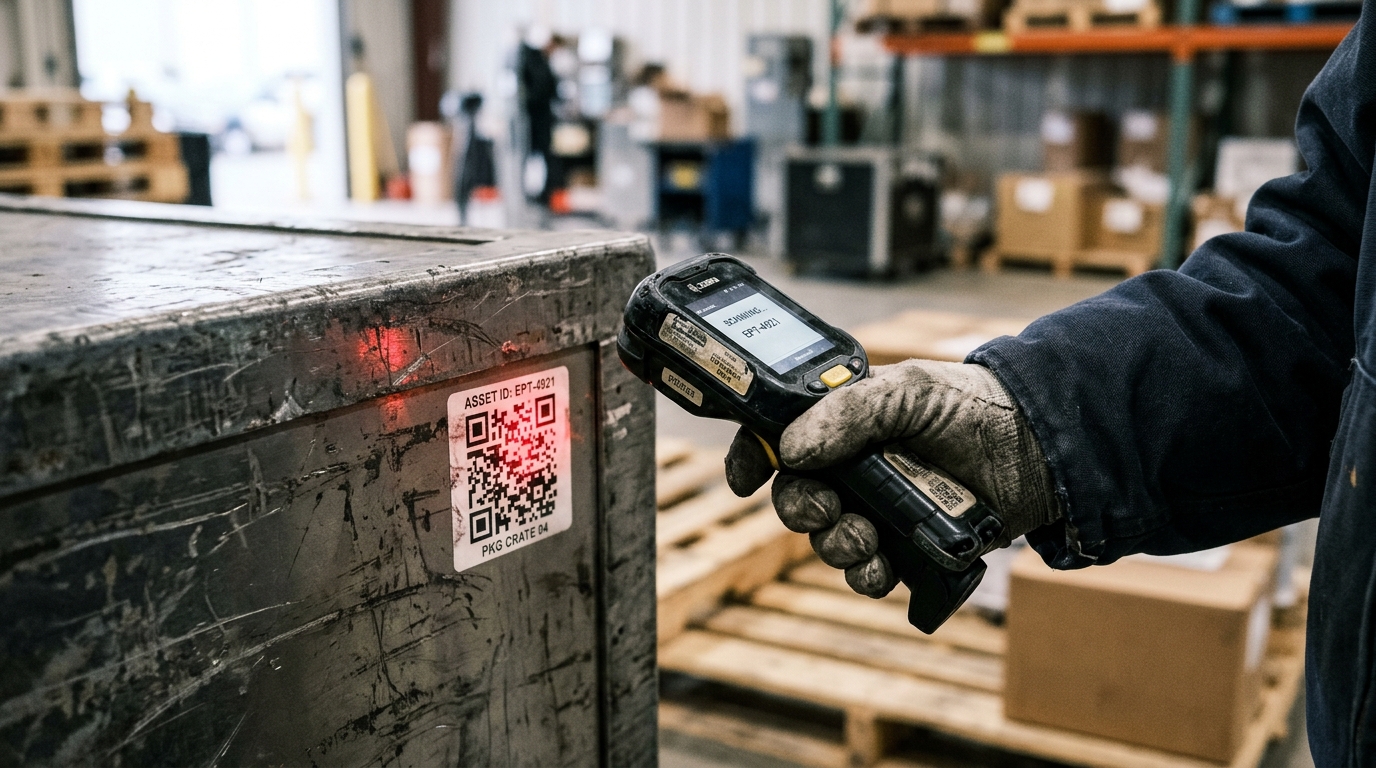
A QR label and a phone camera solve custody for cents per asset. Passive UHF RFID identifies objects automatically without line of sight, enabling checkpoint detection at scale with no battery in the tag. BLE or UWB handles zone location inside a building. Continuous GPS telemetry demands a powered device, a cellular or satellite link, and a recurring subscription.
Each tier adds cost. The question that saves you money is not “what’s the cheapest tracker?” It’s “what’s the cheapest observation that changes how I operate?”
If knowing the last person who checked out a torque wrench prevents a $400 replacement purchase, custody tracking at near-zero cost is the answer. If confirming that a ULD left Building C at 14:07 prevents a three-hour ramp search, you need checkpoint RFID at the dock door. If recovering a stolen $50,000 backhoe requires real-time coordinates shared with law enforcement, you need GPS telemetry. The $240/year subscription pays for itself in a single event.
The Five Cost Layers Most Buyers Miss
Tag price dominates the search results page. The other four layers dominate the actual budget. Here’s a total-cost-of-ownership framework I use in every deployment conversation:
TCO = tags/devices + infrastructure + software and connectivity + labor + replacement
1. Tags and devices
Ranges from $0.05 for a printed QR sticker to $8 for a BLE beacon (Alibaba’s per-unit production cost in their 110,000-courier deployment) to $15 and upward for GPS cellular trackers. This is the number in the ad. It is rarely the number on the invoice twelve months later.
2. Infrastructure
QR scanning needs nothing beyond a phone. RFID needs readers and portals: standard deployments use entrance/exit portals for perimeter control and additional portals for internal movement. That means fixed hardware at every boundary that matters. BLE RTLS requires gateways across the facility. GPS requires nothing on-site but relies on cellular or satellite coverage, and GPS accuracy degrades indoors, underground, and near structures that block or reflect signals.
3. Software and connectivity
Self-hosted open-source asset management platforms can eliminate software license fees for custody management. Some cloud-based inventory tools offer limited free tiers, with paid plans starting around $49/month. GPS service typically runs $10 to $20 per device per month depending on update frequency and contract length. These are recurring costs, compounding across every device in the fleet, every month, for the life of the deployment.
4. Labor
The invisible cost killer. Manual scanning requires someone to physically interact with every asset on a schedule. A 100-asset operation with two 15-second scans per asset per week consumes roughly 43 hours annually. At $30/hour burdened labor, that’s $1,300 a year for a “free” scanning workflow. RFID portals and BLE gateways eliminate that human-scan dependency, but they introduce infrastructure expense. Either way, something costs something. “Free” just decides who pays: hardware or people.
5. Replacement and maintenance
This is where deployments die quietly. Alibaba’s $8 BLE beacons hit ROI payback in 12 months, then reached battery runout and retirement shortly after. The system worked. Then it didn’t. Because nobody budgeted for the refresh cycle. Battery-powered tags are consumables, not permanent fixtures. A system designed for 10,000 assets needs a replacement cadence baked into years two and three. Ignore this layer and the cheapest system becomes the most expensive one you abandoned.
Technology Options at Every Price Tier
The RAIN Alliance reported 42.7 billion passive tag chips shipped in 2025, underscoring how deeply embedded low-cost identification has become across supply chains. But chips are not complete systems. Here’s how the full stack compares, tier by tier:
| Tier | Technology | Per-Asset Annual Cost (est.) | Best For | Key Limitation |
|---|---|---|---|---|
| Near-zero | QR / barcode + phone scanning | $0.10 to $2 | Custody logs, tool checkout, IT inventory | No scan, no data. Depends on human discipline. |
| Low | Passive UHF RFID (RAIN) | $0.10 to $0.50/tag + reader infrastructure | Dock-door inventory, container pool counting, automated checkpoint | Fixed reader cost, site-specific tuning, no standalone location. |
| Mid | BLE beacons + gateways | $5 to $15/beacon/year + gateways | Room-level facility location, equipment utilization | Battery cycle, gateway density requirements. |
| Mid-high | GPS / cellular tracker | $100 to $300 (device amortized + service) | Outdoor fleet, high-value mobile assets, theft recovery | Subscription lock-in, indoor signal loss, power management. |
| High | UWB RTLS | $200+ per tag + dense anchor infrastructure | Sub-meter indoor positioning, manufacturing, AGVs | Highest infrastructure cost of any indoor option. |
Notice the pattern: as position precision increases, infrastructure cost increases with it. A warehouse that needs to confirm “this pallet left the dock” pays a fraction of what a hospital pays to know “this infusion pump is in Room 314 right now.” Neither is wrong. Both are wasteful when applied to the other’s problem.
The broader market framing these tiers is large. Fortune Business Insights estimates the asset tracking market at $28.97 billion in 2026, projected to reach $71.55 billion by 2034, spanning everything from printed labels to satellite telemetry. “Asset tracking” is not one product category. It’s a spectrum, and the low-cost zone depends entirely on which observation your operation actually requires.
Three Real Deployments and What They Cost
Field results beat spec sheets. Here are three documented cases that show how cost plays out at different scales, with different requirements.
TCM Enterprises: scanning solved what GPS couldn’t justify
TCM Enterprises manages construction consumables across job sites using barcode/QR scanning and low-stock alerts. The result: approximately two hours saved weekly and $200 to $500 per month in inventory costs, covering more than 50 supply types. This is a practical example of reducing MRO inventory costs without disrupting operations.
No GPS. No real-time location. Just disciplined scanning and automated reorder thresholds. For consumable tracking where the operating question is “do we have enough?” rather than “where exactly is it?”, this is the right tier. The system cost a fraction of what GPS telemetry would have required. It delivered measurable returns because it matched the actual observation needed.
J&M Contracting: GPS paid for itself in one event
J&M Contracting deployed GPS monitoring across trucks and nearly 40 pieces of heavy equipment. When a backhoe valued at approximately $50,000 was stolen, the system flagged movement outside operating hours and showed coordinates more than 17 miles from the jobsite. The asset was recovered.
One event covered years of subscription cost. That’s GPS telemetry working as designed: high-value mobile assets in theft-prone environments where a single loss exceeds the system’s entire lifetime expense. The monthly fee per device is not “low cost” in isolation. Against the risk it mitigates, the total system cost is negligible.
Royal Mail: 850,000 containers, zero batteries
Royal Mail tagged 850,000 reusable wheeled containers with battery-free ambient IoT across 5,000 sites. The architecture eliminates the replacement cycle that collapsed Alibaba’s BLE deployment after its beacons ran out of power.
Battery-free tags shift cost from ongoing maintenance to upfront infrastructure (gateways, software platform, integration). You still pay. But you’re not paying someone to swap batteries across 850,000 units every two years. At fleet scale, that tradeoff changes the entire economic picture. For any operation managing large container pools or reusable transport equipment, the lesson is clear: unit hardware cost means little if the maintenance tail is unbudgeted.
Shipment Tracking vs. Asset Tracking: Where the Real Money Hides
This is where I see the most money wasted, particularly in aviation and freight logistics.
Shipment tracking answers one question: did the cargo arrive? The system’s job ends at delivery. The tracking device, if there is one, gets discarded or ignored. Everything is optimized for a single leg from origin to destination.
Asset tracking answers a fundamentally different question: where is this reusable asset across its full cycle? Delivery. Dwell. Return. Repositioning. Maintenance. Reuse. A ULD sitting idle at an outstation for three weeks because the system lost visibility after delivery is a revenue leak, not a tracking success. A ground support equipment unit that completed its task at Gate 14 but can’t be located for the next turn is a delay waiting to happen.
The cost difference between these two approaches is not in the hardware. It’s in system design. A shipment tracker pings for a trip and goes silent. An asset tracker maintains a persistent identity across multiple cycles, handlers, and locations. That persistence enables cycle-time reduction, utilization analysis, and dwell-time alerts: the metrics that produce measurable ROI over months, not just a delivery confirmation. These are the same asset tracking metrics for aviation that drive documented aviation asset tracking productivity gains that rarely get audited, including the aviation asset utilization KPIs most airlines fail to measure.
Integration amplifies this. Industry reports from late 2025 showed that integrating Apple’s Share Item Location into airline baggage-recovery workflows reduced delayed-bag recovery time by 26% and “truly lost” bags by 90% for participating airlines. A $29 consumer device, plugged into an operational recovery workflow, outperformed standalone equipment costing ten times more. The device wasn’t special. The integration was.
For aviation specifically, the economics are stark. A single widebody ULD costs $1,000 to $3,000 to replace. Airlines operate thousands. If 5% are functionally “lost” (not destroyed, just invisible in the system), the annual replacement spend dwarfs any tracking investment. Understanding the full picture of aviation asset recovery costs reveals why the genuinely low-cost system for this problem is not the cheapest GPS unit on a search page. It’s the least expensive architecture that maintains visibility across the complete asset lifecycle, which is precisely why aviation asset tracking delivers measurable cost savings through reduced replacement spend, improved asset utilization, and real aviation maintenance labor savings.
Certification matters here too. Equipment used in airfreight and on the ramp must meet standards like DO-160. A consumer GPS tracker attached to a ULD does not satisfy these requirements, which exist for safety, not bureaucracy. The Thingfox T2 is specifically DO-160 approved for airfreight operations, purpose-built for the environment rather than repurposed from a consumer product line. Compliance cost is system cost. Ignoring it creates liability that makes the “savings” irrelevant.
How to Build a System That Stays Low Cost at Scale
After deploying these systems across aviation, maritime, and industrial environments, here’s the process I follow when a new operation asks for help:
- Identify the operational decision, not the technology. Not “we need tracking.” What specific decision improves when you have better visibility? Reorder timing? Theft deterrence? Cycle-time reduction? Utilization balancing? The decision defines the observation tier. Everything else follows.
- Start with the least complex architecture that supports that decision. If custody logging solves the problem, deploy serialized labels and a free database. If checkpoint detection solves it, put RFID portals at the boundaries where assets disappear from view. If continuous outdoor positioning solves it, deploy GPS with a subscription model that scales. Don’t pay for GPS when a dock-door reader answers the question.
- Pilot against a measured baseline. Track search time, loss rate, utilization percentage, or cycle days before deployment. After 90 days, compare. Industry survey data suggests roughly half of asset-tracking adopters reach positive ROI within 12 months. Whether yours does depends on what you measured going in, not on the technology you bought.
- Budget for year two and year three. Include battery replacement, label degradation, software renewals, and operating labor. If year-one cost is $10,000 and year-two refresh is $8,000, annualized cost is $9,000. Alibaba’s beacons proved this the hard way: fast payback, then a dead system when nobody funded the refresh. A “low cost” deployment that gets abandoned in year two was never low cost.
- Match hardware to environment. Industrial assets on a port, ramp, or open yard need ruggedized, weatherproof devices with multi-year battery life. Devices like the Oyster3 or Oyster Edge are built for exactly this: harsh conditions, long deployments, cellular reporting without fragile consumer-grade enclosures. Aviation assets need certified hardware. Office IT inventory needs nothing more than a serialized label. Over-speccing wastes money. Under-speccing wastes assets.
For operations that span multiple environments (warehouse to truck to airport to aircraft), the system must bridge connectivity gaps. A tracker that reports via cellular on the road and via BLE or Wi-Fi inside a facility covers more of the asset lifecycle than either technology alone. That integration layer is where a purpose-built tracking solution outperforms a cobbled-together stack of the cheapest individual components. The cheapest piece-parts do not guarantee the cheapest system.
Frequently Asked Questions
What is the cheapest asset tracking system available?
For custody and inventory management, a self-hosted open-source asset database with QR labels costs nothing beyond your own server and printed labels. For GPS location, a $15 device with $20/month service totals roughly $255 in year one per unit. “Cheapest” depends on the observation tier you need. Total cost of ownership, not tag price, defines the real number.
Can I track assets without a monthly subscription?
Yes, if your observation doesn’t require cellular or satellite data. Snipe-IT and Traccar (free, self-hosted GPS platform) carry no vendor subscription. You still own the hosting, maintenance, and labor costs. “No subscription” means the recurring cost shifts, not that it disappears.
Is an Apple AirTag good enough for business tracking?
Apple’s AirTag at $29 uses crowdsourced Bluetooth through nearby Apple devices to relay approximate location. It’s a recovery aid, not a scheduled telemetry system. For business operations requiring predictable update intervals, defined coverage, and integration with workflow software, purpose-built tracking hardware is the appropriate choice.
How does RFID compare to GPS for asset tracking?
They solve different problems. Passive RFID identifies assets automatically at fixed checkpoints (dock doors, portals, tool cribs) without batteries or subscriptions. GPS provides continuous outdoor location via satellite and cellular with a recurring service fee. Many industrial operations need both: RFID inside facilities for automatic counting and GPS between facilities for transit visibility.
What ROI timeline should I expect?
It depends on what you’re preventing. J&M Contracting recovered a $50,000 backhoe, paying for years of service in one event. TCM Enterprises documented $200 to $500 monthly savings from better consumable management. Verizon’s survey data shows 48% of users reaching positive ROI within 12 months. The fastest payback comes from matching the tracking tier to a specific, measured loss or inefficiency.
Do aviation assets need a different tracking system?
Yes. Equipment operating in or around aircraft must meet certification standards such as DO-160 for airfreight environments. Consumer trackers and general industrial GPS units don’t qualify. Aviation asset tracking also demands full-lifecycle visibility (delivery, dwell, return, MRO), not just origin-to-destination shipment confirmation. The hardware, the certifications, and the system architecture are all different.
If your equipment, containers, or ground support assets vanish from your system the moment they leave the dock, you’re running shipment tracking where you need asset tracking. That’s the gap worth closing. Reach out at info@datanetiot.com or talk to our team directly.








 +1 508 292 2210

One Response