

Your quality team can print a lot label in seconds. Reconstructing which supplier material went into that lot, which sterilization cycle processed it, and which distributor shipped it to which hospital is where things break down. That reconstruction is exactly what ISO 13485 traceability requirements exist to support, and clause 7.5.9 is where most audit findings begin.
The 2025 ISO Survey counted 36,522 active ISO 13485 certificates, a 17% recorded increase from the prior year. Certification is growing. Whether the traceability behind those certificates can survive a real recall or a pointed FDA inspection is a different question. FDA’s Quality Management System Regulation (QMSR), effective since February 2, 2026, now incorporates ISO 13485:2016 into U.S. regulatory law. Four EUDAMED modules became mandatory on May 28, 2026. The standard itself hasn’t changed, but the number of regulators relying on it has.
Identification and Traceability Are Separate Obligations
Clause 7.5.8 covers identification: knowing what a product is and its inspection or release status at any point during realization. Clause 7.5.9 covers traceability: being able to follow a product’s history backward to its inputs and forward to its destination. A device can carry a correct label, have the right status, and still be untraceable if the records linking it to raw materials, process parameters, and distribution don’t exist or can’t be retrieved.
The practical consequence shows up during audits. An auditor may pick a finished-device lot and ask to see its material inputs. Then, separately, they’ll pick a raw material receipt and ask which finished lots consumed it. If either direction fails, the traceability procedure is incomplete regardless of how well the labels read.
Returns add another layer. Clause 7.5.8 specifically requires distinguishing returned product from conforming product. When a hospital sends back a reusable device or a distributor returns unsold stock, that unit must remain identifiable and must not re-enter conforming inventory without documented disposition. Traceability records need to reflect where that unit has been, not only where it’s going next.
With that distinction clear, the question becomes: which clauses carry the specific obligations?
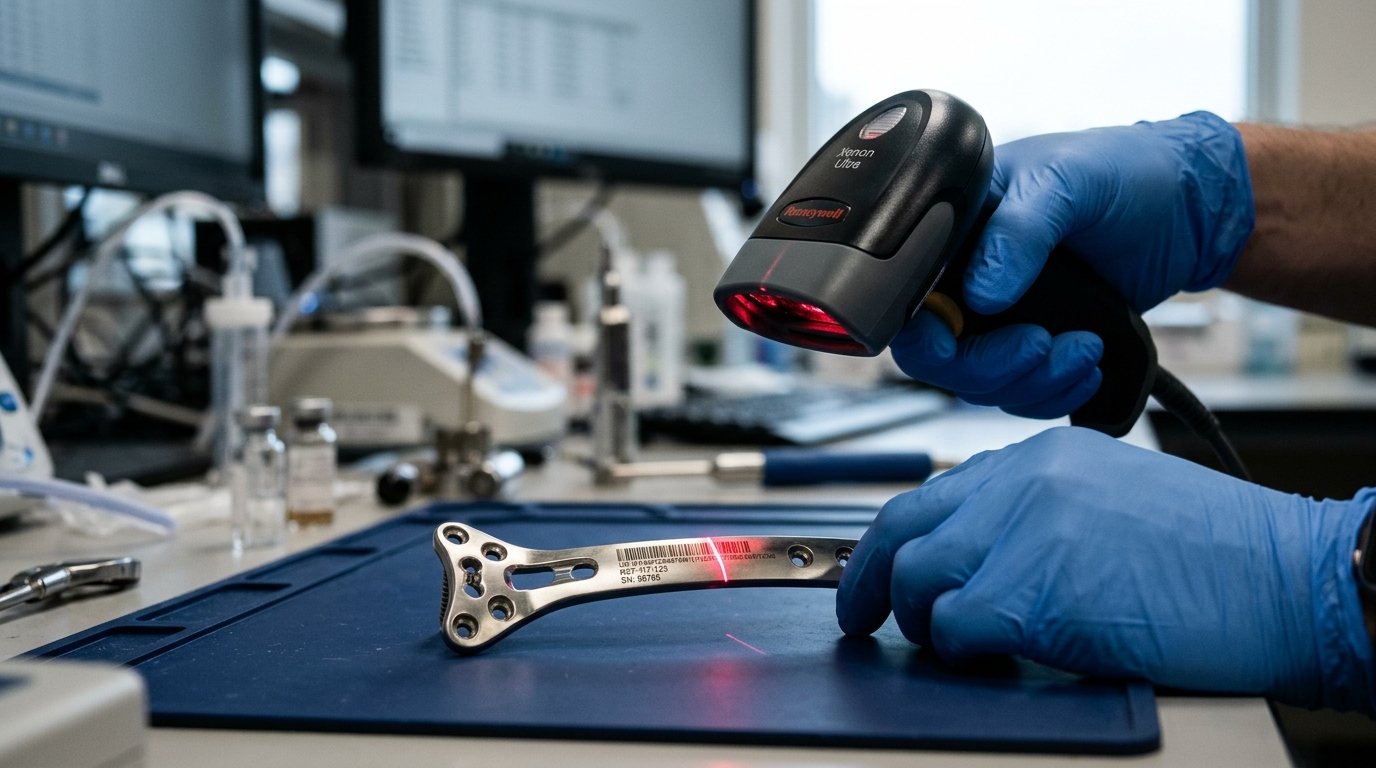
Every Traceability Clause in ISO 13485, Mapped
The traceability obligations in ISO 13485:2016 aren’t confined to a single section. They span purchasing, production, sterilization, and record control. The table below maps each clause to its practical demand and the evidence an auditor typically expects.
| Clause | Practical Requirement | Typical Audit Evidence |
|---|---|---|
| 7.5.8 | Identify product throughout realization. Maintain inspection and release status. Distinguish returns from conforming product. Document UDI assignment where regulations require it. | Identification procedure, status indicators, return segregation records, UDI documentation |
| 7.5.9.1 | Document procedures defining the extent of traceability required by applicable regulations and the records to be maintained. | Traceability procedure with scope rationale, identifier rules, controlled records with demonstrated retrieval |
| 7.5.9.2 | For implantable devices: preserve records of components, materials, and work-environment conditions that could affect safety or performance. Require distributors to maintain inspection-available records. Retain shipping-package consignee names and addresses. | Material genealogy, environmental condition records, distributor agreements, shipment and consignee records |
| 7.5.1 | Maintain a verified, approved record for each device or batch, including traceability data and quantities manufactured vs. approved for distribution. | Approved batch or device history record with quantity reconciliation |
| 7.4.2 | Preserve purchasing information to the extent needed for traceability. | Purchase specifications linked to received material lots |
| 7.5.5 | Record sterilization parameters for each batch. Link sterilization records to production batches. | Sterilization batch records cross-referenced to production batch records |
| 4.2.5 | Control identification, storage, security, integrity, retrieval, retention, and disposition of records. Preserve legibility and identifiable changes. | Retention schedule, access controls, amendment trails, retrieval demonstrations |
| 4.1.6 | Validate QMS software before initial use and after changes. Validation effort proportionate to risk. | Intended-use documentation, risk assessment, validation records, change assessments |
The connecting thread across every row is linkage. A barcode on a finished device satisfies 7.5.8 (identification), but it only satisfies 7.5.9 (traceability) if that barcode leads to retrievable records covering the upstream and downstream chain. Lot or serial identifiers, as described in MDSAP’s audit approach, can apply to components, subassemblies, finished devices, packaging, and labeling. The choice of lot vs. serial must support the applicable regulatory and risk requirements, not simply match a software vendor’s default configuration. Manufacturers serving both medical and aerospace sectors will find parallels in AS9100 traceability requirements, where similar bidirectional record linkage applies to serialized components.
For implantable and life-sustaining devices, those requirements go considerably deeper.
Implantable Devices Carry Deeper Traceability Obligations
Clause 7.5.9.2 applies specifically to implantable devices, and FDA’s QMSR extends similar provisions to qualifying life-supporting and life-sustaining devices under 21 CFR 820.10(d). The requirement here moves from “can you trace the lot?” to “can you trace the genealogy?” For sterile medical devices and instruments, tracking sterile container movements through sterilization cycles and storage becomes a critical component of that genealogy.
Record-keeping obligations expand for these device categories:
- Manufacturers must preserve records of components, materials, and work-environment conditions when those factors could affect safety or performance. This obligation is conditional. It covers factors with demonstrated safety relevance rather than demanding indiscriminate documentation of every administrative input.
- Distribution-service providers and distributors must maintain records available for inspection. Outsourcing logistics does not eliminate the obligation. If a distributor can’t reconstruct where the devices went, the manufacturer still owns the traceability gap.
- The shipping-package recipient’s name and address must be retained. This creates the forward-tracing path that makes field actions possible when a defect surfaces months or years after shipment.
A common misunderstanding is that ISO 13485 itself requires patient-level tracking for implantables. It does not. FDA’s 21 CFR Part 821 establishes device-tracking requirements for qualifying Class II and III devices, but only where FDA has issued a specific tracking order. These are distinct obligations from distinct regulatory frameworks. Building a single traceability procedure that addresses both is efficient; confusing their sources during an audit is a risk.
And that regulatory overlap extends well beyond implantables, because manufacturers exporting globally now face ISO, FDA, and EU MDR simultaneously.
Where ISO 13485, FDA QMSR, and EU MDR Overlap and Diverge
Since February 2026, FDA’s QMSR has incorporated ISO 13485:2016 into 21 CFR Part 820 for U.S. device manufacturers. That sounds like simplification. In practice, manufacturers must comply with the incorporated standard plus FDA-specific additions, and an ISO 13485 certificate does not exempt any manufacturer from FDA inspection.
FDA’s additions include requiring UDI recording for each device or batch under 21 CFR 820.35(c), extending implantable-type traceability to qualifying life-supporting and life-sustaining devices, and removing prior exceptions that shielded management-review and quality-audit reports from regulatory access. That last change is significant: internal evidence now needs to withstand regulatory review, not just certification-body review.
On the European side, the EU Medical Device Regulation sets its own retention periods and supply-chain identification requirements under Articles 10, 25, and 27. These are parallel obligations.
| Framework | What It Establishes | Key Boundary |
|---|---|---|
| ISO 13485 | QMS identification, records, and traceability requirements | Extent depends on applicable regulatory requirements; implantables get additional controls |
| FDA QMSR | ISO-based U.S. manufacturing requirements plus FDA-specific additions | An ISO certificate does not replace FDA inspection or exempt from FDA-only provisions |
| FDA UDI | Device identification across the lifecycle; GUDID database submission | An identifier alone does not constitute a complete traceability system |
| FDA Part 821 | Device tracking for qualifying Class II/III devices with a tracking order | Applies only where FDA has issued a specific order, not automatically to every high-risk device |
| EU MDR | Supply-chain identification, UDI obligations, documentation retention | Institutions must retain UDIs for Class III implantables; broader obligations may depend on national rules |
Manufacturers exporting to multiple markets need a compliance map that separates these layers. A single traceability procedure can serve all of them, but the rationale must demonstrate that every jurisdiction-specific requirement has been addressed. One place where these frameworks diverge sharply is how long you must keep the records.
Record Retention Goes Far Beyond Two Years
ISO 13485 requires retaining records for the device lifetime as defined by the organization or the applicable regulatory period, with a minimum of two years from organizational release. That two-year minimum is a floor.
EU MDR Article 10(8) specifies that technical documentation, declarations of conformity, and relevant certificates must remain available for at least 10 years after the last covered device is placed on the market. For implantable devices, that period extends to 15 years. The trigger is the last device placed on the market, not a single production batch’s release date, which means the clock can reset with each new shipment of the same device family.
The practical implication is that a retention schedule needs to be device-family specific. A Class I non-sterile consumable might legitimately carry a shorter retention period than a Class III implantable, but both need documented rationale. Applying a blanket two-year policy across all product families is a finding waiting to happen.
Retention also means retrievability. Records stored in a decommissioned database, an unsupported file format, or a warehouse of unlabeled paper binders may technically exist. Whether an auditor or a recall team under time pressure can actually retrieve them, follow the links, and act on them is the real test. And recalls, more than audits, provide the sharpest proof of whether traceability records work under pressure.
Recalls Expose Traceability Gaps Faster Than Auditors Do
A December 2025 GAO report reviewing FDA recall data from FY2020 through FY2024 documented 3,934 manufacturer-initiated voluntary recalls, including approximately 350 Class I recalls. Among terminated Class I recalls, the average time from initiation to termination was 632 business days. That’s an administrative lifecycle figure, not a measure of patient exposure. But it illustrates how long corrective actions stretch when scope determination, communication, and reconciliation are slow.
At Hull University Teaching Hospitals (HUTH) in the UK, implementing GS1 barcode scanning across the patient-care pathway enabled 100% traceability of affected ventilators during a recall. Work that previously consumed weeks was completed in hours. The difference: identification followed the device into actual clinical workflows, capturing date, time, staff, patient, and location at the point of use rather than stopping at the warehouse dock.
Contrast that with FDA’s January 2026 warning letter to Diasol. FDA found that the company could not provide underlying raw data supporting a validation report from 2019. The letter also documented incomplete investigation of received materials and additional manufacturing without verifying that remaining material was contamination-free. Forty batches and 20 samples were potentially affected by compromised test kits. The failure was not a missing barcode. It was missing links between quality conclusions, their supporting evidence, and the material scope of the problem.
GAO’s review also identified staffing constraints and inconsistent manufacturer-FDA communications as recall bottlenecks. FDA requires recalling firms to promptly notify affected direct accounts, which presupposes knowing who those accounts are and where the devices went. Traceability records are necessary infrastructure, but they must be paired with current contact information, retrieval instructions, and a reconciliation process that actually closes the loop.
All of which raises the most practical question: how do you test your own traceability before the pressure is real?
Building Traceability That Survives the Test
A traceability system works when it can answer four questions under pressure: what happened, which devices are affected, where did they go, and what action follows. Testing that capability before an audit or recall requires deliberate effort.
Start with a mock recall that includes realistic complexity. Pick a raw material lot. Determine which finished-device batches consumed it. Identify which customers received those batches. Time the entire exercise. Then run it in reverse: pick a customer complaint about a finished device and trace backward to the material, process, and personnel records. Include split lots, combined batches, rework, and subcontracted processing steps if these occur in your operations. If either direction takes more than a few hours, the gaps are real.
Validate your software before you rely on it. ISO 13485 clause 4.1.6 requires validation of QMS software before initial use and after relevant changes, with effort proportionate to risk. FDA’s Computer Software Assurance (CSA) guidance, finalized in February 2026, supports a risk-based approach: concentrate assurance effort on functions whose failure could undermine required controls, like identity matching, release status, or record integrity.
Pay particular attention to the handoffs between systems and organizations. The weakest point in most traceability chains is at the boundary between purchasing and receiving, between production and release, between the manufacturer and the distributor. If a supplier changes a sub-component’s lot numbering scheme, does your receiving process catch it? If a distributor migrates their warehouse management system, can they still produce the records your implantable-device traceability procedure requires? These boundary conditions break traceability far more often than any single-system failure.
Finally, document the scope rationale. Clause 7.5.9.1 requires a documented procedure defining the extent of traceability. “Extent” means you’ve made a deliberate decision about what gets lot-level vs. serial-level vs. batch-level tracking, and you can explain why. If the answer is “that’s how the ERP was configured by default,” expect a finding.
Whether the system behind your traceability lives in a dedicated eQMS platform, a validated ERP configuration, or a carefully maintained hybrid of digital and paper records matters less than whether it actually connects when tested. The goal is a defensible chain of evidence from supplier through distribution, with every link retrievable, every amendment identifiable, and every retention period matched to the applicable regulatory and device-lifetime requirements.
When the physical location and movement of medical devices and equipment after distribution is the missing piece of that chain, IoT-based asset tracking fills the gap. If that’s the layer your traceability system needs, reach out to our team.

Frequently Asked Questions
Does every medical device need serial-level traceability under ISO 13485?
Clause 7.5.9.1 requires documented procedures defining the extent of traceability based on applicable regulatory requirements. Lot-level, control-number, or serial-level identification can all satisfy the standard depending on the device’s risk class, intended use, and jurisdictional requirements. The choice must be justified and documented.
Does ISO 13485 require tracking devices to the patient?
ISO 13485 does not impose universal patient-level tracking. Clause 7.5.9.2 requires consignee records and distributor traceability for implantables, but patient-level tracking is governed separately by FDA’s 21 CFR Part 821, which applies only to qualifying devices subject to a specific FDA tracking order.
How long must traceability records be retained?
ISO sets a minimum of two years from organizational release, with the actual period determined by device lifetime or applicable regulatory requirements. EU MDR requires 10 years (15 for implantables) after the last covered device is placed on the market. Retention must include retrievability, not just storage.
Is an ISO 13485 certificate enough for FDA compliance?
FDA states explicitly that an ISO 13485 certificate does not exempt a manufacturer from inspection. The QMSR incorporates the standard but adds FDA-specific requirements, including UDI documentation, expanded device-category coverage, and regulatory access to previously shielded internal reports.
Can traceability requirements be met without dedicated software?
ISO 13485 specifies controlled identification and records, not a named platform. A paper-based or hybrid system can satisfy the requirements if it achieves the documented outcomes. When software is used for QMS functions, clause 4.1.6 requires validation before initial use and after relevant changes, with effort proportionate to risk.
What is the most common traceability-related audit finding?
Missing links between records rather than missing records themselves. A manufacturer may have excellent incoming-material documentation and excellent batch records, but if no retrievable connection exists between a specific material lot and the production batches that consumed it, the traceability chain is broken. Bidirectional retrieval (forward and backward) is the standard audit test.








 +1 508 292 2210