

Over 31,000 sites worldwide hold AS9100-series certifications as of mid-2026. That certificate proves a management system was audited and found conforming. It does not prove that any particular part at that site can be traced back to its material source, through every process step, and forward to the customer who installed it.
That gap is where real problems live. Counterfeit components with forged identification plates. Lots with unclear substitution histories. Inspection records disconnected from the serial numbers they cover. These aren’t hypothetical scenarios. They’re documented federal cases.
If you’re a quality manager preparing for a certification audit, a supplier onboarding to a Tier 1 contract, or an operations leader weighing paper travelers against an MES, here’s the practical breakdown of AS9100 traceability requirements: what the standard actually demands, where it gives you room, and where auditors push harder than the clause text suggests.
What Clause 8.5.2 Actually Requires
The core traceability requirement in AS9100D sits in clause 8.5.2: Identification and Traceability. Here’s what it says, stripped of consulting jargon:
- The organization must identify outputs (parts, assemblies, products) using suitable means throughout production and service provision.
- It must identify the status of outputs with respect to monitoring and measurement requirements (inspection and test status).
- When traceability is a requirement, it must control the unique identification of outputs and retain the documented information necessary to enable traceability.
The critical phrase: “when traceability is a requirement.” AS9100D does not impose universal serial-number tracking on every item in every situation. It requires unique identification and records when traceability is required by the customer, by regulation, by contract, or by the organization’s own procedures.
This is where many suppliers trip. The standard gives conditional flexibility. Your customer’s purchase order, quality clause, or flow-down may not.
Clause 8.5.2 also connects to configuration management. The organization must retain documented information that provides traceability to the configuration identification, so the actual configuration of the product can be distinguished from the required configuration. In practice, that means linking the physical item to the applicable drawing revision, approved changes, and any concessions or deviations.
Related requirements reinforce the traceability framework:
| Related Clause | What It Controls | Practical Impact |
|---|---|---|
| 8.1.2, Configuration Management | Ensuring actual product matches required design and approved changes | Links part identity to the correct revision, drawing, and change history |
| 8.1.4, Counterfeit Part Prevention | Processes to avoid counterfeit parts entering the supply chain | Requires traceability to the original or authorized manufacturer |
| AS9102C, First Article Inspection | Verification that production processes produce conforming output | FAI proves a process can produce a good part; it does not replace ongoing lot or serial genealogy |
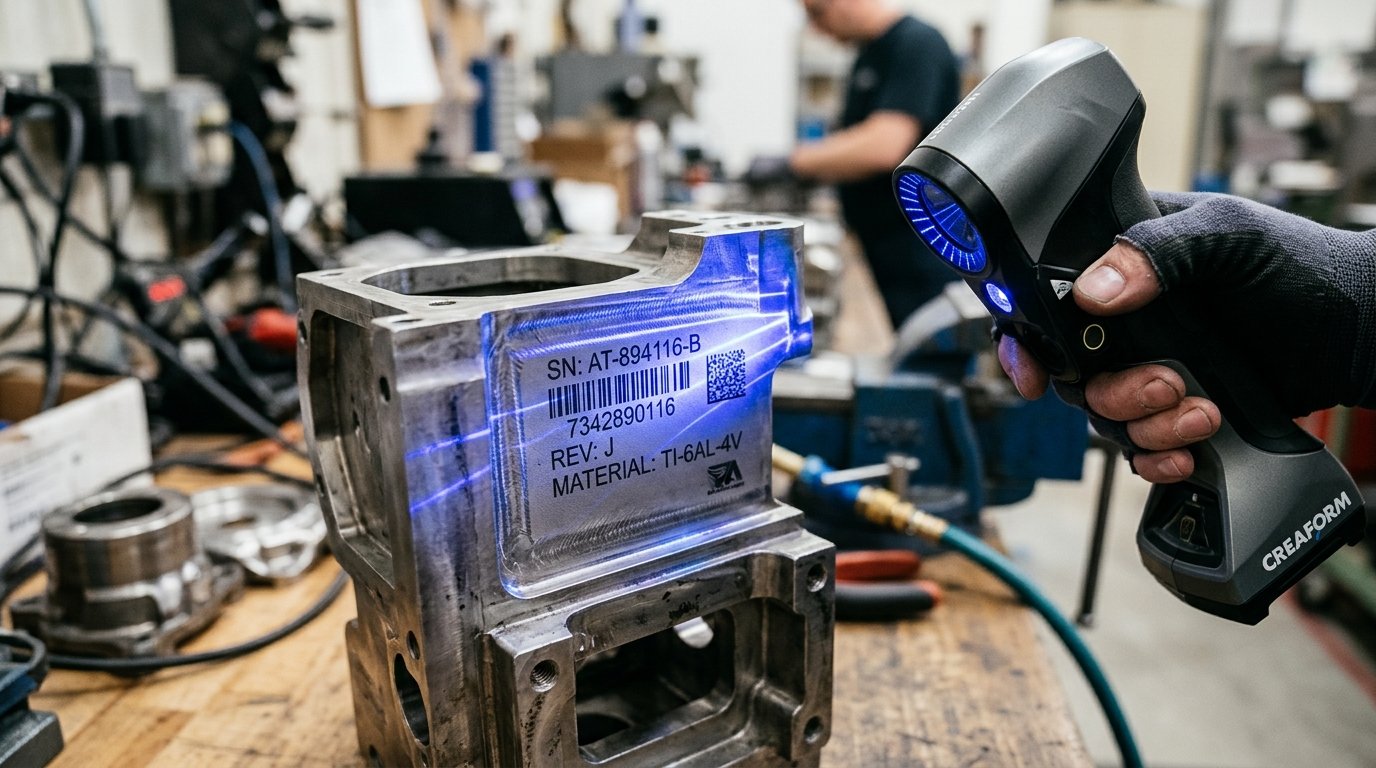
The standard doesn’t prescribe barcodes, RFID, laser etching, or any specific identification technology. IAQG auditor guidance lists physical part marking, labels, tags, barcodes, signage, segregation, storage locations, databases, registers, and certificates as examples of suitable methods. Examples, not mandates.
So the standard tells you what questions your system must answer. It does not tell you which tools to use. That choice depends on understanding the three distinct problems hiding inside the single word “traceability.”
Identity, Status, and Genealogy: Three Problems in One Word
When people say “traceability,” they usually mean one thing. The standard means three.
Start with identity: what is this item, and can you distinguish it from similar items? This could be a serial number, a lot number, a heat number, or a combination. The required granularity (serial vs. lot vs. batch) depends on what your customer and applicable regulations demand, not on what your shop floor finds convenient.
Then status: what is this item’s current acceptance state? Has it passed inspection? Is it awaiting rework? Quarantined as nonconforming? During production, every item should carry clear status so uninspected material doesn’t get shipped and rejected material doesn’t get used.
Finally, genealogy: what materials, sources, processes, inspections, decisions, and changes connect to this item? This is the full record chain. Supplier and purchase order. Material certificate. Work order. Process steps and approved revisions. Operator and equipment where required. Inspection and test results. Nonconformance and rework records. Final acceptance. Shipment data.
These three are linked but not identical. A part can have clear identity (serial number etched right on it) and clear status (green tag, accepted) but broken genealogy (the CoC references a lot number that doesn’t match the purchase order). Conversely, a part can have complete genealogy in the ERP but no physical marking that ties the data to the hardware sitting on the shelf.
Your data model, whether it’s a paper traveler system or an MES, needs to hold all three and keep them connected. When an auditor pulls a part from the shelf and asks “show me the history,” you need to go from physical item to identity to status to full genealogy without gaps.
When all three work together, you can answer any question thrown at you: Where did this material come from? Who inspected it? Which drawing revision was it made to? Was there a deviation? Where did the finished part ship?
But even a perfectly designed data model breaks when the source data is fraudulent. And that is not a theoretical risk in aerospace.
When Records Lie: Counterfeit Parts and the Limits of Paper
In August 2023, the FAA issued an Unapproved Parts Notification for Rockwell Collins TCAS transmitter/receivers (part number 822-1293-XXX). Units sold by Aviation Parts LLC carried counterfeit identification plates. Some units marked as TTR-920 had been physically altered (housings and plates) to resemble TTR-921 units.
Think about what that means for a traceability system. A receiving inspector sees a unit with the right part number, the right serial plate, and presumably accompanying paperwork. The physical identifier is forged. The documentary chain, however complete it looks, points to a lie.
A separate case goes further. The U.S. Department of Justice reported that Aman Khan and California Aircraft and Avionics Corporation sold fraudulent, counterfeit, or unapproved aircraft parts and falsified the related documents. Khan received 46 months in federal prison and was ordered to pay over $1.5 million in restitution. NASA’s Office of Inspector General noted the marketing posed significant risk to critical flight technology.
The lesson for anyone building or auditing a traceability system: a complete-looking file is not proof of a legitimate part. Traceability must combine physical verification, source authorization, chain-of-custody evidence, and investigation procedures. No single control (a serial plate, a CoC, a database entry) is conclusive by itself.
This is exactly why AS9100D clause 8.1.4 requires processes for counterfeit part prevention, including traceability to the original or authorized manufacturer. And it’s why auditors don’t just check that records exist. They check whether the records make sense.
What Auditors Examine on the Floor
The normative text gives you the rules. IAQG auditor guidance reveals what examiners actually look for when they walk the shop floor and pull records.
Based on the published IAQG auditor guidance for 9100:2016, here are the areas auditors evaluate. Organizations working under FAA oversight should also review specific FAA tool calibration requirements which may impose additional measurement traceability obligations:
- Planning and scheduling for identification and traceability, not just the final records.
- Inspection results, test certificates, CoCs, and laboratory reports connected to the specific lot or serial.
- Equipment and measurement standard traceability where required by the product or process.
- Manufacturing method documentation linked to the produced item.
- Acceptance authority evidence showing who accepted the item and under what criteria.
- Nonconformance, rework, and concession records tied to affected items.
The pattern is clear. Auditors test the connections. They pick an item, then pull the thread. Can you get from the item to the supplier? From the inspection result to the calibration record of the gauge used? From the drawing revision on the traveler to the current approved revision in configuration management?
Where organizations fail most often is not missing records. It’s disconnected records. The CoC exists but references a purchase order number that doesn’t match the receiving record. The inspection was performed but the results aren’t linked to the lot number on the traveler. The drawing was revised but the work order still points to the old revision.
Major aerospace customers add their own layer. Lockheed Martin’s supplier quality requirements, for example, can require full or partial first article inspections under AS9102C with associated records. Magellan’s supplier requirements specify traceability to original or authorized manufacturers and note that additional requirements may be flowed down. Passing an AS9100 audit is the baseline. Customer-specific flow-downs often demand more granularity, more retention, and faster retrieval than the standard alone requires.
All of this raises a practical question: if the records need to be this connected, this retrievable, and this resistant to fraud, can paper systems keep up?
The Digital Thread in 2026: Widespread but Unfinished
The aerospace industry’s answer to paper-based traceability is the digital thread: a connected flow of data from design through production through service, enabling traceability and transparency across the lifecycle.
The concept is sound. The execution is uneven.
A 2026 AIA/EY report found that 75% of aerospace and defense organizations are implementing digital-thread efforts in some capacity. That sounds encouraging until you read the next number: only 14% have achieved enterprise-wide scale. A related EY study of 57 A&D leaders reported that only 29% say their enterprise data is standardized, governed, and accessible.
The gap between “we have a pilot” and “our data is trustworthy at scale” is where most organizations live right now. And it matters for traceability because a digital system with inconsistent identifiers, ungoverned data entry, and siloed databases is just an expensive version of the paper problem.
Meanwhile, supply-chain pressure keeps intensifying. IATA reported a commercial aircraft backlog exceeding 17,000 units and estimated $11 billion in airline costs from supply-chain disruption in 2025 alone. That backlog (nearly 60% of the active fleet, compared to a historical norm of 30 to 35%) means sourcing pressure, substitutions, and compressed timelines. All of which make provenance records, substitution approvals, and revision history more critical, not less.
One more variable on the horizon: IAQG has a full IA9100 revision underway, with a target around 2027. The public timelines vary, and no transition deadline has been confirmed. Continue implementing AS9100D controls now. Monitor official publications before changing any compliance claims.
Digitization is the right direction. But buying a platform doesn’t create trustworthy lineage. Clear data ownership, consistent identifiers, validated interfaces, and disciplined change control do. The tool is downstream of the governance. So what does it actually look like when traceability stops being a compliance exercise and starts working as an operational system?
From Compliance to Operational Traceability
Here’s the uncomfortable truth about AS9100 traceability requirements: you can be fully compliant and still operationally blind.
Compliance means you can produce the records an auditor asks for. Operational traceability means you know, in something close to real time, where your assets are, what state they’re in, and whether they match the configuration they’re supposed to match. The first is backward-looking retrieval. The second is live visibility.
The organizations that treat traceability as a competitive advantage, not just an audit obligation, build systems that do both. They connect physical identification (markings, RFID, cellular trackers) to digital records (MES, PLM, ERP) so that any item in the facility or in transit can be queried for its full history and current location.
This is where physical tracking technology and quality-system records meet. A barcode or RFID tag on a component, tool, or container does not replace a CoC or an inspection record. But it creates the real-time bridge between the physical world and the documentary chain. When a tagged asset moves from receiving to inventory to production to shipping, that movement is captured automatically, reducing manual entry errors and creating an auditable custody trail.
Three principles for making the shift:
- Define your required trace depth before selecting tools. Start from customer flow-downs, regulatory requirements, and product risk. If your biggest customer requires serial-level genealogy, designing a lot-level system wastes time and money.
- Connect the physical to the digital. Every identification method (marking, tag, label, tracker) should map to a unique record in your system. If you can’t get from the physical item to the full record chain in under five minutes, the system isn’t working.
- Test the chain, don’t just document it. Run mock recalls. Pick a random lot and try to identify every customer who received material from it. Pick a random customer shipment and trace every component back to its source. Time it. That exercise reveals more about your traceability health than any internal audit checklist.
At Datanet, we work with aerospace manufacturers, MRO facilities, and freight operators on the physical tracking layer: ruggedized IoT devices that provide real-time location, custody, and status data for assets across the supply chain. If your traceability records are solid but you lose visibility whenever parts move between facilities, warehouses, or transit legs, that’s the gap real-time asset tracking closes. Our Thingfox T2 is DO-160 airfreight approved and built for exactly these conditions. Browse our full range of asset tracking devices, or talk to our team if you want to explore what fits your operation.

Frequently Asked Questions
Does AS9100 require a serial number on every part?
No. Clause 8.5.2 requires unique identification and retained records when traceability is a requirement. The granularity (serial, lot, batch) is determined by customer contracts, regulatory obligations, and the organization’s controlled procedures. Some parts require serial-level tracking. Many do not.
How long must traceability records be retained under AS9100D?
The standard requires documented information necessary to enable traceability but does not specify a universal retention period. Retention requirements come from customer contracts, applicable regulations (FAA, EASA), and the organization’s own quality procedures. Always apply the most stringent applicable requirement.
Can paper records satisfy AS9100 traceability requirements?
Yes. The standard requires suitable identification, control, and retained documented information, not a specific software platform. Paper travelers and manual systems can meet the requirement if they preserve the necessary links, control status, and support retrieval. Digital systems scale better when volume, complexity, or multi-site operations increase.
What is the difference between product traceability and calibration traceability?
Product traceability connects an item to its source, process history, and configuration. Metrological traceability, as NIST defines it, concerns a measurement result’s documented relationship to specified measurement references. They serve different purposes and should be linked but not confused in your quality system. For specific guidance on measurement equipment and calibration under AS9100, see our detailed article on AS9100 calibration requirements.
Does an AS9100 certificate prove a specific part is authentic?
No. IAQG’s certification scheme evaluates a quality management system, not individual products. OASIS provides certification status for purchasers, but verifying a specific part’s authenticity requires checking its source documentation, identification, configuration, acceptance records, and chain of custody independently.
Is a revision to AS9100 expected soon?
IAQG has a full IA9100 revision underway with a target around 2027, but no confirmed publication date or mandatory transition deadline has been issued. Organizations should continue operating under AS9100D and monitor official IAQG and SAE publications for formal updates.








 +1 508 292 2210