

In January 2023, the FDA recalled 5,952 Genesis CD5 sterilization containers after shelf-life testing uncovered a sterility breach caused by a packaging change-control failure. The defect was serious. But the operational nightmare was simpler: every hospital using those containers had to search its inventory, find every unit, and destroy them. If your system can’t answer “where is every unit of model X, lot Y, right now?” in minutes, you don’t have a tracking gap. You have a recall problem waiting to happen.
I’ve spent 15+ years building asset tracking systems across aviation, logistics, and industrial supply chains. The pattern repeats everywhere, and figuring out how to track sterile containers is no exception. Teams reach for location technology (RFID readers, RTLS beacons, real-time dashboards) before they’ve built the foundational record that makes location data actionable. Container identity. Contents. Sterilization load. Release decision. Patient linkage. Get that chain right, and every sensor you add later works harder. Skip it, and you’re generating reads nobody can act on.
This guide covers the full picture: the linked record, the technology layers, the failure points, and what’s actually working in hospitals right now.
Three Problems Hiding Behind One Search
The phrase “how to track sterile containers” conflates at least three distinct operational problems. Each requires different records, different systems, and different release criteria.
| Problem | What you’re tracking | System focus |
|---|---|---|
| Reprocessing traceability | Container/set identity, cleaning, sterilization cycle, release, and patient use | SPD/CSSD workflow software (CensiTrac, T-DOC, SPM) |
| Location and availability | Where a sterile tray or case cart is right now | RFID logistics or RTLS |
| Specimen chain of custody | Sterile specimen container linked to patient identity and lab receipt | Laboratory tracking and accession systems |
A laboratory accession number tells you nothing about a surgical sterilization cycle. An RTLS beacon that locates a container between storage and OR does not prove its contents went through a valid process—similar to how tracking trailer location doesn’t verify cargo integrity. Most hospitals searching this term need reprocessing traceability first and location automation second.
The rest of this guide focuses on reusable surgical sterilization containers and their instrument sets, where the complexity and the risk concentrate.
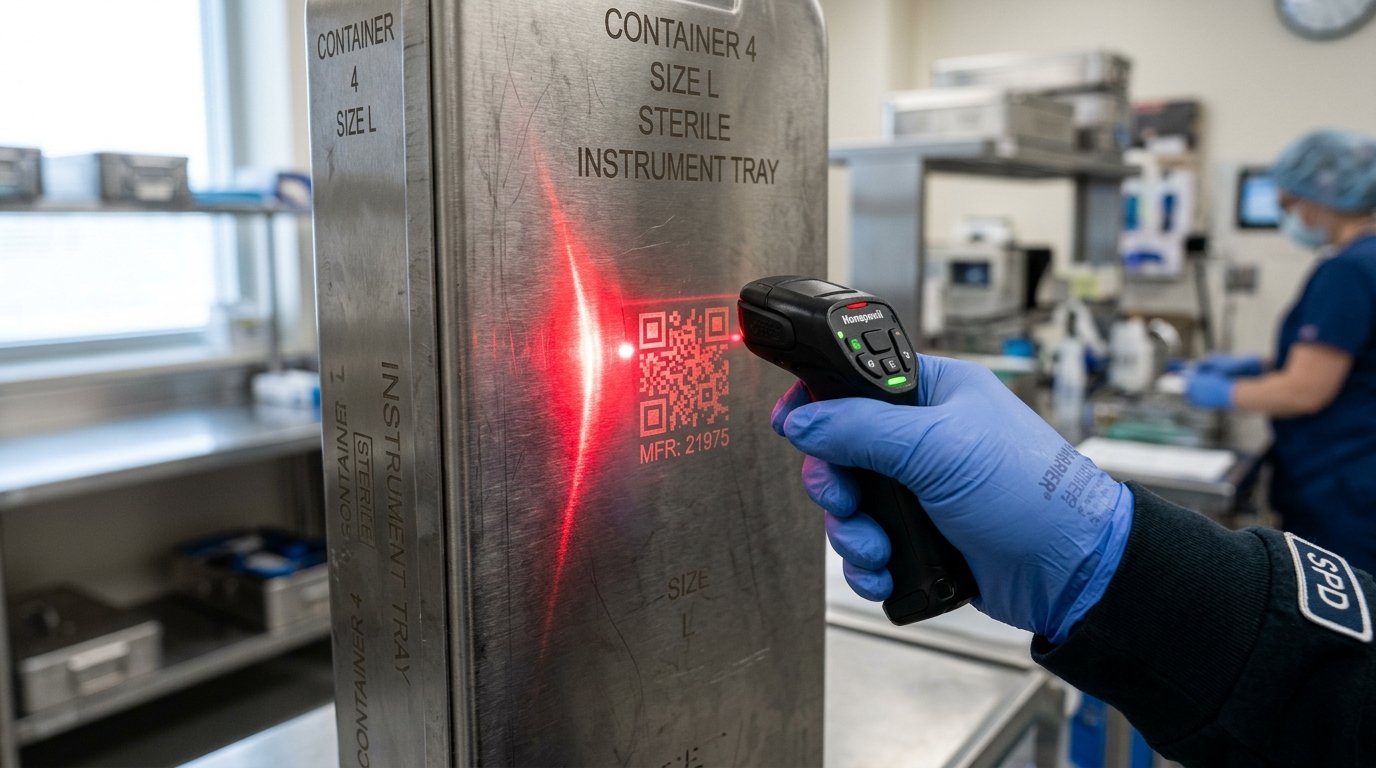
Eight Steps to a Linked Sterile Container Record
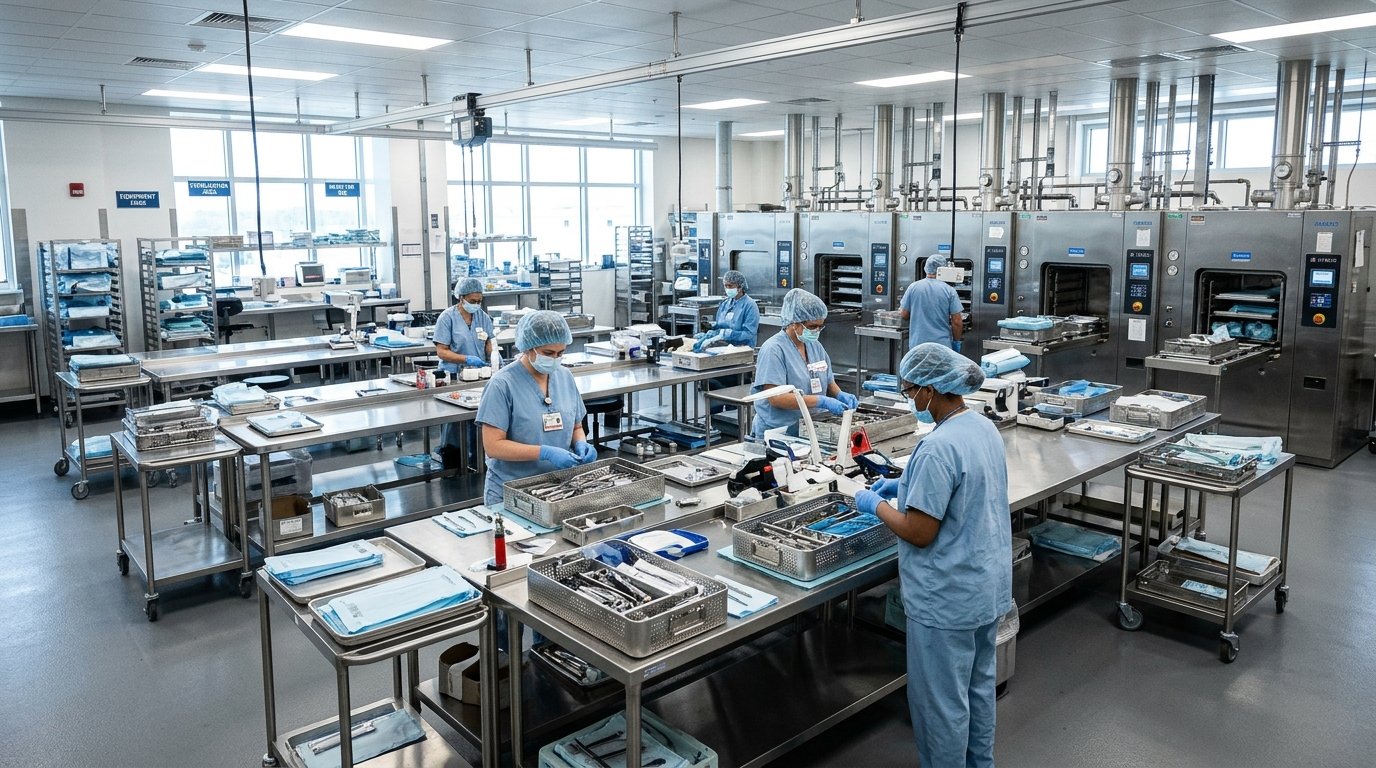
CDC recommendations for sterilization practices establish the baseline: each sterilization load must be documented with sterilizer identity, contents, cycle parameters, operators, and monitoring results. Digital tracking systems extend that baseline to individual assets, patient linkage, and searchable history.
Here’s the practical implementation sequence:
- Register the asset. Create a persistent identifier for each container or managed set. Record manufacturer, model, serial or lot number, and the instrument inventory it carries. Keep the container record and its contents as separate entities, because contents change over time.
- Apply a durable identifier. Barcode, DataMatrix, direct laser mark, RFID tag, or RTLS beacon. The identifier must survive the container’s full reprocessing cycle. GS1’s 2025 direct-marking guide describes DataMatrix marking using GTIN or GIAI identifiers specifically for medical devices.
- Define mandatory handoffs. At minimum: receipt after use, decontamination complete, assembly and inspection complete, sterilization load in, release, storage, dispatch to OR, return. Each handoff is a scan or log entry. Workflow platforms like Getinge’s T-DOC alert staff when steps are skipped.
- Bind the set to the load. Record sterilizer identity, cycle parameters, exposure time, temperature, and the results of mechanical, chemical, and biological indicators. This is CDC’s explicit requirement and the legal backbone of your traceability chain.
- Record release as a separate event. A successful sterilization cycle is not the same as a release decision. Someone must confirm that all monitoring passed, package integrity is intact, and (for implant loads) biological indicators read negative before the load moves to storage.
- Capture location and availability. Log where each released set is stored. Track subsequent movements. Then decide: are manual scan-confirmed locations sufficient, or does the search-and-transport cost justify automatic sensing?
- Link to the case and patient. Record which set was used for which procedure, on which patient. This closes the loop in both directions: from a suspect load forward to affected patients, or from a patient backward to every instrument that touched them.
- Close the lifecycle. Document missing or substituted instruments, repairs, maintenance events, and retirement. Preserve historical set membership instead of overwriting it when instruments move between trays.
The design principle underneath all eight steps: keep asset identity, process status, and physical location as separate fields. When they’re merged, a correctly identified container can appear “available” even when its load hasn’t been released.
Barcode, RFID, or RTLS: Choosing the Right Layer
There’s a widespread assumption that RFID is inherently superior for sterile container tracking. Market data tells a different story. Mordor Intelligence estimates barcode systems held 59.26% of the 2025 surgical instrument tracking market, with RFID growing at 14.05% annually through 2031. Barcode dominates because most tracking problems are workflow problems, not search problems.
| Technology | What it captures well | Primary limitation | Best fit |
|---|---|---|---|
| Barcode / DataMatrix | Identity and status at each handoff scan | Location = last completed scan only | Structured SPD workflow with defined stations |
| RFID at checkpoints | Automatic tray/cart movement between zones | Metal interference, missed reads, tag durability in autoclave | Transport routes between SPD, storage, and OR |
| RTLS (container-integrated) | Continuous location and status updates | Must survive reprocessing; validated software integration required | Large facilities where searching for sets wastes significant staff time |
A Duke University study compared RFID-detected instrument use against trained human observers across 39 surgical cases, reporting 93.8% sensitivity and 80.8% specificity, with Cohen’s kappa of 0.81. Strong agreement, but not perfect. And that study measured use detection (did the instrument leave the tray during surgery?), not container identification accuracy. The distinction matters when evaluating vendor claims.
My honest recommendation: start with barcode-driven workflow traceability. Layer RFID or RTLS only where the search-and-transport cost justifies the validation effort. A mixed deployment (barcodes for process documentation, RFID for logistics) is often more practical than a single-technology rollout that tries to do everything at once.
Where Sterile Container Tracking Breaks Down
Technology doesn’t fail in demos. It fails at 6 AM when the SPD tech is short-staffed, a surgeon needs a tray in ten minutes, and nobody has time to troubleshoot a read error. Four failure modes show up consistently, no matter the industry.
Scanning is not sterility. A successful barcode or RFID read confirms identity, not sterile status. CDC requires process monitoring (mechanical, chemical, biological indicators) and package-integrity checks as independent controls. Keep release decisions and tracking status in separate fields, always. Merging them is how “tracked” containers get used before they’re actually released.
Tags don’t always survive reprocessing. A 2025 systematic review of surgical instrument traceability, covering 22 evaluated studies from 7,189 retrieved articles, documented RFID tags being lost, damaged, contaminated, or degraded by repeated washing and high-temperature sterilization. Newer sterilization-compatible inlays (Avery Dennison launched three in March 2026) are closing this gap, but their announcement does not include repeated-cycle durability data for reusable surgical container service. Test under your actual conditions, not the vendor’s lab conditions.
The human factor is the biggest variable. None of the top-ranking guides on this topic adequately address what happens when staff skip scans under time pressure. The best systems build “hard stops” into the workflow: the container cannot advance to the next stage without a completed scan and a passing check. CensiTrac can block progression when it detects a method mismatch, overweight load, or exceeded use count. But hard stops only work if they’re configured correctly and staff don’t develop workarounds. Process design is behavioral design.
Interoperability is rarely discussed, and it should be. Most hospitals use containers from multiple manufacturers. A tracking system locked into a single brand’s hardware ecosystem creates blind spots for every other container in your mix. During evaluation, insist on a demonstration using your actual mixed inventory: Aesculap, STERIS, Genesis, and whatever else sits on your shelves.
What Hospitals Are Doing Right Now
Evidence matters more than vendor slides. Here’s what’s documented, with honest caveats about what each case does and doesn’t prove.
Licking Memorial Hospital announced its CensiTrac implementation in March 2025, featuring barcode scanning, lifecycle monitoring, tray images, and access to manufacturer reprocessing requirements. The system includes instrument-conflict alerts for scheduling when the same set is needed across overlapping procedures. Worth noting: the announcement describes capabilities and expected benefits, not measured post-implementation savings. It’s evidence of deployment, not a quantified outcomes study.
Lovisenberg Diaconal Hospital in Norway took a different path, implementing GS1-based traceability using Global Returnable Asset Identifiers (GRAI) for trays, encoded in GS1-128 and DataMatrix barcodes. Reported outcomes include training time dropping from 12 months to three months, and manual ordering that previously consumed up to two hours daily reduced to minutes through automation. Devices and implants could also be traced to patients. The lesson: consistent identifiers and redesigned workflows deliver major operational improvements without requiring RFID to be the centerpiece.
A November 2025 retrospective study across five Wuhan hospitals examined cleaning-quality traceability using digital logs, RFID, and process-parameter monitoring. Compliance improved from 78.5% to 96.4%, and healthcare-associated infections declined from 5.4 to 3.1 per 1,000 patient-days, a reported 42.6% reduction. The direction is promising. But the retrospective design, no adjustment for surgical volume or patient severity, and the authors’ own call for cost-effectiveness research mean the infection reduction can’t be attributed to tracking alone.
Then there’s the Genesis CD5 recall, which teaches a different lesson entirely. The containers were identifiable. The tracking was not the issue. The packaging itself failed to maintain sterility after a change-control lapse. Hospitals needed searchable inventory to act on the FDA notice. No electronic record, however complete, repairs a faulty sterile barrier. Tracking tells you where every unit is. Product integrity determines whether any of them are safe to use.
What’s Changing in 2025 and 2026
Three recent developments are reshaping what’s possible in sterile container tracking, and what’s expected.
Getinge launched Automatiq in December 2025, combining robotics, conveyors, and software to physically move instruments between processing workstations. The Automatiq Envoy is a self-navigating mobile robot that interfaces with traceability systems like T-DOC through the Automatiq Hub module. For the first time, tracking data can trigger actual physical transport. The corresponding risk: an incorrect or stale status could now guide an automated action. Data integrity just became a robotics safety issue.
Avery Dennison announced three sterilization-compatible RFID inlays in March 2026 (AD Minidose U9 Steri, AD Accessory U9 Steri, and AD Shelter Steri), validated against autoclave and ethylene oxide sterilization on polypropylene and glass substrates. This moves identification closer to the point of manufacture, not just the hospital receiving dock. But Avery Dennison supplies inlays, not complete systems. Readers, software, integration, and validation remain separate line items in your budget.
GS1 Healthcare Japan published version 2.7 of its direct-marking guide in September 2025, updating DataMatrix marking standards for medical devices. The hospitals seeing the best returns (Lovisenberg remains a clear example) committed to a consistent identification standard before layering automation on top. That sequence holds: identity first, automation second.
The market numbers reflect this momentum. Mordor Intelligence sized surgical instrument tracking at $320.41M in 2025, projecting $673.42M by 2031. Fortune Business Insights put the sterilization containers market at $345.41M in 2025, growing to $466.5M by 2034. These describe different purchases (tracking systems vs. physical containers), not two estimates of the same thing. Budget for each separately.
Frequently Asked Questions
What is the simplest way to start tracking sterile containers?
Assign each container or set a unique ID, label sterilized packs with load information, and maintain cycle and monitoring records linked to patient or procedure. A controlled barcode workflow covers basic traceability. Add automation only after the record structure is solid and staff follow the scanning protocol consistently.
Is RFID required for sterile container tracking?
No. U.S. regulations (21 CFR 801.45) require direct UDI marking on applicable reusable devices, but permitted forms include readable text, not exclusively RFID. Barcode systems still represent roughly 59% of the surgical instrument tracking market. Choose based on your operational gap, not a technology mandate.
Does a tracking system prove that contents are sterile?
No. Tracking documents identity and processing history. Sterile release depends on passing mechanical, chemical, and biological monitoring, plus package-integrity checks. The Genesis CD5 recall demonstrated that a fully identifiable container can still fail to maintain its sterile barrier due to a manufacturing defect.
How long does sterility last in a sealed container?
There is no universal fixed interval. CDC recognizes event-related sterility maintenance. Aesculap’s Aicon IFU reports 365-day shelf-life validation and notes that loss of sterility is normally event-related, not time-based. Follow your specific manufacturer’s instructions and your facility’s written policy.
What should happen after a positive biological indicator?
Follow your facility’s validated response procedure. CDC distinguishes a single positive steam spore test from persistent positives. A single result does not automatically require recall of nonimplantable items unless a sterilizer or procedure defect is confirmed. Persistent positive results require treating affected items as nonsterile and recalling them for reprocessing.
Can one system track containers from different manufacturers?
It should. Most workflow platforms (CensiTrac, T-DOC, SPM) manage containers regardless of brand if identifiers are configured correctly. The risk is in hardware-specific RTLS beacons that only pair with one container line. During vendor evaluation, insist on a live demo using your actual mixed inventory.
Sterile container tracking follows the same core principle we apply to every asset tracking deployment at Datanet, whether it’s aviation ground equipment, reusable transport packaging, bulk liquid vessels where you need to know how to track IBC totes, or MRO parts: identity first, then status, then location, all linked to the people who need to act. If you’re building a tracking architecture for any reusable asset pool and want to get the foundation right, reach out to our team.





 +1 508 292 2210