

U.S. construction firms lose roughly $1 billion a year to tool theft. The recovery rate for stolen items sits around 7%. For every $100 in stolen equipment, $93 is gone for good.
I’ve spent 15+ years helping companies track physical assets across supply chains. Aviation parts, shipping containers, ground support equipment. The pattern behind tool theft is identical to what I see in every industry where assets disappear: the core failure isn’t security. It’s visibility. You can’t protect what you can’t name, locate, or assign to someone. This same visibility challenge shows up in contexts like preventing foreign object debris in aviation, where tracking every tool and part becomes a safety imperative.
What follows is a layered approach to how to prevent tool theft. Not just “buy better locks,” though locks have their place. A system designed so that when one layer fails (and one layer always will), the others catch it.
What Tool Theft Actually Costs You
The replacement cost is the number everyone fixates on. Industry figures put the average per-incident loss around $6,000. That’s painful, but it’s the smallest piece of the problem.
A 2026 TrueLook/Noonlight security report confirmed 2,639 break-ins at active commercial construction sites during 2025, roughly 50% more than the prior year. Over 40% of those break-ins happened on weekends. The highest concentration fell between 11 p.m. and 3 a.m.
When tools vanish, project timelines slip. Crews sit idle waiting for replacements. Insurance premiums climb. And the part that rarely makes it into prevention articles: some industry sources estimate that internal theft (employees, subcontractors, temporary crews) accounts for up to 60% of job site losses. The fence you built to keep outsiders away may not address your biggest exposure.
The financial bleeding doesn’t stop at the sticker price of a new saw. It includes every hour a crew member can’t work, every insurance claim that crawls through processing, and every subcontractor dispute about who lost what. So why does most prevention advice start and end with padlocks?
Why Locks and Cameras Keep Failing on Their Own
Physical security is table stakes. You need it. But treating it as the entire strategy explains why theft numbers keep growing.
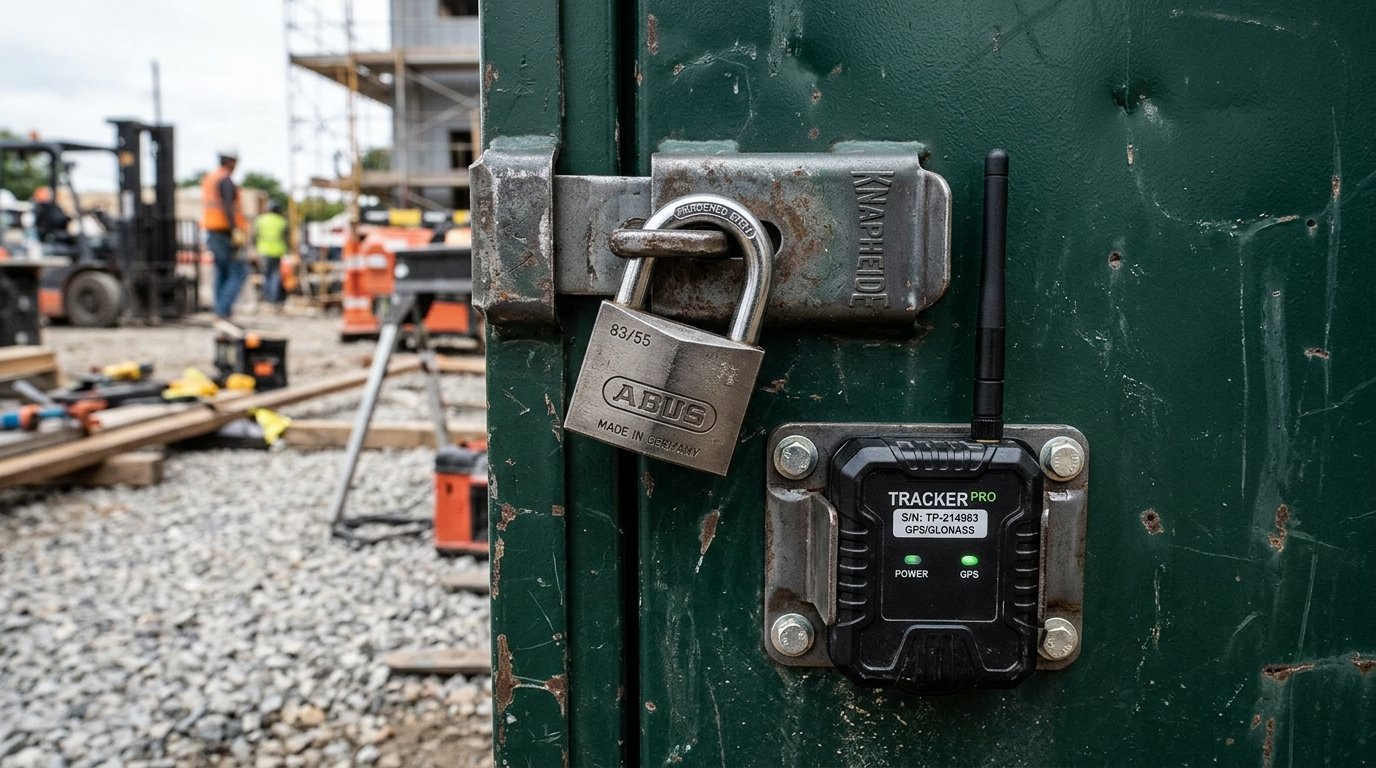
It takes roughly 10 seconds to break into a standard work van. A padlock on a gang box adds friction, sure. But friction only stops opportunistic theft. Organized crews bring bolt cutters. Insiders already have keys.
Cameras are even more misunderstood. Unless someone monitors the feed in near-real time and can respond within minutes, a camera is a documentation device, not a prevention device. And if nobody realizes a tool is missing until days later, the footage may already be overwritten or the thief long gone.
Here’s the structural problem: physical security controls access to a space. It doesn’t track what’s inside that space. If a worker borrows a rotary hammer and never returns it, no lock registers that as a loss. If 12 subcontractor crews share a site, perimeter security can’t tell you which crew was last near the missing tool.
What actually works is layering physical controls with visibility, custody, and documentation. Five layers, each solving a different failure mode.
Five Layers of Tool Theft Prevention That Work Together
Skip any one of these, and the others develop blind spots.
- Know exactly what you own. Record every tool: make, model, serial number, replacement value, photographs, and an owner-applied company mark. Prince William County Police recommends documenting identifying information and photos for all site equipment. This is the foundation every other layer depends on.
- Make physical access difficult. Fences, controlled gates, locked gang boxes and trailers, bolted-down storage, adequate lighting, and clearing portable tools from exposed areas at the end of each shift. These measures slow unauthorized access. They don’t stop insiders or determined crews, which is why physical barriers are one layer, not the whole plan.
- Make assets electronically visible. GPS for high-value equipment, Bluetooth tags for mid-range tools, QR labels for custody records, inventory apps for the full picture. Each approach has trade-offs covered below. The goal: knowing where things are without relying on someone’s memory.
- Assign custody to a person. Every tool gets a name attached to it through check-out/check-in logs, digital or paper. When something moves between sites or vehicles, that transfer gets recorded. This is the layer most contractors skip entirely, and it’s the one that addresses internal losses.
- Prepare your response before you need it. Document your insurer’s claim requirements now. Keep serial number exports and purchase records stored separately from the tools (cloud, not a clipboard in the van). Know who to call: police, insurer, platform admin, site security. Speed and documentation quality after a theft determine whether you recover assets or write them off.
Of these five, the one with the biggest gap between how important it is and how often it’s actually done is the first. Most contractors don’t have an inventory that could survive an insurance claim.
The Inventory Gap That Kills Insurance Claims
In 2024, Howard County, Maryland police recovered approximately 15,000 stolen construction tools across 12 locations, with an estimated value of $3 million to $5 million. It was one of the largest tool recoveries in recent U.S. history.
The challenge that followed was proving who owned what. Without serial numbers, photos, and purchase receipts, a recovered drill is just a drill. It could belong to anyone. Separately, in mid-2025, the Clackamas County Sheriff’s Office recovered over $4,100 in stolen tools that had been resold through Facebook Marketplace. That arrest moved forward because the owner had documentation.
This is where most prevention strategies quietly fail. Not at the lock. Not at the camera. At the paperwork.
For every tool you own or lease, record:
- Manufacturer, model, and serial number
- Purchase date and receipt
- Current replacement value
- Photographs, including distinctive marks or company ID
- Current custodian and job site or vehicle assignment
Store this somewhere that is not the job site or the van. Cloud-based inventory software works. A shared spreadsheet works. What doesn’t work is a mental list or a paper log that rides in the same truck as the tools.
Contractor’s equipment coverage from insurers like The Hartford can protect tools at job sites, in transit, and in temporary storage. But terms vary widely. Ask about scheduled property limits, theft-from-vehicle clauses, unattended-vehicle requirements, deductibles, and proof-of-loss documentation before you need to file a claim. The worst time to discover your policy excludes van theft is the morning after your van gets hit.
Once your inventory is solid, the question becomes: can technology make it smarter?
Trackers and Tags: Honest Expectations
The tracking market has matured, but expectations still run ahead of what any single device delivers.
GPS and cellular trackers provide near-real-time location using satellite and cell networks. They need a power source and work best on higher-value assets: generators, compressors, vehicles. For a $200 hand tool, the per-unit cost and maintenance rarely pencil out.
Bluetooth tags, including consumer options like Apple AirTag, report location only when a compatible device passes within range. In a dense urban area with heavy foot traffic, the crowdsourced network can be surprisingly effective. On a remote job site with three workers, it may take days for a signal to register. And Apple and Google’s unwanted-tracker alerts, rolled out in 2024, mean a Bluetooth tag traveling with a person will eventually notify them. These alerts exist for good reason (anti-stalking protection), but they limit covert recovery scenarios.
QR and barcode labels don’t track in real time at all. They update location only when someone physically scans them. Their strength is in custody accountability: scan at check-out, scan at return, and you have a verifiable record. Miss a scan, and you have a gap.
Connected-tool lockout is a different category entirely. Milwaukee’s ONE-KEY system, for example, can disable compatible tools marked as missing or stolen when they come within Bluetooth range of an enabled device. That’s a meaningful layer for compatible equipment. But it only covers supported Milwaukee models, requires proximity to trigger, and doesn’t physically prevent someone from walking out with the item.
| Approach | Best for | Key limitation |
|---|---|---|
| GPS/cellular trackers | High-value equipment, vehicles, generators | Cost and power requirements limit use on hand tools |
| Bluetooth tags | Supplemental location clues for mid-value items | Network-dependent; unwanted-tracker alerts may expose the tag |
| QR/barcode labels | Custody records, check-in/check-out workflows | No real-time location; depends entirely on consistent scanning |
| Connected-tool lockout | Brand-compatible tools with disable capability | Brand-specific; needs Bluetooth proximity to trigger |
The honest summary: no tracker replaces a lock. No lock replaces an inventory. No single brand’s ecosystem covers every item on your site. The real value of electronic tracking is in shrinking the gap between a loss occurring and someone noticing it, and in creating the documented trail that makes insurance claims and police reports actionable.
This is where I see the most confusion. People treat tool tracking the way they’d track a package: attach a device, watch it move, done at delivery. But tools aren’t packages. They cycle through job sites, vehicles, crews, and warehouses for years. What you need is asset tracking: visibility across the full lifecycle, not just from point A to point B.
So how do you assemble these layers into something your crew actually uses?
Building a Prevention Program That Lasts
The right setup depends on your scale and budget. But the principles hold whether you’re a sole proprietor or running a multi-site operation.
Solo contractors and small crews can get disproportionate value from low-cost measures. Photograph every tool, record serials, store the list in the cloud. Apply a visible company mark (a $5 can of distinctive paint is more effective than people think: a bright pink drill is hard to resell and easy to identify in a recovery pile). Lock tools in an anchored box overnight or bring them inside. Run a 60-second mental checklist at the end of every shift: everything that left the shop this morning should be accounted for tonight. That alone puts you ahead of most.
Site managers and fleet operators need systems. Establish custody rules before the first subcontractor arrives: who checks out tools, who verifies returns, how discrepancies get reported. Pair this with an electronic inventory and scheduled audits, weekly or monthly depending on volume. Gate checks at shift change. Monitored cameras at entry points with a defined response protocol, not just recording for the archive.
At scale across multiple locations, asset tracking platforms earn their keep. Cross-brand tracking that integrates GPS, Bluetooth, and QR across mixed tool fleets, combined with custody workflows, geofencing, and reporting. The goal is knowing within hours, not weeks, that something is missing, and having documentation ready to act on it.
The common thread across every level: a program only works if people use it. The most sophisticated platform in the world fails when tags aren’t attached, scans are skipped, or the inventory hasn’t been updated in months. Simplicity and consistency beat complexity and abandonment every time.
If your tools become invisible the moment they leave the warehouse or the truck, that’s the gap asset tracking closes. We build exactly this kind of visibility for companies across construction, logistics, and industrial operations. If you want to talk through what a layered system looks like for your setup, reach out to our team or drop a line at info@datanetiot.com.

Frequently Asked Questions
What is the single most effective way to prevent tool theft?
No single measure covers every angle. The highest-impact starting point is a detailed, current inventory with serial numbers, photos, and owner-applied marks, because it makes every other layer (insurance claims, police reports, electronic tracking) functional. Combine it with locked storage and a daily accountability check for a strong baseline.
Are AirTags reliable enough to protect construction tools?
AirTags provide supplemental location clues when nearby Apple devices detect the signal. They are not real-time GPS and won’t physically stop a theft. Unwanted-tracker alerts may also notify someone carrying the tagged tool. Use them alongside inventory, physical locks, and custody records, not as a standalone solution.
How do I prove ownership of a recovered tool?
Keep serial numbers, purchase receipts, photographs, and records of owner-applied marks stored separately from the tools themselves. When police recover stolen property, matching specific items to specific owners requires this documentation. Without it, even recovered tools may never be returned to you.
Does insurance cover tools stolen from a work van?
It depends on your policy. Contractor’s equipment coverage may cover tools in transit or temporary storage, but most policies include conditions around unattended vehicles, deductibles, and per-item limits. Review your coverage and document your inventory before a loss occurs.
What should I do immediately after a tool theft?
File a police report with itemized details: make, model, serial number, photos, and last-known location. Notify your insurer and any tracking platforms. Preserve camera footage, access logs, and digital records before they’re overwritten. Never approach a suspected thief or recovery location yourself.
Can employers legally use GPS to track tools in workers’ personal vehicles?
Rules vary by state. Tracking company-owned assets is generally more defensible than tracking personal vehicles. Fisher Phillips recommends written policies covering what is tracked, when, why, who accesses data, and when it’s deleted. Get jurisdiction-specific legal advice before deploying tracking that touches personal property.



 +1 508 292 2210

One Response