

Medical device tracking requirements are spelled out across hundreds of pages of federal code. The compliance gap isn’t in the rules. Between 2018 and 2022, only 25.6% of Class I recall notices for moderate- and high-risk devices included a complete Unique Device Identifier. The rules exist. The data, in too many cases, doesn’t follow the device.
If you’ve landed here, you’re likely dealing with one of three situations: an FDA inspection on the horizon, a recall workflow that feels painfully manual, or a floor full of mobile equipment nobody can find fast enough. Each problem maps to a different regulatory system and a different technical answer. This guide separates them, covers the 2026 compliance milestones, and connects the legal framework to what actually happens on the floor.
Three Systems, One Search Query
The phrase “medical device tracking” covers three distinct mechanisms. I’ve seen procurement teams conflate them, buying RTLS platforms thinking they’re satisfying a Part 821 order, or investing in UDI capture without connecting it to recall workflows. Here’s what each system actually does.
| System | What it does | Who’s responsible | Legal basis |
|---|---|---|---|
| UDI (Unique Device Identification) | Identifies a device model/version on labels and packages via a Device Identifier (DI) and, where applicable, a Production Identifier (PI) | Device labeler (usually the manufacturer) | FDA UDI System, 21 CFR 801.20 |
| Part 821 (FDA-Ordered Tracking) | Follows a specific device population from manufacture through patient use and disposition | Manufacturer (primary), plus distributors and final distributors | 21 CFR Part 821 |
| Hospital RTLS (Real-Time Location) | Locates movable equipment (pumps, wheelchairs, monitors) within a facility in real time | Health system and its technology partners | No federal mandate; operational decision |
UDI tells you what a device is. Part 821 tells you where a specifically ordered device has been. RTLS tells you where a piece of equipment is right now. A UDI label on an infusion pump doesn’t tell a nurse which floor it’s on. An RTLS tag on that pump doesn’t satisfy a Part 821 tracking order. The overlap is smaller than most people assume.
That distinction matters most when liability is on the table. The system with the sharpest legal teeth is Part 821.
Part 821: What FDA-Ordered Tracking Actually Demands
Part 821 does not apply to every medical device. It applies to specific Class II or III devices that FDA has ordered tracked, based on three statutory criteria:
- Failure is reasonably likely to cause serious adverse health consequences.
- The device is an implant intended to remain in a patient for more than one year.
- The device is life-sustaining or life-supporting and used outside a device-user facility.
Until 1998, tracking was automatically mandatory for devices meeting those criteria. FDA then shifted to a discretionary, order-based system. If FDA hasn’t issued a tracking order for your specific device, Part 821 doesn’t apply to it. The current list of ordered devices lives in FDA guidance (not in the regulation text), and FDA acknowledges the guidance can lag behind newly issued orders. Check the actual order, not assumptions.
When an order does apply, the manufacturer must build and maintain a written tracking system. § 821.25 details the content requirements:
- Produce distribution data (lot, serial, identity of recipient) within 3 working days of an FDA request, for devices not yet distributed to patients.
- Produce patient-use data (patient identity, implanting physician, dates) within 10 working days of a request.
- Maintain written procedures for capturing missing information.
- Audit the system at least every 6 months for the first 3 years of distribution, then at least annually.
Records must be retained for the device’s useful life. One detail that catches manufacturers off guard: a patient may refuse to release identifying information. The regulation accounts for that (§ 821.55), but your system still needs a documented process for handling refusals without creating a compliance hole.
Manufacturers bear the primary burden. But the regulation extends down the entire distribution chain.
Distributors and Hospitals: Your Part 821 Obligations
§ 821.30 assigns specific duties to everyone in the chain who isn’t the manufacturer.
Distributors must keep records of devices received and distributed, then furnish that data to the manufacturer (or directly to FDA) within 5 working days of a request. Final distributors, a category that can include hospitals dispensing a single-patient device, must provide acquisition and patient-use data within 10 working days. Facilities distributing life-sustaining or life-supporting devices for use by multiple patients qualify as “multiple distributors” under § 821.3 and carry their own record-keeping duties.
Whether your hospital is a “final distributor,” a “multiple distributor,” or neither depends on the specific ordered device and your facility’s role. The definitions in § 821.3 are precise. Misclassifying your position in the chain is a compliance gap FDA will find in an inspection.
So the chain of custody has clear owners and deadlines. The next question: is the identifier at the center of all this actually working?
UDI: The Identifier That Isn’t a Locator
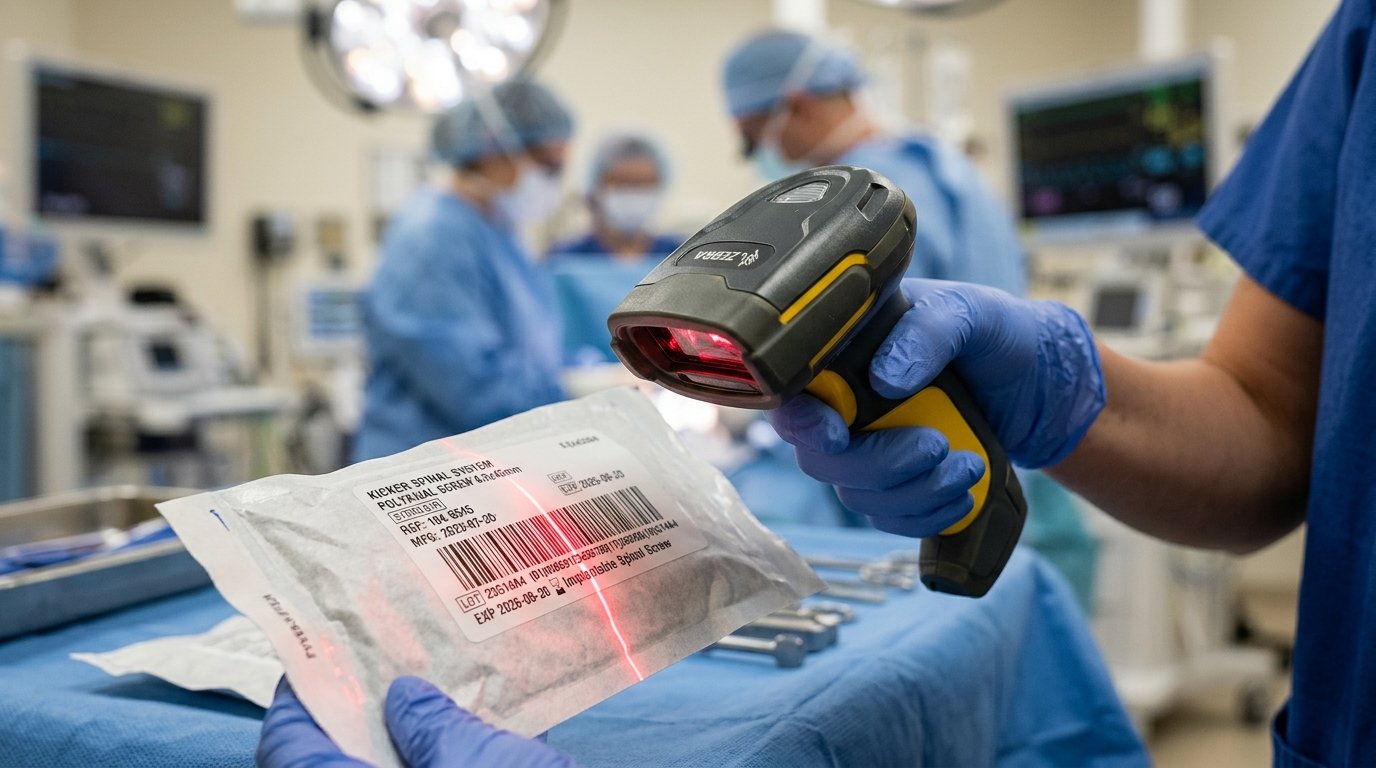
The FDA’s UDI system is an identification architecture, not a location service. Each UDI contains two components. The Device Identifier (DI) is mandatory and identifies the labeler plus the specific device version or model. The Production Identifier (PI) is conditional, encoding lot or batch, serial number, expiration date, or manufacture date depending on the device.
The UDI must appear on applicable labels and packages in both human-readable and machine-readable (AIDC) formats. The labeler submits DI-level data to the Global Unique Device Identification Database (GUDID), searchable through AccessGUDID. But GUDID stores the DI, not the PI value on a specific unit. It’s a reference catalog. It won’t tell you where device serial number X is right now.
Not every device even needs a UDI on its label. Exceptions include specified Class I devices, investigational and custom devices, certain veterinary devices, and devices intended solely for export. Shipping containers are excluded. A Class I device’s UDI doesn’t require a PI.
The practical gap surfaces most sharply during recalls. That JAMA study examined 211 Class I recall notices: only 54 had a complete UDI. A primary DI appeared in 93 cases, while 37 were missing at least one required PI element. Completeness ranged from 16.7% in 2021 to 40.9% in 2022 within the study sample. A hospital receives a recall notice, but the identifier is incomplete or unstructured. Staff can’t efficiently match the notice against inventory or patient records because the structured data isn’t there.
A separate mixed-methods study of eight U.S. health systems found only three had implemented UDI capture for implants in at least one care area. Even those often kept the data in isolated systems rather than connecting it to EHR, inventory, or recall workflows.
And recall oversight itself has capacity issues. GAO found 3,934 device recalls in FY2020 through 2024, all manufacturer-initiated, with 62% still ongoing at the time of analysis. FDA wasn’t meeting its own three-month goal to terminate completed recalls.
This is the kind of disconnect I see across industries. The regulation gets written. The database gets built. The daily workflow that connects the two gets deprioritized until something goes wrong. The 2026 regulatory milestones aim to tighten some of these gaps.
2026 Compliance Milestones: QMSR and EUDAMED
Two regulatory shifts landed this year that change how manufacturers handle device data.
FDA’s Quality Management System Regulation (QMSR) became effective February 2, 2026. It incorporates ISO 13485:2016 into U.S. device quality requirements and replaced the legacy QSIT inspection approach. This changes how FDA inspects quality systems, including record-keeping and traceability processes. It doesn’t create a new hospital RTLS mandate, but it raises the bar for manufacturer documentation discipline. If your GUDID submissions are sloppy or your Part 821 audit trail has holes, QMSR-based inspections will surface them faster.
In Europe, the first four EUDAMED modules became mandatory on May 28, 2026, including Actor Registration and UDI/Device registration. Manufacturers placing devices on the EU market must submit UDI/Device information through EUDAMED. For companies selling in both the U.S. and EU, this means maintaining consistent master data across two separate regulatory databases (GUDID and EUDAMED), each with its own submission requirements and timelines.
Neither milestone requires hospitals to install RTLS on every device. But both increase the value of clean, structured device data at every point in the chain. The strategic takeaway: invest in data quality and workflow integration, not just tag volume.
Regulation sets the floor. For hospitals managing hundreds of mobile assets daily, the ceiling is operational visibility.
From Compliance to Operations: Where Asset Tracking Fits
Hospital RTLS occupies a different category from UDI or Part 821. No federal regulation requires it. But the operational case is documented. Similar tracking principles apply to sterile container management, where location visibility directly impacts surgical readiness.
Mid Cheshire Hospitals NHS Foundation Trust tracked infusion pumps and mobile equipment using RTLS and reported a 75% decrease in clinical incidents involving tracked equipment, with up to 30 minutes saved per staff member per day. Princess Alexandra Hospital NHS Trust reported locating 15 Bair Hugger warming units in about one hour per week instead of eight, saving seven hours weekly.
These are reported implementation outcomes from specific sites, not guaranteed results. Mid Cheshire also documented that building renovations degraded floor-plan accuracy. Princess Alexandra’s initial deployment had six-meter location accuracy, which didn’t meet clinical needs until they refined the setup. In 15 years of deploying tracking systems across industries, the pattern is consistent: technology is rarely the bottleneck. Process design and infrastructure readiness are.
Safety deserves attention too. A controlled study testing RFID near medical devices found 34 electromagnetic interference incidents in 123 tests, with 22 classified as hazardous. The recommendation is straightforward: test your chosen readers and tags in the actual clinical environment before scaling to sensitive care areas.
The practical sequence for a hospital evaluating asset tracking technology (keeping in mind core IoT device requirements for healthcare environments):
- Identify which devices carry regulatory tracking obligations (Part 821 orders, UDI capture requirements).
- Define the operational workflows you need to improve: search time, utilization, maintenance scheduling, recall response.
- Establish UDI capture and data ownership in your inventory and EHR systems.
- Pilot RTLS with a representative mix of equipment. Measure location accuracy by room or zone.
- Test for EMI, infection control compatibility, privacy, and integration with existing systems before expanding.
The healthcare RTLS market is estimated at roughly $2.85 billion in 2025 and projected to reach $9.94 billion by 2033. That growth reflects real demand for asset visibility. But market size isn’t a compliance argument. The question for your facility is specific: which assets, which workflows, which measurable outcome?
If your team is evaluating asset tracking solutions for medical equipment visibility, start with the workflow, not the hardware. The technology is mature. The gap is almost always in process design and data integration. If you need help mapping the right approach to your compliance and operational requirements, reach out to our team.

Frequently Asked Questions
Does every medical device need a tracking tag?
No. The UDI rule requires specified labels and packages to carry a device identifier, with defined exceptions for certain Class I, investigational, and custom devices. Part 821 tracking applies only to devices FDA specifically orders tracked. Hospital RTLS is an operational choice, not a federal mandate.
What is the difference between UDI and Part 821 tracking?
UDI is a product identification system. It tells you what a device is via a label-based identifier and a public database (GUDID). Part 821 is a distribution and disposition tracking system. It follows FDA-ordered devices from manufacture through patient use and requires the manufacturer to produce location records within defined timelines.
Can a hospital be held responsible under Part 821?
Yes. Under § 821.3, hospitals can qualify as “final distributors” or “multiple distributors” depending on the ordered device and the facility’s role. Those classifications carry record-keeping and information-transfer obligations with specific deadlines (up to 10 working days for patient-use data).
Does GUDID show where a specific device is located?
No. GUDID stores the Device Identifier (DI) as a public reference record. It contains no production identifiers for individual units and no location history. Connecting a serial number to a patient, inventory location, or maintenance record requires the hospital’s or manufacturer’s own systems.
What changed in 2026 for medical device compliance?
Two milestones. FDA’s QMSR became effective February 2, 2026, incorporating ISO 13485:2016 and replacing the QSIT inspection method. In the EU, the first four EUDAMED modules became mandatory May 28, 2026. Neither creates a new hospital RTLS requirement, but both raise the standard for data quality and documentation.
Is RFID safe to use near all medical equipment?
Not universally. A controlled study found potentially hazardous electromagnetic interference incidents in some device-and-reader combinations. Hospitals should test chosen RFID or BLE equipment in their actual clinical environment and conduct a safety review before scaling deployment to sensitive care areas.








 +1 508 292 2210

One Response