

Every MRO director I’ve talked to in the past two years says some version of the same thing: “We tagged everything. We still can’t find what we need when we need it.”
The challenges of tracking assets in aerospace operations aren’t about missing technology. Global aviation MRO demand hit $136 billion in 2025, up from $126 billion the year before, with roughly 30,000 commercial aircraft in service. There’s no shortage of tags, readers, or platforms. The problem is that most deployments confuse location data with operational control. They know where an asset sits on a map, but not whether it’s serviceable, who has custody, or if the paperwork behind it is genuine.
After 15-plus years deploying IoT across aviation and industrial supply chains—including military asset tracking operations with similar custody and compliance requirements—I keep seeing the same five structural failures that shape how aviation companies track critical equipment. They’re worth naming, because the fix for each one is different.
1. Location Without Identity Is Just a Dot on a Screen
Shipment tracking answers one question: where is this item right now? Asset tracking answers five: what is it, where was it last credibly observed, who has custody, is it serviceable, and what evidence authorizes its next use?
In aerospace, that distinction separates a dashboard metric from an airworthy component. 14 CFR 43.10 defines specific controls for life-limited aircraft parts on removal and transfer. A part moving through the supply chain must carry its identifying mark, tag, or record. A GPS coordinate doesn’t satisfy that requirement. Neither does a Bluetooth ping.
The AOG Technics case made this painfully concrete. UK investigators found that more than 60,000 engine parts worth GBP 6.9 million were sold with forged release certificates between 2019 and 2023. An RFID reader would have counted every one of those parts accurately. It would not have caught a single fake certificate. The fraud only surfaced when an airline asked Safran to verify a document.
If your tracking system reports coordinates but can’t surface service status, remaining life, calibration dates, or custody history, you’re running shipment tracking. Fine for a package. Not enough for a life-limited part or a calibrated tool.
But even when you solve the identity layer, the physical environment has its own objections.
2. Metal Hangars Are Where RF Signals Go to Die
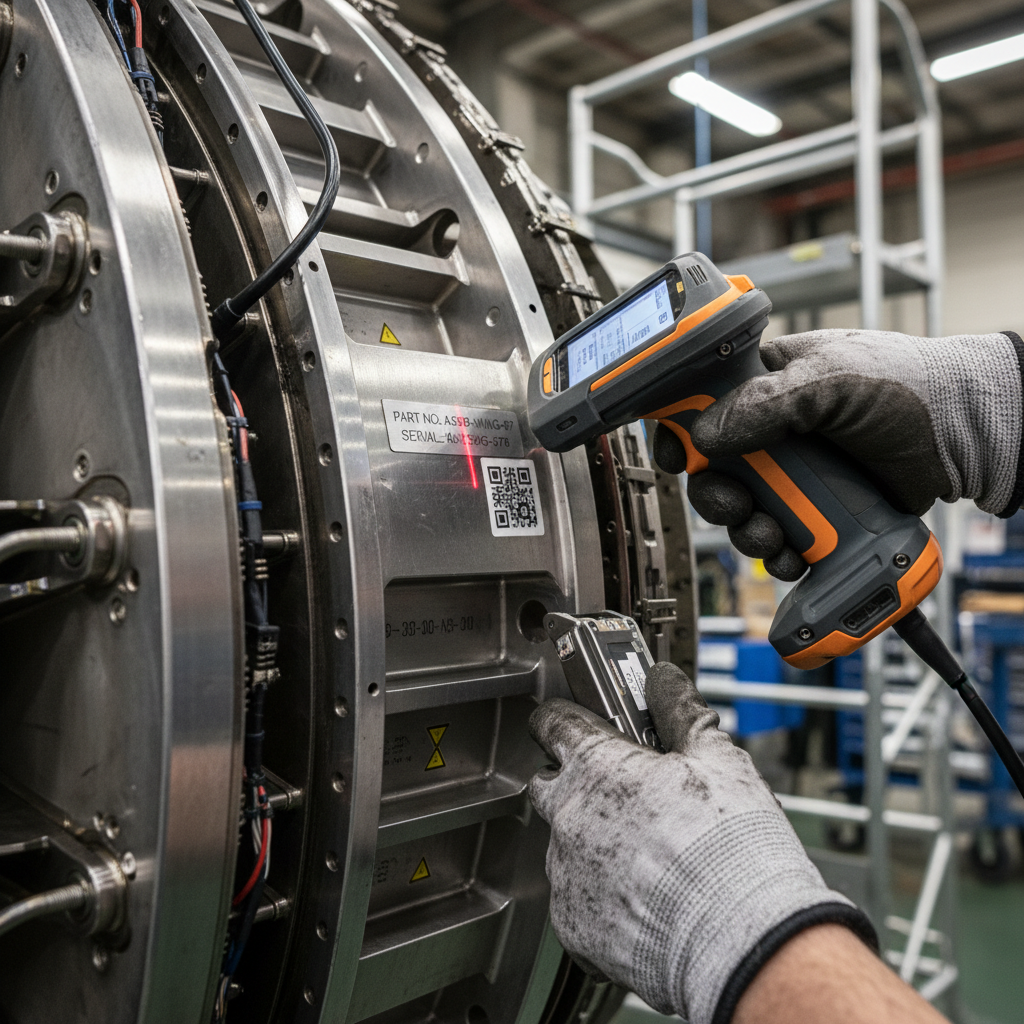
Aerospace maintenance doesn’t happen in clean warehouses with open sightlines. It happens inside steel-framed hangars, around aluminum fuselages, and increasingly near carbon-fiber composite structures. Each of those materials reflects, absorbs, or distorts radio frequencies in ways that break off-the-shelf tracking hardware.
Passive UHF RFID performs well at instrumented chokepoints: doorways, tool cribs, receiving docks. Bury a tagged tool inside a metal toolbox on a maintenance stand surrounded by aircraft skin, and read rates collapse. WiFi-based location systems fight multipath interference where signal bounces off every surface before reaching the receiver. BLE beacons lose reliability at distances that would be trivial in a standard logistics warehouse.
The physics aren’t negotiable. What’s negotiable is the match between technology and environment. A passive RFID gate at the tool crib confirms what left the room. An active tag on a different frequency profile tracks ground support equipment across the ramp. A cellular or satellite-enabled device follows a ULD container that left the airport three weeks ago and is sitting at a handler’s yard in another country.
Operations that try to standardize on one radio protocol across their entire facility end up with excellent coverage in one zone and total darkness 50 meters away. The smarter play is layered: purpose-matched devices for each zone and asset class, feeding a single visibility platform.
Still, even perfect RF coverage inside your four walls doesn’t help the moment an asset crosses your property line. And that boundary is where the most expensive failures happen.
3. Every Handoff Is a Visibility Cliff
A ULD container touches the airline, the ground handler, the warehouse, another airline, another handler, maybe a repair shop, and back again. A serialized part starts at a manufacturer, moves through distributors, enters your warehouse, gets pulled for a work order, ships to an external repair station, and returns (if you’re lucky). Every organizational boundary is a point where tracking data dies, which is exactly what to consider when tracking aircraft assets across custody handoffs.
IATA’s Resolution 753 was supposed to fix this for baggage by requiring records at four journey events: acceptance, transfer, loading, and arrival. The 2025 implementation review tells a different story. Of 256 airlines in scope, 205 had submitted plans. Of those 205, only 29% reported implementation at both hub and network level. Almost half hadn’t started.
The financial impact speaks for itself. Industry estimates put airline spending on mishandled baggage at $6.3 billion in 2025, averaging $260 per affected bag. Transfer failures still caused 39% of that mishandling.
Baggage gets the headlines, but the pattern repeats across every asset class. Unilode operates a ULD network with more than 900 readers across 220 airports and over 140,000 digital tags, yet launched its 2026 Super Sentinel initiative specifically to find containers that drift beyond fixed-reader coverage. Calibrated tools get loaned to partner MROs and never come back. Parts ship between repair stations with paper records the receiving system can’t parse.
Tracking works within your walls. The second an asset crosses an organizational boundary, visibility drops to zero. And the records that should travel with that asset? They have their own set of problems.
4. Paper Trails Can’t Keep Up (and Sometimes They Lie)
A significant number of aerospace operations still manage asset records through paper forms, manual logbooks, and spreadsheets. The consequences surface in two places: audits and incidents.
On the audit side, documentation gaps remain one of the top drivers of FAA findings. Not missing parts. Missing records. The maintenance was performed correctly, but nobody captured it in a format an inspector can verify. Every manual transcription is a chance for error, delay, or omission. EASA Part-145 imposes comparable tool-control and calibration-status documentation requirements on European repair stations, per its published tooling guidance.
On the incident side, the NTSB’s 2025 findings on Alaska Airlines Flight 1282 are the starkest example. The investigation found that four bolts securing the door plug were missing, and that the absence of proper work documentation meant no quality-assurance inspection of the plug closure ever occurred. The root cause wasn’t a sensor failure. It was a fracture between physical work and its record.
A tracking system that links every physical event (removal, installation, calibration, custody transfer) to a timestamped digital record creates the audit trail regulators require and safety depends on. But only if the record itself is trustworthy. The AOG Technics fraud proved that a well-organized digital system is worthless when forged documents feed it. Identity verification, supplier authentication, and receiving inspection have to work alongside the tracking layer.
One without the other is how 60,000 suspect parts slip through a supply chain for four years. Which brings up the final structural challenge: the belief that one technology solves all of this at once.
5. There Is No Universal Tracker
This is the myth I spend the most time dismantling with clients. The idea that one device, one protocol, one platform covers every aerospace asset from a life-limited turbine blade to a baggage tug.
Each asset class presents a fundamentally different tracking problem:
| Asset Class | Primary Need | Best-Fit Technology | What It Won’t Do |
|---|---|---|---|
| Life-limited parts | Identity, provenance, remaining life, custody | Barcode/data matrix + digital records | Continuously locate the part on a shelf |
| Calibrated tools | Hangar location, cal status, check-in/out | Passive RFID at read points | Verify calibration accuracy |
| ULD containers | Cross-org custody, return-to-pool, dwell time | BLE/cellular tags + reader networks | Report outside instrumented zones without cellular fallback |
| Ground support equipment | Ramp location, utilization, driver authorization | GNSS + cellular telematics | Identify every tool or bag the vehicle carries |
| Baggage | Journey events at acceptance, transfer, load, arrival | RFID tags + checkpoint readers | Continuously track a bag between airports |
| Aircraft (in flight) | Position per ICAO normal tracking (15-min intervals) | ADS-B, satellite reporting | Track parts, tools, or cargo on board |
Delta invested $50 million in RFID baggage tracking across 344 stations and reports 99.9% success in tracking tagged items. Massive, proven, real. And completely irrelevant to tracking a torque wrench inside a maintenance hangar or a container that left the airport three weeks ago.
In a vendor-reported MRO case in Hong Kong, RFID reduced a daily 3,200-tool inventory check from 20 minutes to under three. Different asset class, different technology, different environment, different result.
The right approach is layered. One control loop per asset class. Devices matched to the environment and the decision each operator needs to make. All connected through standardized identifiers and event exchanges on a single platform.
So what does that actually look like?
What Operations That Get This Right Actually Do
The organizations I’ve seen close these gaps share three operating principles. Understanding how to digitize asset visibility in MRO facilities is the foundation each one builds on.
They define the business event before selecting the hardware. “We need to track tools” is not a specification. “Every calibrated tool issued for a C-check must be confirmed returned within 30 minutes of task completion, with calibration status verified at check-in” is. The event dictates the technology, the read environment, and the exception workflow.
They instrument the handoff, not just the location. The costliest blind spots aren’t inside the hangar. They’re at the boundary: the moment a ULD leaves your custody, the moment a part ships to a repair station, the moment a tool gets loaned to a subcontractor. If your system goes dark at that transition, you’ve solved the easy half of the problem.
They connect every physical event to a digital record that travels with the asset. A position update is useful. A position update linked to a custody change, calibration status, remaining-life counter, and verifiable release document is operational control. That’s the difference between shipment tracking and asset tracking, in one sentence.
In practice, this means deploying purpose-matched hardware. A DO-160 approved device like the Thingfox T2 for airfreight containers that need to survive vibration, altitude, and temperature extremes. A rugged cellular tracker for ground equipment moving across ramp and apron. RFID for tool cribs where read-point control makes sense. All feeding one platform that reconciles events across asset classes and organizational boundaries.
The goal isn’t more dots on a dashboard. It’s fewer unresolved exceptions, faster audits, and safer decisions about what goes on (or back onto) an aircr See also the article: How Real-Time Tracking Supports Aircraft Production.aft.
If your asset pool goes invisible the moment it leaves your facility, that’s exactly the gap we help close. Reach out at datanetiot.com/contact-us or drop a line to info@datanetiot.com.

Frequently Asked Questions
What’s the difference between shipment tracking and asset tracking in aerospace?
Shipment tracking tells you where an item is right now. Asset tracking follows the item across its full lifecycle: location, identity, custody, service status, remaining useful life, and documentation. In aerospace, a tagged part that appears on a map but lacks verified provenance or current calibration data is only half-tracked. Asset tracking closes that gap by linking every physical event to a verifiable digital record that travels with the asset.
Can RFID alone prove an aircraft part is safe to install?
No. RFID identifies and locates, but it cannot verify that a release certificate is genuine, that remaining life is sufficient, or that the part matches the aircraft configuration. FAA regulations on life-limited parts require documentation controls a tag scan alone cannot satisfy. RFID is one layer in a system that also needs receiving inspection, source authentication, and maintenance-record integration.
Which tracking technology works best inside metal hangars?
No single technology wins everywhere. Passive UHF RFID works at instrumented chokepoints like doorways and tool cribs. Active UWB provides sub-meter indoor accuracy when anchor infrastructure is deployed. BLE handles proximity detection but loses range in reflective environments. The practical answer: test read performance in your actual hangar, with real aircraft present, before committing to a fleet-wide rollout.
How should aerospace operations calculate ROI on asset tracking?
Baseline your measurable losses: hours spent searching for tools and parts, cost per grounded-aircraft-hour from missing components, audit preparation labor, mishandled-bag expenses, ULD loss or dwell-time penalties. Compare a pilot’s verified outcomes against that baseline. Industry benchmarks (SITA’s $260 per mishandled bag, vendor-reported 85% tool-check time reductions) are useful references, but your business case should use your own numbers, including installation, integration, training, and exception-resolution costs.
Does “aircraft tracking” also cover parts and baggage?
No. ICAO’s aircraft tracking framework concerns the airplane’s position, with normal reporting intervals of 15 minutes or less. Parts, tools, baggage, and ULD containers each require their own identifiers, records, and custody events. Treating aircraft tracking, parts traceability, and baggage handling as one technology category creates gaps that cost real money and, in some cases, compromise safety.









 +1 508 292 2210

One Response