

FDA’s Global Unique Device Identification Database passed 5.2 million device identifier records in November 2026. The infrastructure behind FDA UDI requirements looks mature on paper. But when researchers examined 211 high-severity recalls issued between 2018 and 2022, they found complete UDIs in only 25.6% of the notices. The identifiers got printed on labels. They failed to reach the safety communications where they were needed.
If you manage regulatory affairs, quality systems, or supply chain for a device manufacturer, that disconnect matters more than any single compliance deadline. FDA UDI requirements span identification, physical marking, database submission, ongoing maintenance, and increasingly, integration into clinical workflows. Getting one layer right while others fall apart is the pattern that generates warning letters and weakens recall execution.
What FDA UDI Compliance Actually Involves
The UDI system, codified in 21 CFR Part 801 Subpart B and 21 CFR Part 830, creates separate obligations that operate independently. A device can have a perfect label and still be non-compliant if its GUDID record is missing. A complete GUDID submission means nothing if the physical label fails inspection.
| Obligation | Requirement | Key Distinction |
|---|---|---|
| Label and package | UDI in both human-readable plain text and AIDC (barcode) on device labels and device packages | Shipping containers are excepted; ordinary device packaging is not |
| Direct marking | Permanent UDI on devices intended for repeated use and reprocessing before each use | Triggered by use pattern, not by device class or implant status alone |
| GUDID submission | DI-level attributes submitted to FDA’s database, maintained through the product lifecycle | Stores catalog data and PI-type flags; does not store actual lot or serial values |
The UDI itself combines a device identifier (DI), fixed for a specific version or model, with a conditional production identifier (PI). PI elements can include lot or batch number, serial number, manufacturing date, expiration date, or a distinct identification code for certain human cell and tissue products. Whether a PI element is required depends on what information appears on the label.
The responsible party is the labeler, generally defined as the entity that causes a label to be applied, replaced, or modified for commercial distribution. This can include manufacturers, private-label distributors, relabelers, and repackagers. Outsourcing GUDID submission to a third party does not transfer the labeler’s accountability. Part 830 allows delegation of submission mechanics while keeping responsibility with the labeler.
GUDID is a reference catalog. It tells you what a device identifier represents. It cannot tell you which patient received which lot. For that, the identifier must flow through procurement, inventory management, and clinical documentation. That downstream chain has no single regulatory owner, and as the recall data confirms, no guaranteed completeness.
The technical details of identifier construction, format rules, and issuing agency selection determine whether the barcode on your label will actually scan and validate correctly.
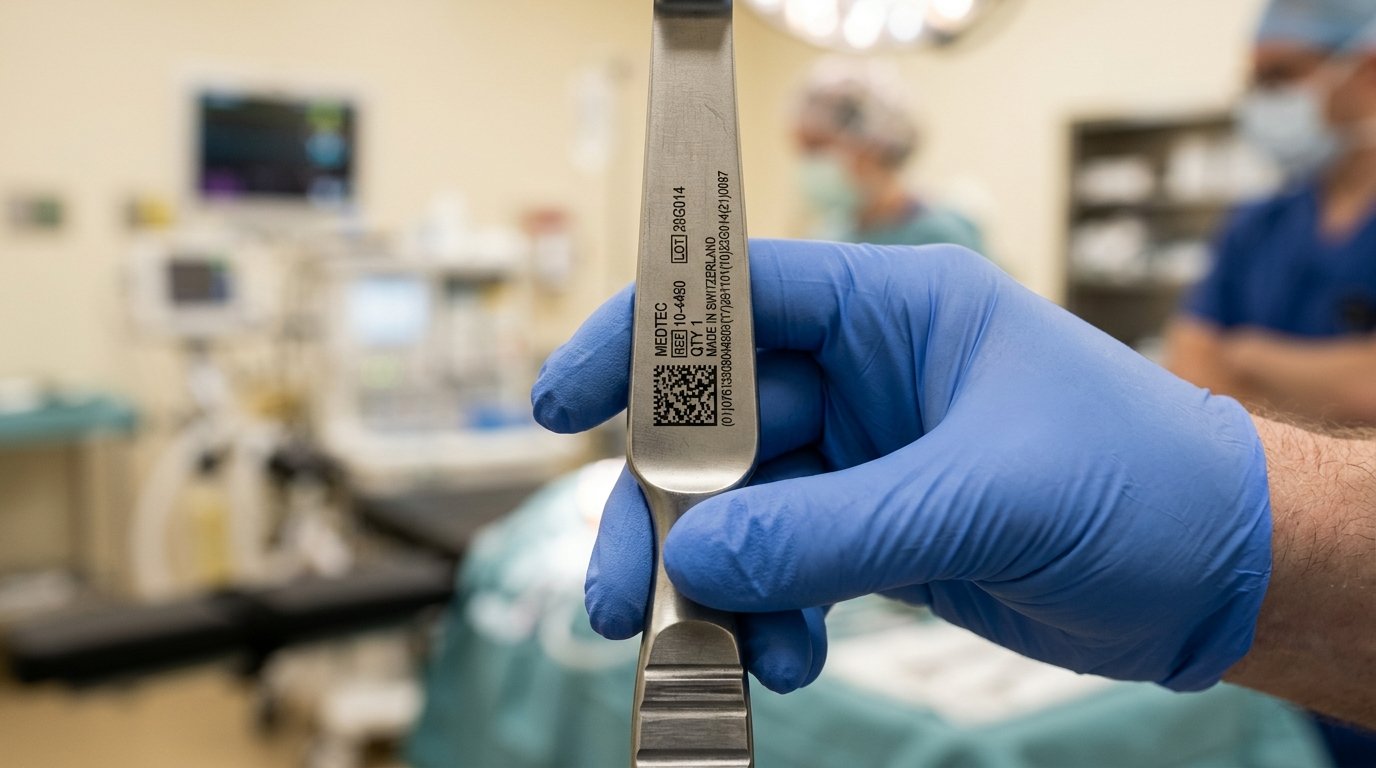
How a UDI Is Built: Device Identifier, Production Identifier, and Format
Every UDI starts with the device identifier (DI), a mandatory code that identifies the labeler and the specific version or model. The production identifier (PI) is conditional, carrying variable information that also appears on the label. If your label includes an expiration date, the UDI must encode it. If your device is Class I, PI is not required at all under the UDI provision. A serial number is not universally mandatory just because a device falls under UDI rules.
The identifier must appear on the label in two forms, human-readable plain text and automatic identification and data capture (AIDC), typically a linear or 2D barcode. Both must be present. A label with only a barcode or only printed text fails the requirement.
FDA accredits issuing agencies with distinct syntaxes for constructing and encoding identifiers.
| Issuing Agency | Standard | Common Application |
|---|---|---|
| GS1 | GS1 identifiers with application identifiers (01) for DI, (10) for lot, (17) for expiration, (21) for serial | Broad healthcare supply chain adoption |
| HIBCC | HIBC (Health Industry Bar Code) | Smaller device manufacturers and specialized distributors |
| ICCBBA | ISBT 128 | Products of human origin (blood, tissue, cells) |
The choice is worth careful consideration. Your trading partners, hospital customers, and distribution channels may already operate within one framework. Switching later means relabeling inventory, resubmitting GUDID records, and retraining downstream scanning systems. FDA’s format document (version 1.4, September 2025) details the encoding syntax for each agency, including data delimiters and element ordering.
Printed dates on labels follow the YYYY-MM-DD format under 21 CFR 801.18, with narrow exceptions for NDC-labeled combination products. Encoded dates inside barcodes follow the issuing agency’s syntax, which may differ from the printed format. Getting one right and the other wrong is a frequent source of validation failures.
Improvising a barcode layout outside the issuing agency’s specifications will either fail GUDID validation outright or, worse, pass validation while creating scanning errors at hospitals and distribution centers downstream.
With the identifier structure clear, the question shifts to applicability. The regulation defaults to requiring UDI on every device, then carves out specific exceptions, and the exceptions are where most compliance teams misjudge their position.
Which Devices Need a UDI, and Which Get Exceptions
The default under 21 CFR Part 801 Subpart B is that all medical devices commercially distributed in the U.S. require UDI labeling. The regulation then defines specific exceptions. The common mistake is working backward, assuming a device is exempt and looking for confirmation, rather than starting from the general rule and verifying whether a defined exception actually applies.
FDA phased in compliance by risk class between 2014 and 2018.
| Device Category | Original Compliance Date |
|---|---|
| Class III and PHS Act-licensed devices | September 24, 2014 |
| Implantable, life-supporting, life-sustaining | September 24, 2015 |
| Class II | September 24, 2016 |
| Class I and unclassified | September 24, 2018 |
These are historical dates. If you are manufacturing and distributing today, the relevant question is whether a specific exception or enforcement policy covers your product right now.
Class I devices get specific relief. If a Class I device already carries a UPC on its label and packages, that UPC is deemed to satisfy UDI labeling requirements. Class I UDIs also do not require production identifier elements. These are specific provisions within the regulation, and they do not create a blanket pass on GUDID submission.
FDA’s July 2022 guidance goes further for a narrow subset of qualifying 510(k)-exempt Class I over-the-counter products sold directly to consumers. For these products, FDA states it does not intend to enforce GUDID submission requirements. The guidance explicitly excludes Class I reserved devices, restricted devices, implantables, life-supporting or life-sustaining devices, and products distributed to healthcare facilities for professional use. Labeling a product as “consumer” does not activate this policy unless every stated condition is met.
Direct marking follows a different trigger entirely. It applies to devices intended for repeated use that undergo reprocessing before each use. The regulation does not prescribe a specific marking technology, and implantable status alone does not create the requirement. When a manufacturer claims an exception based on interference with safety or technological infeasibility, the rationale must be documented and defensible.
Regulated stand-alone software (SaMD) has its own presentation rules. The UDI must be displayed in human-readable text at startup, through an “About” menu command, or both. Software distributed without physical packaging conveys its version number within the production identifier. SaMD manufacturers who have never handled hardware labeling often underestimate how specific these requirements are.
Additional defined exceptions cover research or teaching devices, custom devices, investigational devices, veterinary devices, export-only devices, individual single-use units within a larger package (provided the containing package carries UDI and the devices are not implantable), and certain combination-product configurations. Each comes with its own qualifying conditions. Labeling a collection of products as a “kit” does not automatically invoke the kit exception.
Identifying which requirements apply to a device is the regulatory question. Submitting and maintaining accurate data in GUDID is the operational one, and it brings its own recurring failure points.
GUDID Submission, Maintenance, and the 10-Day Rule
GUDID is not a one-time upload. It is a living catalog that requires initial submission, ongoing updates, and version control tied to your product lifecycle.
The practical workflow begins with establishing an organization account in the GUDID system, assigning identifiers through your chosen issuing agency, preparing the required device attributes, submitting, resolving validation errors, and maintaining records as products change. FDA offers a web application for individual records (suitable for small portfolios) and HL7 Structured Product Labeling (SPL) submission through the Electronic Submissions Gateway for bulk uploads.
Required attributes extend well beyond the DI. They include brand name, version or model, sterility status, latex content, MRI safety information, device size, production identifier types, premarket submission numbers, listing numbers, Global Medical Device Nomenclature (GMDN) codes, and package quantity at each packaging level. Missing or incorrect values in any of these fields can trigger a validation rejection or, if they pass initial review, create discrepancies that surface during audits.
Timing rules are specific. Initial GUDID information must be submitted no later than the applicable UDI labeling compliance date. When a label change triggers a record update, the submission must follow the first labeling run reflecting that change. For information that does not appear on the label, updates are due within 10 business days of the change. Missing that window is a compliance gap, even if the underlying label is correct.
Change control is where programs most frequently break down. Creating a new version or model requires a new DI. Changing a package configuration requires a new DI. Relabeling requires a new DI, and the labeler must maintain the relationship between the new and prior identifiers. A discontinued DI cannot be reassigned to a different device. These rules mean your packaging, engineering, labeling, and regulatory teams cannot operate in isolation. A packaging change that nobody flags to the regulatory team creates a compliance gap by default.
One development worth monitoring is FDA’s December 2024 announcement of plans to remove FDA Preferred Term codes from GUDID because GMDN codes became freely accessible. The transition timeline has not been finalized. Treat it as a planned migration rather than a completed change.
Submitting accurate data to GUDID satisfies one obligation. Whether that data actually reaches the people who need it during a recall, an audit, or a clinical event is a separate question, and the evidence on that front is sobering.
Where the Compliance Chain Breaks in Practice
The gap between catalog compliance and operational traceability is not theoretical. FDA enforcement actions in 2025 show how compliance gaps emerge in different forms.
FDA’s January 2025 warning letter to Robbins Instruments concerned the Dermo-Jet device. FDA found 32 entries under “Robbins Instruments Inc.” in GUDID but none for the Dermo-Jet or another injector product. The company had a GUDID account with records. It was still non-compliant because the specific product lacked its own entry. Company-level database presence does not equal product-level completeness.
The June 2025 letter to Reset Technology identified a different combination of failures. The ResetSmile Partial Denture and Impression Kit labels lacked the required DI and proper UDI presentation, and FDA also found missing GUDID information. The letter confirms that inspectors check labeling and database records independently. Passing one does not protect you from failures in the other.
Beyond enforcement letters, the recall data reveals a broader pattern. The study by Mooghali, Ross, Kadakia, and Dhruva examined 211 unique Class I recalls (the most serious severity category, not a reference to device risk class) issued between 2018 and 2022. Only 54 notices (25.6%) included complete UDIs. 118 notices (55.9%) lacked even a primary device identifier. The study measured the information available in recall communications, not whether every affected device had a compliant label. Its practical significance is in exposing the disconnect: identifiers may be assigned and labels may be printed, but the information fails to propagate into the safety workflow where it would enable targeted recall execution.
A practical test anyone can run: select a product from your catalog, locate its GUDID record, scan the actual packaging, recover the applicable lot or serial information, and check whether that information chain supports a targeted recall action. If it falls apart midway, the compliance investment is underperforming at the exact point where it was designed to protect patients.
Regulatory developments in 2026 add pressure on this downstream chain, making it harder to treat UDI as a labeling-only exercise.
The 2026 Regulatory Landscape
The Quality Management System Regulation (QMSR), effective February 2, 2026, incorporates ISO 13485:2016 into FDA’s quality system requirements. Among its provisions, 21 CFR 820.45 now explicitly requires that labeling examination and control activities include checking the correct UDI or UPC information and preventing mix-ups, with documented release and inspection procedures. This does not create a new UDI compliance deadline, but it embeds UDI verification directly into quality-system audits. If your quality team has been treating UDI as “regulatory’s problem,” QMSR makes that division untenable.
On the EU side, EUDAMED’s first four modules became mandatory on May 28, 2026. The European UDI framework shares the DI-plus-PI structure but adds a Basic UDI-DI, a grouping key used in regulatory documentation that does not appear on trade-item packaging. Manufacturers selling into both markets can share master product data to reduce duplication, but the actual identifiers, data relationships, and submission formats differ. Building one global master dataset is efficient; assuming the U.S. and EU submissions are interchangeable is a compliance risk.
On the clinical interoperability front, USCDI Version 7 (July 2026) includes UDI as a data element within the Medical Devices class, referencing FDA’s UDI system as the applicable standard. This provides an interoperability foundation for electronic health records to capture and exchange device identifiers. It does not mandate that hospitals populate the field, and a health-system study documented significant organizational, workflow, and IT barriers to doing so. But the direction is unmistakable: regulators and standards bodies expect UDI to flow from the label into the patient record.
Each of these shifts reinforces the same operational expectation. UDI must travel from the label into procurement, clinical records, and recall workflows. Making that happen requires technology and process integration beyond the labeling department.
From Identifier to Operational Traceability
The clearest evidence of what full UDI integration looks like in practice comes from Duke University Health System. Duke converted its cardiac catheterization and electrophysiology labs to a UDI-centric environment, linking scanned identifiers across inventory management, supply chain (SAP), procedure documentation, the EHR (Epic), and an enterprise data warehouse. Staff documentation time dropped by 15 to 20 minutes per cardiac device implant procedure, and the system recognized return on investment in under a year.
Duke’s experience also surfaced the friction. Staff encountered multiple barcodes on a single package and needed training to select the correct one. Erroneous implant scans required correction workflows. Scanning technology enables traceability, but integration design and exception handling determine whether the data is reliable enough to act on.
For manufacturers, this translates into a practical imperative. Your UDI strategy should not end at the label. The identifier you print must survive transit, storage, reprocessing (for reusable devices), and point-of-use scanning. Reusable surgical instruments with direct markings must remain legible after hundreds of sterilization cycles. Implantable device identifiers must be capturable at the moment of implantation, not reconstructed from paperwork days later.
This is where physical asset tracking technology becomes operationally relevant. IoT-enabled sensors, RFID, and automated scanning systems bridge the gap between a compliant label and a functioning traceability chain. For reusable medical devices that cycle through departments, sterilization, and storage, continuous tracking ensures the identifier remains locatable and the device’s status stays current throughout its lifecycle. The identifier exists because regulation demands it. Whether your organization can retrieve and act on that identifier during a recall or clinical event depends entirely on what happens after the label is printed.
At Datanet, we build IoT-based asset tracking systems that connect to the traceability chain UDI compliance initiates. If your reusable devices or high-value equipment lose visibility between the loading dock and the point of care, talk to our team.

Frequently Asked Questions
Does every FDA-regulated medical device need a UDI?
The general requirement applies to all commercially distributed devices, but 21 CFR Part 801 Subpart B defines specific exceptions for certain Class I devices, custom devices, investigational devices, and others. Neither “Class I” nor “510(k)-exempt” alone is sufficient to claim an exemption. Each product must be evaluated against the actual regulatory conditions and applicable enforcement policies.
Is a serial number always required as part of the UDI?
No. Production identifier (PI) content depends on what information appears on the device label. Class I devices do not require a PI at all under the UDI provision. GUDID stores flags indicating which PI types apply to a given device but does not store actual serial or lot values.
Can a standard UPC barcode serve as a UDI?
For Class I devices, a UPC on the label and packages is deemed to meet UDI labeling requirements under a specific regulatory provision. This does not extend to other device classes, and it does not exempt the device from GUDID submission. Other products must carry UDIs assigned by an FDA-accredited issuing agency in the proper format.
Do reusable surgical instruments need to be laser marked?
Direct marking is required for devices intended for repeated use that undergo reprocessing before each use, but the regulation does not prescribe laser marking specifically. Exceptions exist where marking would interfere with safety or is technologically infeasible. Implantable status alone does not trigger the direct marking requirement. Any exception claimed must be documented.
Does a GUDID record mean FDA has approved the device?
No. GUDID is a reference catalog. Part 830 permits FDA to reject or remove data for devices that lack required premarket authorization. A published GUDID record should never be represented as evidence of clearance, approval, or compliance with other regulatory obligations.
What triggers the need for a new device identifier in GUDID?
A new version or model, a new package configuration, or relabeling by a different entity all require a new DI. The relationship between new and prior identifiers must be maintained. For changes to GUDID information that do not appear on the label, updates are due within 10 business days of the change.








 +1 508 292 2210

2 Responses