

In September 2024, West Pharmaceutical Services recalled 129,600 Vial2Bag Advanced admixture devices after shipping-related heat exposure damaged packaging and potentially breached the sterile barrier. The product was designed for ambient storage. Medical device transport validation exists to prevent exactly this kind of failure, and the evidence bar in 2026 is higher than it has ever been.
Transport validation is the documented proof that a defined device-packaging-shipping configuration survives its anticipated distribution environment while preserving device performance and, where applicable, sterile integrity. FDA’s Quality Management System Regulation took effect in February 2026, ISO 11607 added a third part in September, and medical device recall volumes hit 313.1 million units in the first half of this year alone.
Most validation programs prove the system can survive controlled laboratory conditions. Fewer extend that evidence to what each individual shipment actually encounters in transit.
Regulatory Framework for Transport Validation in 2026
The core obligation under both FDA and EU frameworks is demonstrating preservation of device conformity through distribution, with evidence proportionate to the product and its environment. No single test standard satisfies this by default.
FDA’s QMSR, effective February 2, 2026, incorporates ISO 13485:2016. Clause 7.5.11 requires a risk-based process for preserving device conformity during processing, storage, handling, and distribution. It does not prescribe a universal shipping-test recipe. It requires that the evidence exist and that the approach be justified by risk.
EU MDR (Regulation 2017/745), Annex I, requires devices to retain their characteristics and performance during transport and storage, including through temperature and humidity fluctuations. Sterile packaging must maintain sterility under manufacturer-specified conditions until the package is opened.
The ISO 11607 series provides the packaging-specific scaffold:
| Standard | Primary Scope | Important Boundary |
|---|---|---|
| ISO 11607-1:2019 (amended 2023) | Materials, sterile barrier systems, packaging systems | Excludes contaminated-device transport to reprocessing |
| ISO 11607-2:2019 | Validation of forming, sealing, and assembly processes | A capable sealing process alone does not demonstrate shipping robustness |
| ISO 11607-3:2026 | Heat-sealing process development before process validation | Does not replace Part 2 or distribution testing |
Part 3 is worth attention. Published in September 2026, it formalizes a step many teams were doing informally: documenting heat-sealing process development before jumping into validation runs. The practical effect is earlier coordination among package designers, sealing-equipment suppliers, and manufacturing teams. If your previous approach went from design directly to sealing validation, Part 3 inserts a formal documentation stage between them.
Knowing what regulations require is a different exercise from structuring the evidence. The protocol is where most programs either build their defense or accumulate gaps that surface during audits.
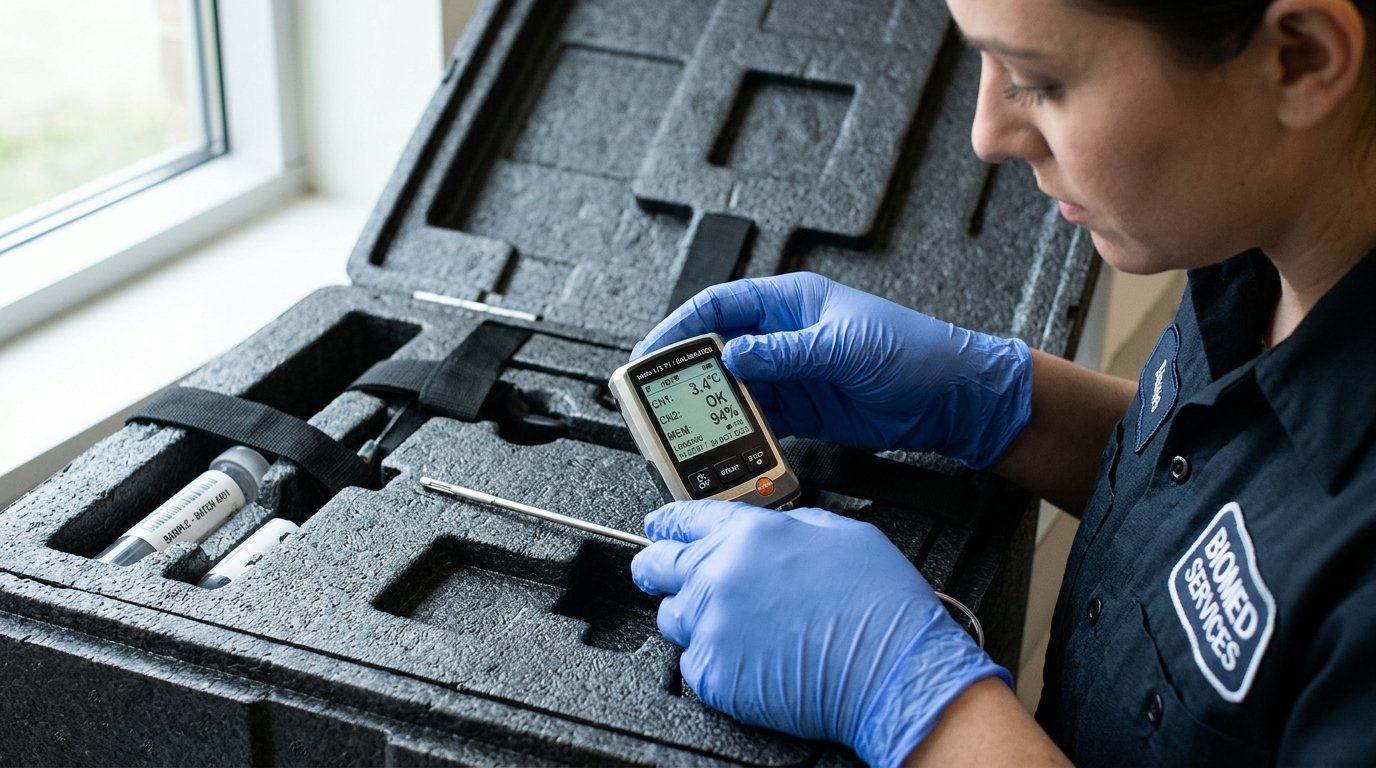
Building the Validation Protocol
Transport validation proves a defined system works. Change the device variant, the tray material, the shipper dimensions, the pallet configuration, or the route, and the existing evidence may no longer apply.
The protocol starts with precision about what exactly is being validated and ends with criteria for maintaining that validated state over time.
Start with configuration. Specify device variants, primary sterile barrier, protective packaging, shipper, palletization pattern, payload range, transport modes, routes, and foreseeable delays. A vague scope produces an undefendable report.
Map distribution hazards. Shock, vibration, compression, temperature extremes, humidity, low pressure, and handling transitions are the standard categories. STERIS identifies cycle selection as dependent on transportation mode and shipping configuration, which means a single hazard profile rarely covers air, ground, and ocean distribution simultaneously.
Select worst cases with documented rationale. Explain why a specific product and pack-out represent the broader family. The heaviest item is not automatically the worst case for every failure mode; a lighter device in an oversized shipper may experience more internal movement and cushion bottoming.
Lock the protocol before testing begins. Acceptance criteria, sample sizes, conditioning parameters, test sequence, deviation procedures, and responsibilities all need approval. If criteria are adjusted after results arrive, an auditor will treat the entire report with suspicion.
Measure both package and device performance. This is the step most often shortchanged. Terumo Medical Corporation’s iterative distribution testing illustrates the risk: when a radial compression device was tested under cold exposure, shock, and vibration, changing the adhesive resolved tray tearing, but a connection tube still broke at the tab weld. The package passed while the device-level vulnerability persisted. If Terumo had evaluated only package integrity, that failure would have shipped.
Close failures and maintain the validated state. Revalidation is warranted when shipping methods, packaging, or routes change. Minor changes may be justified through documented risk assessment without full retesting, but cumulative changes demand a fresh evaluation.
One of the first protocol decisions, and one of the most debated, is which test standard the distribution simulation should follow.
ASTM D4169 vs. ISTA 3A: Matching the Standard to the Shipment
Both are legitimate frameworks. The choice should follow the distribution system and regulatory pathway, not whichever test appears easier to pass.
ASTM D4169 simulates distribution-cycle hazards through sequential testing on the same shipping units, which remain unopened until the full sequence is complete. This preserves cumulative damage effects that isolated tests would miss. FDA’s recognized consensus standards database lists edition D4169-22, while ASTM’s current publication is D4169-23e1, updated March 2024. If a submission references this standard, the edition and any deviations from the recognized version should be documented explicitly.
ISTA 3A targets parcel-delivery packages up to 70 kg (150 lb), specifying one sample per procedure with a recommendation of five or more repetitions using new samples. Some moisture, low-pressure, or unusual-handling conditions may fall outside its scope.
| Factor | ASTM D4169 | ISTA 3A |
|---|---|---|
| Distribution mode | Multiple modes via distribution cycles | Parcel delivery, single-package focus |
| Weight limit | No inherent limit (cycle-dependent) | 70 kg / 150 lb |
| Test sequencing | Sequential on same units, cumulative damage preserved | Individual procedures, repetition encouraged |
| FDA recognition | Yes (D4169-22, recognition #14-576) | Not listed in FDA consensus standards database |
| Sample guidance | No fixed count mandated by standard | One sample per run; five or more repetitions recommended |
Sample size is frequently debated and rarely settled by a single rule. DDL recommends ten assembled shipping units for its distribution simulation program. Under a zero-failure binomial model, 95% confidence at 95% reliability requires 59 independent units, while 99% reliability pushes to 299. These are statistical reference points. Units exposed together on the same pallet, or multiple seal strips from one package, may not satisfy the independence assumption those calculations require.
Once the distribution simulation is complete, post-test evaluation introduces complexity of its own, especially around seal testing.
Seal Strength and Seal Integrity Are Separate Evidence Streams
A sealed package can produce excellent peel-force values and still contain a channel defect that allows microbial ingress. Strength and integrity measure different things. Conflating them is one of the more common gaps auditors flag.
| Endpoint | Typical Method | What It Answers | What It Does Not Answer |
|---|---|---|---|
| Seal strength | ASTM F88 peel testing | Mechanical force to separate sealed surfaces | Whether leak paths exist |
| Seal integrity | ASTM F1929 dye penetration | Presence of individual seal leaks (pass/fail) | Quantitative leak rate |
| Gross leaks | ASTM F2096 bubble emission | Large-scale leak detection | Sub-visible channel defects |
| Visual inspection | ASTM F1886 | Visible seal anomalies | Non-visible internal defects |
Nelson Labs emphasizes that test methods themselves need facility-specific validation for repeatability, reproducibility, and sensitivity. A method transferred between laboratories without revalidation may detect different defect populations.
One additional distinction frequently gets lost in validation plans: accelerated aging and transport testing answer separate questions. ASTM F1980 supports provisional shelf-life claims while real-time data accumulates, but it explicitly excludes shipping, handling, and environmental performance. A device that survives accelerated aging has demonstrated time-related durability. Transit resilience requires separate evidence, and the two should not be conflated in the same validation report.
All of this produces laboratory evidence that the system can survive its anticipated environment under controlled conditions. Each individual shipment still needs its own confirmation, which is where operational monitoring enters the picture.
Where Lab Qualification Ends and Shipment Monitoring Begins
A validated configuration proves the system can work. It does not confirm that Tuesday’s shipment from Memphis to Frankfurt was handled according to protocol, or that it spent the expected time on a tarmac rather than six additional hours in July heat.
This is the gap that operational monitoring fills. Qualification is prospective evidence (can it survive?). Monitoring is concurrent evidence (did it survive this time?). The two layers serve different purposes.
I’ve deployed IoT-based environmental monitoring across air freight and industrial logistics for over a decade. The sensor technology is rarely the bottleneck. The gap is almost always in what happens after the data shows a problem: who reviews it, who makes the disposition call, and what changes before the next shipment goes out.
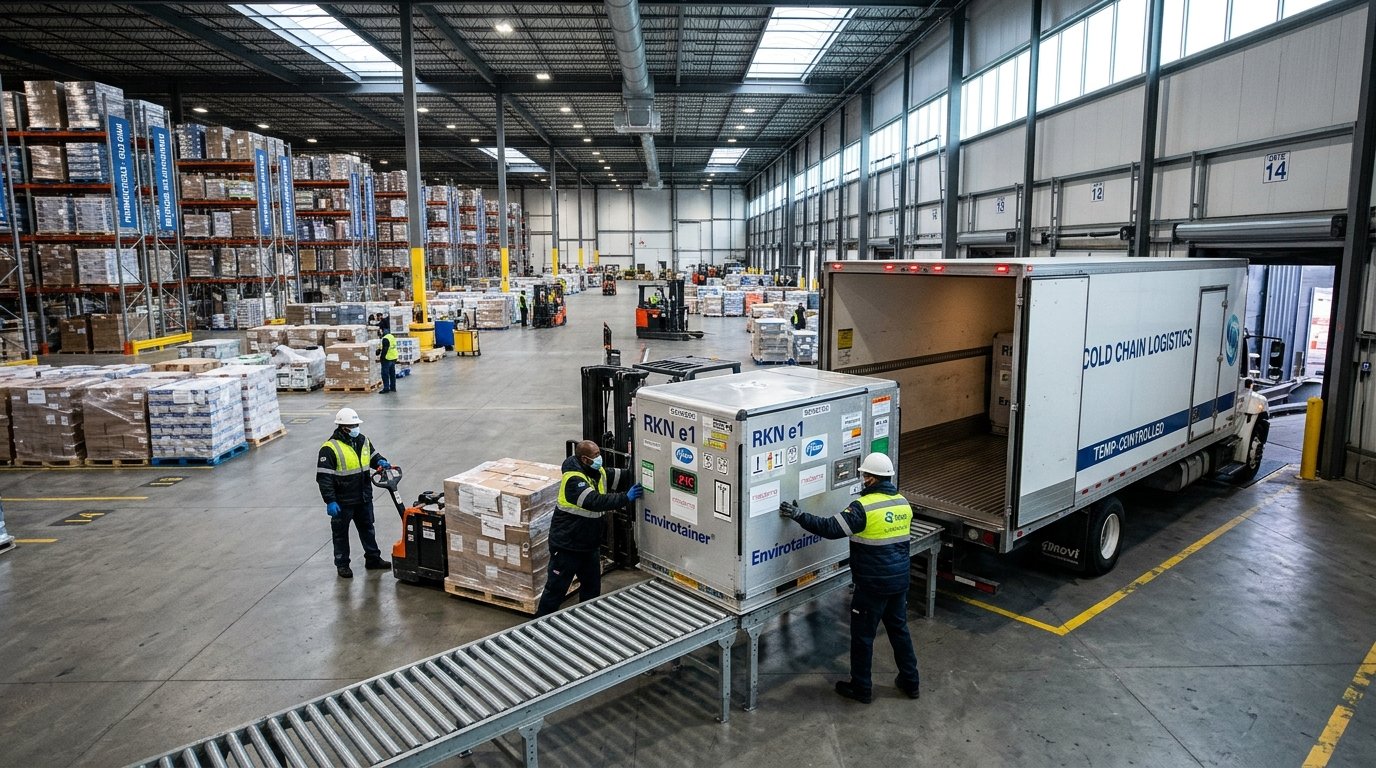
Expeditors demonstrated this layered approach shipping medical supplies internationally, using qualified pallet shippers, temperature-controlled vehicles, trained handling crews, and continuous monitoring. The result was zero temperature excursions on a 44-pallet shipment. The logistics team also reviewed weather data and assessed risk at freight-lane handoffs, converting monitoring from passive recording into active exception management. The packaging and protocols had been qualified beforehand. Monitoring confirmed each individual event.
The monitoring technology available in 2026 covers more than temperature. ELPRO’s LIBERO GH loggers combine temperature, humidity, location, light exposure, and movement data. Sensitech’s TempTale GEO series adds real-time cellular connectivity for in-transit alerts. The industrial IoT device range extends monitoring capabilities beyond medical-specific applications, enabling cross-industry logistics validation. The sensor capability exists. The more common gap is in release rules: without documented disposition criteria tied to product-specific tolerances, a monitoring dashboard is just an expensive thermometer.
If your transport validation program stops at the lab report, it misses the layer that catches the real-world exceptions your protocol assumed away. Environmental monitoring devices built for shipment-level tracking can bridge that gap, provided they’re paired with clear operational rules and integrated into the quality system.
Recent cases show why both evidence layers matter.
Failures That Shaped Current Practice
West Pharmaceutical Services’ 2024 recall covered 129,600 Vial2Bag Advanced 20mm devices. Shipping-related heat exposure damaged packaging and potentially compromised the sterile barrier. Affected inventory required quarantine and return through a designated processor. Temperature interacts with packaging materials, adhesives, and seal performance in ways that ambient-storage labeling alone does not predict. If the thermal extremes of actual distribution routes were never qualified, the validation is incomplete regardless of storage claims.
Terumo Medical Corporation’s experience, documented across three distribution studies by Modality Solutions, is more nuanced. Cold exposure combined with shock and vibration at -35°C and -20°C revealed torn thermoformed trays and a broken connection tube. After Terumo changed the adhesive, tray tearing resolved in follow-on studies. But connection-tube breakage at the tab weld persisted under combined stressors. The package fix worked. The device vulnerability required separate engineering. Acceptance criteria that cover only package integrity leave device-level risks unexamined.
A 2025 study by Lungren and Okezue analyzed 791 product IDs across 146 unique seal-integrity recall events from 2019 through 2025, finding that 96.7% were devices. The FDA’s records do not reliably distinguish whether failures originated during manufacturing, storage, or transport. But the concentration of seal-related issues confirms that this failure mode is persistent and that assuming a sealed package stays sealed is insufficient evidence for release decisions.
These failure patterns have directly influenced where incoming standards and regulatory expectations are heading.
What ISO 11607-3 and QMSR Change Going Forward
ISO 11607-3, published September 2026, formalizes heat-sealing process development as a documented step before process validation begins. The standard addresses equipment features that support validation, control, and monitoring. Teams that previously went from package design directly to sealing validation now have an intermediate documentation requirement, which front-loads engineering decisions and forces conversations between packaging engineers and equipment suppliers before the first validation seal is made.
The QMSR’s incorporation of ISO 13485 means preservation evidence belongs inside the quality management system. Distribution testing, aging data, monitoring protocols, and change-control procedures should connect to the CAPA process, management review, and design-history file. Understanding ISO 13485 calibration requirements helps ensure monitoring equipment used in transport validation maintains the documented accuracy the QMS demands. An isolated binder of shipping-test reports, disconnected from the QMS, is increasingly difficult to defend in an audit.
One developing tension: the EU’s Packaging and Packaging Waste Regulation (2025/40) pressures manufacturers toward reduced material and increased recyclability. Contact-sensitive medical device packaging has specific exemptions from certain recycled-content and recyclability provisions, but those exemptions do not cover every component in a shipping system. Terumo’s adhesive change is a reminder that even a targeted material substitution can alter transport performance. Sustainability-driven packaging changes should carry transport-validation impact assessments before implementation.
The common thread is that transport validation is becoming a lifecycle evidence system. Process development, qualification testing, shipment monitoring, and change control need to function as a connected record, because gaps in any one layer surface during audits, recalls, and customer qualifications.
Frequently Asked Questions
Is medical device transport validation legally required?
Manufacturers must demonstrate preservation of device conformity under applicable regulations. FDA’s QMSR incorporates ISO 13485 clause 7.5.11, requiring risk-based preservation evidence across processing, storage, handling, and distribution. EU MDR Annex I explicitly addresses transport and storage. The obligation exists; the specific test method is not universally prescribed.
Should I choose ASTM D4169 or ISTA 3A?
Match the standard to your distribution system. ISTA 3A covers parcel shipments up to 70 kg. ASTM D4169 offers distribution-cycle simulation across multiple transport modes with cumulative damage preserved. Document why the selected standard, edition, and cycle represent your actual shipping environment and product risk.
How many samples should a transport validation use?
There is no universal number. ISTA 3A specifies one sample per procedure with five or more repetitions recommended. DDL recommends ten shipping units. Statistical confidence depends on the reliability target and the assumption of sample independence. Justify the sample plan in the protocol rather than defaulting to an arbitrary count.
Can accelerated aging replace transport testing?
No. ASTM F1980 supports shelf-life claims by simulating time-related degradation but explicitly excludes shipping, handling, and environmental challenge. Transport testing addresses a separate hazard set. Both evidence streams are necessary for a complete validation file.
What triggers revalidation?
Changes to the device, packaging materials, sealing process, shipper, palletization, transport mode, or distribution route can invalidate existing evidence. Minor changes may be justified without full retesting through a documented risk assessment, but cumulative changes require a fresh evaluation.
Does a clean temperature log prove the shipment is safe to release?
A temperature trace confirms environmental conditions during transit. It does not confirm seal integrity, device function, or absence of mechanical damage. Shipment release should follow documented criteria that may include temperature data alongside visual inspection, integrity checks, or other product-specific evaluations.
If your validation program needs the monitoring layer that connects lab evidence to real-world shipment conditions, talk to our team or email info@datanetiot.com. We help medical device manufacturers and logistics operators deploy environmental tracking that integrates with existing quality systems.






 +1 508 292 2210

One Response