

A hospital’s sterile processing department can cycle hundreds of surgical trays per day. Each tray holds dozens of instruments, many worth thousands of dollars individually. And yet, direct observation in seven pediatric ORs documented 236 instrument errors across 147 cases, with nearly 89% tied to visualization failures. Someone couldn’t see what was missing, damaged, or out of place.
That’s the problem surgical instrument tracking solves. Not just knowing where a tray sits, but building a verifiable chain of events: who handled each instrument, when it was cleaned, how it was sterilized, which patient it was used on, and whether it came back complete. Every link in that chain serves a different purpose: compliance, patient safety, or operational dollars.
Here’s how the full cycle works, what technologies power it, and where the real limits are.
What Surgical Instrument Tracking Actually Does
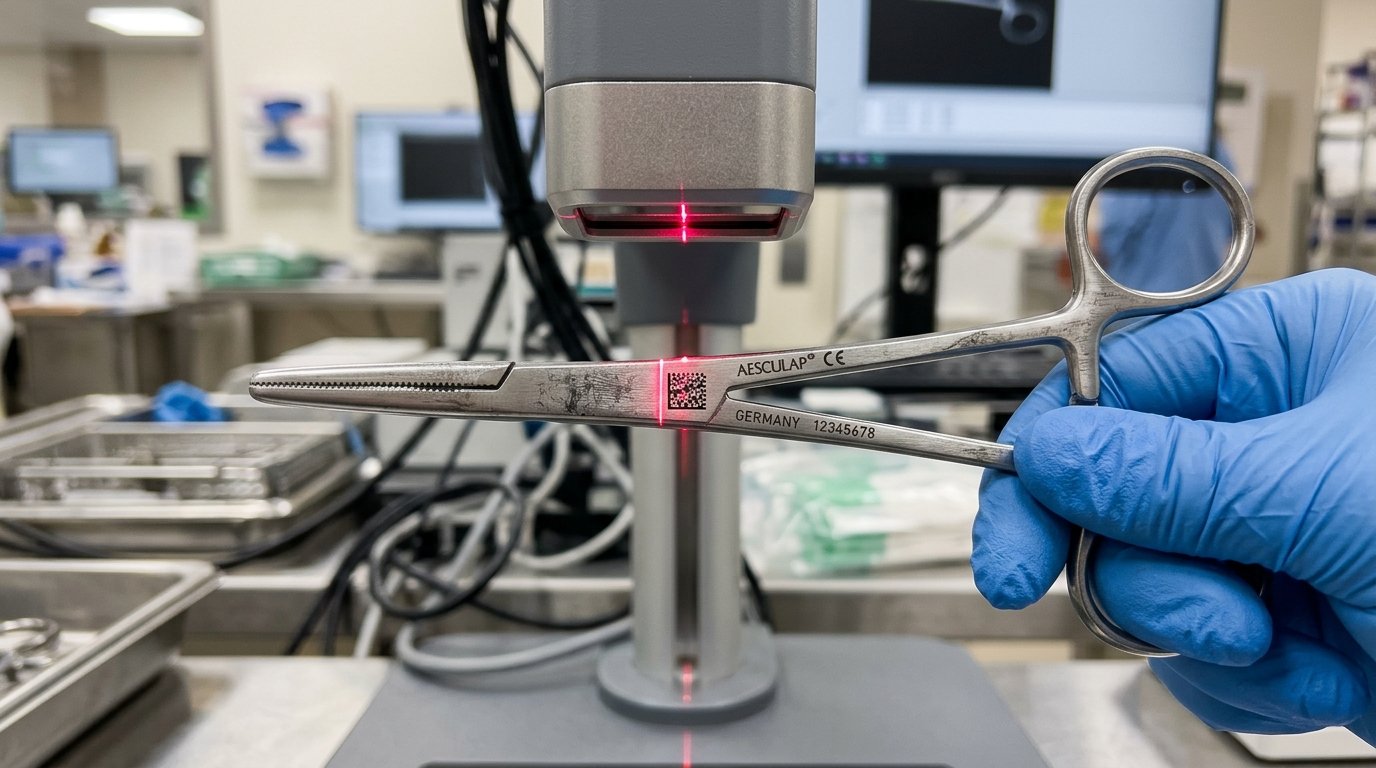
Surgical instrument tracking is a system that records the identity, location, processing history, and condition of surgical instruments and trays as they move through decontamination, sterilization, storage, surgery, and return. It combines an identifier on the instrument or tray (barcode, RFID tag, or laser-etched mark), a reading device, workflow software, and a database that links every event to a person, timestamp, and piece of equipment.
Three jobs frequently get confused, and the confusion leads to bad purchasing decisions:
- Tray-level tracking locates a complete set: in storage, in the OR, in transit. It answers “where is the total knee tray?” but cannot tell you whether every instrument inside is present or functional.
- Item-level tracking identifies individual instruments within a tray. It flags a missing hemostat during assembly, logs which instruments were used in a procedure, and connects each one to its full sterilization record.
- Retained-item detection is a different system entirely. RF-tagged sponge counters detect objects left inside a patient during surgery. They don’t track instruments through reprocessing or storage.
Before evaluating any platform, define which of these three problems is costing you the most. A container beacon that helps find trays across the facility solves a logistics problem. Item-level identification during assembly solves a patient-safety and compliance problem. They’re complementary, not interchangeable.
The 7-Stage Tracking Cycle
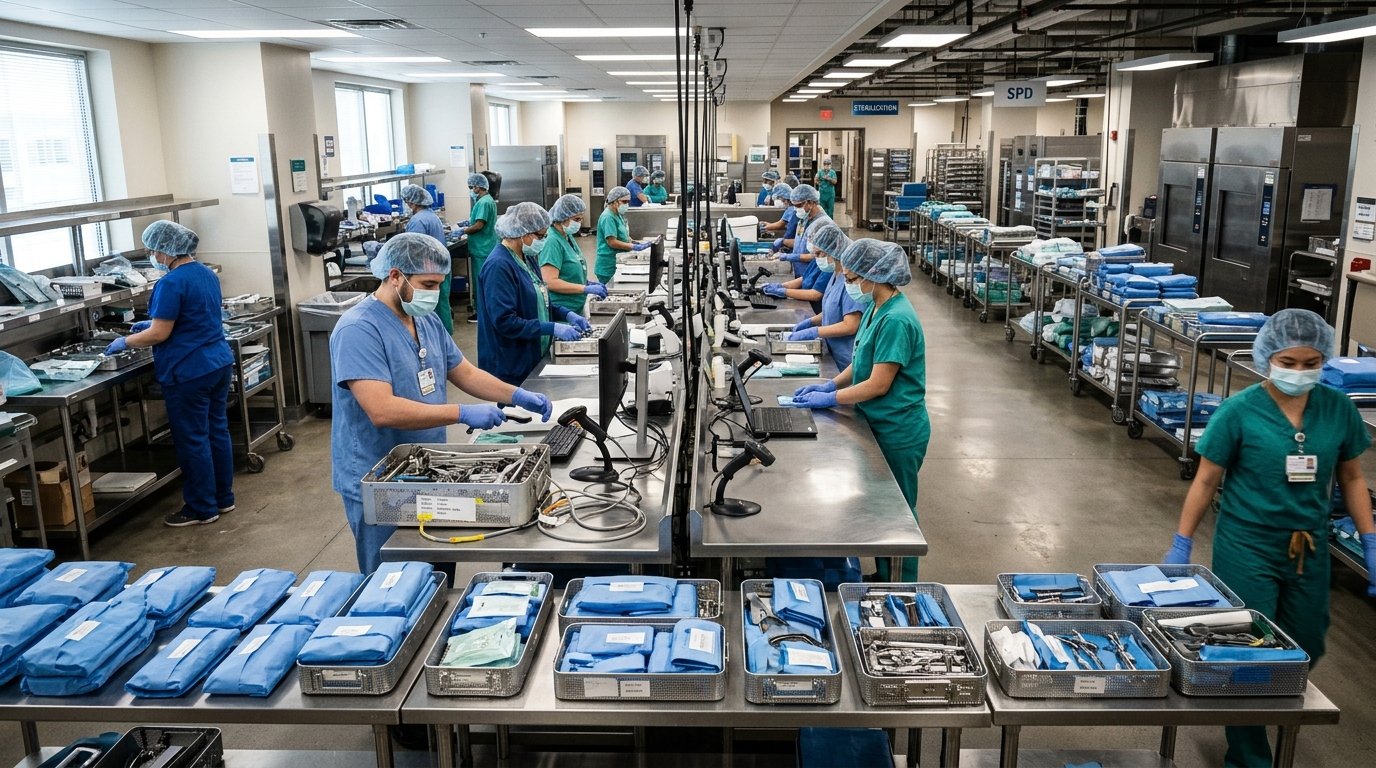
Every surgical instrument follows roughly the same loop, and a tracking system records what happens at each station. Here is what a properly configured system captures and why each step matters.
| Stage | What the system records | Why it matters |
|---|---|---|
| 1. Register and identify | A device or local inventory ID is linked to its item record, set, or tray. For FDA-regulated devices, this may include a Unique Device Identifier (UDI). | Defines whether you’re tracking a complete set or each physical instrument. Everything downstream depends on this decision. |
| 2. Receive and decontaminate | Receipt scan, location, staff ID, decontamination method and time. | Creates a traceable handoff between the OR and sterile processing. Supports workload and turnaround reporting. |
| 3. Inspect and assemble | Visual prompts, count verification, images of required contents, alerts for missing or incorrect items. | This is where most errors happen. The system guides the tech, but a scan does not replace looking at the instrument. |
| 4. Sterilize and release | Sterilizer ID, cycle parameters, load ID and contents, operator, mechanical/chemical/biological monitoring results. | Links a released set to its actual reprocessing evidence. CDC recommendations specify recording all three monitoring types for every sterilization cycle. |
| 5. Store and prioritize | Location, readiness status, link to surgery schedule, overdue or unreturned flags. | Reduces searching. Helps case-cart assembly match the next day’s slate, if scan data and schedules stay current. |
| 6. Issue to case and patient | Tray or instrument linked to procedure, patient, surgeon, time in and out. | Enables targeted trace-back: “which patients received instruments from load #4721?” instead of “every patient this week.” |
| 7. Return, repair, learn | Return scan, missing-item investigation, repair history, cost, utilization data, replacement triggers. | Closes the loop. Usage analytics from this stage can drive inventory optimization and preventive maintenance scheduling. |
Each stage is only as reliable as the scan compliance and data quality behind it. A skipped scan at Stage 2 breaks the chain. A tech who overrides an assembly alert at Stage 3 eliminates the safety catch. The software provides the structure. People determine whether it works or not.
This loop is the same regardless of technology. The difference between a barcode system, an RFID system, and a hybrid deployment is how the identification step happens and how much manual intervention each handoff requires.
RFID vs. Barcode vs. Beacons vs. Computer Vision
The technology you choose determines what you can track, how fast, and with what failure modes. No single technology covers every use case.
| Technology | Best for | Key advantage | Key limitation |
|---|---|---|---|
| Barcode / DataMatrix | Item or tray identity via deliberate scan | Visible, proven, lower hardware cost. Laser-etched DataMatrix marks survive sterilization. | Requires line of sight. Speed depends entirely on the person scanning. A missed scan means a gap. |
| Passive RFID (UHF) | Bulk item reads, faster identification | Can read multiple tagged instruments without direct line of sight. One study found RFID reading was 2.7 to 3 times faster than barcode scanning for a varicose-vein instrument set. | Tags must survive repeated autoclaving. Metal instruments can interfere with RF signals. That speed comparison used 8 participants and 41 instruments. |
| RTLS / Container beacons | Locating complete trays across a facility | Continuous location updates through facility gateways. Helps prioritize case carts and locate misplaced sets. | Tracks the container, not the instruments inside it. Cannot verify completeness. |
| Computer vision (AI) | Automated recognition during assembly | No tag on each item needed. A 2026 proof-of-concept achieved 92.5% correct identification across 2,200+ experiments. | Testing used clean, dry, unobscured items under controlled lighting. Performance with blood residue, overlapping instruments, or varying trays is unvalidated. |
Most facilities don’t pick just one. A common approach: laser-etched DataMatrix for item-level identity (permanent, survives sterilization), RFID for bulk tray reads at decontamination and dispatch, and software that ties both data streams into a single event log.
For RFID, the physics matter. A passive tag has no battery. It draws power from the reader’s electromagnetic field and returns a weaker backscatter signal. That limits range compared to active (battery-powered) designs. Metal, water, and tightly packed trays can degrade read rates. A 2025 systematic review of surgical instrument traceability screened 7,189 records but retained only 22 for evaluation, noting that published validation remains limited relative to the market’s size. That gap between vendor claims and peer-reviewed evidence should concern any buyer doing due diligence.
FDA UDI: What’s Required and What Isn’t
A persistent misconception: “The FDA requires RFID on every surgical instrument.” It does not.
The FDA’s Unique Device Identification system requires applicable medical devices to carry a UDI containing a device identifier (who made it and what model) and potentially production identifiers (serial number, lot, expiration date). For reusable devices that get reprocessed between uses, 21 CFR 801.45 generally requires a permanent direct mark on the device itself.
The mark can be plain text, AIDC (like a barcode or DataMatrix), or another technology that provides the UDI on demand. Exceptions apply when marking would impair safety, effectiveness, or is not technologically feasible.
Also worth noting: a UDI doesn’t always include a serial number. The device identifier tells you the labeler and device model. A production identifier may include a serial, but not in every case. Many hospitals add their own item-level IDs for internal inventory control, separate from the UDI entirely.
Practical takeaway: UDI compliance dictates what must be on the instrument. Your internal tracking system determines what you do with that information. Related responsibilities, but distinct ones.
Patient Safety: What Tracking Helps and Where It Falls Short
The Joint Commission recorded 119 unintended retained foreign-object sentinel events in 2024, including 13 retained instruments. AHRQ estimates the broader incidence at roughly 1.3 retained surgical items per 10,000 procedures. Different measures, same conclusion: things get left behind in patients.
Instrument tracking helps. Item-level systems can flag when an instrument doesn’t return to the tray. Count-verification software structures the manual count instead of relying on memory. Usage logs create a record of what entered the surgical field and what came back.
But it is not a guarantee. In a study of 2,251 hip and knee arthroplasty procedures using RF-tagged sponges alongside manual counts, one retained sponge was confirmed after a false-negative RF scan. The sponge had become embedded near a cemented implant. The technology missed it.
AORN draws a useful line: counting items is not the same as accounting for whether an item placed in a patient has been removed. A completed scan proves the scan happened. It doesn’t prove the instrument is where it should be.
The honest framing: tracking is one layer in a defense system that includes manual counts, team communication, and escalation protocols when counts don’t reconcile. Any vendor promising that their system eliminates retained instruments is overselling.
Where the Operational ROI Shows Up
Patient safety anchors the conversation, but operational savings often drive the purchase order. Three areas produce measurable returns.
Inventory right-sizing. A Duke University Hospital study used RFID to track actual instrument usage during breast and orthopedic procedures. The data supported a 50.8% reduction in instrument supply for those cases. In the reduced-tray procedures, no eliminated instrument was requested by the surgeon. Breast surgery setup time dropped from 23 to 17 minutes. Fewer instruments means fewer sterilization cycles, less assembly time, and faster OR turnover. The caveat: three surgeons were monitored, and no formal cost analysis was included. The direction of evidence is clear; the magnitude will vary by specialty and facility.
Targeted recall instead of mass quarantine. When a sterilization biological indicator fails, a hospital without item-level tracking may need to quarantine every tray processed in that window. With event-level data linking instruments to specific loads, the recall scope shrinks to affected instruments and the patients they touched. The difference between recalling 20 trays and 200 is significant in cost, staff time, and schedule disruption.
Loaner set visibility. Consigned and loaner instrument sets from device manufacturers arrive before a case, must be sterilized, used, decontaminated, and returned on deadline. Without tracking, hospitals discover missing loaners weeks later when the invoice arrives. Item-level tracking creates visibility into loaner location, processing status, and return timelines.
The financial dimension nobody publishes: implementation cost. Tag procurement, reader hardware, software licensing, EHR integration, staff training, workflow redesign. A Duke research prototype reported per-tag costs around $3.79 and a reader at $922, but those are research component costs, not a commercial deployment quote. If a vendor won’t give you a total-cost-of-ownership model before you sign, treat that as a signal.
The Gaps That Vendor Brochures Skip
After 15+ years deploying IoT tracking systems across aviation, logistics, and industrial supply chains, I can tell you the pattern repeats across every industry: the technology is rarely the bottleneck. The gaps are human, organizational, and architectural. Whether you’re managing tool tracking in industrial settings or surgical instruments in healthcare, the same adoption challenges emerge.
Staff adoption determines everything. A tracking system that sterile processing techs find cumbersome will produce bad data. Bad data is worse than no data because it creates false confidence. One editorial discussing a hospital RFID rollout noted that outcomes didn’t improve immediately, citing staff confusion, pandemic disruption, and incomplete cultural integration as possible causes. The software worked. The organization wasn’t ready for it.
Interoperability remains mostly aspirational. A hospital might run RFID tags from one vendor, a tray reader from another, sterilization monitoring from a third, and an EHR from a fourth. Making data flow cleanly across those boundaries requires API integrations that are often custom, expensive, and fragile. The market talks about “open architecture.” The reality involves months of middleware work.
Tag durability deserves independent testing, not vendor spec sheets alone. One 50-month study of 94 tagged instruments found friction on about 70% of tag jigs but no corrosion after 200 processing cycles. Encouraging for that specific tag, instrument, and sterilization protocol. Meanwhile, reports from a hospital in Poznan, Poland described hundreds of RFID chips damaged after tagging over 12,000 instruments, with staff alleging that tags detached during sterilization or use. Those allegations are still under investigation. The contrast doesn’t mean one finding is wrong. It means tag attachment method, sterilization temperature, instrument geometry, and processing volume all affect durability. Demand validation data for your instruments and your autoclaves before committing.
A completed scan is not proof of sterility. A successful RFID or barcode read proves the instrument was present and was scanned. It does not prove the instrument is clean, assembled correctly, or sterile. Those assurances come from the processing steps themselves, verified through mechanical, chemical, and biological monitoring at every sterilization cycle. Conflating “scanned” with “safe” is a category error that no software should encourage.
Frequently Asked Questions
Does the FDA require RFID on every reusable surgical instrument?
No. The UDI rule requires a permanent direct mark on applicable reusable devices, but the mark can be plain text, barcode, DataMatrix, or another technology that delivers the UDI on demand. RFID is one option among several, not a regulatory mandate.
What is the difference between instrument tracking and sponge counting systems?
Instrument tracking follows surgical tools through the full reprocessing cycle: decontamination, sterilization, storage, surgery, and return. Sponge counting systems use RF-tagged disposables to detect retained soft goods inside a patient during surgery. They serve different functions, use different products, and are typically purchased separately.
How much does a surgical instrument tracking system cost?
Published commercial pricing is scarce. Costs vary by the number of instruments tagged, reader infrastructure, software licensing, EHR integration scope, and training requirements. Research prototype components have been reported at $3 to $4 per tag and under $1,000 per reader, but a facility-wide deployment involves considerably more. Ask any vendor for a total-cost-of-ownership model before evaluating.
Para contexto sobre estruturas de custo em sistemas de rastreamento, veja: análise de custos de rastreamento de frotas.
Can tracking prevent retained surgical instruments?
It reduces risk but cannot eliminate it. Item-level tracking supports count verification and tray completeness checks. However, a study of 2,251 arthroplasty procedures using RF-tagged sponges alongside manual counts still recorded one retained sponge after a false-negative scan. Tracking is one defensive layer, not a standalone guarantee.
Is barcode or RFID faster for surgical instrument identification?
In one controlled study using a 41-instrument varicose-vein set, RFID reading was 2.7 to 3 times faster than barcode scanning. That study used 8 participants and a single set configuration. Actual speed depends on instrument count, tray layout, tag placement, and reading environment. Pilot both technologies with your own trays before committing.
Does a successful scan prove an instrument is sterile?
No. A scan confirms the instrument was present and read at that station. Sterility assurance comes from validated processing steps and the mechanical, chemical, and biological monitoring that CDC recommends for every sterilization cycle. Software should document those results, not imply that a scan alone means the instrument is safe to use.
Whether you’re tracking surgical trays through sterile processing, containers across a shipping network, or ground equipment on an airport ramp, the architecture follows the same principle: identifier, reader, event chain, analytics. The technology varies by environment and durability requirements. The logic of lifecycle visibility doesn’t.
If your tracking challenge extends into logistics, MRO, or reusable equipment management, that’s where we work. Reach us at info@datanetiot.com.








 +1 508 292 2210