

Every industrial IoT vendor has a favorite number: ten. Emerson rates the Rosemount 648 wireless transmitter at ten years. Analog Devices advertises ten-plus for SmartMesh IP. ABB goes to fifteen for the high-performance Smart Sensor. These are real products from serious companies, and the numbers are real too, under the exact conditions each datasheet describes.
The problem is that your facility is not a datasheet.
Nordic Semiconductor’s own cellular profiling measured 115.06 mC per transmission session versus a model estimate of 48.33 mC. That’s a 138% gap between prediction and measurement, in a controlled test, from the chipmaker itself. In the field, with variable RF conditions, temperature swings, and retry logic, the gap only grows.
I’ve spent 15-plus years deploying trackers and sensors across aviation, port logistics, MRO, and industrial supply chains. The pattern repeats: a vendor headline becomes a planning assumption, the planning assumption becomes a maintenance budget, and then batteries start failing in year two. Wireless still represents only about 7% of newly installed factory-network nodes, according to HMS Networks. Where it’s deployed, it’s deployed because wiring isn’t practical, which usually means hard-to-access locations where a premature battery failure doesn’t just cost data. It costs a truck roll, a scaffold, a permit, and a production interruption.
Understanding what actually determines industrial IoT device battery life is the difference between a scalable deployment and an expensive recall.
The Battery Life Calculation That Misleads Everyone
The formula itself is straightforward:
Lifetime (hours) = Usable battery capacity (mAh) / Average device current (mA)
Take a 2,400 mAh lithium cell. Assume a steady average draw of 20 µA. The math gives you roughly 13.7 years. Derate to 70% usable capacity for calendar aging, self-discharge, and temperature effects, and you still land near 9.6 years. Sounds great on a procurement spreadsheet.
The formula isn’t wrong. The inputs are.
“Average device current” is a composite of sleep current, sensing current, processing current, radio transmit current, radio receive current, and every wait state in between. Each state draws different current for different durations. A device might sleep at 2 µA for 59 minutes, then spike to 120 mA for a few seconds during transmission. The arithmetic average is tiny, but the transmission spike is what stresses the battery and determines whether the cell can actually deliver the voltage the radio needs.
Nordic’s worked example makes this concrete. A single cellular transmission sequence took 12.32 seconds and consumed 115.06 mC. The initial model estimated 7.9 seconds and 48.33 mC. The primary cause: an 11-second RRC inactivity timer set by the network operator, keeping the radio awake long after the payload was sent. That’s energy the device firmware cannot reclaim.
If your lifetime calculation uses a radio current from one datasheet and a sleep current from another, you’re building a maintenance plan on two fictions stitched together.
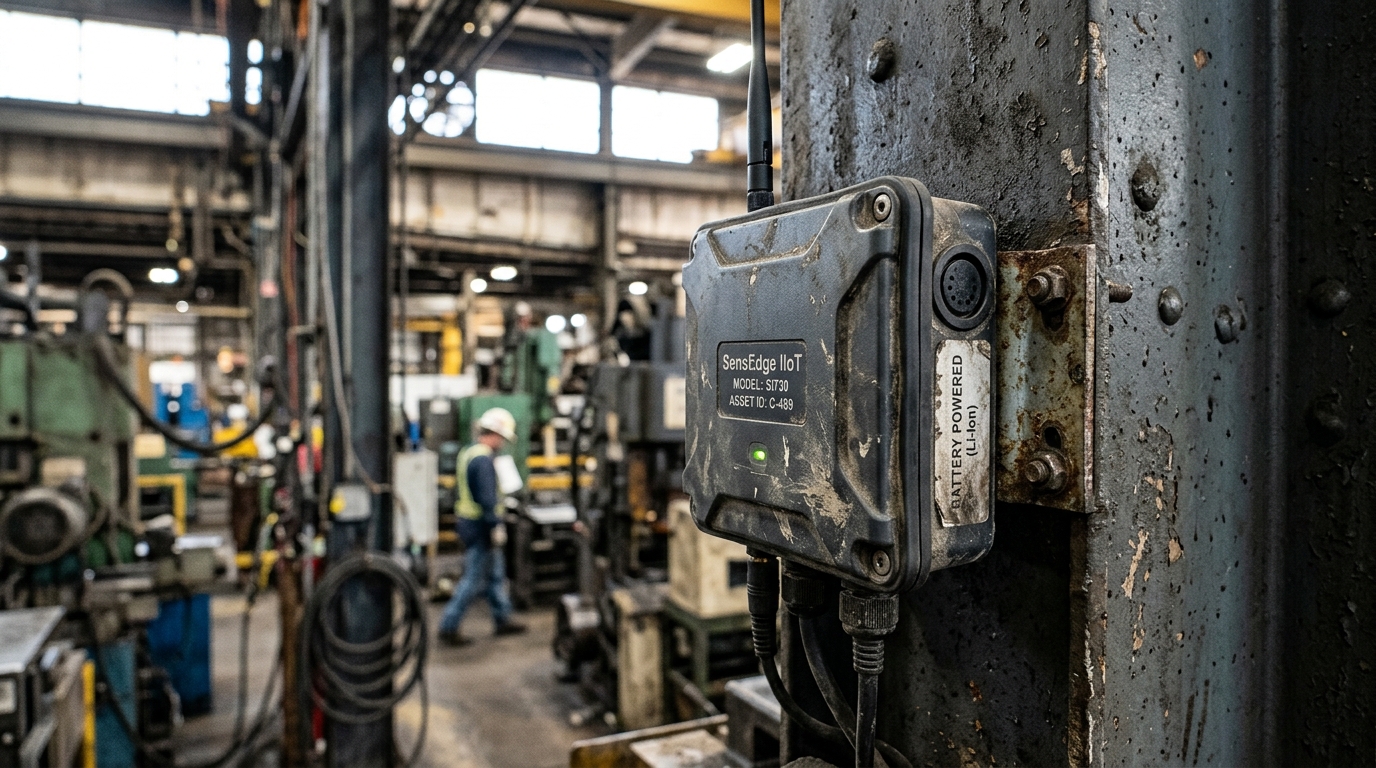
Six Factors That Drain Industrial IoT Batteries Early
Battery life is a system specification, not a cell property, not a radio feature, not a firmware toggle. These six variables interact, and any one of them can turn a ten-year projection into a three-year headache.
Sampling frequency is not reporting frequency
You can sample a temperature sensor every ten minutes and batch six readings into a single hourly transmission. Nordic recommends exactly this for cellular devices. But many deployments configure the radio to establish a new connection for every sensor reading, wasting energy on connection setup, authentication, and teardown that could have been amortized across multiple data points.
A LoRaWAN energy model based on measured platform behavior illustrates the diminishing returns clearly: cutting transmission frequency from every five minutes to every hour dramatically improves lifetime. But pushing intervals even longer yields smaller gains as sleep current and sensing energy start dominating the budget. There’s an asymptote, and every device hits it at a different point.
Network timers you don’t control
PSM (Power Save Mode) and eDRX (Extended Discontinuous Reception) let cellular IoT devices sleep deeply between transmissions. On paper, eDRX cycles can extend to 175 minutes. In practice, the behavior depends on your carrier’s network configuration. If the operator sets an aggressive RRC inactivity timer, your device stays awake burning milliamps after every transmission. You specified a low-power chip. The network operator decided how low-power it actually gets to be.
This matters for any deployment on LTE-M or NB-IoT. And it’s nearly invisible until you profile the device on the production network.
Temperature: the silent accelerator
NIST experiments with wireless sensor batteries confirm that ambient temperature affects both discharge rate and data-delivery quality. This applies to every chemistry, though the curve differs. Li-SOCl2 handles cold better than alkaline, but extreme heat accelerates self-discharge in any cell. A tracker mounted on sun-exposed ground equipment in Arizona lives a fundamentally different life than one inside a climate-controlled warehouse in Antwerp. If your vendor tested at 25°C and you deploy at 55°C, the gap isn’t a rounding error. It’s a different product.
Passivation: full battery, dead device
This is the failure mode that catches even experienced teams. Lithium thionyl chloride (Li-SOCl2) cells develop a passivation film on the lithium anode during storage and low-drain periods. That film protects the cell and enables the extremely low self-discharge rates (under 1% per year) that make long-life industrial IoT possible.
The catch: when the device suddenly demands a high-current pulse for radio transmission, the passivation layer causes a voltage dip. If that dip drops below the radio module’s minimum operating voltage, the transmission fails. Saft documents seven distinct passivation pitfalls and their mitigation strategies, recommending matched cell construction, appropriate pulse-support capacitors, and application-specific loading profiles.
The cell still holds 80% of its charge. It simply can’t deliver it fast enough. Your dashboard shows a battery that should last five more years. Your device shows a transmission failure.
Retry storms and security overhead
When a transmission fails, most firmware retries. Each retry burns another complete radio session. Stack three retries on a failed attempt, and you’ve consumed four sessions’ worth of energy to deliver one reading. Or zero, if all retries fail too.
Add TLS/DTLS handshakes, certificate validation, and encrypted payloads, and your “low-power” device spends meaningful energy on communication overhead. Research on denial-of-sleep attacks has demonstrated battery life reduction by a factor of seven through forced wakefulness. You don’t need a deliberate attack for this to matter. A noisy RF environment or an unreliable gateway can produce similar effects through natural retry escalation.
Cell quality varies more than vendors admit
Tadiran’s own white paper on self-discharge states that high-quality bobbin-type Li-SOCl2 cells lose less than 1% capacity per year, while lower-quality cells can lose up to 3% annually. At scale, that compounds fast. A cell losing 3% per year has shed nearly 20% of its capacity in six years before the device has drawn a single milliamp. Counterfeit or poorly sourced cells at industrial volumes are not a theoretical risk. They’re a procurement reality that no firmware optimization can fix.
Protocol Comparison: No Universal Winner
The protocol question comes up in every deployment conversation. Here’s an honest comparison based on published data, not vendor marketing slides.
| Protocol | Published battery life range | Conditions behind the claim | Best fit |
|---|---|---|---|
| WirelessHART | Up to 10 years | Rosemount 648: 1-min updates, reference conditions, Li-SOCl2 power module | Fixed process instruments in plant environments |
| LoRaWAN | ~1 to 6 years | Platform-specific model: ~1 year at 5-min reports from 2,400 mAh, approaching 6 years with infrequent transmission | Low-data-rate, wide-area asset and environmental monitoring |
| NB-IoT / LTE-M | Up to 8+ years | Validated model: 8 years with daily reporting in poor coverage; highly dependent on network config and traffic | Mobile assets, remote sites needing cellular reach |
| BLE (condition monitoring) | 5 to 15 years | ABB Smart Sensor: hourly measurements, daily data collection, non-replaceable battery | Rotating equipment with gateway infrastructure nearby |
| 5G RedCap / eRedCap | Multi-year (projected) | GSMA describes eDRX, relaxed monitoring, wake-up signaling; long communication intervals assumed | Mid-bandwidth applications needing 5G ecosystem access |
Notice what this table reveals: every “years” number sits on a different foundation. Rosemount’s ten years describes a specific temperature instrument with a specific battery module. ABB’s fifteen years describes a Bluetooth sensor with non-replaceable cells. The LoRaWAN figure comes from a research platform, not a product warranty. Comparing them head-to-head is like comparing fuel economy across a motorcycle, a delivery van, and a tugboat.
What matters more than the protocol label is the complete energy budget for your specific workload: how much current during sensing, how much during processing, how long the radio stays active per session, how many sessions per day. Two devices running the same protocol with different firmware can have wildly different battery lives.
What Successful Deployments Actually Prove
Real-world results are the strongest evidence. But read them carefully, because most of them prove monitoring value, not battery endurance.
AbbVie’s collaboration with Emerson on wireless steam-trap monitoring reported $214,000 in cost avoidance and 445 fewer maintenance-round hours over two years. Their wireless sensors identified 14 steam-trap failures in a single year at one facility. The project expanded from Lake County to campuses in Chicago, Irvine, and Puerto Rico.
Powerful results. But notice what’s missing: a measured battery-replacement interval. The case proves that wireless monitoring catches failures between manual rounds and saves meaningful money. It does not establish how long the sensor batteries lasted or will last.
Sasol Technology R&D’s pilot with 20 Emerson acoustic transmitters tells a similar story: annual steam-cost savings above $42,000, maintenance savings of $15,627, payback in roughly three months. Their prior inspection process left failed traps undetected for three to four weeks. The win is operational visibility.
For vibration monitoring, the picture is more complicated. Higher diagnostic resolution (waveform capture, multi-axis analysis) consumes more energy than simple threshold alerts. Advantech’s WISE-2410X datasheet (August 2026 revision) still carries a discrepancy: up to two years with two batteries at hourly reporting in the summary, but two years at 30-minute reporting in the specification table. Which number goes into your maintenance budget? ABB’s Smart Sensor specifies up to fifteen years under normal conditions but explicitly lists a non-replaceable battery, meaning end-of-battery equals end-of-device.
The lesson: separate “this monitoring program saved us money” from “this battery lasted X years.” Both matter for your total cost of ownership. They’re different claims.
Battery-Free Industrial Monitoring: Real but Conditional
Eliminating batteries entirely is the cleanest answer to the battery-life question. And it’s no longer theoretical.
Commercial self-powered steam-trap monitors already exist, offering readings as frequently as every ten seconds by harvesting ambient energy from light, vibration, and temperature differentials. The scale math is compelling: an MIT analysis illustrated that a hypothetical 10,000-sensor fleet with three-year batteries would require roughly 3,333 replacements per year, or more than nine per day. Eliminating that maintenance stream changes the business case entirely.
On the research side, a factory experiment with thermoelectric harvesting mounted a generator on a 0.25 kW industrial motor and harvested 6.17 joules over 9,612 seconds. That was enough for 41 successful LoRa transmissions with positive energy balance.
Both examples carry honest limits. The research team explicitly notes single-motor testing under stable conditions with no month-scale endurance claim. Everactive’s system depends on sufficient ambient energy at the installation point. When the motor stops, when the thermal gradient disappears, when the lights go off, the energy source goes with it.
Battery-free monitoring removes the replacement problem. It replaces it with a qualification problem: prove that the energy source is reliable enough for your monitoring needs, including startup, shutdown, seasonal variation, and maintenance windows when equipment sits idle.
How to Evaluate Battery Life Claims Before You Buy
After years of specifying and deploying industrial IoT devices, here’s the checklist I use before accepting any vendor’s battery-life number. These criteria align with what to look for in an industrial IoT device for long-term deployments.
- Get the written operating profile. Sensing interval, reporting interval, retry policy, expected payload size. If the vendor quotes “up to ten years” without specifying these, the number is marketing, not engineering.
- Demand measured energy per cycle. Not calculated from component datasheets. Measured on the actual hardware, with the actual firmware, on the actual target network. Nordic’s 138% gap happened with their own chipset and their own tools.
- Match temperature testing to your deployment site. If they tested at 25°C and your equipment sits outdoors in the Gulf, the datasheet doesn’t apply.
- Clarify battery chemistry, model, and replaceability. ABB’s 15-year Smart Sensor uses a non-replaceable cell. That’s a fundamentally different total cost of ownership than a device with a field-swappable battery. Know which one you’re buying.
- Ask about firmware updates. Over-the-air updates consume energy. If the vendor plans annual firmware pushes, that energy belongs in your battery budget.
- Run a 30-day acceptance test on your configuration. Not the demo defaults. Your sensing schedule, your reporting frequency, your network, your environment. Before committing to fleet rollout.
Regulation is adding another dimension. European Commission guidance on battery removability and replaceability establishes Article 11 obligations for portable and light-means-of-transport batteries effective February 18, 2027. While this doesn’t automatically cover every industrial sensor or industrial battery category, the direction is clear: sealed, non-replaceable batteries are getting regulatory scrutiny. Factor replaceability into your long-term fleet decisions.
This is exactly the kind of scoping we do every week at Datanet. When a client needs to track reusable containers across ocean routes or monitor ground-support equipment across airport tarmacs, we don’t start with a product. We start with the operating envelope: temperature range, reporting frequency, physical access for battery swaps, expected asset cycle time. Our approach to industrial IoT solutions considers battery performance as one component of total system design. The hardware choice, whether it’s an Oyster3 for rugged long-life asset tracking, an Oyster Edge for extended cellular reach, or a Thingfox T2 for DO-160 airfreight compliance, follows from that profile. Industrial IoT device battery life is an outcome of correct system design, not a feature you shop for in isolation.
Frequently Asked Questions
How long do industrial IoT device batteries actually last?
Published examples range from about one year (Advantech WISE-2410X, single battery) to fifteen years (ABB Smart Sensor, high-performance mode). Every number depends on sensing frequency, reporting interval, temperature, battery chemistry, and firmware behavior. Require the specific operating conditions behind any vendor claim before using it in your maintenance budget.
Why does my IoT device battery die before the rated life?
Common causes: higher-than-expected reporting activity, network timers keeping the radio awake, temperature extremes accelerating self-discharge, passivation causing pulse-voltage failures, and retry storms from poor RF conditions. Profile the device current under actual operating load before assuming the cell is defective.
Which wireless protocol gives the longest battery life?
No protocol wins across all workloads. WirelessHART, LoRaWAN, NB-IoT, LTE-M, and BLE all achieve multi-year battery life under the right conditions. The complete energy budget (sensing, processing, radio session duration, sessions per day) matters more than the protocol name on the spec sheet.
Can energy harvesting eliminate IoT batteries entirely?
In specific conditions, yes. Commercial solutions like Everactive’s self-powered sensors work where ambient energy (heat, light, vibration) is reliably available. But battery-free doesn’t mean energy-unlimited. Qualify the source for your site, including equipment shutdowns, seasonal changes, and startup behavior.
What battery chemistry is best for industrial IoT?
Lithium thionyl chloride (Li-SOCl2) dominates long-duration, low-power industrial applications thanks to very low self-discharge. But it requires attention to passivation and pulse-voltage behavior. Select the cell, pulse-support capacitor, and operating temperature range together as one design decision, not three separate procurement items.
What should I require from a vendor before accepting a battery life claim?
A written operating profile. Measured (not calculated) charge per sensing and communication cycle. Temperature test results matching your deployment conditions. Battery model and explicit replaceability statement. Firmware update assumptions. And a minimum 30-day acceptance test on your actual configuration before fleet commitment.
If your deployment needs industrial IoT battery life that holds up in the field, not just on a datasheet, that’s a conversation we have every week. Reach out at info@datanetiot.com.








 +1 508 292 2210