

46% of large manufacturers now report facility-level IIoT adoption. That’s a Deloitte figure from a survey of 600 executives at companies with $500M+ revenue. Sounds encouraging. What no survey captures is the percentage of those devices that got quietly replaced, re-scoped, or shelved within two years. From what I’ve seen in the field, the number would make the adoption stat a lot less impressive.
If you’re working through how to choose industrial IoT devices, the spec sheet is the wrong starting point. Frequency range, IP rating, LoRaWAN support: those are filters. They matter, but only after you’ve answered a more basic question. Knowing what to look for in an industrial IoT device and understanding the real industrial IoT device requirements means asking: what operational failure does this device need to prevent, and what does someone actually do with the data?
I’ve spent over 15 years deploying tracking and sensing solutions across aviation, port logistics, MRO, and ground support. The pattern repeats: teams that start with the problem scale their deployments. Teams that start with a product catalog replace their hardware. Here’s the framework I use.
Start With the Decision, Not the Device
Before you open a single vendor datasheet, answer four questions:
- What asset, process, or condition are you monitoring?
- What failure mode or inefficiency are you targeting?
- What specific action does a person take when the data arrives?
- How fast must that action happen?
If you can’t describe the human action triggered by the device’s data, you don’t have a use case. You have a curiosity project. Curiosity projects lose funding by quarter three.
This shows up constantly in our work at Datanet. Companies come to us saying they need “tracking.” But shipment tracking and asset tracking are different problems with different device requirements. Shipment tracking ends at delivery: the package arrived, done. Asset tracking follows the asset through its entire lifecycle, including deployment, dwell time, maintenance, return, and reuse. Cycle time, battery endurance, reporting intervals, environmental exposure: all change based on which problem you’re actually solving. A device that’s perfect for one is a bad purchase for the other.
NIST’s OT security guidance reinforces this from a systems perspective: operational technology interacts with the physical environment and carries distinctive performance, reliability, and safety requirements. A vibration sensor feeding an advisory dashboard has different demands than one that triggers an emergency shutdown. Specify the function before shopping for the form.
Match the Device to Where It Actually Lives
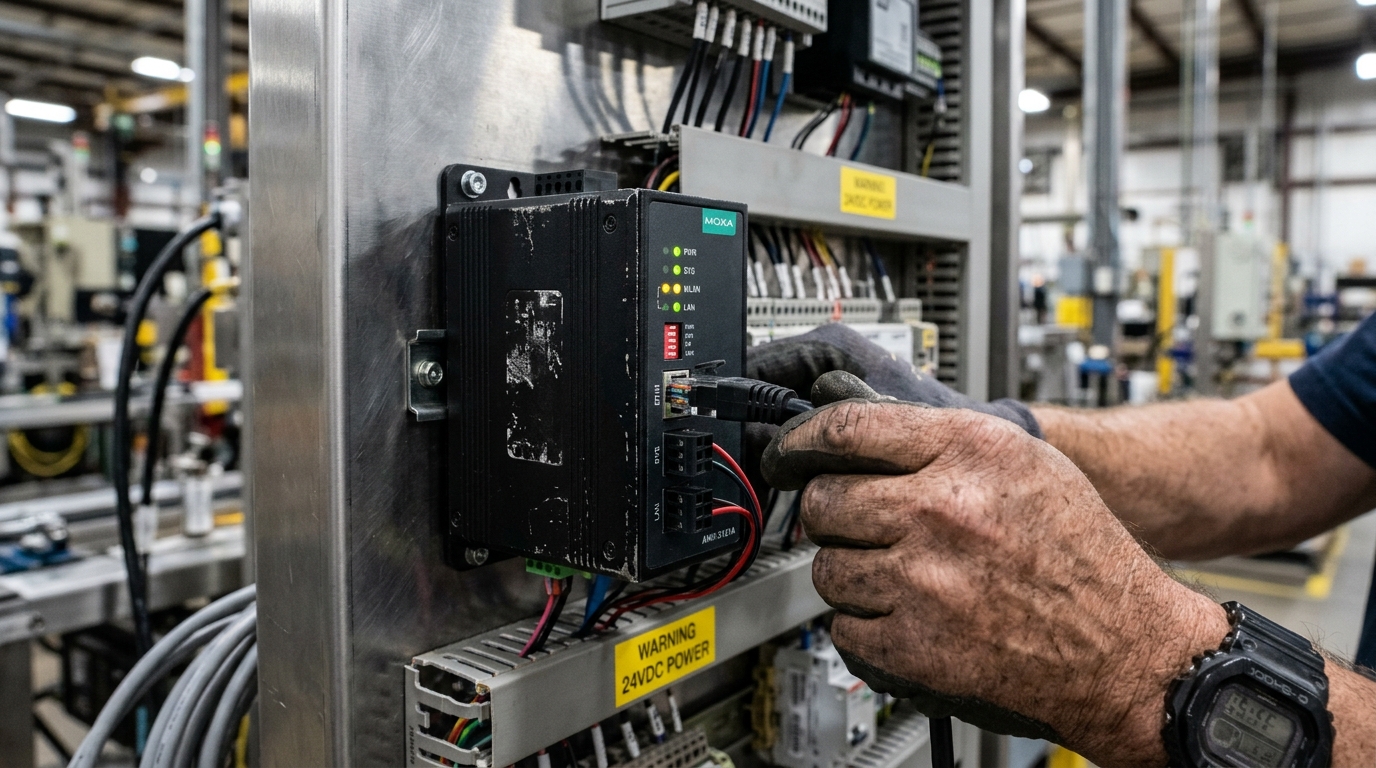
Here is where spec-sheet comparisons fall apart. An IP67 rating means the enclosure survived temporary immersion under controlled lab conditions. It tells you nothing about sustained vibration on a ground support vehicle, thermal cycling in an aircraft belly, electromagnetic interference on a factory floor, or months of salt spray at a port terminal. Those are separate failure modes that need separate evidence.
Operating temperature range is not the same as measurement range. Some battery-powered sensors can measure up to 120°C but stop functioning above 80°C because the battery chemistry fails first. If your mounting location sits inside that gap, the device is disqualified regardless of what the headline spec suggests.
Environmental monitoring extends beyond temperature: water quality applications like aquaculture pH management demonstrate similar sensor selection principles across industrial contexts.
Shock and vibration resistance requires its own validation. IP ratings cover ingress of dust and water, full stop. For mobile equipment, vehicle-mounted trackers, or anything that gets dropped on a tarmac, look for MIL-STD-810G testing or equivalent. And if your environment contains explosive atmospheres, generic “industrial-grade” claims are useless. IECEx maintains publicly searchable certificates for specific models and production facilities. Check the exact device and its specific approval, not the brand’s general reputation.
Aviation and aerospace carry their own certification layer. Ground support equipment, ULD tracking, air cargo monitoring: each has compliance requirements that consumer or generic industrial hardware won’t meet. DO-160 approved devices exist for exactly this environment. Using non-certified hardware in airfreight isn’t just risky. It’s non-compliant.
One more thing: over-specifying is real waste too. Deploying military-rated hardware in a climate-controlled warehouse spends money that could go toward more coverage points or better system integration. Match the protection to the actual conditions, not to the worst environment your company happens to own somewhere else.
Pick Connectivity by Constraints, Not by Label
Every connectivity option trades range, throughput, power consumption, infrastructure needs, and cost against each other. There is no universal winner. The right choice depends on your constraints, not on which technology has the freshest marketing cycle.
| Technology | Strong starting fit | What to validate before committing |
|---|---|---|
| Cellular (LTE-M / NB-IoT) | Distributed assets without local infrastructure: containers, trailers, ground equipment spread across multiple sites | Coverage inside metal enclosures and remote yards. Subscription costs at fleet scale. Modem lifecycle and carrier migration path. |
| LoRaWAN | High-volume, low-data-rate sensing: environmental monitoring, basic asset presence, occupancy | Payload limits. Class A downlinks follow uplinks, limiting real-time control. Gateway density in metal-heavy environments. |
| Wi-Fi | Higher-bandwidth applications where infrastructure already exists: video feeds, high-frequency telemetry | Power demand kills battery life. Roaming and congestion under real production conditions won’t match office-grade performance. |
| Wired (Ethernet, IO-Link) | Fixed equipment with accessible cabling and power. Deterministic control loops. | Installation labor in retrofit environments. IO-Link is a point-to-point sensor-to-master link, not an end-to-end network. |
| WirelessHART | Process-plant condition monitoring where compatible infrastructure already exists | Gateway and system-level compatibility. Achievable update rates vary by mesh size and traffic. |
Two things most buyers underestimate.
First, battery life claims always have conditions. A sensor marketed with “two-year battery life” typically assumes hourly reporting at 25°C with strong signal. Change the interval to every 15 minutes, deploy it at 50°C, or put it inside a steel container where signal strength drops, and that headline number collapses. Always request lifetime estimates under your actual measurement and reporting schedule, not the manufacturer’s best-case scenario.
Second, connectivity must survive failure. What happens when the WAN drops? When the gateway reboots? When power cycles unexpectedly? NIST recommends segmentation, recovery planning, and redundancy appropriate to criticality. Ask vendors to demonstrate store-and-forward behavior, local data buffering, and graceful degradation. If they can’t show you what happens during a 30-minute network outage, that’s a red flag for any operation where uptime matters.
Treat Security and Lifecycle as Pass/Fail Gates
Security isn’t a feature to weigh against cost. It’s a gate. The device passes or it doesn’t. Same for lifecycle support. Understanding how to secure IoT solutions at the device selection stage prevents expensive remediation later.
NISTIR 8259A identifies six core device cybersecurity capabilities: device identification, configuration management, data protection, logical interface access control, software/firmware updates, and cybersecurity-state awareness. Turn these into live demonstrations, not marketing checkboxes. Can the vendor show you authenticated firmware updates? Restricted network interfaces? Unique credentials per device? If the answer is “we’ll configure that during deployment,” treat it as a no.
Two real cases explain why this matters more than any framework on paper.
In 2023, a U.S. water facility was forced to switch to manual operations after attackers compromised internet-exposed PLCs running default passwords. No sophisticated exploit. Just poor deployment hygiene. By 2026, CISA expanded its advisories to cover PLC targeting across Schneider Electric, Siemens, and other vendors, with confirmed operational disruption and financial losses. Brand reputation alone doesn’t protect you.
On the platform side, Google discontinued its IoT Core service in August 2023. The devices kept working. The cloud service they depended on stopped. Every customer who had locked credentials, data pipelines, and device management into that platform faced a forced migration under pressure. This was Google, not some startup.
The lesson from both: device selection must include an exit plan. Contractual support periods, firmware update commitments, data export in standard formats, documented APIs, and explicit end-of-life notification are not nice-to-haves. NIST’s April 2026 manufacturer guidance now explicitly addresses support duration, component documentation, and vulnerability-reporting obligations. Put those into your purchase agreements before you sign.
For companies operating within or selling into the EU, the Cyber Resilience Act adds regulatory pressure. Manufacturers must report actively exploited vulnerabilities within 24 hours as of September 2026, with full product-lifecycle obligations applying from December 2027. This isn’t future compliance. It’s happening now.
Calculate Lifetime Cost Before Comparing Unit Prices
The device price tag is typically less than a third of what you’ll actually spend over the deployment’s life. The rest hides in places procurement teams often don’t examine until renewal time.
A complete total cost of ownership picture includes:
- Hardware (device, gateway, antenna, mounting accessories)
- Installation labor and commissioning time
- Connectivity (SIM subscriptions, data plans, gateway backhaul)
- Platform or cloud fees (monthly per-device charges add up at scale)
- Integration effort (connecting device data to your existing systems)
- Calibration and periodic recalibration
- Battery replacement, including the labor to locate, access, and swap cells across a fleet
- Security patching and firmware maintenance
- Spare inventory and buffer stock
- Retirement and disposal
For a quick financial sanity check, divide total installed cost by annual realized benefit minus annual recurring cost. If that denominator isn’t clearly positive, the business case needs more work. And “realized benefit” means measured against your actual baseline: documented downtime hours, lost or idle assets, inspection labor, energy waste. Not an industry average pulled from a vendor’s slide deck.
Here’s something I’ve seen play out dozens of times in logistics: the economics often hinge on utilization visibility rather than on the tracking itself. When a freight forwarder discovers that 30% of their reusable container pool sits idle at any given time because nobody knows where those units are, the tracker pays for itself by reducing the float needed to maintain operations. That’s not a speculative efficiency gain. That’s operational dollars recovered from containers you already own. If your container pool feels invisible after delivery, that’s exactly the gap asset tracking closes.
What to Test in the First 30 Days
Buying the right device is half the job. Validating it under real conditions is the other half. Most failed deployments looked perfectly fine during the vendor demo.
In the first 30 days after deployment, run these tests deliberately. Not if you find time. Deliberately.
- Kill the WAN connection for 30 minutes. Check: does the device buffer data locally? How much data is lost? How quickly does it re-sync after reconnection?
- Cycle the power unexpectedly. Check: does the device re-register, re-authenticate, and resume reporting without someone physically touching it?
- Revoke a single device credential. Check: can you isolate one compromised unit without disrupting the rest of the fleet?
- Measure actual battery drain against the manufacturer’s claim. Compare under your real reporting interval, ambient temperature, and signal conditions.
- Verify data quality in your downstream system. Correct timestamps, correct units, correct asset identifiers. If anything arrives garbled, fix it now. Garbage in the dashboard means bad decisions in the field.
- Audit false alarms. Count how many alerts in the first 30 days triggered unnecessary action. If the maintenance team stops trusting the system in month one, the deployment is dead by month six.
This isn’t academic rigor. It’s the difference between a deployment that scales and one that becomes the project nobody wants to own.
If you’re evaluating industrial IoT devices for asset tracking, fleet visibility, or environmental monitoring and want to talk through the specifics of your environment, reach out at info@datanetiot.com. We do this assessment regularly, and the conversation usually saves more money than the device itself.

Frequently Asked Questions
What makes an industrial IoT device different from a consumer one?
Operating requirements. Industrial devices must survive environmental extremes (temperature, vibration, dust, moisture), integrate with operational systems, meet safety and security certifications, and remain supported for years. A consumer device rebooting is an inconvenience. An industrial device rebooting mid-process can halt a production line or lose critical data.
Do I need 5G for industrial IoT?
Not by default. LTE-M, NB-IoT, LoRaWAN, Wi-Fi, and wired connections cover most industrial use cases today. Private 5G becomes relevant when you need managed quality-of-service, mobility, and higher throughput that existing options can’t deliver. Evaluate it against your actual constraints, not against a technology roadmap.
How long should a wireless sensor battery last?
There’s no universal answer. Manufacturers commonly state two to five years, but those numbers assume specific reporting intervals, temperatures, and signal conditions. Under aggressive duty cycles (frequent updates, extreme temperatures, weak signal), real-world battery life can be half the headline number. Always request estimates matched to your operating conditions.
Can I connect legacy machines without replacing them?
Usually, yes. A gateway with serial or Modbus interfaces can pull data from older controllers and forward it to modern platforms via MQTT or OPC UA. The limitation: a gateway cannot create a measurement that doesn’t physically exist. If the legacy machine lacks the sensor you need, you’ll still add hardware at the measurement point.
How do I avoid vendor lock-in with IoT platforms?
Require data export in standard formats, documented APIs, and credential portability. Test platform substitution before you’re forced into it under pressure. Google’s IoT Core shutdown proved that even major providers can exit a product. Build your architecture so the device layer and the platform layer can be changed independently.
What’s a realistic first step for evaluating asset tracking devices?
Map the lifecycle you need visibility into: deployment, transit, dwell, maintenance, return. Define the minimum reporting interval and location accuracy that would change an operational decision. Then match devices to those requirements. Starting from the decision you need to make, rather than from a product feature list, eliminates most of the noise.








 +1 508 292 2210

2 Responses