

Twenty-one billion connected IoT devices. $324 billion in enterprise IoT spending in 2025 alone. And yet, most of the operations leaders I talk to still can’t tell me where a third of their returnable assets are at any given moment.
The gap is not a shortage of industrial IoT device connectivity options. It is the opposite. So many protocols, radio technologies, and vendor ecosystems compete for attention that choosing the wrong one can lock a company into years of expensive regret. Industrial IoT device connectivity is not a spec-sheet exercise. It is an operational decision, and the consequences of getting it wrong go well beyond inconvenience.
I have spent 15+ years deploying IoT tracking solutions across aviation, maritime, and industrial supply chains. Here is what the protocol comparison tables will not tell you.
What Industrial IoT Device Connectivity Actually Means
Consumer IoT fails and your thermostat resets. Industrial IoT fails and cargo spoils, a production line stops, or a safety system goes blind. That distinction changes everything about how connectivity should be designed.
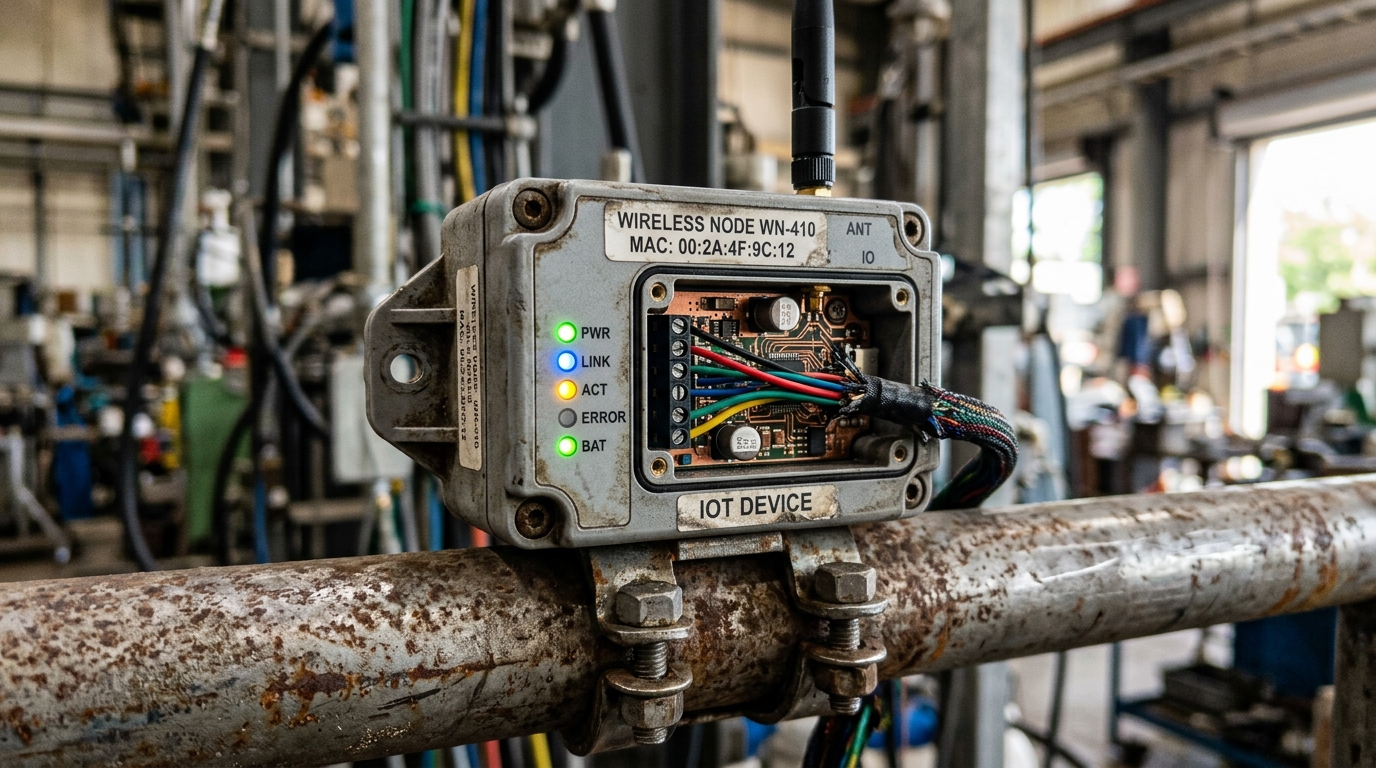
Industrial IoT device connectivity is the complete chain of links, protocols, data models, and security controls that move information between physical assets (sensors, machines, vehicles, containers) and the systems that act on that information. The Congressional Research Service describes IoT as interrelated devices exchanging data without necessarily requiring human interaction. The industrial subset demands something consumer devices never face: deterministic behavior under harsh conditions, sometimes for decades.
Most guides treat connectivity as one choice. In reality, it is four layered decisions:
- Physical network: the radio or cable that carries bits (Wi-Fi, cellular, LoRaWAN, Ethernet, satellite).
- Communication protocol: how devices structure and route those bits (MQTT, OPC UA, Modbus, PROFINET).
- Data semantics: what the bits mean. A temperature reading without context (which container, which zone, what threshold triggers an alert) is just a number.
- Security boundary: who can access what, and what happens when a link goes down.
Pick the perfect radio and ignore the data model, and you get floods of raw telemetry nobody can act on. Nail the data model but neglect security segmentation, and you expose your OT network to threats it was never designed to handle. Real connectivity engineering solves all four layers together.
The Protocol Comparison Everyone Gets Wrong
Most connectivity guides present a table of protocols ranked by bandwidth, range, and power consumption. Then they leave you to figure out which combination fits your actual operation. That is like handing someone a parts catalog and calling it engineering.
The better question: what is the operational job this connection needs to do?
| Technology | Best operational fit | Where it falls short |
|---|---|---|
| Industrial Ethernet / TSN | Fixed-position control loops requiring predictable, deterministic delivery: PLCs, CNC machines, safety interlocks. | Zero mobility. Reconfiguration means pulling new cable. |
| Wi-Fi 6 | Flexible local connectivity for mobile terminals, cameras, quality inspection stations. Cisco notes Wi-Fi 6 accommodates earlier Wi-Fi generations, which helps brownfield sites. | Performance depends heavily on the RF environment. A steel warehouse with EMI is nothing like an office. |
| Private 5G | Campus-scale mobile asset tracking, AGVs, connected tooling across large production areas. Siemens offers a private 5G ecosystem with core, RAN, and industrial routers. | Expensive to deploy and operate. Requires spectrum rights, network design, and ongoing management. |
| LTE-M / NB-IoT | Periodic telemetry from distributed assets: environmental sensors, remote tank levels, container trackers crossing borders. Battery life measured in years. | Low throughput. Not suitable for video, real-time control, or high-frequency data. |
| LoRaWAN | Dense sensor deployments in large facilities, agriculture, utility monitoring. Unlicensed spectrum means no carrier dependency. | Limited data rate. Latency is variable. Not deterministic enough for closed-loop control. |
| Satellite (LEO / NTN) | Truly remote assets: offshore equipment, mining, cross-ocean containers, in-flight cargo. Fills coverage gaps where terrestrial networks do not exist. | Higher latency and cost per message. Not a replacement for local plant connectivity. |
The point of this table is not to crown a winner. It is to show that the “best” protocol depends on whether your asset is fixed or mobile, whether you need millisecond control or daily check-ins, and whether you are operating inside a factory or across an ocean.
Two real-world deployments that prove the point
Mercedes-Benz Factory 56 in Sindelfingen deployed a private 5G network across 20,000+ square meters to connect asset tracking, quality inspection, AGVs, and tooling. Impressive. But every article citing it omits one detail: there is no publicly reported ROI figure. The network works. Whether it paid for itself compared to industrial Wi-Fi or wired alternatives is an open question.
Contrast that with Maersk. Their reefer container fleet needs connectivity that works across oceans, port terminals, inland trucks, and dozens of carrier networks worldwide. Maersk deployed next-generation connectivity devices across 450 vessels, using 4G/5G radios that fall back to 2G/3G where newer networks are unavailable. Roughly 30% of the reefer fleet had been upgraded by mid-2026, with the rest phased over coming years. Solar energy harvesting and backward compatibility across network generations were non-negotiable design features.
Maersk’s approach reveals something protocol tables cannot: global asset connectivity is a lifecycle problem. Devices must survive variable coverage, power constraints, shipboard environments, and generational technology transitions. You do not pick one protocol. You design an architecture that degrades gracefully.
What Connectivity Actually Costs
This is the section nobody ranking for this topic wants to write, because honest cost data makes vendor marketing uncomfortable.
SNS Insider estimates the IIoT market at $325.70 billion in 2025, with wireless connectivity accounting for 58.60% of spending. Big number. But for the operations manager standing in front of a budget committee, the question is narrower: what will it cost to connect my specific assets, and when will I see a return?
Total cost of ownership breaks into five categories that vendors conveniently scatter across separate sales conversations:
- Hardware sets the capex baseline: devices, gateways, antennas, edge compute. For cellular trackers, include module design and certification for your specific operating environment (aviation has DO-160 requirements, marine has salt spray and vibration, mining has ATEX).
- Network access scales very differently depending on the model. Carrier data plans for multi-country cellular deployments multiply fast. Private 5G requires upfront spectrum licensing and infrastructure. LoRaWAN shifts cost to gateway deployment. Each model trades capex for opex differently.
- Integration is consistently the most underestimated line item. Connecting device data to ERP, WMS, TMS, or MES requires engineering, not configuration. NIST documents that traditional fieldbus standards like IEC 61158, CAN, and Modbus are not interchangeable, which means data translation between systems is real work.
- Operations recur annually and compound: device management, firmware updates, battery replacement, SIM management, platform subscriptions. At 1,000 devices these are manageable. At 50,000 they become a headcount question.
- Lifecycle cost hits when a carrier sunsets 2G/3G, a module reaches end of life, or a platform vendor changes pricing. Maersk’s multi-generation rollout exists specifically because they planned for this.
The hidden killer is not any single line item. It is pilot purgatory. A study based on 12 expert interviews identified unclear business value, legacy integration challenges, cross-plant variation, IT/OT friction, and interoperability as recurring reasons IIoT projects stall between proof of concept and production scale. The pilot works. The scaling business case never closes. And the investment joins the sunk-cost pile.
My advice: before selecting any connectivity technology, define the operational metric you will measure. Asset utilization? Cycle time? Temperature excursions per quarter? Unplanned downtime hours? If you cannot state the baseline number and the improvement target, you are buying technology, not solving a problem.
Connecting Machines That Predate the Internet
I have seen stamping presses from the 1980s running production alongside brand-new robotic cells. The press works fine. It just has no data port that speaks anything designed after 1995.
This is the brownfield reality that connectivity guides written by cloud-platform companies tend to skip. They assume your assets have an IP stack or at least an OPC UA endpoint. Many do not.
Three approaches that work in the real world:
Bolt-on sensors with dedicated gateways. Rather than extracting data from a legacy PLC, you instrument the machine externally. Vibration sensors, current clamps, temperature probes, and optical counters feed into a gateway that normalizes data and transmits via cellular or Wi-Fi. The machine itself does not know it is being monitored. This is the lowest-risk, fastest-to-deploy path for condition monitoring and basic OEE tracking.
Protocol converters at the edge. When the legacy system does have a data interface (serial, Modbus RTU, PROFIBUS), an edge gateway can translate that protocol into something the modern stack understands. OPC UA supports standardized information models that bridge between old fieldbus data and modern analytics or cloud platforms. The real complexity is in semantic mapping: making sure the data that comes out means what you think it means.
Track the asset, not the machine’s brain. Sometimes the highest-value connectivity play is not extracting machine data at all. It is knowing where the asset is, how long it has been idle, and whether it is in the right place at the right time. A cellular tracker attached to a ground support vehicle, a ULD, or a reusable container reports location, motion, and dwell time independently. It does not need the asset’s cooperation. It does not need an IT integration project to finish. This is where purpose-built asset tracking devices earn their keep: they deliver visibility while the bigger integration projects are still in planning.
Security at the OT Boundary
In IT, the priority stack is confidentiality first, then integrity, then availability. In OT, flip it. A production line that stops because a security patch rebooted the wrong controller is a security failure, not a security success.
NIST SP 800-82 Rev. 3 lays out the framework that should guide every industrial IoT connectivity design:
- Map your assets and data flows before designing security controls. You cannot protect what you have not inventoried.
- Segment OT networks from general IT using DMZs and boundary enforcement devices. A compromised temperature sensor should never be able to reach a safety interlock.
- Control remote access with least privilege. If a vendor needs remote access to a PLC, that access should be temporary, logged, and revocable.
- Monitor network boundaries continuously. Anomalies on the OT side often look different from typical IT intrusions.
- Accept that patching follows production schedules, not IT calendars. NIST explicitly acknowledges that OT patches may need to wait for planned downtime.
Every connected sensor, tracker, or gateway expands the attack surface. The mitigation is straightforward in principle: choose devices with secure boot and encrypted communication, keep the IoT device network segmented from the control network, and manage firmware updates through a controlled channel. The difficulty is discipline, not technology.
What’s Coming: RedCap, eSIM, Satellite, and the 1% Reality
The connectivity pipeline is loaded with promising technologies. The question for anyone making procurement decisions today: which ones are ready for production, and which are analyst forecasts to monitor?
5G RedCap fills the gap between low-power LPWAN and full 5G broadband. Ericsson reports commercial RedCap launches by 14 service providers, with investment from 42 providers across 27 countries. IoT Analytics projects RedCap chipset shipments growing at 82% CAGR through 2030. That is a trajectory, not an installed base. For planning: RedCap is real, commercially available, and worth evaluating for new device designs. It is not yet a reason to rearchitect working deployments.
eSIM SGP.32 enables remote SIM profile switching for IoT fleets, eliminating physical SIM swaps for devices deployed across multiple countries and carriers. The GSMA describes SGP.32 as part of the next chapter for 5G-IoT, supporting remote profile management for large-scale, multi-country deployments. The practical limitation: existing hardware typically cannot be upgraded over the air to support it. For operations managing global asset fleets (reefers, ULDs, returnable containers), SGP.32 belongs in the next procurement cycle, not as a retrofit wish.
Satellite NTN extends connectivity to locations where no cellular tower exists. GSMA describes hybrid terrestrial-5G plus NTN architectures as a path to ubiquitous coverage. For ocean-going containers, remote mining equipment, and aircraft in flight, satellite fill is not a nice-to-have. It is often the only connectivity that exists.
The 1% reality check. IoT Analytics estimates that fewer than 1% of the 21.1 billion IoT connections had a dedicated edge-AI accelerator as of December 2025. The gap between “connected” and “intelligent at the edge” is enormous. More connections create a data path. They do not create local inference, closed-loop autonomy, or a business case. Do not confuse having data with having insight.
How to Get Industrial IoT Connectivity Right
After years of deploying tracking and connectivity solutions across airports, ocean freight, MRO facilities, and industrial supply chains, I have seen enough projects succeed and fail to recognize the pattern.
Start from the operational problem. “We need 5G” is not a problem statement. “We lose 12% of our reusable containers every cycle because we have no visibility after delivery” is. The first buys infrastructure. The second buys a measurable outcome.
Define a baseline before you buy hardware. How many assets are unaccounted for right now? What is your average cycle time? How many temperature excursions occurred last quarter? Without a number, you cannot prove the investment worked. Without proof, you cannot scale.
Design for hybrid from day one. No single connectivity technology covers every environment your assets will pass through. A container might use cellular in port, satellite at sea, and LoRaWAN in a warehouse. An airfreight ULD needs a DO-160 approved tracker that handles GNSS positioning and multi-network cellular handoff. The architecture should degrade gracefully when a link drops, not fail silently.
Segment relentlessly. Keep safety-critical control local and deterministic. Connect mobile or distributed assets with fit-for-purpose wireless. Normalize data at the edge so enterprise systems receive clean, contextualized information. Never let a tracking network touch a control network without a properly engineered boundary.
Pilot with reuse in mind. The biggest scaling failure is not technical. It is building a pilot so customized to one site that it cannot be replicated. Choose devices, platforms, and integration patterns that work across your fleet, not just in the showcase facility.
If your assets go invisible the moment they leave your facility, that is not a technology problem. It is a connectivity architecture problem. And it is solvable.
We help companies close that gap across airfreight, ocean freight, ground support, and industrial supply chains with proven industrial IoT solutions. If you want to talk specifics, reach out to our team or drop a line at info@datanetiot.com.

Frequently Asked Questions
What is industrial IoT device connectivity?
It is the complete stack of networks, protocols, data models, and security controls that link industrial assets (sensors, machines, vehicles, containers) to monitoring or control systems. It spans four layers: physical transport, communication protocol, data semantics, and security boundary. Choosing a radio technology alone does not solve the connectivity problem.
Is private 5G better than Wi-Fi for factories?
Not universally. Private 5G suits mobile assets across large campus areas where local network control matters. Wi-Fi fits flexible connectivity for terminals and inspection stations. Wired Ethernet with TSN remains the stronger option for fixed, deterministic control loops. The right choice depends on asset mobility, data latency requirements, and acceptable failure modes.
How do you connect legacy machines that lack modern data ports?
Three common paths: bolt-on sensors with gateways that instrument the machine externally, protocol converters that translate serial or fieldbus data into OPC UA or MQTT, and asset-level tracking that monitors location and condition without touching the control system. External sensors and trackers deploy fastest because they require no legacy PLC integration.
What does industrial IoT connectivity actually cost?
Total cost of ownership includes hardware, network access (carrier plans or private infrastructure), system integration, ongoing operations (device and SIM management, firmware updates), and lifecycle costs when networks sunset or modules reach end of life. Integration and lifecycle costs are the most consistently underestimated categories.
Why do IIoT connectivity projects stall after the pilot?
Research identifies unclear business value, legacy system diversity, plant-to-plant variation, IT/OT friction, and interoperability gaps as recurring barriers. The pattern is a pilot that works at one site but cannot replicate because it was over-customized. Designing for transferable architecture and defining measurable KPIs before deployment are the strongest countermeasures.
Which emerging connectivity technologies matter most right now?
5G RedCap is commercially available and worth evaluating for new device designs. eSIM SGP.32 simplifies SIM management for multi-country fleets but requires compatible hardware. Satellite NTN fills coverage gaps in maritime and remote environments. Edge AI is expanding but is present in fewer than 1% of connected devices today. Evaluate these for new procurement cycles rather than immediate retrofits.








 +1 508 292 2210

2 Responses