

Analysts project the global IoT-in-smart-cities market to reach $952 billion by 2032. South Bend, Indiana, pays $499,576 per year to keep 94 sewer-sensor sites running. That gap between market narrative and municipal operating reality defines the conversation around IoT-based equipment for municipalities in 2026. (See also: what to look for in an industrial IoT device.)
I spend most of my working life in industrial and aviation asset tracking, not municipal infrastructure. But the failure pattern is identical across both worlds. Organizations buy sensors, celebrate the pilot, then discover nobody budgeted for the decade of maintenance, connectivity fees, firmware patches, and field repairs that keeps a connected system alive.
This piece is for the municipal IT director building a business case, the infrastructure engineer writing an RFP, and the public works manager who just inherited a “smart city” initiative without a maintenance line item. I’ll walk through what the equipment actually is, which deployments carry real evidence, and where cities keep making the same expensive mistakes.
What IoT-Based Municipal Equipment Includes
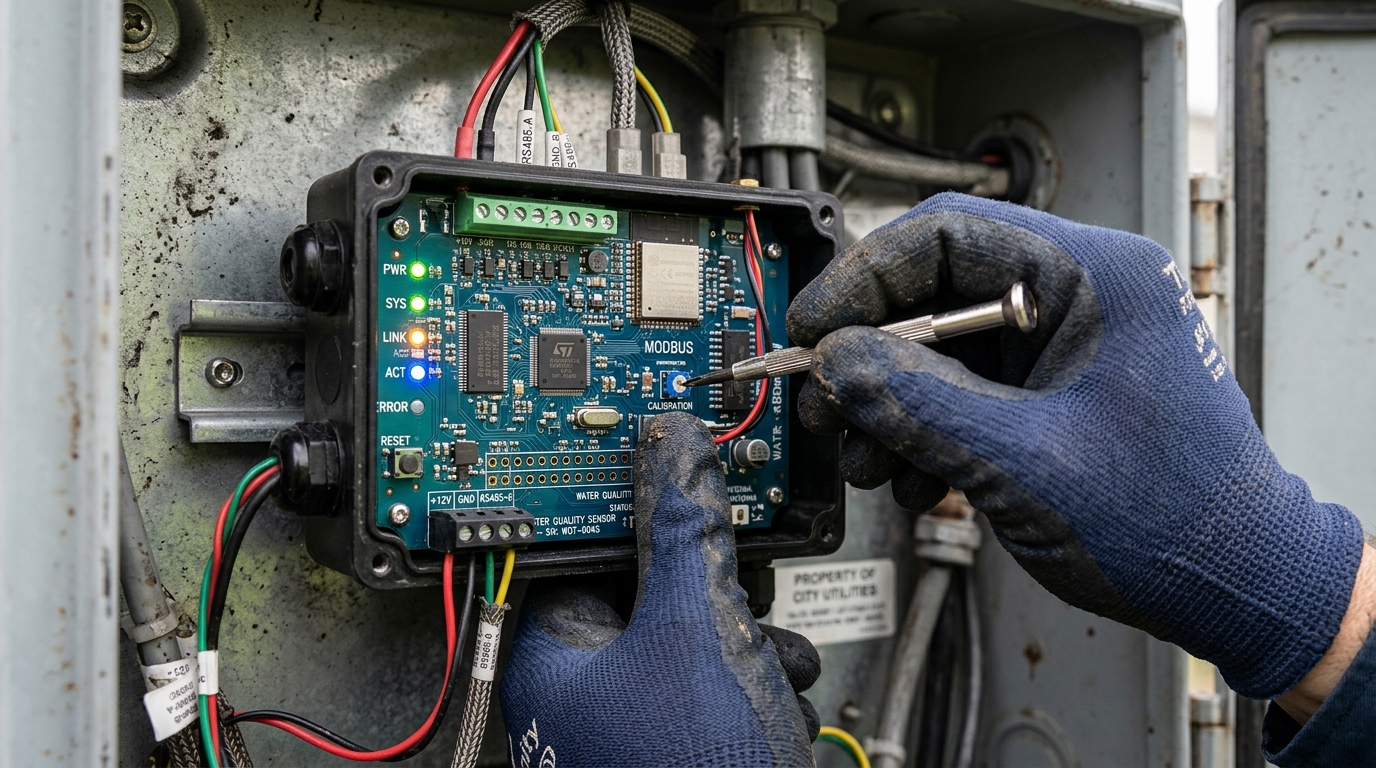
There’s no single product called “municipal IoT.” It’s a collection of connected physical assets. Sensors measure conditions. Actuators change them. Gateways relay data. Networks carry it. Platforms turn it into something an operator can act on. EPA describes smart sewer systems as a combination of real-time monitoring, modeling, analytics, and operational control, with no single design suitable for every utility. The same principle applies to every other vertical.
The practical equipment categories for municipalities:
- Water and wastewater: flow meters, level sensors, pressure transducers, remote-actuated gates and valves
- Streetlighting: LED controllers, photocells, dimming modules, energy meters, fault detectors
- Traffic and parking: vehicle detectors, pedestrian counters, occupancy sensors, adaptive signal controllers
- Waste management: fill-level sensors, solar compactors, route-optimization platforms
- Flood and environmental: ultrasonic gauges, rain sensors, air-quality monitors, soil-moisture probes
- Gateways and connectivity: cellular routers, LoRaWAN base stations, mesh radios, edge processors
- Fleet and field equipment: GPS trackers, rugged asset tracking devices, and telematics units for vehicles, containers, and ground-support equipment
What matters is the chain: sensor → gateway → network → platform → decision → physical response. A sewer-level reading that never triggers a crew dispatch or gate closure is decoration. Municipal value appears only when data changes what somebody does.
Where the ROI Is Documented (and Where It’s Guesswork)
Smart-city case studies tend to blend verified results, vendor claims, and optimistic projections into one shiny narrative. Before you commit budget, you need to know which category each number falls into.
South Bend, Indiana (smart sewers). This is the strongest documented municipal IoT case I’ve found. EPA reports 120 sensors and actuators managing real-time sewer capacity, cutting combined-sewer-overflow volume by over 70%, avoiding roughly 1 billion gallons of overflow annually, and saving $1.5 million in yearly operating costs. The city’s own Board of Public Works documentation references 165 monitoring sites and 13 gates or valves, with separate vendor reporting citing an 80% CSO reduction and approximately $400 million in avoided capital spending, while EPA estimates closer to $500 million. The numbers don’t perfectly align (one counts sensors and actuators, the other monitoring sites; capital estimates differ), but the direction is consistent across multiple independent sources. That’s rare.
Chicago (smart streetlighting). The city planned to replace roughly 270,000 high-pressure-sodium fixtures with LEDs and networked controllers. Project documentation estimates annual savings of 181.7 million kWh and about $9.3 million. Key word: estimates. Not post-installation measurements. DOE separately warns that connected controllers can be sensitive to power-quality problems in older cities with aging electrical infrastructure.
Philadelphia (connected waste bins). The city deployed Bigbelly solar-powered compactors for route optimization. A Controller’s Office audit found a software outage left up to 82% of units unable to communicate. Software cost $130,000 annually. Repairs could take months or years. The city lacked an effective system for tracking maintenance. The technology worked in theory. Operations killed it in practice.
San Francisco (SFpark). Real-time parking-availability sensors combined with demand-responsive pricing. SFMTA’s evaluation reports improved availability, easier parking, and lower vehicle miles traveled. But the study doesn’t isolate sensor impact from pricing-policy impact. When data and policy change simultaneously, attributing the outcome to equipment alone is a stretch.
New York City (FloodNet). FloodNet publishes real-time urban flood-monitoring data using ultrasonic range-finders. Genuinely useful for emergency response. The published materials don’t yet provide a verified network-wide sensor count or quantified losses avoided, so it’s promising but early.
| Deployment | Equipment Type | Key Reported Outcome | Evidence Quality |
|---|---|---|---|
| South Bend (sewer) | Sensors, actuators, real-time flow control | 70%+ CSO reduction, ~$1.5M annual O&M savings | EPA-documented, multi-source verified |
| Chicago (lighting) | 270K LED fixtures, networked controllers | Est. 181.7M kWh and ~$9.3M annual savings | Pre-installation estimates, not measured |
| Philadelphia (waste) | Solar compactors, fill-level sensors | 82% communication failure during outage | Government audit (Controller’s Office) |
| San Francisco (parking) | Occupancy sensors, dynamic pricing | Improved availability, lower VMT | SFMTA evaluation, mixed attribution |
| NYC FloodNet (flood) | Ultrasonic range-finders | Real-time public flood data | Operating system, limited quantified outcomes |
Notice the pattern: the deployment with the strongest evidence (South Bend) paired sensors with physical control, a dedicated operations team, and an explicit maintenance contract. Equipment alone proved nothing. The operating model behind it did.
The Maintenance Budget Nobody Writes
Here is the number that should be on every municipal IoT slide deck and almost never is. South Bend’s 2026 maintenance agreement for its smart sewer system: $499,576 per year across 94 sites. That breaks down to $430,896 for network maintenance, $35,700 for hosting, and $32,980 for reconfiguration. The contract specifies a 95% uptime guarantee.
Roughly $5,300 per sensor site per year. No new features. No expansion. Just keeping things alive.
Philadelphia shows what happens without that discipline. Up to 82% of connected waste bins lost communication during a software outage. Repairs languished. The $130,000 annual software fee kept getting paid whether the system worked or not.
In my own field, I see this constantly. An airline or logistics company buys 500 GPS trackers, deploys them across a container pool or ground-support fleet, and 18 months later half the devices are offline because nobody budgeted for battery replacement, SIM renewals, or firmware updates. The hardware worked. The operating model didn’t. The same dynamic applies to a city deploying 200 flood gauges or 3,000 smart streetlights—whether managing municipal assets or implementing geofencing for equipment tracking, sustained operations require dedicated maintenance budgets.
Before you approve any municipal IoT purchase, answer three questions:
- Who physically maintains each device, and what’s their response time?
- What happens to the service when the network or software platform goes down?
- What is the fully loaded annual cost of keeping this system running after year one?
If the vendor’s proposal doesn’t address all three with specifics, you’re buying a pilot that someone labeled a deployment.
Choosing a Network by Asset, Not by Trend
Global IoT connections split roughly into Wi-Fi (32%), Bluetooth (24%), and cellular (22%), with the remainder spread across LPWAN protocols like LoRaWAN and NB-IoT. Those are worldwide device averages across all industries, not a blueprint for your city.
The right network depends on the asset. A sewer sensor 20 feet underground has different range, power, and latency needs than a streetlight controller on a main road. A flood gauge in a coastal zone needs to transmit during the exact conditions (power outages, tower congestion) when its data matters most.
| Technology | Strong Fit | Municipal Limitation |
|---|---|---|
| Cellular (LTE-M, NB-IoT) | Dispersed assets, moderate data, carrier-managed coverage | Monthly carrier fees, underground/remote gaps, carrier dependency |
| LoRaWAN | High sensor density, low data volume, city-owned gateway network | Requires gateway buildout, limited bandwidth, interference in dense RF environments |
| Wi-Fi / Wi-Fi HaLow | Powered sites with existing LAN, building-level deployments | Range limits on standard Wi-Fi, HaLow ecosystem still maturing |
| Private RF mesh | Utility metering, lighting networks with dedicated spectrum | Often vendor-specific, limited third-party integration |
One strong recommendation: pilot coverage and battery life at your actual locations before signing any connectivity contract. Metal enclosures, seasonal flooding, basement installations, distance from gateways, and local interference patterns all affect performance in ways that spec sheets cannot predict. We’ve seen the same challenge in aviation and maritime environments, where a tracker that tests perfectly in a warehouse fails inside a cargo container or in a port yard. The physics don’t care about the data sheet. Municipal deployments benefit from similar monitoring capabilities—geofence alerts for equipment can immediately flag when assets leave designated areas or connectivity drops unexpectedly.
Why 70% of Water Systems Fail Basic Cyber Requirements
EPA reports that over 70% of water systems inspected since September 2023 have violated basic Safe Drinking Water Act risk-and-resilience or emergency-plan requirements. That’s not a future threat. That’s the current state of the infrastructure many cities want to layer IoT on top of.
As municipal IoT shifts from passive monitoring to active control (closing sewer gates, adjusting signal timing, managing grid load), unauthorized access stops being a data problem and becomes a physical safety problem. A compromised streetlight controller is an inconvenience. A compromised water-treatment controller is a public health crisis.
The regulatory landscape is tightening. The EU Cyber Resilience Act began requiring vulnerability reporting from hardware manufacturers in September 2026, with full product-security obligations arriving in December 2027. Even if your city operates in the U.S., your equipment suppliers may build to CRA requirements. CISA’s IoT Acquisition Guidance and NIST’s SP 800-213 series provide frameworks you can reference directly in procurement language.
At minimum, every municipal IoT RFP should specify:
- Defined support and patching periods for every device model
- Credential management with no shared default passwords
- Network segmentation between IoT devices and administrative systems
- Incident-notification timelines and escalation paths
- Manual fallback for any system controlling physical infrastructure
- End-of-life data wipe and device decommissioning procedures
When a Streetlight Becomes a Camera
A connected streetlight controller can dim bulbs, report faults, and monitor energy consumption without capturing a single image. But when San Diego’s smart streetlight program added cameras and automated license-plate readers (ALPR) at 500 locations, the public reaction was sharp. Of 394 public comments reviewed by the city, 324 were negative, raising concerns about privacy, surveillance overreach, spending, and data sharing.
The San Diego Police Department’s 2025 ALPR report documented over 140,000 investigative searches linked to 294 cases, 208 arrests, and roughly $3 million in recovered stolen property. Real law-enforcement value. But the department also acknowledged ending federal and out-of-state data sharing in May 2025, partly in response to the public backlash.
The lesson is structural, not philosophical. Separate camera capability from lighting control in every procurement. If your RFP bundles imaging sensors with streetlight upgrades, you’ve made a surveillance decision, not just an energy decision. That requires its own public process, retention policies, access-control rules, and community consent. Conflating the two erodes the public trust you’ll need for every IoT project that follows.
Vendor Lock-In Starts at the RFP
NIST’s Smart City Framework states plainly that many municipal IoT projects end up customized and neither fully interoperable nor scalable. This shouldn’t surprise anyone. Vendors compete by building ecosystems, not by making it easy to leave.
Claims like “supports TALQ-certified lighting controls” or “integrates with 120+ protocols” are useful evaluation starting points. They are not proof that the platform will work cleanly with your existing SCADA, GIS, work-order, or financial systems. Proof only comes from testing against your live environment, and the same scrutiny applies to industrial IoT device requirements that go well beyond the data sheet.
Three requirements before contract signing:
- Documented, tested interfaces. Not “we support open APIs” on a marketing page. Actual API documentation, exercised against your production systems during evaluation.
- Data export rights. Your sensor readings, meter data, configuration files, and historical records must be exportable in standard formats at any point during the contract, not just at termination.
- A credible exit plan. If you switch providers, what data transfers? What equipment still functions? What goes dark? If the vendor can’t answer these clearly, you know exactly what kind of relationship they’re building.
This is the same discipline we apply when selecting asset tracking hardware for aviation and logistics clients. The device is the easy decision. The data architecture, integration path, and exit strategy are where the real procurement risk lives.
Three Decisions That Shape Every Municipal IoT Outcome
After working in IoT across aviation, freight, and industrial supply chains for 15+ years, I’ve watched dozens of deployments either thrive or stall. The outcome almost always traces back to three early decisions:
- Start with a service problem, not a technology category. South Bend didn’t buy “IoT.” They solved a combined-sewer-overflow crisis that was triggering EPA enforcement actions. The sensors, gates, and analytics followed from the problem. If your starting point is “we need smart city equipment,” you’ll end up with sensors searching for a purpose.
- Budget for the decade, not the demo. South Bend’s $499,576 annual maintenance contract exists because somebody recognized that sensor networks don’t maintain themselves. Philadelphia’s Bigbelly outage happened because nobody owned ongoing operations. Equipment cost is the smallest line in a 10-year total cost of ownership.
- Stage before you scale. Pilot 10 sites. Measure whether the data actually changed an operating decision. Test what breaks during a network outage. Confirm that repair response meets your SLA. Then expand. The cities that skip this end up with thousands of silent devices and a sunk cost nobody wants to report.
The technology works. In 2026, with over 21 billion connected IoT devices worldwide, hardware reliability isn’t the bottleneck. It’s the operating model, the maintenance contracts, the cybersecurity posture, and the political will to sustain a deployment past the press release.
If your municipality is evaluating IoT-based equipment and you want a conversation grounded in field reality, not slide decks, reach out to our team or drop a line at info@datanetiot.com. We work primarily in aviation and industrial asset tracking, but the principles (right hardware, right connectivity, lifecycle visibility, and an operating model that outlasts the pilot) transfer directly to municipal infrastructure.

Frequently Asked Questions
What counts as IoT-based equipment for municipalities?
Any connected physical device that collects, transmits, or acts on data for a municipal service. Common categories include water and sewer sensors, streetlight controllers, traffic detectors, parking sensors, flood gauges, waste-bin monitors, environmental probes, and the gateways and platforms that connect them. The defining feature is that the device communicates its status without manual data collection.
How much does municipal IoT cost to operate per year?
Costs vary widely by deployment type and scale. One documented benchmark: South Bend pays $499,576 annually to maintain 94 sewer-sensor sites, roughly $5,300 per site per year for network maintenance, hosting, and reconfiguration alone. Equipment purchase is typically a fraction of 10-year total operating cost.
Which wireless network is best for municipal IoT?
No single network fits every use case. Cellular (LTE-M, NB-IoT) suits dispersed assets with carrier-managed coverage. LoRaWAN works well for high-density, low-data deployments where the city owns the gateway network. Wi-Fi fits powered sites with existing infrastructure. Always pilot at real locations before committing to a network contract.
What are the biggest risks of municipal IoT deployments?
Maintenance failure (Philadelphia lost communication with 82% of smart waste bins during an outage), cybersecurity gaps (EPA found over 70% of inspected water systems in violation of basic requirements), vendor lock-in (proprietary platforms that block data export), and surveillance scope creep (San Diego’s streetlight cameras drew 324 negative public comments out of 394). Budget for operations, security, and governance from day one.
Does smart streetlighting require surveillance cameras?
No. A connected light controller handles dimming, fault detection, and energy monitoring without any imaging sensor. Cameras and license-plate readers are separate equipment decisions with distinct privacy implications. If a vendor bundles them into a lighting upgrade, treat the camera component as a separate procurement requiring public disclosure and community consent.
How can a municipality avoid IoT vendor lock-in?
Require documented API access, exportable data in standard formats, and a tested exit plan before signing any contract. NIST warns that many municipal IoT projects are customized and not fully interoperable. Test the vendor’s integration claims against your live systems during evaluation, not in a controlled demo.








 +1 508 292 2210

3 Responses