

The phrase “industrial IoT device range” sounds like a single number on a datasheet. It’s not. It means at least three different things, and most vendors are happy to let you confuse them.
Communication distance. Device portfolio breadth. Operating envelope. Conflating them is how experienced teams end up with sensors that reach 10 km but die in six months because nobody checked the battery draw against the actual reporting frequency.
I’ve spent 15+ years deploying IoT across aviation, logistics, and industrial operations. The pattern keeps repeating: buyers over-index on one version of “range” and get burned by the other two. Here’s what actually matters in 2026, with real numbers and honest trade-offs.
“Range” Has Three Separate Meanings
Before comparing products, agree on which question you’re answering.
Communication distance is what most people picture first: how far a device can send data to a gateway or base station. Useful, but misleading in isolation. NIST defines wireless range as the distance achieved while maintaining all other application requirements, not simply the farthest detectable signal. A sensor that “reaches” 2 km but drops 40% of packets at 500 m in a steel-frame warehouse hasn’t met any meaningful range spec.
Device portfolio breadth is the catalog question. Does the vendor or integrator offer vibration sensors, GPS trackers, environmental monitors, edge gateways, and the software to tie them together? Or are you stitching five vendor relationships to cover one facility? In aviation MRO alone, we’ve seen operations need airfreight-approved trackers (DO-160 certified), ground support equipment monitors, and temperature loggers for parts storage, all under one platform.
Operating envelope is the question that bites hardest after deployment. Temperature tolerance, ingress protection, hazardous-area certification, battery life under real duty cycles. Emerson’s AMS Wireless Vibration Monitor specifies -40 to 85°C and IP66/NEMA 4X. Siemens’ IOT2050, often mentioned in the same IIoT conversations, permits indoor operation only. Same category label. Entirely different deployment reality.
Get specific about which “range” you need before you open a vendor comparison. The wrong lens wastes months.
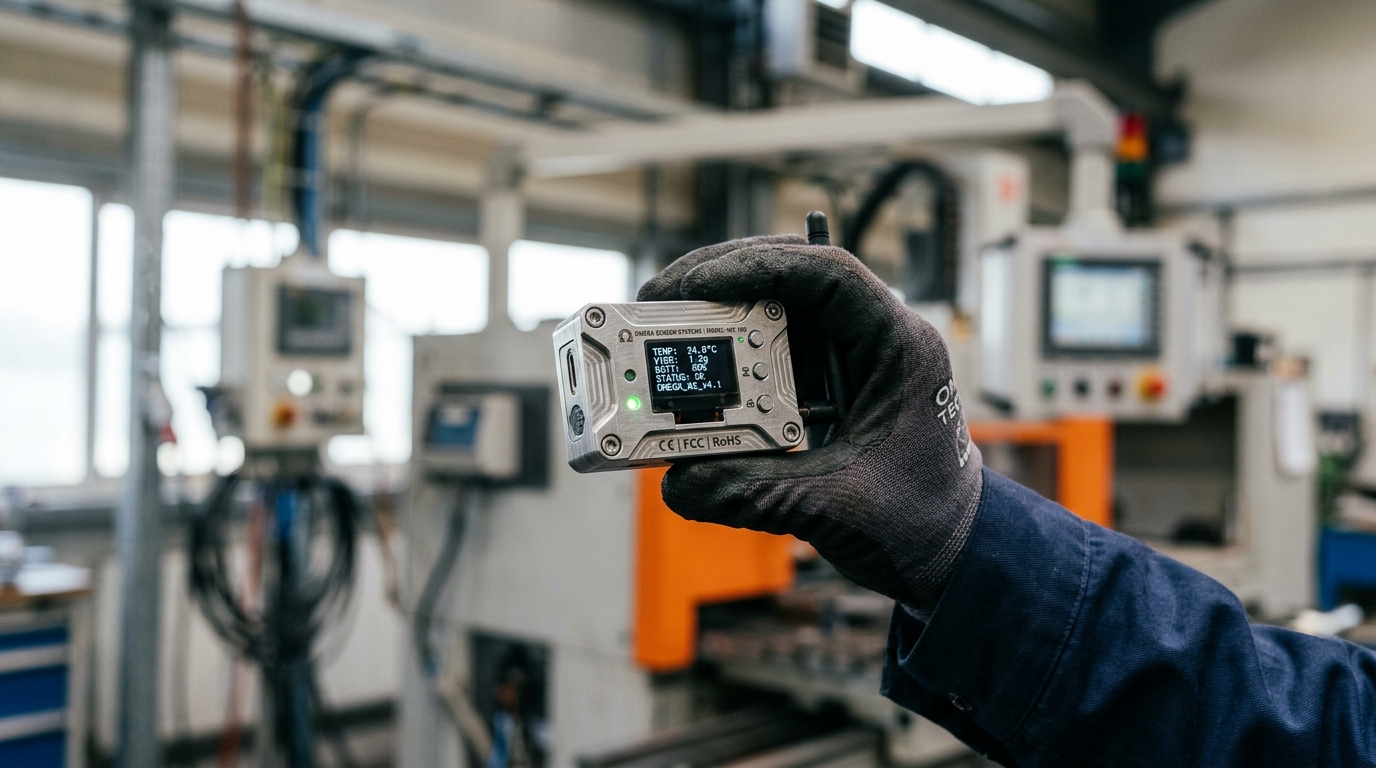
Communication Distance by Technology: Honest Numbers
Every connectivity technology advertises its best-case scenario. Here’s what the standards bodies and specifications actually say, along with the trade-off each one forces.
| Technology | Documented Range | Best Fit | Main Trade-Off |
|---|---|---|---|
| Bluetooth / BLE | Under 1 m to over 1 km, depending on PHY, power, and antenna | Short-range asset ID, indoor positioning, wearables | Implementation-dependent; the familiar “10-meter” assumption doesn’t apply universally |
| Wi-Fi (industrial) | Engineered per site; NIST discusses 10 m workcells to 30 m+ larger cells | High-bandwidth needs (cameras, HMI), facility-wide coverage | Interference management, roaming, infrastructure cost |
| WirelessHART | Mesh-dependent; engineered per installation | Process instrumentation, vibration monitoring | Mesh adds hops and latency; power budget and update frequency are linked |
| LoRaWAN | Several kilometers in typical deployments | Distributed telemetry, metering, environmental sensing | Small payload, seconds of latency; not suited for large-data or real-time transport |
| Private LTE / 5G | Coverage engineered per deployment | Mobile industrial equipment, autonomous vehicles | Infrastructure investment; RedCap/eRedCap require 5G standalone architecture |
| Industrial Ethernet | Medium-dependent (copper, fiber) | Fixed automation, control loops, high-reliability links | Physical cabling; still 79% of new factory-automation nodes in 2026 |
No technology wins on distance, battery life, throughput, latency, and infrastructure cost simultaneously. The right question isn’t “which has the longest range?” It’s: what must this data path survive, and what happens when it doesn’t?
Building materials, moving metal, electromagnetic interference from motors, and seasonal temperature swings all change effective range. A spec sheet measured in open air tells you nothing about your steel-and-concrete plant floor. Ask vendors for tested performance under your site’s conditions, or run a pilot before committing to a purchase order.
Operating Envelope: Where Deployments Actually Break
Communication distance gets the spotlight in sales conversations. The operating envelope gets the blame in failure analyses.
Three variables deserve scrutiny before any purchase order.
Temperature and ingress protection. The gap between “industrial-grade” marketing and actual specifications can be enormous. An IP66-rated sensor designed for outdoor chemical plants is not the same product as an indoor-only gateway in a protective enclosure, even if both carry “Industrial IoT” in the product name. The spec doesn’t transfer by category. Always check the individual datasheet.
Battery life under real duty cycles. Emerson’s AMS Wireless Vibration Monitor claims 3 to 5 years of battery life, but under a specific reporting profile: 13 device variables hourly and four high-resolution waveforms daily. Increase the waveform frequency for faster fault detection, and that number shrinks. Every battery-powered IIoT device carries this trade-off. If a vendor quotes battery life without specifying the duty cycle, the number is fiction.
Certification for the actual environment. Hazardous-area approvals (ATEX, IECEx, NEC Class/Division) aren’t optional add-ons. In aviation, ground support equipment trackers face their own certification demands. The Thingfox T2, for example, is DO-160 approved for airfreight, a qualification most general-purpose industrial trackers don’t carry. The environment defines the device, not the other way around.
Day-2 reality makes all of this worse. A device might survive its first year. But firmware updates, battery replacements, recalibration, and physical inspections across thousands of deployed units create a maintenance burden that rarely appears in the pilot-phase budget. Before scaling past 100 devices, ask: who replaces the batteries, how often, and what does it cost per unit per year?
Where Devices Sit in the Stack
Comparing a vibration sensor to a cloud analytics platform because both qualify as “industrial IoT” is like comparing a tire to a truck because both relate to transportation. The device range in an IIoT system spans distinct layers, each with different selection criteria.
| Layer | What Belongs Here | Example |
|---|---|---|
| Condition sensors | Vibration, temperature, pressure, machinery health | Emerson AMS Wireless Vibration Monitor (triaxial vibration + temperature) |
| Identification and tracking | Tags reporting location, identity, or status of mobile assets | GPS/cellular asset trackers for containers, vehicles, ground support equipment |
| Acquisition and I/O gateways | Analog/digital inputs, protocol conversion, local alarms | Advantech ADAM-6700 with onboard I/O, RS-485/Ethernet, and logging |
| Edge compute | Local processing, buffering, analytics close to the asset | Rockwell ControlLogix Embedded Edge Compute, industrial PCs |
| Software platforms | Asset models, OEE dashboards, maintenance workflows | AWS IoT SiteWise, Azure IoT Operations, Siemens Insights Hub |
A useful device-range decision identifies which layers you need and whether one vendor or integrator can deliver them coherently. Buying best-of-breed at every layer sounds smart until you’re maintaining five integration bridges and no single vendor owns the data flow end to end.
Market Context: 21 Billion Devices, 79% Still Wired
The headline numbers are real. IoT Analytics counted 21.1 billion connected IoT devices at the end of 2025, with enterprise IoT spending reaching $324 billion. Fortune Business Insights puts the broader IIoT technology market at roughly $751 billion for 2026.
Two caveats matter for buyers, not analysts.
First, “enterprise IoT” is not “industrial IoT.” That 21.1 billion includes consumer wearables, smart meters, connected vehicles, and office systems. Only 45% are enterprise connections, and even that bucket mixes retail point-of-sale with factory vibration monitors. Sizing a plant investment from a global device count is like estimating your grocery bill from GDP.
Second, wireless is not replacing wired in factories. HMS Networks reports Industrial Ethernet at 79% of newly installed factory-automation nodes in 2026, versus 7% wireless. Growth is real, but the installed reality is hybrid. Plan for wired backbones with wireless instrumentation at the edges, not a full wireless replacement of your control network.
Forecast revisions tell a story too. IoT Analytics projected 18.8 billion devices for end-2024, then revised the actual figure to 18.5 billion. The 2030 projection moved from 40 billion to 39 billion. Growth is happening, but it isn’t immune to correction. Size your deployment from asset count and operational need, not from market headline numbers.
Matching Range to Workload: Four Real Cases
The best industrial IoT device range is the one that solves a specific operational problem. Four documented deployments illustrate how different problems demand completely different device portfolios.
Schneider Electric, Lexington: energy management. Schneider reports a 26% energy reduction using IoT sensors, automation, and analytics. The 78% CO2 reduction cited includes renewable-energy credits, a procurement decision, not a sensor outcome. Define separate baselines for energy, emissions, and maintenance. Sensors alone didn’t deliver that headline number.
Michelin, Shenyang: quality and flexibility. The World Economic Forum reports a 36% lower defect rate and 51% shorter trial lead time from more than 30 digital solutions spanning AI, machine vision, and big data. This is not a sensor project. It’s a coordinated transformation. A maintenance-only device portfolio would miss the cameras and analytics that produced those quality gains.
Boliden, Aitik mine: mobile autonomy. Ericsson documents a private LTE network enabling autonomous haulage with Komatsu trucks at this Swedish copper mine. Not 5G. Not LoRaWAN. Private LTE, engineered for reliability and real-time equipment visibility in an open-pit environment. Multi-ton autonomous trucks need continuous, reliable, wide-area connectivity. A battery-powered LoRa sensor would have been absurd here.
Veolia, France: distributed metering. The LoRa Alliance reports over 4 million active smart meters for Veolia across France. The opposite workload: small readings, low frequency, massive geographic spread. LoRaWAN’s long range and low power consumption fit perfectly here. Private LTE for water meters would have been an expensive disaster.
The common thread: none of these teams started from a technology preference. They started from an operational outcome, then selected the device range that served it.
Security and Lifecycle: The Ranges Nobody Markets
Two risks sit outside the typical range discussion but determine whether a deployment survives past year two.
Security is a physical-process risk, not just an IT concern. In January 2024, an attack called FrostyGoop manipulated heating controls at a Ukrainian municipal utility through legitimate Modbus commands. Over 600 apartment buildings lost heat, and remediation took almost two days in sub-zero temperatures. The attacker didn’t exploit a software vulnerability. They used the protocol as designed, without authorization controls in place. Any IIoT deployment with write access to operational equipment needs segmentation, least-privilege access, and controlled communication paths. NIST SP 800-82 Rev. 3 provides the framework.
Platform lifecycle can be shorter than equipment lifecycle. Google discontinued IoT Core on August 16, 2023, stranding devices that were physically functional but had lost their cloud integration path. A factory machine may run 20 years. The digital layer connecting it can disappear in three. Before signing with any platform, price the migration: credential transfer, configuration export, alternative ingestion. If you can’t exit, you’re not a customer. You’re a hostage.
Regulatory pressure reinforces this. The European Cyber Resilience Act began reporting obligations in September 2026, with full compliance required from December 2027. For products entering the EU market, cybersecurity across design, development, and ongoing maintenance is now a legal requirement.
How to Scope the Right Device Range
Skip the vendor matrix for now. Start with five questions that align with industrial IoT device requirements for real-world deployments:
- What asset or process are you instrumenting? Fixed machinery, mobile equipment, reusable containers, airfreight ULDs, environmental conditions? The answer determines sensor type, mounting method, and power source.
- What measurement and reporting frequency does the outcome require? A vibration monitor sampling four waveforms daily and a GPS tracker pinging every 15 minutes have fundamentally different battery and bandwidth profiles.
- What are the physical conditions at the deployment site? Temperature extremes, moisture, dust, vibration, explosive atmospheres, indoor versus outdoor. Match IP ratings and certifications to the actual installation point, not the product category.
- What happens when the connection fails? Does the device buffer data and retry? Does the process stop? Does a safety system take over? Azure IoT Operations documents a maximum 72-hour offline window with possible degradation. Know your platform’s boundary before it surprises you in production.
- Who maintains the devices after deployment, and for how long? Battery swaps, firmware updates, physical inspections, recalibration. If the deployment lifecycle is 10 years and the platform vendor’s commitment is three, you have a structural gap.
Once those answers are concrete, the technology comparison becomes tractable. You’re no longer debating LoRaWAN versus 5G in the abstract. You’re evaluating specific devices against a specific installation, duty cycle, failure consequence, and support requirement.
This is how we scope every engagement at Datanet. Whether it’s ocean container tracking across port operations or environmental monitoring through sensitive supply chains, the device portfolio follows the operational problem. If your team is working through these questions right now, we’re happy to compare notes: info@datanetiot.com.

Frequently Asked Questions
What does “industrial IoT device range” actually mean?
It can refer to communication distance (how far a device transmits reliably), device portfolio breadth (what types of sensors, gateways, and platforms are available), or operating envelope (temperature, IP rating, battery life, certifications). NIST defines wireless range as distance achieved while maintaining all application requirements. Treat the three meanings separately when evaluating vendors.
How far can an industrial IoT device communicate?
There is no universal answer. Bluetooth implementations span under 1 meter to over 1 kilometer. LoRaWAN covers several kilometers in typical deployments. Private LTE and 5G coverage is engineered per site. Building materials, metal structures, interference, and antenna placement all change real-world performance, making site-specific testing essential.
Is LoRaWAN better than Wi-Fi or 5G for industrial use?
Not universally. LoRaWAN excels at long-range, low-frequency telemetry (smart meters, environmental sensors) but the LoRa Alliance explicitly excludes large-data and real-time transport from its use cases. For mobile industrial automation or video inspection, private LTE or 5G may be necessary. Start from the workload, not the technology.
Can legacy machines connect to IIoT without being replaced?
Often, yes. I/O gateways like the Advantech ADAM-6700 provide RS-485 and Ethernet interfaces with protocol conversion for existing equipment. Compatibility requires engineering validation on a case-by-case basis. NIST also recommends compensating security measures for unsupported legacy systems that cannot receive patches.
How long do industrial IoT device batteries actually last?
It depends entirely on the reporting profile. Emerson’s AMS Wireless Vibration Monitor specifies 3 to 5 years under a defined duty cycle (13 variables hourly, four waveforms daily). Higher reporting frequencies shorten battery life proportionally. Require vendors to state battery estimates tied to your specific measurement and transmission schedule.
What should an industrial IoT pilot measure first?
Pick one operational baseline before deployment: energy consumption, defect rate, unplanned downtime, or asset cycle time. Measure it before and after. Include connectivity reliability, data quality, safe-failure behavior, and ongoing maintenance effort in your acceptance criteria alongside the business metric.






 +1 508 292 2210