

Cellular IoT connects physical devices to digital services through mobile networks instead of Wi-Fi or proprietary radio. At its core, the concept is simple: a sensor, a cellular modem, a SIM card, and a tower doing what towers have done for decades. But with 4.7 billion cellular IoT connections active at the end of 2025 and growth continuing at double digits, the simplicity of the idea hides a tangle of standards, costs, and lifecycle decisions that most guides gloss over.
I deploy cellular IoT devices across aviation, logistics, and industrial asset tracking. Every week, someone asks me whether they need NB-IoT or LTE-M, whether a battery will really last ten years, or whether 5G makes everything else obsolete. The answers are never as clean as the spec sheets suggest. This guide covers what cellular IoT actually is, which standards matter, what it really costs, and where it breaks.
The Core Concept: Machines Using Cell Towers
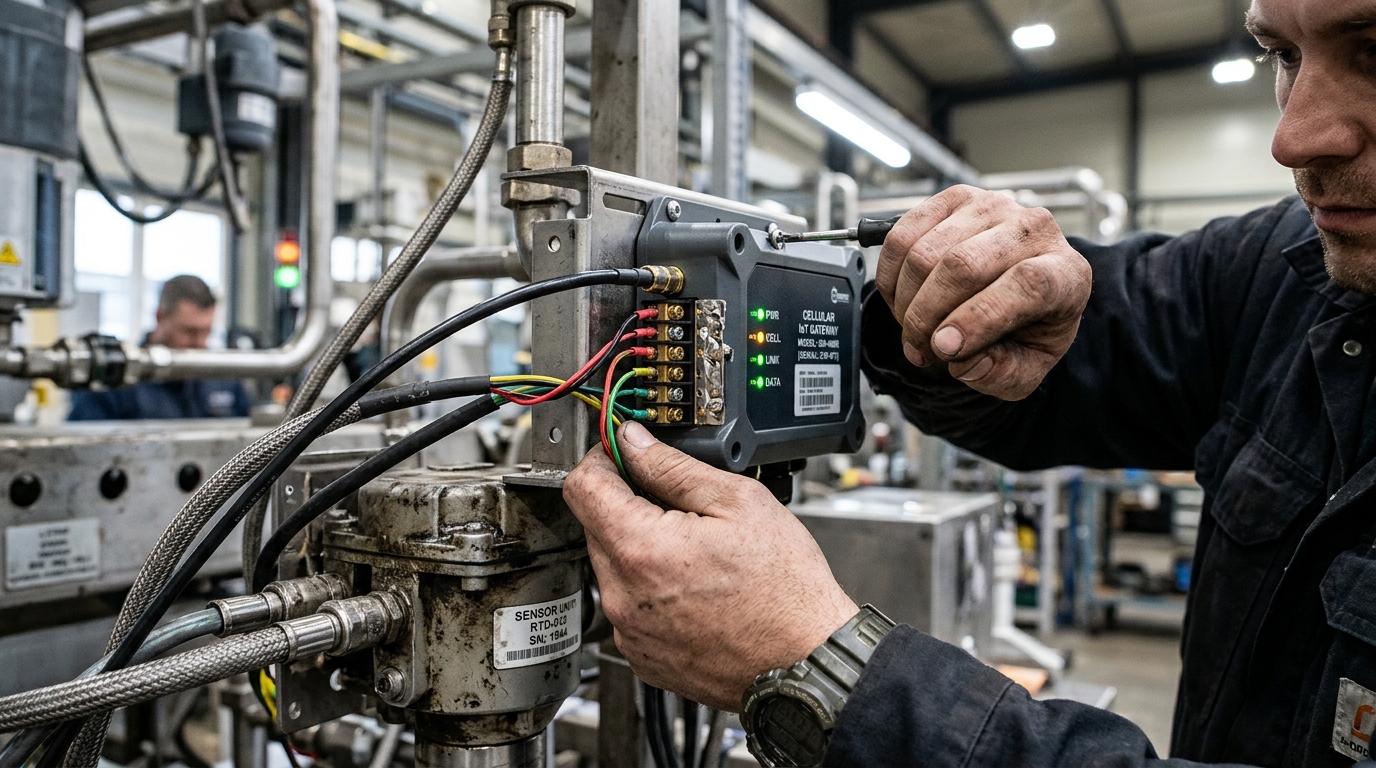
Cellular IoT means giving a non-phone device (a tracker, a meter, a valve sensor, a medical instrument) its own mobile-network identity so it can send and receive data independently. The device carries a cellular modem and a SIM or eSIM. It authenticates with a carrier the same way your phone does and transmits data over licensed spectrum.
The architecture is straightforward:
- Endpoint (sensor or actuator) captures a measurement: position, temperature, vibration, fill level.
- Cellular modem packages that data and transmits it to the nearest cell tower.
- Mobile network routes the data to the internet or a private backend.
- Cloud platform or application processes the data, triggers alerts, feeds dashboards, or sends commands back to the device.
What makes cellular different from Wi-Fi or Bluetooth: the device does not need a local network managed by someone on-site. It connects directly to carrier infrastructure that already covers most populated areas and many remote ones. For assets that move (containers, trailers, aircraft ground equipment) or sit in locations where nobody will install a router, that independence is the entire point.
NB-IoT, LTE-M, Cat-1 bis, RedCap: Which One Matters
Cellular IoT is not a single radio technology. It is a family of standards designed for different jobs. GSMA identifies LTE-M and NB-IoT as complementary licensed-spectrum LPWA standards, both completed under 3GPP Release 13 in 2016. They were designed from the start for machines, not phones. Cat-1 bis and the newer RedCap sit above them, handling use cases that need more data or lower latency.
Here is what each one actually does:
| Technology | Bandwidth | Best Fit | Key Trade-Off |
|---|---|---|---|
| NB-IoT | 180 kHz | Small, infrequent messages in difficult radio environments (basements, underground meters, deep indoor) | Limited mobility support; coverage enhancement through repetitions adds latency |
| LTE-M (Cat-M1) | 1.4 MHz | Mobile assets, trackers, devices needing voice or faster handovers | Higher power draw than NB-IoT in purely static deployments; verify local operator support |
| Cat-1 bis | Standard LTE | Terminals, alarms, scanners, mid-tier data (up to 10 Mbps downlink) | Higher energy and module cost than LPWA categories |
| 5G RedCap | 5G NR (reduced) | Mid-complexity 5G applications; first products shipped in 2024 | Ecosystem still maturing; Ericsson places full commercial scale for eRedCap in 2028 and beyond |
A common mistake: assuming the narrowest radio is always the most energy-efficient. Qualcomm’s comparison of a single 500-byte transfer shows radio-on time of 400 ms for NB-IoT, 40 ms for LTE-M, and just 8 ms for Cat-1 bis. If your device sends meaningful payloads (not just a single coordinate), the “low-power” option might keep the radio active ten times longer per transaction.
The takeaway: start from what your device needs to send, how often, and under what conditions. Then pick the standard. Not the other way around.
How Cellular Compares to Wi-Fi, LoRaWAN, and Satellite
Cellular is not the only way to connect a device. The choice depends on who controls the infrastructure, where the asset operates, and what the data budget looks like.
| Connectivity | Coverage | Who Manages It | Best For | Weak Spot |
|---|---|---|---|---|
| Cellular (NB-IoT / LTE-M) | Carrier infrastructure, wide-area | Mobile operator | Distributed, mobile, or unattended assets | Recurring connectivity cost; coverage gaps in truly remote areas |
| Wi-Fi | Tens of meters | You | High-throughput, fixed-location devices on your own premises | Requires on-site network; useless for mobile assets |
| LoRaWAN | Kilometers (private or public network) | You or a public operator | Dense sensor deployments on your own property | You own the gateway infrastructure; unlicensed spectrum means shared airtime |
| Satellite (NTN) | Global, including oceans | Satellite provider | Assets completely outside terrestrial coverage | Higher latency, lower throughput, higher cost per byte |
In 2026, the boundaries are blurring. Hybrid devices that combine cellular and satellite fallback are reaching the market. Particle’s M635e achieved Skylo satellite certification in September 2026, combining LTE-M, satellite NTN, Wi-Fi, and Bluetooth in a single module. For assets that travel between urban centers and off-grid sites (ocean freight, mining equipment, agricultural fleets), this kind of fallback removes the dead-zone problem.
But hybrid is not a default answer. Satellite costs more per message. For assets that stay within cellular coverage, adding satellite capability adds cost without adding value. Match the connectivity to the actual operating environment.
The Battery Myth: Why “10 Years” Needs Context
Every cellular IoT vendor quotes battery life in years. Some say ten. Nordic Semiconductor’s documentation references conditional estimates of up to 10 years for NB-IoT and LTE-M devices. The word “conditional” does a lot of heavy lifting in that sentence.
Battery life is an outcome of four variables, not a fixed hardware spec:
- Reporting frequency. A device sending a GPS fix every 15 minutes drains its battery many times faster than one reporting once per day.
- Payload size. Transmitting 500 bytes of sensor data keeps the radio active much longer than a 50-byte heartbeat.
- Coverage quality. In weak-signal areas, the modem repeats transmissions. Every repetition costs energy.
- Firmware updates. A single over-the-air firmware push can consume what months of normal telemetry would use.
Power Saving Mode (PSM) and extended Discontinuous Reception (eDRX) are the mechanisms that make multi-year battery life possible. PSM lets the device go nearly dormant between transmissions. eDRX extends the interval between “listening” cycles. Both reduce reachability: a device in deep PSM might not respond to a downlink command for hours. That is a deliberate engineering trade-off, not a flaw.
In our asset tracking deployments, battery life is a design conversation, not a number on a box. A Digital Matter Oyster3 configured for daily check-ins on a shipping container behaves very differently from the same device tracking a rental trailer with hourly updates during business hours. Same hardware. Completely different battery outcomes.
What Cellular IoT Actually Costs (Beyond the SIM Price)
The headline number is tempting. 1NCE’s October 2026 U.S. price list offers a $14 lifetime plan: 500 MB and 250 SMS over 10 years. That works out to roughly 4.2 MB per month. For sparse telemetry (a GPS fix and a temperature reading a few times per day), it can be enough. For anything involving firmware updates, diagnostic logs, or richer sensor data, you will hit the ceiling fast.
But connectivity is only one line in the budget. The real total cost of ownership includes:
- Hardware. The device: modem, antenna, sensors, enclosure, battery. Industrial-grade trackers with multi-year battery life and IP67 enclosures are not $10 consumer gadgets.
- Connectivity. SIM plans, data overages, roaming fees. BEREC’s report documents permanent-roaming restrictions and limited NB-IoT/LTE-M access in some markets. A “global coverage” claim does not guarantee your specific radio technology works in every country.
- Platform and integration. Data needs to land somewhere useful. Cloud hosting, API integrations, dashboards, alerting rules.
- Certification. FCC, CE, carrier approvals. For regulated environments like aviation, add DO-160 testing. These cost thousands per device model and months of lead time.
- Lifecycle management. Firmware updates. Battery replacements. SIM migrations when networks shut down.
That last item is where most budgets quietly fall apart.
The Network Sunset Trap
A working cellular IoT device can become useless overnight if its network disappears.
Australia learned this in 2024. When Telstra and Optus shut down their 3G networks on October 28, Australia’s Therapeutic Goods Administration warned that medical devices and personal alarms could lose their remote-monitoring connections. The devices themselves still functioned. But their ability to communicate (the entire reason they were connected) stopped.
A parliamentary inquiry found the same risk extending to smart meters, agricultural equipment, elevator emergency phones, and safety systems. The core problem: equipment with a 15-year physical lifespan had been deployed on a network with a 10-year commercial horizon.
2G shutdowns are already underway in multiple countries. And here is the uncomfortable reality: NB-IoT and LTE-M, despite being labeled “future-proof” at launch, depend on operators continuing to allocate spectrum and maintain infrastructure. If your asset lifecycle is 10 to 15 years, you need a migration plan from day one.
eSIM technology helps. GSMA’s SGP.32 specification, published in May 2026, enables remote profile provisioning for constrained IoT devices, so you can switch a device to a different operator without physically swapping a SIM. That is a real improvement in operational flexibility. But it does not solve the hardware problem: if the modem only supports 3G bands, no SIM swap will save it.
Success in cellular IoT means a supported service over the asset’s entire life. Not just a successful installation.
Three Deployments with Actual Numbers
Theory is useful. Field results are better.
Water Meters: 6.4% Usage Reduction
Gwinnett County, Georgia ran a 502-house pilot combining LTE-connected water meters with analytics tools. The study documented a 6.4% decline in customer water usage and approximately 253,000 gallons in annual savings for just the pilot group. The meters did not reduce water use on their own. What changed was visibility: leak alerts, consumption feedback, and faster repair response. The cellular connection made the intervention loop possible.
Trailer Tracking: $2.5M to $3M in Annual Savings
Hawk Trax deployed 1,500 Digital Matter Oyster Edge trackers across a leasing company’s trailer fleet, using LTE-M/NB-IoT for data transmission and GPS plus Wi-Fi for location determination. The case study reports estimated annual savings of $2.5 to $3 million from reduced trailer theft, faster recovery, and tighter operational controls. The cellular modem’s job was small: transmit a location fix a few times per day. But that small job eliminated the invisibility that made theft easy and recovery slow.
Australia’s 3G Shutdown: When Connectivity Disappears
The Australian case works as a cautionary counterpoint. Devices that had operated reliably for years stopped communicating overnight. The hardware was intact. The batteries still had charge. The network they depended on was gone. Every deployment in the table above could face the same scenario if the next network transition is not planned into the original budget.
Choosing the Right Cellular IoT Path
After fifteen years of deploying connected devices across aviation, logistics, and industrial operations, here is the decision framework I actually use. For a deeper dive into device selection criteria, see our guide on what to look for in an industrial IoT device:
Start from the workload, not the radio. What does the device need to send? How often? How large is the payload? Does it move? Those four questions eliminate half the options immediately.
Map the operating environment. Indoor or outdoor? Urban, rural, or remote? Underground? Cross-border? Check actual operator coverage for the specific technology you are considering (NB-IoT and LTE-M availability varies by carrier and country), not just a map labeled “4G.”
Calculate total cost of ownership over the asset’s life. Not over the SIM contract. Over the asset’s life. A reusable container that circulates for 12 years needs a connectivity plan that spans 12 years, including at least one likely network transition.
Build migration into the design. Choose devices with multi-mode modems (LTE-M plus NB-IoT at minimum). Prefer eSIM-compatible hardware where available. Budget for at least one device refresh cycle over a 10-year program.
Separate the layers. Your tracker vendor is not your connectivity provider is not your platform vendor. Understand what you are buying at each layer and who is responsible when something breaks.
For asset tracking specifically, the devices we deploy at Datanet (the Digital Matter range for ground and logistics assets, the Thingfox T2 for DO-160 certified airfreight) are cellular IoT devices at their core. The cellular modem is just the communication layer. The value comes from what you do with the location, condition, and status data that layer carries. If your container pool goes invisible after delivery, that is exactly the gap asset tracking closes.
Questions about which cellular IoT setup fits your operation? Talk to our team or reach us at info@datanetiot.com.

Frequently Asked Questions
Is cellular IoT the same as 5G?
No. Cellular IoT includes 4G-era technologies like LTE-M and NB-IoT, which also satisfy 5G massive machine-type communication requirements under 3GPP specifications. “5G IoT” can refer to several distinct device categories and radio standards. Always clarify which specific technology is being discussed.
How long does a cellular IoT battery actually last?
Reference estimates reach up to 10 years for low-power configurations, but real battery life depends on reporting frequency, payload size, signal strength, and firmware update cycles. A device reporting hourly in weak coverage drains far faster than one sending a daily heartbeat in strong signal. Always request a workload-specific energy estimate rather than relying on a generic claim.
What is the difference between NB-IoT and LTE-M?
NB-IoT uses 180 kHz bandwidth and excels at small, infrequent messages in difficult radio environments like basements and underground installations. LTE-M uses 1.4 MHz, supports mobility and tower handovers, and handles larger payloads more efficiently. Many industrial trackers support both modes so the device can use whichever network is available.
Does every cellular IoT device need a SIM card?
Yes. Cellular IoT devices require a subscriber identity (physical SIM or eSIM) to authenticate on mobile networks. The GSMA SGP.32 specification, with commercial products available since mid-2026, enables remote profile management for IoT eSIMs, reducing the need for physical SIM swaps in sealed or hard-to-reach devices.
How much does cellular IoT connectivity cost?
Plans vary widely. One benchmark: 1NCE offers a $14 lifetime plan covering 500 MB and 250 SMS over 10 years in the U.S. That suits sparse telemetry but leaves little room for firmware updates or diagnostics. Total deployment cost must also include hardware, platform integration, certification, management, and eventual network migration. A SIM tariff is not a deployment budget.
Can cellular IoT work where there is no cell coverage?
Standard cellular IoT requires carrier infrastructure. For assets that move beyond terrestrial coverage, hybrid cellular and satellite devices entered the market in 2026 (for example, Particle’s M635e with Skylo NTN certification). Satellite adds cost and latency but eliminates dead zones for critical status messages like location pings or threshold alerts.





 +1 508 292 2210

3 Responses