

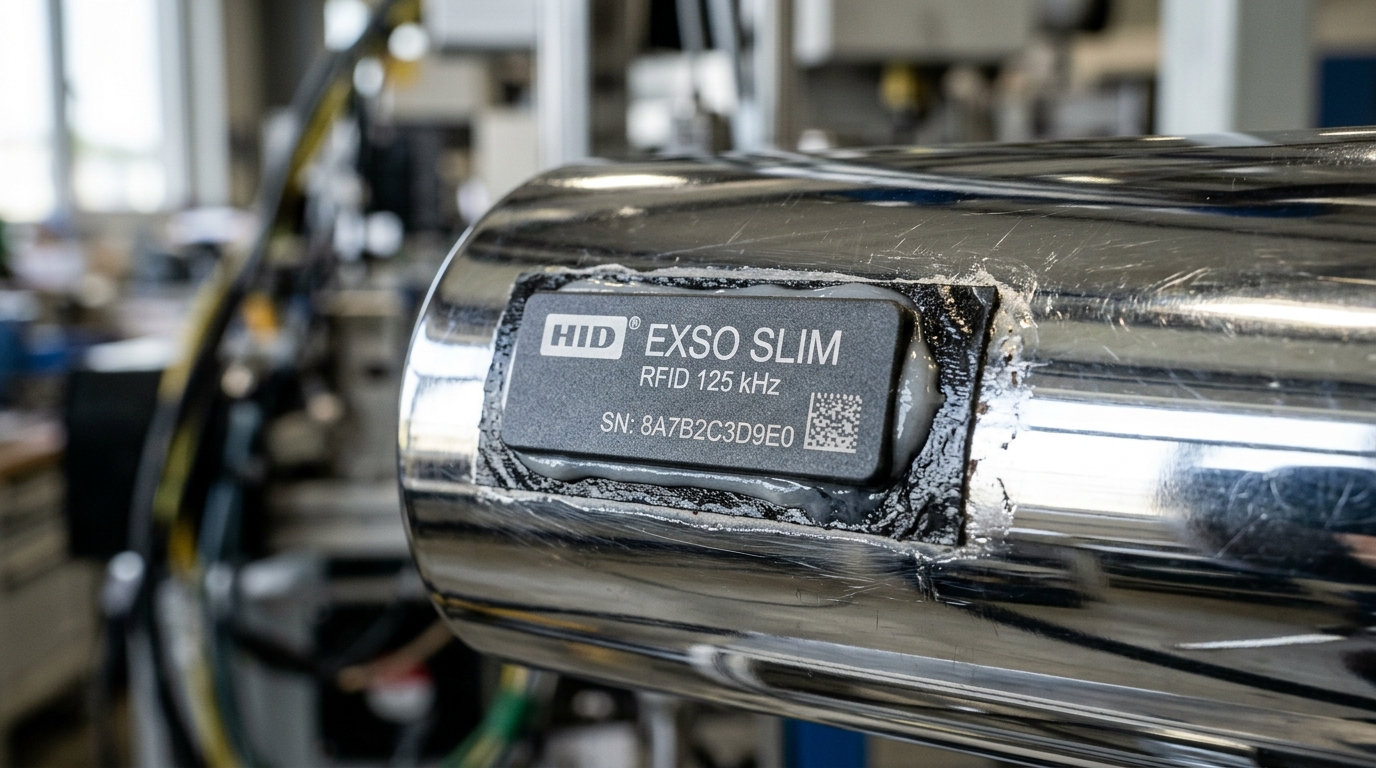
RFID tags work on metal when they are designed for it. A standard label stuck on steel or aluminum will lose range or go silent, because metal reflects radio energy and shifts the tag antenna’s resonance. Purpose-built on-metal tags solve this with spacers, ground-plane designs, or ferrite layers. Some actually read farther on metal than in open air.
I work with metal assets every day. Containers, engine components, drill pipes, ground support equipment. Over fifteen years of deploying tracking systems across aviation, oil and gas, and industrial logistics, I have watched teams burn thousands on the wrong tags. I have also seen well-chosen tags survive 180,000 wear cycles downhole on a pipe. The difference is not luck. It is understanding the physics, matching the tag to the specific metal, and testing in the actual workflow before buying at scale.
Why Standard RFID Tags Fail on Metal
A UHF RFID reader sends electromagnetic energy to a tag. The tag antenna absorbs that energy, powers up, and transmits its identifier back. Simple enough. Until you place the tag directly on a conductive surface.
Two things happen. First, the metal reflects the reader’s signal. Instead of clean energy arriving at the antenna, reflected waves create destructive interference. Second, the metal changes the antenna’s electrical impedance. Engineers call this “detuning”: the antenna was tuned to resonate at a specific frequency (typically 860 to 960 MHz for UHF), and the conductive surface shifts that resonance point. The tag either cannot harvest enough energy to power up, or its return signal is too weak to reach the reader.
This is not random. It is predictable electromagnetic behavior. A peer-reviewed study published in Sensors demonstrated it clearly: a commercial UHF label placed directly on metal saw severe range degradation, while the same label separated by just 2.5 mm of Styrofoam communicated at 2 meters with recognition rates comparable to commercial on-metal tags.
The predictability is the good news. If you know why it fails, you can engineer around it.
Three Engineering Approaches That Fix It
Not every on-metal solution uses the same principle. The right approach depends on the read distance you need, the environment the tag must survive, and the budget per asset.
The simplest fix is a spacer. A thin foam or polymer layer between a conventional inlay and the metal surface restores enough antenna tuning to function. These are the thinnest, cheapest on-metal options. The tradeoff: spacer thickness and adhesive durability need validation on your specific surface and conditions. A 2.5 mm gap works in a lab. In a vibrating airfreight container or a sun-baked laydown yard, adhesive failure becomes a real risk.
The second approach designs the antenna for metal from the ground up. Purpose-built UHF on-metal tags use patch antennas, air gaps, or tuned metal layers that treat the asset surface as part of the RF structure. Here is the counterintuitive result: some on-metal tags use the metal as a ground plane and read farther on metal than in free air. A research design at the University of Glasgow reported a 14-meter read range on a metal plate, while separate research with a different antenna geometry reported 3.46 meters. The variation is the point. Antenna design and test conditions drive range, not just the label “on-metal compatible.”
The third option applies to short-range workflows. HF/NFC tags operating at 13.56 MHz use a ferrite layer to isolate the magnetic field from the metal surface. These are tap-to-read solutions: maintenance logging, part authentication, technician check-in. Not a replacement for UHF portal scanning, but effective when the reader comes to the asset.
| Approach | Mechanism | Typical range | Best for |
|---|---|---|---|
| Spacer label | Foam/polymer separates standard antenna from metal | ~2 m (peer-reviewed) | Controlled environments, cost-sensitive pilots |
| Purpose-built UHF on-metal tag | Antenna designed to use metal surface interaction | 3 to 17 m (varies by product and conditions) | Industrial assets, portal scanning, outdoor yards |
| HF/NFC ferrite inlay | Ferrite blocks magnetic interference at 13.56 MHz | Close range (tap/touch) | Maintenance ID, part authentication |
The engineering keeps advancing. Beontag launched the Steelwave Edge on-metal label in July 2026 with Impinj Gen2X chip support, and GS1 released Gen2 specification v3.0.1 in February 2026. More options, better protocols. But the fundamental selection logic remains: match the tag architecture to your metal, your read distance, and your operating environment.
Not All Metals Behave the Same
Most guides treat “metal” as a single category. That is a problem. The conductivity and magnetic properties of the surface change how severely a tag is detuned, and by extension, which tag design will work.
Aluminum is highly conductive but non-magnetic. It reflects UHF energy efficiently, creating strong interference patterns. Steel (carbon and stainless) is both conductive and often ferromagnetic, which adds energy losses through eddy currents. Copper, the most conductive common industrial metal, presents the most aggressive detuning environment of the three.
Operationally, that means a tag delivering consistent 6-meter reads on a steel I-beam might drop to 4 meters on an aluminum panel and barely register on a copper busbar. A 2025 antenna study confirmed that on-metal tag performance depends on both the type and the shape of the metal behind the tag, not just the binary question of metal versus non-metal.
In aviation MRO, a single maintenance bay might include aluminum airframe sections, steel tooling, titanium fasteners, and copper wiring assemblies. If your tracking plan assumes one tag model fits all of those, you are setting up for inconsistent reads and frustrated technicians.
The fix is straightforward, even if it takes effort: test each candidate tag on each metal surface type in your asset pool. Do not extrapolate from one metal to another.
Published Read Ranges vs. What You Will Actually Get
Manufacturer range specifications span from 4 meters to 17 meters. That spread does not mean some tags are four times better than others. It means the numbers come from different form factors, different test powers, different environments, and sometimes theoretical calculations rather than field measurements.
| Tag | Published on-metal range | Context |
|---|---|---|
| HID IronTag UHF | Up to 4 m | Compact industrial format designed for pressure, vibration, harsh conditions. |
| Zebra Silverline Blade II+ | Up to 7 m on metal | Label form factor. Tested at 2W ERP. Also reads on plastic (3 m) and liquid (5 m). |
| Xerafy Metal Skin Mercury 86 Max | Up to 13 m | Printable on-metal label. Test power not specified on product page. |
| Zebra/Confidex Ironside Slim | Up to 17 m on metal | Rugged hard tag. Zebra calls this a theoretical value in a non-reflective environment. |
The 17-meter claim deserves scrutiny. Zebra explicitly qualifies it as theoretical, calculated for a non-reflective environment. In a warehouse with steel racking, concrete floors, and adjacent tagged assets, that number shrinks. Meanwhile, the 4-meter IronTag might deliver 99.5% read reliability in exactly the harsh conditions where a longer-range tag struggles with stray reflections.
Range is a system property, not a tag property. Reader power, antenna placement, tag orientation, nearby reflective surfaces, and the way assets are stored all affect the real number. The only specification that matters is the one you measure on your asset, in your facility, with your reader configuration.
Field Deployments That Prove It Works
Spec sheets are promises. Field deployments are evidence. Four cases cover different industries, metals, and value propositions.
Saipem deployed passive RFID across its offshore and drilling operations, tagging floaters, buoys, vessels, cranes, pipes, and drilling equipment. They chose passive tags specifically to avoid battery replacement in marine environments. Reported reads: 8 meters or more with fixed readers, 2 meters with handhelds. The mix of metal and plastic assets made tag selection for each surface type a non-negotiable part of the deployment.
Holt Cat tracked tools in an environment where roughly 90% of assets were all-metal, stored on metal shelving, surrounded by metal shavings. Before RFID, each site lost approximately $10,000 per month in labor time searching for missing tools. The solution partner reported ROI in under eight months. The system also linked tool identifiers to individual workers and tracked usage duration, which creates a data governance question worth addressing before deployment.
Xerafy embedded passive UHF tags into OCTG tubing for well-completion operations. The tags survived 180,000 mechanical wear cycles, outlasting the pipe itself. This is not a bench test. It is a tag enduring repeated downhole stress across a full service life.
JPL RFID used Metalcraft on-metal tags to track drill pipes without manually rotating heavy pipes for identification, enabling simultaneous reads of multiple pipes. In an industry where manual pipe handling creates real injury risk, the safety improvement alone justified the investment.
Each case shows a different kind of return: eliminating battery logistics offshore, recovering $10,000 per month in lost labor, extending tag life beyond the asset’s own lifespan, and reducing injury exposure in heavy industrial workflows.
How to Select the Right On-Metal Tag
Start with the workflow, not the catalog.
Five questions narrow your options faster than comparing a hundred data sheets:
- What metal is the asset made of? (Aluminum, steel, copper, mixed alloy, painted or bare)
- Where will the tag be read? (Fixed portal, handheld at a tool crib, forklift-mounted at a dock door)
- What read distance do you actually need? (2 meters at a maintenance bench is very different from 10 meters at a loading bay)
- What must the tag survive? (Temperature extremes, chemicals, vibration, UV, abrasion, autoclave cycles)
- How will you attach it? (Industrial adhesive, rivet, screw, weld, embed into the asset)
Then pilot. Not on a bench. On the real asset, in its real storage configuration, with the reader you plan to deploy. Include worst-case scenarios: stacked assets, different orientations, oily or wet surfaces.
A quick diagnostic when reads fail in testing:
- Tag reads in hand but fails on the asset: the metal is detuning the antenna. You need a tag designed for that specific surface.
- Tag works on the asset alone but fails in storage: adjacent metal or stacking is causing interference. Adjust tag placement, orientation, or storage layout.
- Reads are inconsistent at distance: check reader power, antenna alignment, and whether tag polarization matches the reader antenna.
- Tag works initially but fails over weeks: adhesive degradation, surface corrosion under the tag, or environmental exposure is the likely cause. Evaluate a different mounting method.
Mistakes That Kill Your Read Rate
After fifteen years of watching RFID deployments succeed and fail, these are the patterns I see repeated most often.
Skipping the pilot is the most expensive one. Teams purchase thousands of tags based on a spec sheet, deploy them across a facility, and discover their actual read rate is 60% instead of 99%. A 200-tag pilot on your real assets, in your real facility, costs a fraction of a failed rollout. Every single time.
Treating all metals as equal is the next. A tag qualified on mild steel is not automatically qualified on aluminum or copper. If your asset pool contains multiple metal types, you need test data for each.
Ignoring orientation and storage geometry catches teams off guard. A tag that reads perfectly when an asset faces outward on a rack can go completely silent when the tagged face is pressed against another metal surface. This is especially common with shelved tools and stacked containers. Plan for how assets are actually stored, not just how they pass through a portal.
Chasing maximum published range wastes budget. If your read point is a 3-meter dock door, you do not need a 17-meter tag. You need 100% reliability at 3 meters. Over-specifying range typically means over-specifying cost and physical size.
Finally, ignoring long-term adhesive performance. Oxidation on the metal surface, thermal cycling, oil exposure, and vibration all attack the bond between tag and asset. A tag that scans perfectly on day one but falls off at month six is worse than no tag at all, because your system shows an asset as tagged when it is not. For high-value assets in harsh environments, mechanical mounting (rivets, screws, embedding) is worth the extra installation effort.
Where RFID Stops and Continuous Asset Tracking Starts
RFID answers “what passed this read point and when.” It does not answer “where is this asset right now” when the asset is between readers.
For many workflows, checkpoint identification is enough: tool cribs, dock doors, maintenance check-in points, receiving stations. But when metal assets move between facilities, travel internationally, sit idle in laydown yards, or circulate through a reusable container pool across multiple parties, the gap between read points becomes the gap in your visibility.
That is where continuous IoT asset tracking fills in. Cellular or satellite-connected devices mounted on the asset report location, movement, and environmental conditions independently of any fixed reader infrastructure. Choosing between LTE-M and LoRaWAN connectivity depends on your deployment geography and power budget. RFID and IoT tracking are not competing approaches. They are complementary layers. RFID identifies the asset at checkpoints. IoT tracking follows it through the entire cycle: deployment, transit, dwell, return, reuse.
If your metal assets disappear between RFID read points, that gap is exactly what continuous asset tracking devices are built to close. The choice of cellular protocol—NB-IoT versus LTE-M—affects battery life, latency, and indoor penetration on metal-rich industrial sites. It is also the conversation I have most often with operations teams who assumed RFID alone would give them full visibility. RFID gives identification. Full lifecycle visibility takes another layer.
Trying to figure out the right tracking architecture for your metal assets? Talk to our team or reach us at info@datanetiot.com.

Frequently Asked Questions
Do RFID tags work on metal surfaces?
Yes, when the tag is designed for it. Standard labels often fail because metal detunes the antenna and reflects the reader’s signal. Purpose-built on-metal tags use spacers, specialized antenna designs, or ferrite layers to maintain reliable reads on conductive surfaces.
Does metal completely block RFID signals?
No. Metal disrupts conventional tags but does not make RFID impossible. Some on-metal tags use the metal surface as a ground plane and actually read farther on metal than in open air. The outcome depends on tag design, metal type, and mounting method.
What read range can I expect from an on-metal RFID tag?
Published ranges run from 4 meters to 17 meters, but those numbers come from different products, test powers, and environments. The only reliable figure is the one measured on your specific asset, with your reader setup, in your actual operating conditions.
Does the type of metal affect RFID performance?
Significantly. Aluminum, steel, and copper have different conductivities and magnetic properties, each detuning tag antennas differently. A tag performing well on steel may underperform on aluminum or fail on copper. Test on each metal type in your asset pool before scaling.
Can I use a foam spacer behind a standard RFID tag instead of buying on-metal tags?
It can work in controlled conditions. Published research achieved 2-meter reads using a 2.5 mm Styrofoam spacer behind a standard UHF label on metal. However, spacer durability, adhesive longevity, and environmental exposure all affect long-term reliability. Validate on your specific surface.
When should I use IoT tracking instead of RFID on metal assets?
When you need continuous location visibility between fixed read points. RFID identifies assets at checkpoints. Cellular or satellite-connected IoT trackers report location and environmental data regardless of reader infrastructure, making them the right fit for assets in transit or cycling across multiple sites and parties.







 +1 508 292 2210

3 Responses