

Every IoT architecture diagram has one. That box between sensors and the cloud, labeled “gateway.” Most definitions stop there: “a bridge between devices and the cloud.” That tells you nothing about what to buy, what to skip, or where the real cost hides.
An IoT gateway is a device or software service that connects sensors, machines, and endpoints to applications, networks, or cloud platforms. It can translate protocols, filter data, buffer transmissions during outages, and execute local logic. The important word is “can.” What you need depends entirely on the problem in front of you. Sometimes the right answer is no gateway at all.
I’ve spent fifteen years deploying IoT across aviation, logistics, and industrial operations. The pattern I see on repeat: teams over-engineer the gateway layer because a vendor said they needed it, or under-engineer it because they treated it like a router. Both mistakes cost operational dollars. Let me walk through what this layer actually does, when it earns its place, and when it doesn’t.
How an IoT Gateway Works: Follow the Data
The simplest way to understand a gateway is to trace data through it.
A sensor reads a value (temperature, vibration, location). That reading travels over a local connection, such as Bluetooth, Zigbee, LoRaWAN, Modbus, or serial, to the gateway. The gateway processes the reading: converts the protocol, normalizes units, applies a filter or threshold, stores it temporarily. Then it forwards the result upstream over a longer-range connection (cellular, Wi-Fi, Ethernet) to a cloud platform or application. Commands can travel the reverse path. Industrial IoT remote sensors often rely on this gateway architecture when direct cloud connectivity isn’t practical.
Here’s what each layer requires in practice:
| Layer | What to specify | Why it matters |
|---|---|---|
| Device-side connectivity | Radios, ports, supported device profiles | Determines which sensors and machines the gateway can actually talk to |
| Translation and normalization | Protocol conversion, timestamp handling, unit standardization | Raw connection without data alignment produces garbage in the application |
| Local processing | Filtering rules, aggregation, threshold alerts | Reduces upstream bandwidth and cloud cost; enables faster local responses |
| Upstream connectivity | Destination protocols (MQTT, HTTPS, Kafka), authentication | Defines how and how reliably data reaches the application |
| Buffering and continuity | Storage capacity, retry logic, reconnection behavior | Prevents data loss during network interruptions |
| Management and security | Update mechanism, credential handling, access control, monitoring | A gateway you can’t patch or monitor is a liability, not an asset |
AWS’s IoT architecture guidance recommends preprocessing high-volume data before transmission and using buffering when the upstream link is unreliable. The gateway isn’t there to fill a box on a diagram. It’s there to solve a specific data-path problem.
Gateway vs. Router vs. Edge Device: Clear the Confusion
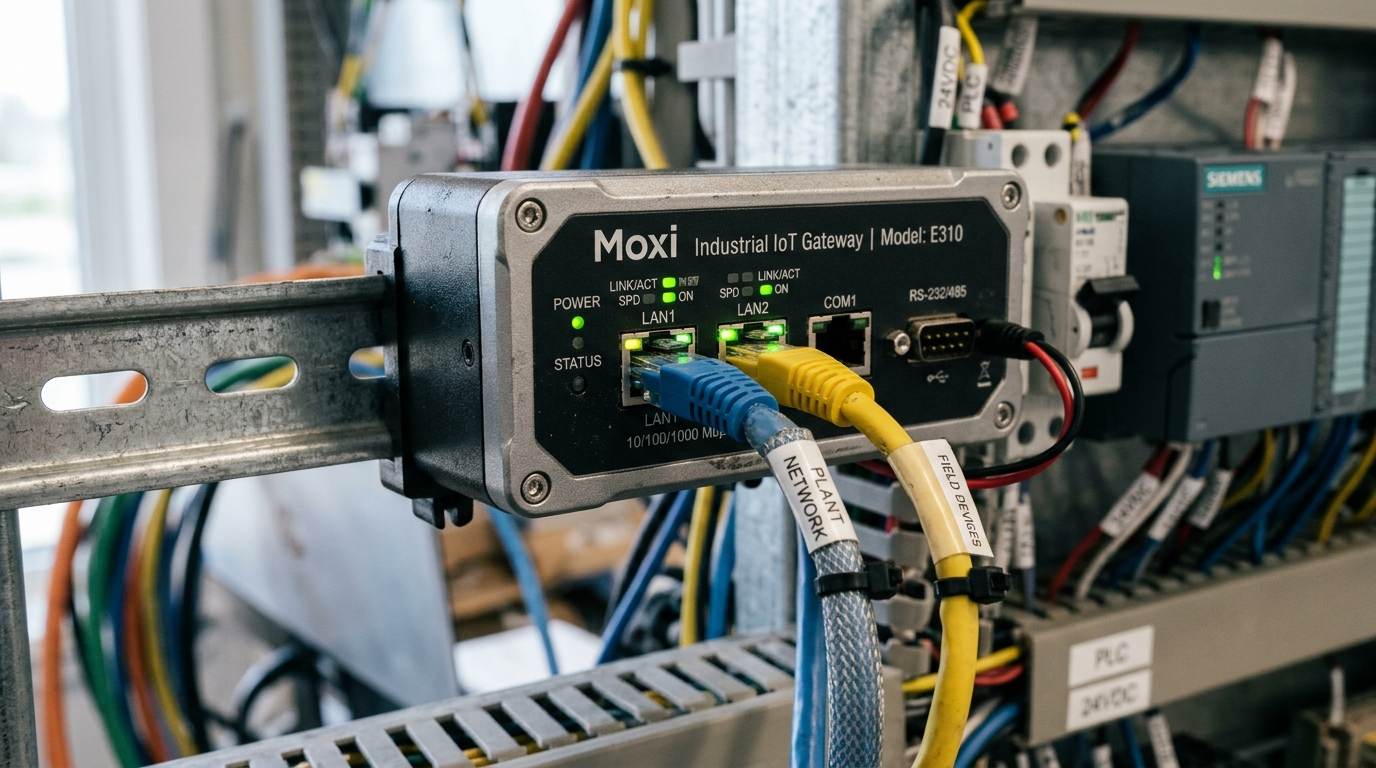
These terms get used interchangeably in sales decks. They shouldn’t be. A router forwards network packets between IP networks. An IoT gateway can also route, but its defining capability is application-level work: protocol translation, data transformation, device management. An edge device runs workloads near the data source, which may or may not include gateway functions.
| Concept | Primary role | Key distinction |
|---|---|---|
| IP router | Forwards traffic between IP networks | No application-level data conversion or device management |
| IoT gateway | Bridges devices and applications across protocol or processing boundaries | Can be hardware, software, or both |
| Edge computer | Runs workloads near the data source | May host gateway functions, but local computation is a broader role |
| LoRaWAN gateway | Forwards radio packets between devices and a network server over IP | Does not necessarily interpret application payloads |
| Thread border router | Connects Thread mesh network to Wi-Fi/Ethernet infrastructure | Routes IPv6 traffic; not inherently an application translator |
The LoRaWAN distinction is worth highlighting. In LoRaWAN architecture, gateways forward payloads without interpreting them. The network server handles deduplication and routing. Saying “all gateways translate sensor data” is simply too broad.
Eclipse Kura illustrates the overlap from the other direction: it combines protocol integration, local processing, and device management in an open-source framework that can run on hardware ranging from a Raspberry Pi to an industrial edge computer. The label matters less than the functions. Specify what you need the device to do, then choose accordingly.
When You Need a Gateway (and When Direct-to-Cloud Works)
Not every IoT deployment benefits from a gateway. The question is practical, not ideological: does adding this layer solve a problem that justifies its cost, complexity, and long-term maintenance?
You likely need a gateway when:
- Your devices speak different protocols. A factory floor with Modbus RTU PLCs, BLE vibration sensors, and legacy serial equipment needs a unifying layer before data reaches the application.
- Bandwidth or power is constrained. Sending every raw reading to the cloud over cellular gets expensive. A gateway that filters and aggregates before transmitting can cut data costs dramatically.
- Connectivity is intermittent. Remote sites, vessels at sea, aircraft on the ground between flights. The gateway buffers locally and forwards when the link returns.
- You need local response times. If a temperature threshold must trigger a compressor shutdown, waiting for a cloud round-trip is unacceptable. Local logic at the gateway handles it in milliseconds.
- You’re connecting legacy equipment. Machines that predate IP networking by decades still generate valuable data. A gateway translates their native protocols into something modern systems understand.
- You’re aggregating many sensors in one location. In a Migros supermarket deployment, a single gateway served 70 to 100 temperature sensors per store, monitoring cooling units for food-safety compliance. That many-to-one ratio is where gateways earn their keep.
You probably don’t need one when:
- Your devices already have IP connectivity and speak MQTT or HTTPS natively.
- You’re deploying a small number of endpoints with reliable, always-on connectivity.
- The data volume is low enough that preprocessing doesn’t save meaningful cost.
AWS explicitly frames this as a decision based on application requirements, sensor characteristics, and network conditions. Not a default inclusion. If someone tells you every IoT project needs a gateway, they’re probably selling one.
The Protocol Translation Trap
Connecting two devices is not the same as making them understand each other.
A gateway that converts Modbus to MQTT has solved the transport problem. But if the receiving application doesn’t know that register 40001 represents inlet pressure in PSI while register 40002 is outlet temperature in Celsius, the data arrives meaningless. Protocol translation without semantic alignment is plumbing, not intelligence.
OPC UA addresses this through information models that encompass process data, alarms, historical records, and methods. Companion Specifications standardize domain-specific structures so that a pump from one manufacturer describes itself the same way as a pump from another. MQTT, by contrast, provides messaging but doesn’t prescribe topic namespaces or payload encoding. The Eclipse Sparkplug specification adds an industrial topic structure, payload definition, and session-state management on top of MQTT.
When evaluating a gateway, ask two questions: “Can it connect?” and “Will the application actually interpret the data correctly?” The first is easy to demo. The second is where integration projects stall for months.
Security at the Gateway: It’s Configuration, Not a Feature List
The gateway sits between your devices and your network. That makes it either a security control point or an attack surface. Which one depends entirely on how it’s configured and maintained.
In August 2026, CISA published an advisory for the Siemens SIMATIC IoT2050 Advanced with a CVSS score of 10.0 (the maximum). The vulnerability: an unauthenticated Node-RED interface in a specific configuration enabled arbitrary code execution. The fix was a software update to V4.3.4.1. A well-known industrial gateway, from a major manufacturer, with a critical vulnerability that depended on which software was installed and how it was configured.
That’s not an outlier. NIST’s IoT Device Cybersecurity Capability Core Baseline defines foundational capabilities every IoT device should support: device identification, authorized configuration, restricted interface access, secure software updates, and cybersecurity-state awareness. These are minimums, not extras.
A practical gateway security evaluation covers:
- What interfaces are exposed by default, and which can be disabled?
- How are credentials provisioned and rotated?
- How quickly does the vendor release patches after a vulnerability disclosure?
- Can updates be applied remotely without physical access?
- What is the documented end-of-support date?
CISA’s acquisition guidance treats security as a lifecycle issue, not something you check once during procurement and forget. Network segmentation, patch-support duration, and operational continuity all belong in the purchase decision.
Build, Buy, or Managed Service: Where the Real Cost Lives
The gateway hardware is the smallest line item. Always.
Total cost includes power supplies, antennas, enclosures, installation labor, cellular or satellite plans, cloud ingestion fees, protocol licensing, integration development, monitoring, patch management, spare inventory, and eventual migration when the product reaches end of life. Enterprise spending on IoT controllers and gateways fell 8% in 2024, even as IoT software spending grew over 20%. That split tells you where the ongoing expense actually concentrates.
Three paths, each with different trade-offs:
Buy an industrial appliance. Siemens, Moxa, and similar manufacturers build purpose-built hardware with industrial certifications and protocol support. A typical example: a LoRaWAN gateway paired with vibration sensors and predictive-maintenance software for a compressor monitoring deployment. The benefit: tested hardware, vendor support, known integration paths. The risk: dependency on that vendor’s roadmap and patching cadence.
Deploy a managed edge platform. AWS IoT Greengrass and Microsoft Azure IoT Operations provide runtimes, connectors, and management that run on compatible hardware. Greengrass v2.17 introduced non-root Linux operation and lighter components (the Secure Tunneling lite component uses 4 MB versus 36 MB for the standard version). The benefit: programmable workloads, fleet management, cloud-native integration. The risk: platform dependency. When Google discontinued IoT Core in August 2023, every deployment built on it needed re-architecture. Technically functional gateways became stranded assets overnight.
Build on open-source frameworks. Eclipse Kura supports MQTT, Modbus, OPC UA, and runs on hardware from Raspberry Pi to Nvidia Jetson Nano. The benefit: architectural control, no vendor lock-in. The cost: you own the integration, security patching, recovery procedures, and long-term support. That ownership has a salary attached to it.
None of these paths eliminates lifecycle responsibility. They redistribute it. The honest evaluation asks: does our team have the capacity to maintain this for the next five to ten years?
Choosing a Gateway That Outlasts Your Deployment
Gateways are evolving in two directions simultaneously. Enterprise platforms add richer orchestration and data processing. Lightweight runtimes reduce resource and privilege requirements. Both trends respond to the same reality: 18.5 billion connected IoT devices were counted in 2024, with projections reaching 39 billion by 2030. The infrastructure deployed today has to coexist with whatever comes next.
Four factors determine whether a gateway choice ages well:
Network sunset planning. The 2G/3G shutdowns caught some deployments by surprise. If your gateway relies on cellular IoT connectivity, verify the modem supports the bands and technologies your carriers will operate for the equipment’s expected life. For remote sites with no terrestrial coverage, understanding what is satellite IoT can shape your connectivity plan. 4G will be around for years. “Years” is not a specification.
Firmware and security support commitments. The EU Cyber Resilience Act, which entered into force December 10, 2024, requires manufacturers to identify the support period and handle vulnerabilities throughout it. Vulnerability reporting obligations apply from September 2026. Main provisions apply from December 2027. Even outside the EU, this sets a procurement standard worth adopting. Demand a documented support commitment before you buy.
Cloud portability. Google IoT Core’s discontinuation is the cautionary tale everyone knows and few actually plan for. Preserve exportable data formats, replaceable upstream connectors, and a credible migration path. If the gateway’s management plane is inseparable from a single cloud provider, that’s a business risk masquerading as technical architecture.
Offline resilience (actually tested). “Edge processing” implies it works without the internet. Sometimes it does. Microsoft’s Azure IoT Operations documents a maximum 72-hour offline operating period with possible degradation. Test what actually happens when your gateway loses its upstream connection for a day, a week, a month. The specification sheet and the field behavior may disagree substantially.
Choosing for adaptability costs slightly more upfront. Choosing for cheapest-today costs significantly more in year four.
Where Gateways Fit in Asset Tracking
At Datanet, we integrate IoT solutions across aviation, logistics, and industrial operations. Gateways are part of the architecture when they need to be. But in asset tracking, they’re often not the headline.
A cellular tracker like the Oyster3 has GNSS for positioning and a cellular modem for direct cloud communication. No intermediary needed. The device connects to the platform directly. For most container tracking, fleet visibility, and MRO tool tracking scenarios, this direct-to-cloud approach is simpler, cheaper, and easier to maintain.
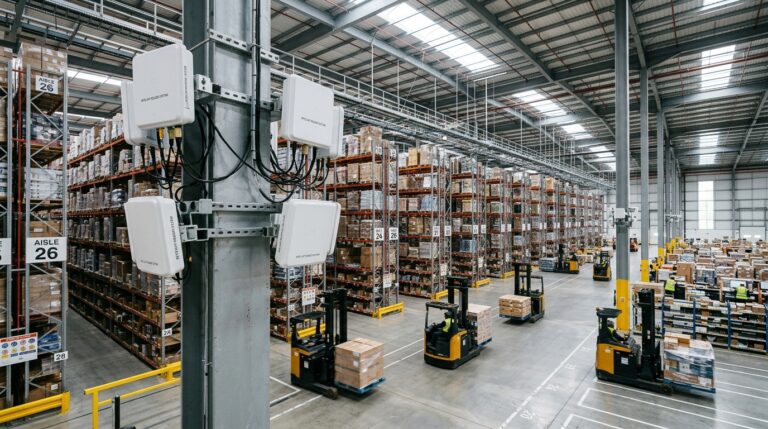
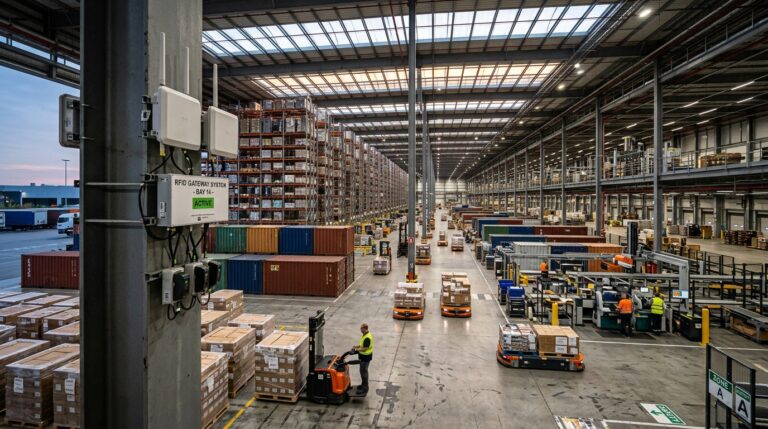
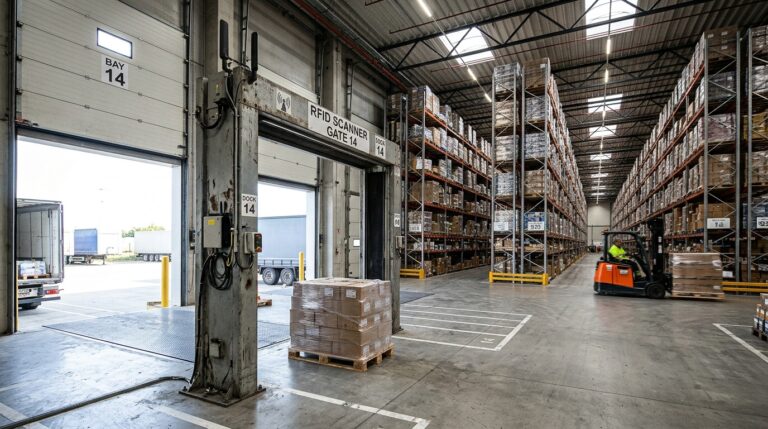
Gateways become relevant in specific situations: aggregating data from dozens of BLE-tagged ground support equipment units in a maintenance hangar, concentrating environmental readings from cold-chain containers in a port yard before uplinking, or bridging legacy equipment data into a modern visibility platform. Those are real use cases where the many-to-one ratio and the protocol-bridging need justify the extra layer.
The decision framework stays the same. Does the gateway solve a specific connectivity, power, bandwidth, or protocol problem the endpoint can’t solve on its own? If yes, add it. If not, keep the architecture simple.
If you’re working through this decision for your fleet, warehouse, or MRO operation, talk to our team. We’ll give you a straight answer on whether a gateway belongs in your deployment or not. Sometimes the honest recommendation is: skip it.

Frequently Asked Questions
Do all IoT devices need a gateway?
No. Devices with native IP connectivity and sufficient processing power can communicate directly with cloud platforms or applications. A gateway adds value when it solves a protocol mismatch, bandwidth constraint, power limitation, or reliability problem that the endpoint device can’t handle alone.
What is the difference between an IoT gateway and a router?
A router forwards network packets between IP networks. An IoT gateway can also route, but its defining role includes application-level functions: protocol translation, data preprocessing, device management, and local logic. Many gateways contain a router. Not every router is a gateway.
Can an IoT gateway work without internet access?
Some local functions can operate during connectivity loss, including buffering data, executing local rules, and triggering threshold alerts. Duration and capability vary by product. Microsoft Azure IoT Operations documents a maximum 72-hour offline period with possible degradation. Always test actual disconnection behavior in your environment.
How much does an IoT gateway cost?
Hardware ranges from a few hundred to several thousand dollars, but the unit price is misleading. Total deployment cost includes installation, connectivity plans, cloud fees, integration development, monitoring, patching, and eventual replacement. Compare full lifecycle cost across five to ten years, not the sticker on the device.
Is an IoT gateway the same as an edge device?
They overlap but aren’t identical. A gateway is defined by its bridging role between devices and applications. An edge device is defined by running workloads near the data source. One device can perform both roles. The distinction matters when specifying requirements: you may need protocol translation, local computation, or both.
Does the Matter protocol eliminate the need for gateways?
Not universally. Matter uses IPv6 over Wi-Fi, Ethernet, and Thread, but Thread devices still need a border router to reach adjacent networks. Non-Matter devices require a bridge to participate. Matter reduces fragmentation within its ecosystem but doesn’t remove every intermediary from every deployment.





 +1 508 292 2210

3 Responses