

How much do active RFID tags cost? The internet will give you a range of $15 to $150 and call it an answer. That’s about as useful as saying a vehicle costs “somewhere between $20,000 and $200,000.” Accurate, technically. Useless, practically.
I’ve deployed IoT tracking systems across aviation MRO, freight forwarding, and industrial logistics for over 15 years. The single most expensive mistake I see in active RFID projects isn’t overpaying for tags. It’s confusing the per-tag price with the cost of the system. They are related the way a tire price is related to operating a fleet.
Here’s what the real numbers look like, what drives them, and how to build a budget that doesn’t collapse on first contact with procurement.
What One Active RFID Tag Actually Costs
Let me give you a concrete number first.
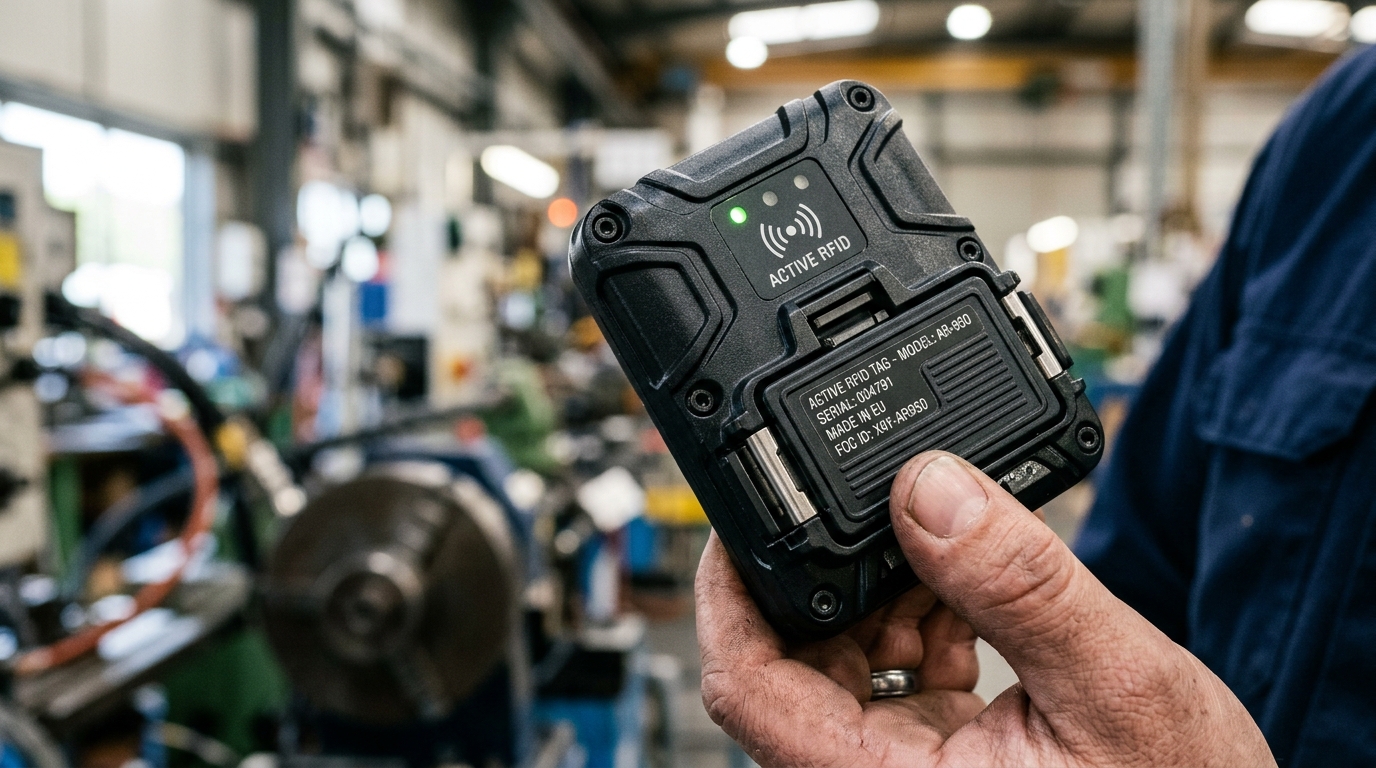
RFID, Inc. lists conventional 433 MHz active tags at $35 to $45 each, depending on the model. These are catalog prices from an identifiable manufacturer, not analyst estimates. The AT-CS and AT-MM sit at $35. The weatherproof AT-DC runs $40. Motion-sensor variants reach $45.
RFID Journal places the general starting point at $25 and up, noting that specialized housings, longer battery life, or embedded sensors push tags to $100 or more. Industry system-cost guides for 2026 generally estimate active tags at $10 to $50+, depending on specifications and volume.
These numbers don’t conflict. They describe different products solving different problems. The table below shows why.
| Product | Published Price | What You Get |
|---|---|---|
| RFID, Inc. AT-CS / AT-MM (433 MHz) | $35 | Standard active identification |
| RFID, Inc. AT-DC (433 MHz, IP69) | $40 | Weatherproof enclosure |
| RFID, Inc. AT-OM (433 MHz, motion sensor) | $45 | Motion detection capability |
| Minew MTB09 / MTB10 (BLE) | $3.99 | Small BLE beacon (not 433 MHz compatible) |
| Minew MTB11 (BLE, light-harvested) | $18 | Battery-free, ambient-light-powered |
| GrowSpace Q1 (UWB) | $277 | Centimeter-precision UWB positioning tag |
A $3.99 BLE tag and a $277 UWB tag both appear in “active tracking” conversations. They use different radios, different infrastructure, and different software. Comparing them on unit price is like comparing a bicycle and a forklift because both have wheels.
Why Per-Tag Pricing Misleads Every Budget
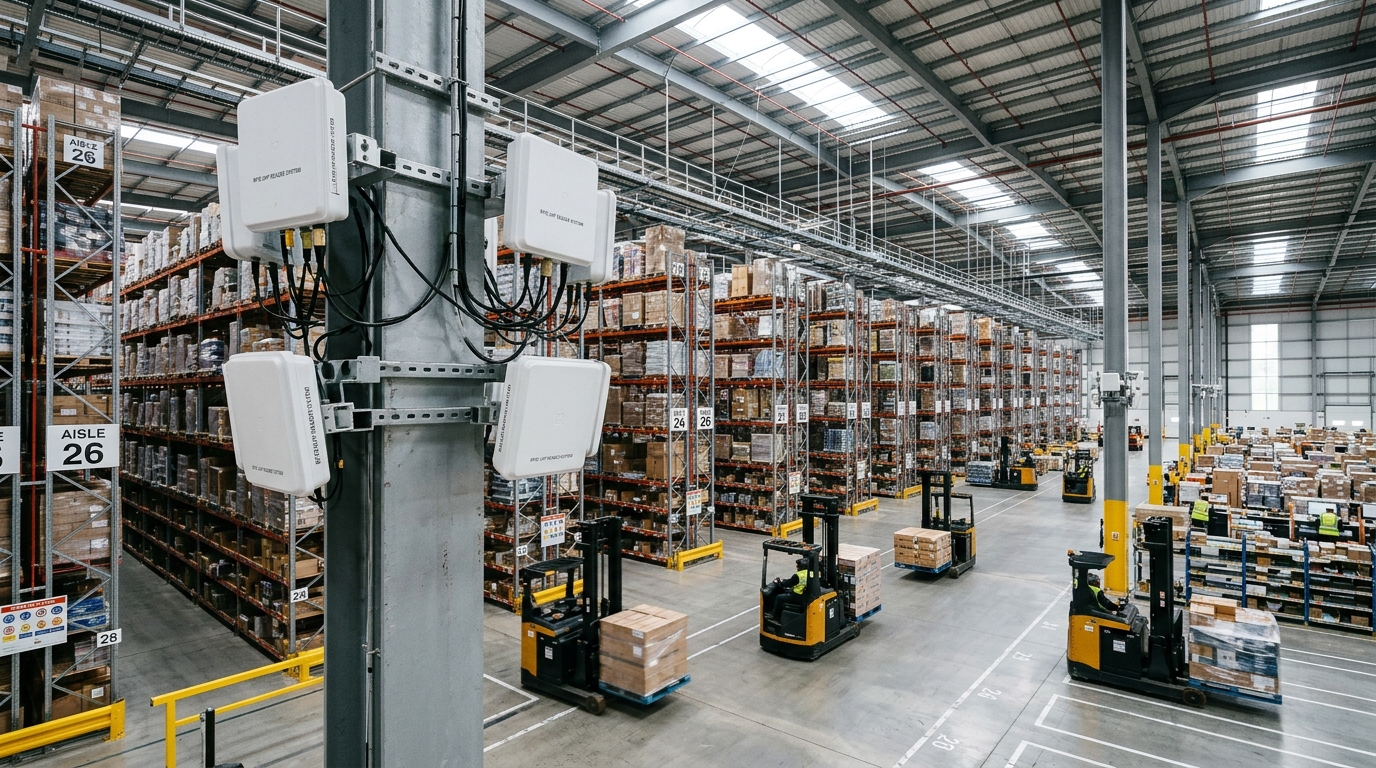
A tag does nothing by itself. It needs readers, software, installation, and maintenance. The tag is the most visible line item and often the smallest one.
Here’s an illustrative budget for 1,000 active tags. This is not an engineering design. It’s a planning exercise using published prices.
| Component | Calculation | Estimated Cost |
|---|---|---|
| Active tags (1,000 units) | 1,000 × $35 to $45 (RFID, Inc. catalog) | $35,000 to $45,000 |
| Active readers (10 units) | 10 × $1,250 to $1,500 (AMI estimate) | $12,500 to $15,000 |
| Hardware subtotal | $47,500 to $60,000 |
That hardware subtotal, built from RFID, Inc.’s published tag prices and published active reader cost estimates, excludes locators, networking, mounting hardware, cabling, installation labor, software licenses, middleware, ERP integration, battery replacement, training, and eventual disposal. Every one of those is a real line item. Teams planning similar deployments for vehicle or equipment fleets should review comprehensive fleet tracking cost breakdowns to understand full system economics.
Then there are subscriptions. Some UWB RTLS vendors list production starter kits in the $6,000 to $8,000 range, with annual production licenses billed at over $2,000 from year two onward. Over five years, that recurring cost exceeds the original hardware purchase. Many RTLS platforms follow a similar model: a reasonable upfront price, then software fees that compound quietly year after year.
And don’t overlook your people’s time. Training warehouse or ramp staff, configuring software, debugging false reads, adapting workflows. Those hours don’t appear on any vendor quote, but they represent real operational cost during the first six to twelve months.
All of this is why “how much does an active tag cost” is the wrong question. The better question: what does it cost to reliably know where 1,000 assets are over the next three to five years?
Active, Passive, and BLE Are Different Purchases
GS1 defines an active tag as one with its own radio transmitter and usually its own power source. Passive tags harvest energy from the reader’s signal and communicate through backscatter. Battery-assisted passive (BAP) tags use a battery to power onboard circuitry while still relying on backscatter for communication. A battery alone does not make a tag active. The transmitter does.
BLE and UWB appear alongside traditional active RFID in asset tracking discussions, but they are not interchangeable. They use different radios, different readers (or gateways), and different software ecosystems. For wide-area deployments, it’s also worth understanding what cellular IoT is and, for truly remote coverage, what satellite IoT is and where each fits.
| Technology | Typical Tag Cost | Infrastructure | Best For |
|---|---|---|---|
| Passive RFID (UHF) | $0.05 to $10 | Readers at chokepoints; no tag battery | Identification at fixed locations (dock doors, gates) |
| Active RFID (433 MHz) | $25 to $100+ | Active readers/locators; tags transmit autonomously | Wide-area asset visibility, multi-year battery life |
| BLE asset tags | $3.99 to $18 | BLE gateways; smartphone-readable | Indoor tracking, moderate accuracy, cost-sensitive |
| UWB positioning tags | $175 to $277 | UWB anchors and gateways | Centimeter-precision indoor location |
The cheapest option in the table is a $0.05 passive inlay. The most expensive is a $277 UWB tag. Both are legitimate tools. Neither replaces the other. Your choice depends on what location accuracy the operation actually needs, whether the environment supports the radio technology, and how the data integrates into your workflow.
Five Factors That Move Your Price
Knowing the catalog price is step one. Knowing why your price will differ from it is step two.
1. Enclosure and operating environment. A tag tracking containers in a port yard needs different packaging than one monitoring medical carts indoors. RFID Journal identifies protective housings as a primary cost driver, pushing tags from the $25 range to $100 or more. In aviation and airfreight, DO-160 certification adds engineering, testing, and documentation cost that lands squarely on the unit price. Metal surfaces, extreme temperatures, chemical exposure, and high-pressure washdowns all demand specialized packaging.
2. Battery life and transmission interval. Active tag lifespan depends directly on battery capacity and how often the tag transmits. A tag pinging every second drains its battery orders of magnitude faster than one reporting every 10 minutes. Some manufacturers advertise up to 10 years of battery life for active tags with configurable transmission intervals ranging from sub-second to multiple hours. That’s at specific settings. Always request battery estimates at your proposed operating parameters, not the vendor’s best-case datasheet number.
3. Onboard sensors. Temperature, humidity, motion, tamper detection. Every sensor adds component cost and power consumption. If you don’t need temperature monitoring, don’t pay for it. I’ve seen procurement teams specify sensor-equipped tags for an entire fleet when only 10% of the assets needed environmental data. That’s 90% wasted spending on features nobody reads.
4. Volume. RFID, Inc. invites bulk quotations without publishing a specific discount curve. The industry norm is meaningful price breaks starting around 1,000 units. But volume pricing only matters when you’re buying compatible specifications. Ten thousand units of the wrong tag is a loss, not a savings.
5. Software and integration complexity. Software and integration cost varies significantly by deployment. A standalone tracking dashboard is one price. Feeding location data into your ERP, WMS, or MRO platform is another. The integration often costs more than the tags themselves. If a vendor can’t give you a clear integration estimate, that’s a risk signal, not a detail to sort out later.
What Real Deployments Actually Cost
Published case studies deliver something pricing tables cannot: evidence of what happens after the purchase order gets signed.
NHS Forth Valley: the hybrid model that pays for itself
NHS Forth Valley deployed 14,000 passive tags and 4,000 active tags across its equipment population. Active tracking went on high-value, high-mobility assets. Passive identification handled the rest. The investment: approximately GBP 200,000. The cost avoidance: GBP 360,000, primarily from eliminating unnecessary equipment re-purchases because staff could actually find what they already had.
The lesson: you do not need active tags on everything. Segment your assets by the cost of not knowing where they are. Put continuous tracking where search time, downtime, or unnecessary replacement purchases justify it. Use cheaper identification for the rest.
BMW and KINEXON: the value is in orchestration, not hardware
KINEXON reports its platform running as production-critical at 11 BMW plants across four continents, tracking 65,000 assets and 20,000 vehicles daily, with more than $10M in reported annual operational savings. The platform combines RFID, UWB, GPS, Wi-Fi, and NFC. No single tag technology generated that number. The savings came from integrating location data into production decision-making.
This is the point most pricing guides miss entirely. A $35 tag produces zero value if the data it generates doesn’t eliminate a task, shorten a cycle, or prevent a loss.
A university hospital: when working tags build a failing system
A peer-reviewed feasibility study at a university hospital attached active BLE/Wi-Fi tags to 400 surgical instruments. Development required 30 developers over 13 months. The outcome: unreliable location data, insufficient update frequency for the emergency department, and tags that kept losing adhesion and falling off equipment.
The radios transmitted. The system failed. This is the risk of optimizing for per-tag cost without validating the actual workflow. A cheap tag that falls off creates more search work than no tag at all.
Princess Alexandra Hospital: the pilot that saved a rollout
Princess Alexandra Hospital rejected its initial RTLS proof of concept when roughly 6-meter accuracy proved inadequate for its requirements. After refinement, the system delivered: controlled-drug keys located within 10 minutes with 100% retrieval rate, and time spent finding 15 Bair Huggers cut from eight hours to one hour per week.
The pilot cost far less than a failed rollout would have. Budget for one.
Battery-Free Tags and the 2025-2026 Shift
The biggest recent change isn’t a collapse in conventional active tag prices. It’s the arrival of tags that eliminate batteries entirely.
In mid-2025, the first mass-produced ambient-light-powered BLE tracker was announced, priced around $18. In October 2025, Powercast and InPlay introduced an RF-powered BLE sensor tag with a 1.2mm form factor and wireless power reception at up to 85 feet (that’s the power range, not positioning accuracy). Understanding how far RFID tags can be read is crucial when evaluating RF-powered systems. In June 2026, Identiv launched ID-Pixels 3.0, battery-free BLE inlays using harvested Bluetooth and UHF energy.
These are shipping products, not roadmap slides. But they shift the trade-off rather than remove it. A light-powered tag needs light. An RF-powered tag needs RF energy infrastructure. Battery replacement disappears; energy-environment planning appears in its place. If you’re evaluating these for a specific application, test them in your actual operating conditions.
Meanwhile, ISO/IEC 18000-7, the 433 MHz active RFID air-interface standard, was confirmed in 2025. Conventional active RFID isn’t going anywhere. It coexists with BLE, UWB, and energy-harvesting technologies rather than being replaced by them.
Plan for coexistence. Do not postpone a justified project on the unsupported assumption that all tags will soon become nearly free.
Building a Budget That Survives Contact with Reality
Here’s the framework I use with operations teams planning their first active tracking deployment.
Step 1: Name the decision the data enables. “Find pump X within 5 minutes” is a requirement. “Track assets” is not. If you can’t name the operational decision or the time it saves, you can’t calculate ROI.
Step 2: Segment assets by tracking need. Not everything requires real-time active tracking. Some assets need identification at chokepoints (passive RFID). Some need periodic location updates (BLE or active with long intervals). A small subset may need continuous high-precision visibility (UWB or active with short intervals). The NHS Forth Valley split (active on 4,000 high-value assets, passive on 14,000 others) is a model worth studying.
Here’s a distinction that matters more than most teams realize: if your tracking need ends at delivery, that’s shipment tracking, and passive RFID at dock doors may be enough. If you need visibility through the full asset cycle (return, dwell time, reuse, maintenance), that’s asset tracking. Active technology earns its price when it covers the parts of the cycle where assets become invisible.
Step 3: Budget the system, not the tag. Total cost of ownership includes tags, readers or gateways, installation, software, integration, training, maintenance, battery replacement, and eventual disposal. Active tags with batteries are electronic waste in most jurisdictions, so disposal is not free either. If a vendor quotes you only the tag price, you’re looking at roughly 40% to 60% of the actual first-year spend.
Step 4: Pilot before you scale. Princess Alexandra Hospital’s initial proof of concept failed at 6-meter accuracy. After refinement, the system worked. The pilot prevented a six-figure mistake. Budget $10,000 to $25,000 for a meaningful proof of concept. It’s the cheapest insurance in the project.
Step 5: Evaluate the ecosystem, not the datasheet. Request quotes that cover the same asset count, site conditions, update interval, location accuracy, installation scope, software, service term, and replacement policy. Require separate line items for tags, infrastructure, software, deployment, and ongoing support. The lowest per-tag price is frequently not the lowest ownership cost.
At Datanet, we build asset tracking systems that match the right technology to each layer of the problem. From DO-160 certified airfreight trackers to ruggedized industrial devices, the goal is the same: make asset visibility reliable enough to drive decisions, not just generate data points. If your team is building a business case and needs help separating tag cost from system cost, reach out. That’s the conversation where budgets stop being guesses.
Frequently Asked Questions
How much does a single active RFID tag cost?
Plan for $15 to $150 depending on specifications. For a concrete benchmark, RFID, Inc. lists conventional 433 MHz active tags at $35 to $45 each. Specialized enclosures, onboard sensors, or extended battery life push prices above $100.
What’s the total cost of an active RFID system for 1,000 assets?
Hardware alone (tags plus readers) runs approximately $47,500 to $60,000 based on published catalog and estimate data. The complete installed system, including software, integration, and training, typically costs 1.5x to 2.5x the hardware subtotal depending on site complexity.
How long do active RFID tag batteries last?
Manufacturers advertise 3 to 10 years, but actual life varies with transmission frequency and operating conditions. Some vendors claim up to 10 years at specific, optimized settings. Request estimates based on your intended update interval, not the vendor’s best-case number.
Are BLE tags a cheaper alternative to active RFID?
Per unit, yes. BLE asset tags can start under $5. But BLE uses different infrastructure (gateways, not 433 MHz readers) and delivers different accuracy. A cheaper tag that requires more gateways to achieve the same coverage can narrow or reverse the cost gap at the system level.
Can I mix active and passive RFID in one deployment?
Yes, and most mature deployments do exactly this. NHS Forth Valley used active tags on 4,000 high-value assets and passive tags on 14,000 others, achieving GBP 360,000 in cost avoidance from a GBP 200,000 investment. Segment by the operational cost of not knowing where an asset is.
Do active RFID systems have monthly or annual fees?
Most do. Software licenses, cloud hosting, and support contracts are standard. Some UWB RTLS vendors charge over $2,000 annually for production licenses starting in year two. Always request the full five-year ownership cost before comparing vendors on tag price alone.





 +1 508 292 2210

One Response