

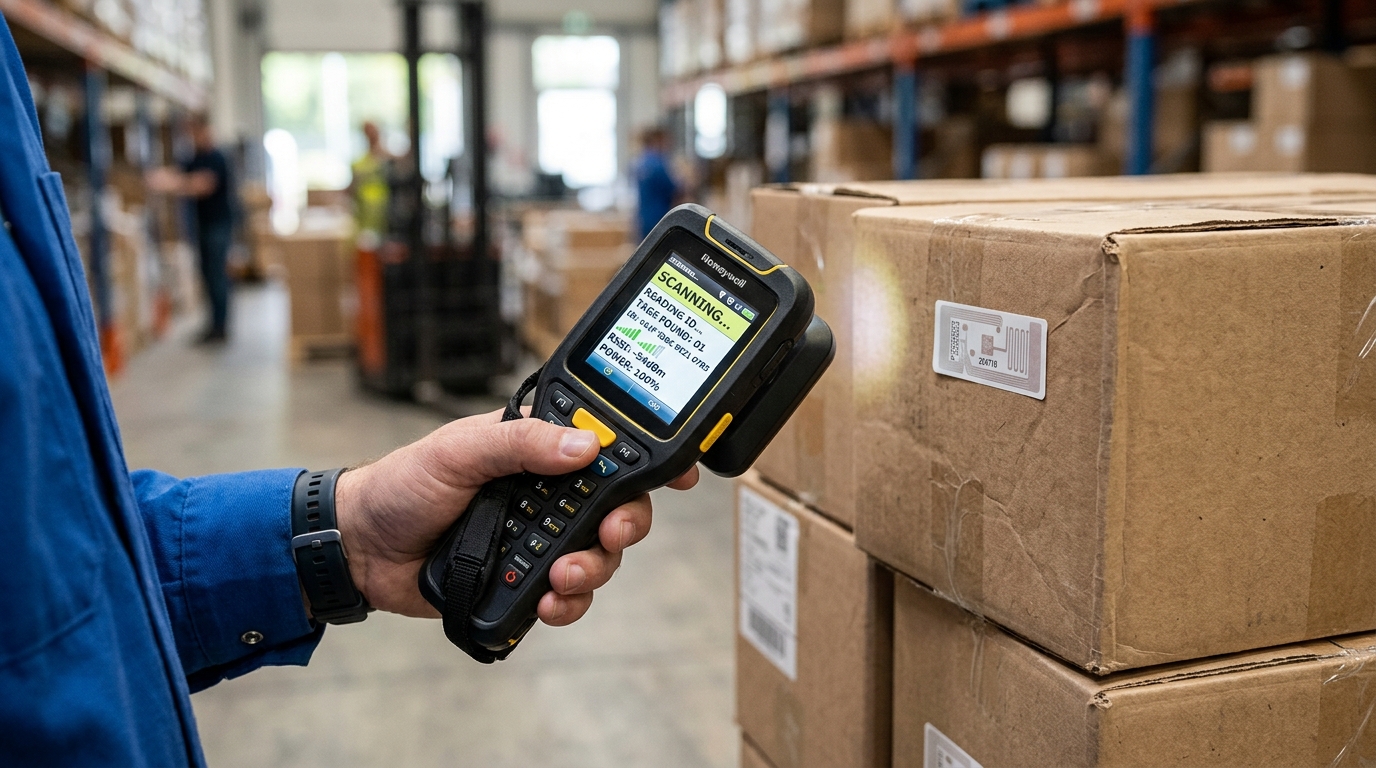
How far can RFID tags be read? The short answer: anywhere from 2 centimeters to over 200 meters. The useful answer: it depends on the tag type, the frequency, the reader, the material you’re mounting on, and the regulatory limits of the country you’re operating in. A spec sheet number and a warehouse floor number are rarely the same thing.
I’ve spent 15+ years deploying IoT tracking in aviation, logistics, and industrial settings. The single most common source of disappointment in RFID rollouts isn’t bad hardware. It’s buying based on maximum advertised range instead of reliable, repeatable read-zone performance in the actual operating environment.
This guide breaks down what determines RFID read distance, what the numbers actually look like by tag type and frequency, and how to think about range as a business decision rather than a physics contest.
RFID Read Range by Tag Type: The Quick Reference
Before we get into the “why,” here are the numbers. This table reflects published specifications and field reality, not aspirational marketing.
| RFID Type | Frequency | Typical Read Range | Maximum (Ideal Conditions) |
|---|---|---|---|
| LF Passive | 125/134 kHz | 10–50 cm (4–20 in) | ~1 m with specialized readers |
| HF Passive | 13.56 MHz | 10 cm–1 m (4 in–3.3 ft) | ~1.5 m with vicinity-coupled readers |
| NFC (subset of HF) | 13.56 MHz | 2–7 cm (phone-dependent) | ~10 cm with dedicated reader |
| UHF Passive (RAIN) | 860–960 MHz | 3–10 m (10–33 ft) | 15–20 m with phased-array antennas |
| Specialty Passive UHF (on-metal) | 860–960 MHz | 5–15 m | 40 m (Xerafy, specific config) |
| Battery-Assisted Passive (BAP) | 860–960 MHz | 10–30 m | 60 m (Confidex Survivor B, lab) |
| Active RFID | 433 MHz / 2.4 GHz | 30–100 m | 122–200 m (outdoors, unobstructed) |
Sources: GS1 frequency overview lists LF at 10–50 cm, HF at 10 cm–1 m, and UHF as environment-dependent. GS1 describes passive UHF as “several meters” with special configurations reaching 15–20 m. EUIPO describes active RFID reaching up to 200 m, with specific examples of 122 m outdoors for industrial active tags at 433 MHz.
Notice the spread within each category. A “passive UHF tag” can mean 3 meters on a cardboard box or 40 meters on a steel container. The category name tells you very little. The configuration tells you everything.
Why Frequency Is the First Variable, Not the Only One
RFID operates across three main frequency bands, and each one exists because it solves a different physical problem.
Low Frequency (125–134 kHz) penetrates water and animal tissue better than higher bands. That’s why it’s the standard for livestock implants and some access control cards. The trade-off: short range (under 50 cm typically) and slow data transfer. If you’re reading a pet microchip or an employee badge at a door, LF does the job. If you need to read 500 pallets rolling through a dock door, it doesn’t.
High Frequency (13.56 MHz) covers NFC payments, library books, and pharmaceutical anti-counterfeiting. Range tops out around a meter in most implementations. NXP lists up to 4 cm for proximity and 7 cm for vicinity applications on smartphones. The NFC Forum’s 2025 Release 15 expanded the specified operating distance from 0.5 cm to 2 cm, which is about making tap interactions more forgiving, not competing with warehouse-scale identification.
Ultra-High Frequency (860–960 MHz) is where supply chain, logistics, and asset tracking live. This is the band where read ranges stretch from a few meters to double digits. It’s also where environmental factors hit hardest: metal reflects UHF signals, water absorbs them, and nearby tags can interfere with each other. Most of what follows in this article concerns UHF, because that’s where the question “how far?” actually shapes operational decisions.
The Physics That Spec Sheets Skip
A passive UHF tag has no battery. It harvests energy from the reader’s radio signal, uses that energy to power its chip, then reflects a modulated signal back. This means two things have to work simultaneously:
- The reader must deliver enough power to wake the tag up (the “forward link”).
- The reader must detect the tag’s faint reflected signal (the “return link”).
Nikitin and Rao’s engineering analysis identifies chip sensitivity, antenna gain, impedance matching, polarization, and reader sensitivity as separate constraints in each link. One important result from their work: doubling the available power increases idealized range by roughly 41%, not 100%. The relationship is a square-root function. Throwing more watts at the problem gives diminishing returns.
Polarization adds another layer. A circularly polarized reader antenna can read linearly polarized tags at various orientations, which is useful when you can’t control how a tag sits on an asset. But that flexibility costs about 3 dB of signal, which translates to reduced range.
This is why a tag rated at 10 meters in a lab can deliver 4 meters in a warehouse full of metal shelving and forklifts. The lab number assumed a single tag in free space, perfectly oriented, with an optimized reader. Your warehouse assumes none of those things.
Lab Range vs. Field Range: Where the Gap Comes From
Every RFID deployment I’ve been involved with has a moment where someone says: “The tag says 12 meters on the datasheet. We’re getting 5. What’s wrong?”
Usually, nothing is wrong. The datasheet described a ceiling. The field delivered a floor. The gap comes from predictable factors:
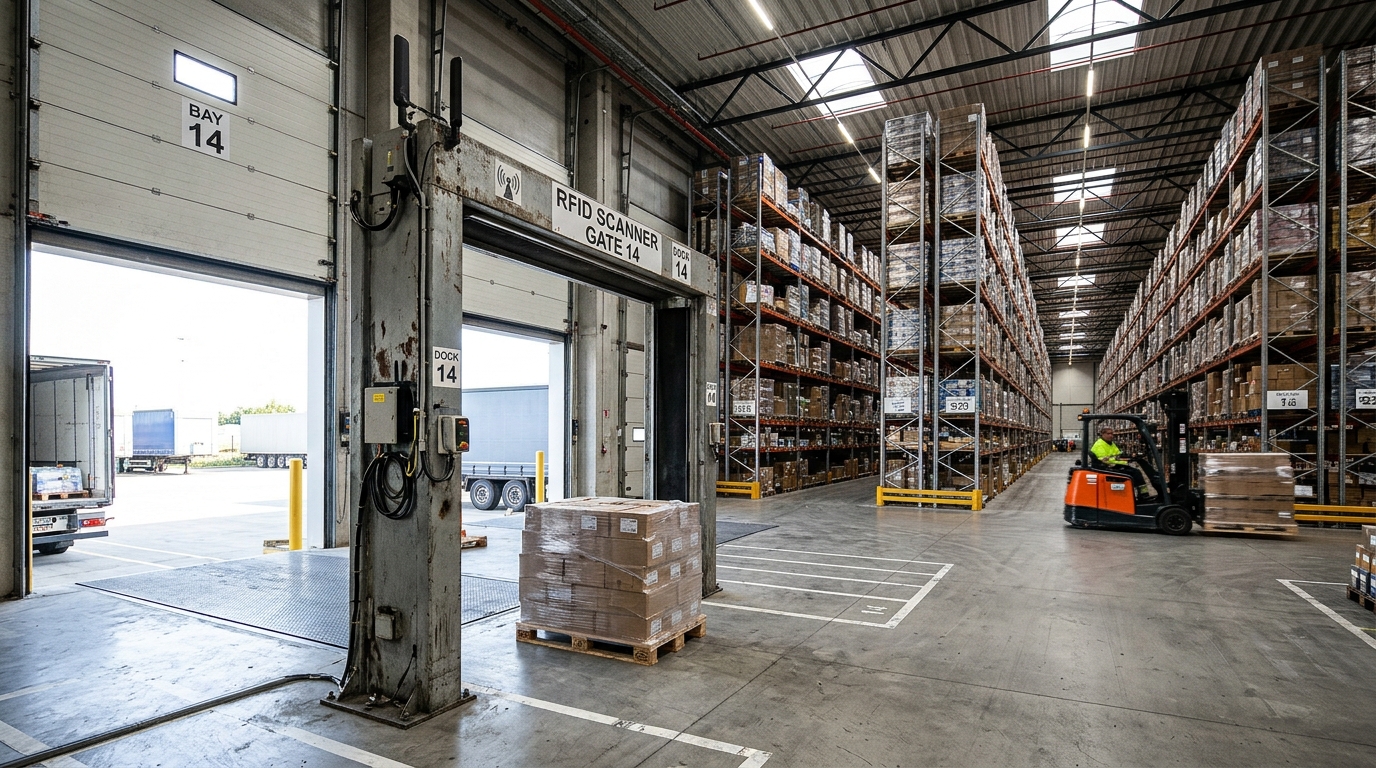
Metal and liquids. UHF radio waves reflect off metal surfaces and get absorbed by water. A tag stuck directly on a steel asset will detune badly unless it’s designed for on-metal use. Products like Zebra’s Silverline labels and other specialty industrial on-metal tags are engineered with spacers and antenna geometries that use the metal surface as part of the antenna system. Specialty on-metal passive UHF tags can reach 40 meters in specific configurations, precisely because the antenna design exploits the metal surface. An ordinary paper label on the same surface might read at 1 meter or not at all.
Water’s RF absorption properties create similar challenges across IoT sensor applications. See also: aquaculture pH monitoring and water quality sensors.
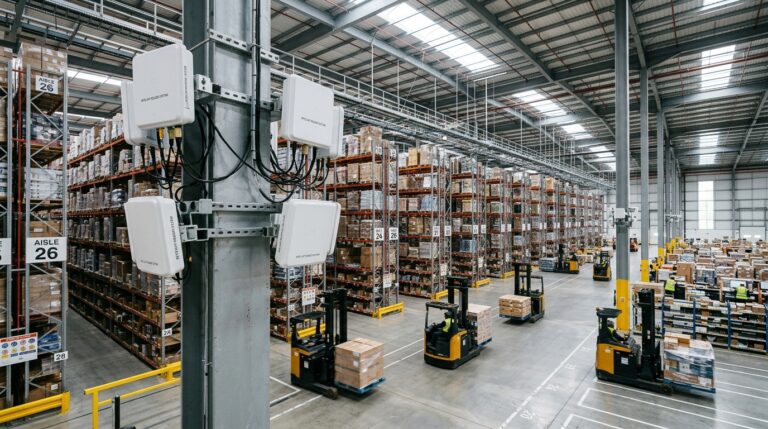
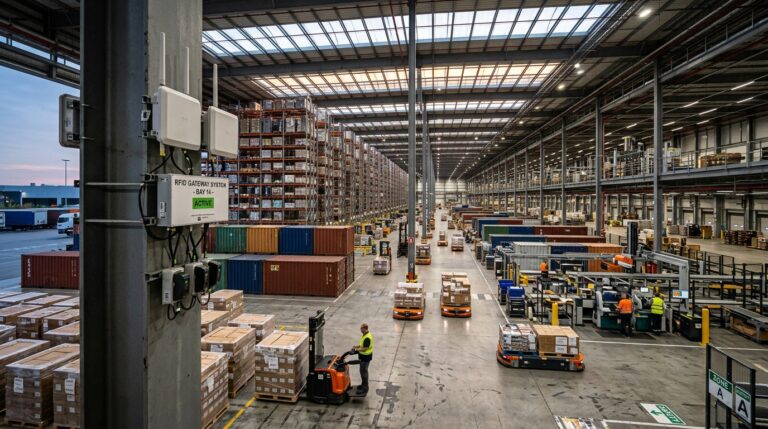
Tag population density. Reading one tag at 10 meters is a physics question. Reading 200 tags on a pallet moving through a dock door at walking speed is an engineering question. Dense tag populations create collisions, require anti-collision protocols, and can reduce effective per-tag read rates.
Mounting surface and orientation. An NHS hospital tracking medical equipment found that for metal-framed wheelchairs, the underside of the seat was the most reliable tagging location. Heat caused adhesive-mounted tags to detach from other equipment entirely. A tag that falls off delivers zero range, regardless of its rated specs.
Regulatory power limits. In the US, GS1’s spectrum overview lists 902–928 MHz at 4 W EIRP for RAIN RFID. In Europe, common allocations include 865.6–867.6 MHz at 2 W ERP, with higher-band options under national rules. ERP and EIRP measure different things. A system designed for US power levels won’t legally operate at the same output in most European jurisdictions, which directly affects achievable range.
Interference. Wi-Fi access points, other RFID readers, industrial motors, and fluorescent lighting all generate noise in or near UHF bands. A clean RF environment in a test lab bears little resemblance to an active warehouse or airport tarmac.
When Longer Range Makes Things Worse
This is the part most RFID guides don’t cover, and it’s the part that matters most for asset tracking.
More range means more tags in the read zone. That sounds like a benefit until you realize it also means more unwanted reads. A reader at a dock door that can see 20 meters into the warehouse will pick up tags on assets that aren’t moving through that door. Now your system says a container shipped when it’s still sitting on a shelf 15 meters away.
Delta Air Lines understood this when it built its RFID baggage system. Delta invested $50M across 344 stations, handling 120 million bags annually, and reported 99.9% tracking success in initial deployments. The system works not because it reads tags from enormous distances, but because it reads tags at precisely controlled points: belt loaders, sorting conveyors, aircraft holds. Each read corresponds to a specific handling event. Extending the range would have created ambiguity, not visibility.
Impinj’s 2025 Gen2X expansion explicitly emphasizes read-zone confinement alongside improved sensitivity. The industry is recognizing that precision beats reach. If you can’t reliably answer “which container passed through which gate at which time,” a longer read range is adding noise, not data.
For container pool management and reusable asset tracking, this distinction is everything. You don’t need to know that a ULD exists somewhere in the vicinity of a cargo facility. You need to know it transitioned from inbound staging to MRO, or from MRO back to the active fleet. That requires bounded, event-driven reads at specific chokepoints.
Active vs. Passive: Different Problems, Not Better or Worse
Active tags carry their own battery and transmitter. They don’t depend on harvesting energy from the reader, which removes the forward-link bottleneck entirely. EUIPO documents active RFID tags reaching 122–200 meters outdoors without obstructions, typically at 433 MHz. That’s a legitimate capability for tracking shipping containers across a port yard or military supply chain. For industrial IoT deployments, understanding how active RFID compares to BLE helps determine which protocol suits specific operational requirements.
But active tags cost more (often 10–50x per unit versus passive), require battery management, and are physically larger. For item-level retail tagging where IDTechEx forecasts over 31 billion apparel tags in 2025 alone, active tags make no economic sense.
Battery-assisted passive (BAP) tags split the difference. The battery powers onboard electronics (including sensors for temperature or humidity), but communication still uses backscatter. Confidex’s Survivor B claims up to 60 meters, but its application note explicitly warns that the measurement excludes reader-sensitivity limitations. When the battery dies, it falls back to passive operation at 3–5 meters. So “60 meters” is a conditional truth, not a permanent one.
The choice between active, passive, and BAP isn’t about maximizing distance. It’s about matching the technology to the asset lifecycle. A disposable shipping label needs to survive one trip. A reusable container tag needs to survive hundreds of cycles, report its condition, and work reliably at chokepoints that might be 5 meters wide or 50 meters across.
Real Deployments, Real Lessons
Three cases illustrate what read range actually means when money and operations are on the line.
Decathlon: range served the workflow, not the other way around. GS1 US reports Decathlon tagged 100% of its products and deployed over 50,000 readers across factories, warehouses, and stores. The result: 20% improvement in cash-collection efficiency and fivefold inventory efficiency. Decathlon didn’t chase maximum range. It built read points into every stage of the product journey, from factory to checkout. The identifier followed the item through its entire lifecycle.
US-VISIT border program: range existed, but the system failed. A GAO report documented a 2006 vehicle test where readers identified only 14% of 166 vehicles, against a 70% target. Metallic tinted windows blocked overhead readers. Moving readers to the side and having occupants hold documents against windows improved results. The tags had adequate range in free space. The vehicles, the window tinting, and human behavior didn’t cooperate.
NHS hospital: range was fine, accuracy was not. At Princess Alexandra Hospital, active tracking reduced device search time from one hour to ten minutes. But the initial proof of concept delivered approximately 6-meter location accuracy, sometimes placing equipment in the wrong room. Range (could the system detect the tag?) was not the problem. Localization (where exactly is it?) was.
Each case reinforces the same lesson. RFID read range creates opportunity. What you do with the read zone, how you position readers, how you define events, and how you handle exceptions determines whether you get operational value.
What’s Changing in 2026 and Beyond
The RFID landscape is not standing still, but the improvements that matter most aren’t about pushing range further.
Protocol intelligence is improving. GS1’s Gen2v3 adds richer inventory capabilities and mechanisms to reduce interference from fringe tags. More detectable tags without better selection logic means more ambiguous events. Gen2v3 addresses that.
Impedance-matching research is extracting more from existing hardware. Barbot, Prodan, and Nikitin’s 2024 research reported 8% range improvement for passive tags and 22% for semi-passive tags through system-aware matching optimization. These are real, measured gains, not theoretical projections.
Passive sensing is expanding. UC San Diego’s SenSync research reported fivefold sensory resolution and up to 500 samples/second from commercial RFID tags. This is about what the tag can report (temperature, strain, humidity), not about reading it from farther away.
Cellular-native IoT is emerging. 3GPP’s Release 19 describes ambient IoT devices that harvest energy and communicate by modulating an externally provided carrier. This creates a new architecture class alongside traditional RFID, not a replacement for it.
The direction is clear: smarter reads, richer data per read, better boundary control. Not longer range for its own sake.
How to Specify Range for Your Project
If you’re evaluating an RFID system for asset tracking, container management, or supply chain visibility, here’s how to think about range as a procurement requirement, not a wish.
1. Define the event, not the distance. What operational event do you need to capture? A container entering a staging area? A ULD transitioning from MRO to flight-ready status? A pallet crossing a dock door? Each event has a physical geometry. That geometry determines the read zone you need.
2. Specify the complete system. Reader model. Antenna model and placement. Tag model and mounting surface. Legal power configuration. Tag orientation range. Speed of the asset through the read zone. Environmental conditions (temperature, humidity, nearby metals, RF interference). A range claim without these parameters is marketing, not engineering.
3. Test for failures, not successes. Measure missed reads and unwanted reads, not just successful ones. A system that reads 98% of passing tags but also reads 15% of tags in the adjacent lane is generating false events that poison your data downstream.
4. Separate identification from localization. If you need to know which room, which zone, or which parking position an asset occupies, that’s a localization requirement on top of identification. RFID can contribute to localization, but a 10-meter read range does not equal 10-meter location accuracy. They’re different measurements.
5. Budget for the lifecycle. Active tags need battery replacement. BAP tags degrade to shorter passive range when batteries expire. Adhesive-mounted tags can detach in harsh environments. The range on day one is not the range on day 500.
Perguntas frequentes
What is the maximum range of a passive RFID tag?
Standard passive UHF tags read at 3–10 meters in typical deployments. Specialty on-metal tags (like Xerafy’s Container OUTDOOR M830) claim up to 40 meters in specific configurations. Battery-assisted passive tags can reach 60 meters under lab conditions. These are not interchangeable numbers. Each requires its own reader, antenna, and mounting setup.
Can someone read my RFID card from far away without my knowledge?
Standard contactless cards (ISO 14443, 13.56 MHz) are designed for centimeter-range interaction. However, researchers demonstrated skimming at approximately 25 cm using modified antennas in 2006. Nominal short range is not a security guarantee. Authentication protocols and shielding provide actual protection.
Does RFID work through metal and water?
Not equally. UHF signals reflect off metal and are absorbed by water. Standard labels fail on metal surfaces. Purpose-built on-metal tags use the metal as part of the antenna design and can perform well. The answer depends entirely on whether the tag was engineered for that material.
What is the difference between RFID read range and location accuracy?
Read range measures whether a reader can detect and identify a tag at a given distance. Location accuracy measures how precisely the system can determine the tag’s physical position. An NHS hospital achieved reliable tag detection but initial location accuracy of only 6 meters, placing assets in wrong rooms. These are separate system properties requiring separate specifications.
Is active RFID better than passive RFID?
Not inherently. Active tags offer longer range (100+ meters) and support continuous broadcasting, but cost significantly more, require battery management, and are physically larger. Passive tags cost pennies per unit and work indefinitely without power management. The right choice depends on asset value, cycle frequency, read-zone geometry, and whether you need onboard sensing.
How do I verify a supplier’s advertised RFID range?
Request the exact reader model, antenna configuration, tag mounting material, legal power setting, and definition of “successful read” used in their test. Then replicate the test with your actual assets, at your actual site, moving at your actual speed. Confidex, for example, explicitly states that its 60-meter BAP measurement assumes a very sensitive field reader. That qualification should survive into your procurement specification.
If your operation tracks containers, ULDs, GSE, or any reusable asset through a cycle that extends beyond the point of delivery, the read range question is only the beginning. The harder question is whether your system captures each transition in the asset’s lifecycle with enough precision to drive decisions. That’s the territory where shipment tracking ends and asset tracking begins.
If your container pool goes invisible after delivery, let’s talk about closing that gap. Reach us at info@datanetiot.com.





 +1 508 292 2210

2 Responses