

How long do active RFID tags last? The answer you’ll find most places is “3 to 5 years.” That number is not wrong. It’s just incomplete enough to cost you real money.
Published battery specs for active RFID tags span from 2 years warranted to 10 years advertised. A 5x spread in the same product category. The gap exists because battery life is not a fixed property of active RFID. It is an output of how you configure the tag, what environment it operates in, and whether anyone defined “last” before purchasing 5,000 units.
After 15+ years deploying tracking systems across aviation, logistics, and industrial operations, I can tell you the battery question comes up in nearly every scoping call. And almost every time, it’s masking the question that actually matters: what’s the total cost of keeping these tags alive over the lifecycle of the assets they track?
Here’s what the spec sheets leave out.
The Quick Number, and Why It Misleads
If you need a single figure for a budget meeting, plan for 3 to 5 years of battery life under moderate use. That planning envelope will get you through initial procurement without embarrassing surprises.
But “moderate use” is doing a lot of heavy lifting in that sentence. Look at the actual conditions behind published specs:
| Product | Technology | Published Battery Life | Conditions / Notes |
|---|---|---|---|
| Savi ST-654 | 433 MHz active | ~5 years | 2 collections/day; user-replaceable 3.6 V lithium cell |
| RFID Inc. AT-CS | 433 MHz active | 2 years (warranted) | 2.01-second transmission rate; replaceable battery |
| RFID Inc. AT-DC | 433 MHz active | 2 years (warranted) | Same family; no replaceable battery |
| ELA Innovation COIN ID | 433 MHz active | Up to 10 years | Configurable 220 ms to 12-hour interval; IP68 |
| Zebra UWB | Ultra-wideband RTLS | Up to 7 years | 1 Hz blink rate |
| Sewio Leonardo Asset | UWB RTLS | ~4.5 years | 1,000 ms refresh, 0.5 motion ratio; replaceable CR2477 |
| Extronics T2s | 2.4 GHz Wi-Fi RTLS | Up to 4 years | Replaceable lithium cell; varies by use and environment |
Not one of those numbers stands on its own. Every spec comes paired with an operating profile. Savi’s “5 years” assumes just two collections per day. Zebra’s “7 years” assumes a 1 Hz blink rate. Change those parameters and the headline number changes with them.
A year count without an operating profile is marketing. An operating profile without a year count is an engineering spec missing its punchline. You need both before signing a purchase order.
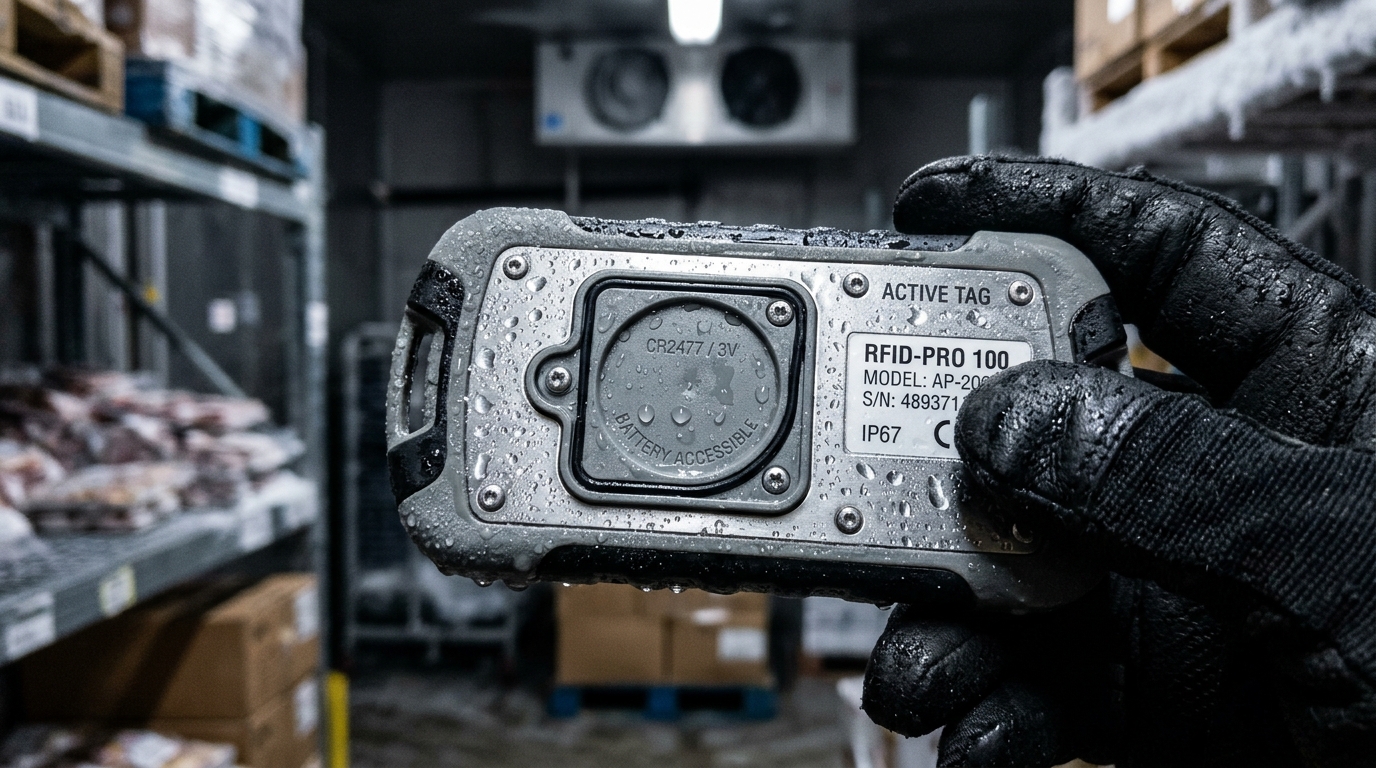
Four Clocks Running Inside Every Active Tag
When someone asks “how long does this tag last,” they usually mean battery operating life. But four distinct lifespans are running simultaneously, and they rarely align:
- The battery operating life is the one most people care about: how long the power source supports the tag’s configured behavior before it can’t. This is what those “3 to 5 years” numbers describe.
- Battery shelf life is a different number entirely. Tadiran documents less than 1% annual capacity loss over 10 years at room temperature for its lithium thionyl chloride cells. That’s a cell-storage spec for an inactive tag, not an operating spec.
- The tag service life covers the complete device: enclosure, electronics, antenna. With a replaceable battery, a tag can outlive its first cell by years. A sealed tag dies when the battery does.
- The warranty period is what the supplier contractually covers. RFID Inc. warrants 2 years. That tells you their risk exposure, not your expected performance.
There’s also a fifth, invisible clock: protocol and platform relevance. A tag battery might last 7 years. If the middleware platform it reports to gets deprecated in 4, or the communication protocol is superseded, functional life is 4 years regardless of remaining charge. None of the major RFID spec sheets mention this. Your IT roadmap should.
At scale, the gap between these clocks is where costs multiply. If you’re deploying 5,000 tags on reusable transport assets, the difference between “tag dies at year 3” and “battery dies at year 3 but the tag is serviceable” determines whether you’re budgeting for 5,000 new batteries or 5,000 new tags.
What Actually Drains the Battery
The battery in an active RFID tag has one primary job: power radio transmissions. Everything else, sleeping, listening, sensing, is overhead. The faster and more often the tag transmits, the sooner the battery is finished.
The core relationship is simple: operating hours = usable battery capacity (mAh) divided by average current draw (mA). In practice, five variables make the output swing wildly.
Beacon interval: the dominant variable
Sewio publishes numbers that make the relationship concrete:
| Refresh Interval | Estimated Battery Life |
|---|---|
| 500 ms | 2.6 years |
| 1,000 ms | 4.5 years |
| 1,500 ms | 5.0 years |
All three assume a 0.5 motion ratio (tag is moving half the time). Going from 500 ms to 1,500 ms nearly doubles battery life. But notice it’s not a linear relationship: tripling the interval does not triple the life. Sleep-mode consumption and wake-up events still draw current regardless of beacon rate.
Motion and sensor activity
Tags with accelerometers can sleep when stationary and wake on movement. For assets that sit idle most of the time (parked trailers, stored ULDs, seasonal GSE), this single feature can dramatically extend battery life. Tags running continuous temperature or humidity sensors drain faster than tags transmitting only an ID.
Similar sensor-driven monitoring principles apply in environmental control systems—see our guide on pH management in aquaculture for another IoT sensor application.
Reader polling
NIST SP 800-98 identifies reader polling as a mechanism that directly reduces active-tag battery life. If your infrastructure polls tags instead of passively listening for beacons, the tag is forced into additional wake-transmit cycles it wouldn’t otherwise perform. This is an infrastructure design decision that shows up on your hardware replacement schedule.
Environmental stress
Temperature is the quiet killer. Lithium cells lose effective capacity at both extremes. A tag rated for 5 years in a climate-controlled warehouse may deliver 3 on an airside ramp in Phoenix or a cold-chain corridor in Anchorage. ELA Innovation’s COIN ID lists an operating range of -30°C to +70°C. The 10-year headline life does not specify behavior at those boundaries.
Security overhead
Encryption and authentication require processing cycles. In most deployments the power impact is marginal compared to radio transmission. But in high-security environments with frequent authentication handshakes, it becomes another line in the energy budget. NIST’s guidance also flags a related concern: persistent active transmission creates a tracking exposure that adds security planning on top of the power question.
Published Specs vs. Field Results
Spec sheets describe laboratory conditions. Assets live in the real world. The gap between the two is where budget surprises are born.
Three documented deployments tell the story:
The 100-day problem
A feasibility study at a major teaching hospital tested BLE/Wi-Fi-based asset tracking tags and found they needed battery replacement every 100 days. The tags also reported incorrect room and floor locations. The technology was operational. The maintenance burden was not sustainable. This highlights key differences in active RFID vs BLE implementations for healthcare asset tracking.
The 3-year success
Scotland’s Forth Valley Royal Hospital deployed 4,000 active and 14,000 passive RFID tags in a hybrid system. After three years, most active tags were still running. Replacement batteries cost roughly 12 pence each. The system worked because the hospital matched tag type to asset value: active for high-value mobile equipment, passive for everything else.
The $110 million waste
A GAO investigation into U.S. defense logistics found that 84% of 614,681 active RFID tags in one dataset had been used only once or twice. Estimated waste: over $110 million in tags purchased, deployed, and never recovered for reuse. The batteries didn’t fail. The return process did.
That third case is the one I bring up most in scoping conversations. The tag’s battery might last 5 years. But if the tag vanishes from your return loop after 6 months, you’ve paid for 5 years and gotten 6 months of value. Battery life is an engineering problem. Tag recovery is a process problem. Both cost operational dollars, and the process problem is usually bigger.
The Replacement Cost Nobody Budgets
The battery itself is almost never the expensive part. At Forth Valley, a replacement cell cost 12 pence. Even premium lithium cells for industrial tags rarely exceed a few dollars.
The real cost is labor.
Replacing a battery on a single tag means locating the asset, physically accessing the tag, performing the swap, testing the tag post-swap, and updating the asset management system. Multiply that across 5,000 tags spread over multiple facilities and you’re looking at a substantial maintenance event. Someone has to plan it, staff it, and absorb the downtime.
This is where the replaceable vs. sealed design choice becomes a financial decision:
- Savi’s ST-654 supports tool-free battery replacement. The enclosure and electronics survive across multiple battery cycles. You budget for cells and labor.
- Some RFID Inc. models have no replaceable battery. When the cell dies, you replace the entire tag. You budget for new hardware.
Neither approach is always better. Replaceable batteries mean more complex enclosures and potential ingress points for moisture or dust. Sealed tags are simpler and often more rugged, but their service life has a hard ceiling.
The question to ask at procurement: “When this battery dies in year 3, what exactly do I replace, and what does that process cost per tag across my entire fleet?”
How to Actually Get 5+ Years From Active RFID Tags
Most of these are configuration decisions you make during system design, not hardware purchases you make later.
- Match beacon interval to actual need. If your process needs a location update every 30 seconds, don’t configure the tag for 500 ms. The Sewio data shows that stepping from 500 ms to 1,500 ms nearly doubles battery life. Ask operations what refresh rate they genuinely require, not what sounds impressive in a demo.
- Enable motion-triggered reporting. Tags with accelerometers can sleep when stationary and wake on movement. For assets idle 80% of the time, this alone can shift a 3-year battery toward 5.
- Design infrastructure to listen, not poll. If readers poll tags rather than waiting for beacons, you’re forcing extra wake cycles the tag didn’t plan for. Push back on system architectures that treat tags like database rows to be queried.
- Store tags deactivated in controlled conditions. Tadiran’s data shows less than 1% annual capacity loss at room temperature. A pallet of activated tags sitting in a hot warehouse for a year before deployment starts the clock early and quietly.
- Choose replaceable-battery models for long-lifecycle assets. If the asset has a 15-year service life (containers, GSE, airframe tooling), the tag enclosure should survive longer than one battery cycle.
- Schedule replacement proactively. Use battery telemetry to plan swaps before failure, not after. A dead tag doesn’t just stop reporting. It creates a gap in your asset visibility that you might not discover until the asset itself is missing.
When the Better Question Is “Do I Need Active RFID at All?”
Sometimes the best answer to “how long do active RFID tags last” is: long enough that the battery is not your constraint. The real constraint is whether active RFID is the right tracking architecture for the job.
GS1 defines three RFID architectures:
- Passive RFID: no battery. Powered by the reader’s signal. Range limited to a few meters. The tag cannot initiate a transmission. No battery to replace, ever. Best suited for checkpoint identification at fixed read points.
- Battery-Assisted Passive (BAP): a battery powers sensors or circuitry, but the tag still communicates via backscatter. You get sensor data without the full power cost of active transmission. Battery lasts longer because it’s not driving a radio.
- Active RFID: its own transmitter and power source. Autonomous, long-range reporting. Every transmission costs battery life.
There’s also a category that frequently gets conflated with active RFID but runs on entirely different infrastructure: cellular and GNSS-based trackers. These devices use LTE-M, NB-IoT, or satellite networks instead of dedicated RFID readers. They can report asset position globally, not just within the footprint of a fixed read infrastructure. Battery life varies from months to years depending on configuration, and many support replaceable or rechargeable cells.
On the emerging end, battery-free BLE sensor tags powered by RF energy harvesting arrived in late 2025. They eliminate the battery replacement event entirely, but replace it with dependency on available RF power infrastructure. Worth watching. Not yet a fleet-scale solution.
The choice between these architectures is really a question about what “visibility” means for your operation:
- Zone-level location inside a single facility (MRO hangar, warehouse): active RFID or UWB.
- Global position across a distributed supply chain (reusable containers, ULDs, ground support equipment): cellular/GNSS trackers.
- Checkpoint verification without battery maintenance (pallet inventory, tool check-in/out): passive RFID.
This is the distinction I keep coming back to with clients: shipment tracking ends when the package arrives. Asset tracking follows the asset through its full lifecycle, including return, dwell time, maintenance, and redeployment. If your container pool goes invisible after delivery, or your GSE disappears between the ramp and the maintenance bay, the problem isn’t that your tags died too early. It’s that the architecture doesn’t cover the visibility gap you actually have.
That’s a design question, not a battery question. And it’s exactly the conversation we have every week at Datanet. If you’re scoping a deployment and the battery question keeps surfacing, it might be worth stepping back to look at the architecture first. Our asset tracking device catalog spans cellular, GNSS, and RFID options, including DO-160 airfreight-approved trackers for aviation environments. Reach out if you want to talk through which approach fits your asset lifecycle.

Frequently Asked Questions
What is the typical lifespan of an active RFID tag?
Published specs range from 2 to 10 years, but most industrial deployments see 3 to 5 years of useful battery life under moderate conditions. The actual number depends on beacon interval, motion ratio, temperature, and whether the battery is replaceable. Always ask for the operating profile behind any year count before comparing products.
Can you replace the battery in an active RFID tag?
Some models allow it, some don’t. Savi’s ST-654 supports tool-free battery swaps. Certain RFID Inc. models are sealed and require full tag replacement when the cell dies. The design choice directly affects whether you budget for batteries or entirely new tags at end of cycle.
Does a faster beacon rate always shorten battery life?
Yes, but not linearly. Sewio’s published data shows that moving from a 500 ms to a 1,500 ms refresh interval nearly doubles battery life, not triples it. Sleep-mode consumption, wake-up events, and sensor polling all draw current regardless of how often the tag beacons.
How long do active RFID tags last in storage before first use?
That depends on the cell chemistry and whether the tag activates during storage. Tadiran documents less than 1% annual capacity loss over 10 years at room temperature for lithium thionyl chloride cells in an inactive state. An activated tag stored in a hot warehouse drains faster. Check manufacture date and activation state before deploying stored inventory.
Are passive RFID tags more cost-effective since they have no battery?
Passive tags eliminate battery maintenance entirely, but they can only communicate within a few meters of a powered reader and cannot transmit autonomously. For checkpoint identification (inventory counts, tool check-out), passive often wins on total cost. For continuous location tracking or global supply chain visibility, passive RFID simply cannot do the job.
What should I do with active RFID tags at end of life?
Active tags contain lithium cells that need proper handling. The EPA classifies single-use lithium-metal batteries as non-rechargeable and warns against placing them in household trash or standard municipal recycling. Protect battery terminals with non-conductive tape and route them through an appropriate collection program. Build disposal logistics into your total cost of ownership from the start.








 +1 508 292 2210

2 Responses