

IoT attacks grew 124% year-over-year in SonicWall’s latest threat data. In the same period, the connected device count crossed 21.1 billion globally. More endpoints, more attack surface, faster threats. And yet most vendors still call their gateway-plus-dashboard setup “a secure end-to-end IoT solution.”
I’ve been deploying IoT across aviation, freight, and industrial operations for over fifteen years. The pattern I keep seeing: a vendor encrypts the device-to-cloud link, adds a nice portal, and ships it. Nobody asks about device identity. Nobody asks what happens when credentials expire, when firmware needs patching, or when a tracker crosses three custody chains before reaching its destination. That’s where security actually breaks.
This piece covers what end-to-end really means, the six layers you need to get right, the regulatory deadlines making this urgent, and how to test whether a vendor’s claim holds up under pressure.
What “End-to-End” Actually Means in IoT Security
A secure end-to-end IoT solution is an architecture where security responsibility covers every stage: from device hardware through the cloud and back, including provisioning, operation, updates, and retirement. If any single handoff is unprotected, the chain breaks.
The reference architecture spans six stages:
- Device silicon and firmware
- Secure edge or gateway
- Access network
- Cloud control plane
- Applications and data
- Security operations
Across every connection between these stages, cross-cutting services must follow: identity, key management, authorization, segmentation, telemetry, secure updates, vulnerability management, and incident response. NIST’s IoT device cybersecurity baseline (NISTIR 8259A) treats these capabilities as features that protect the device, its data, connected systems, and the broader ecosystem. Understanding how to implement Industry 4.0 practices helps organizations integrate these security requirements into their digital transformation roadmap. That’s a useful procurement starting point. It’s not a finish line.
Where most vendors fall short is predictable. They encrypt the device-to-cloud link and call it done. The device shipped with shared credentials. The firmware can’t be updated remotely. Nobody tracks which software components are inside. When a vulnerability appears, the response is manual, slow, or nonexistent. That’s one layer, not six. And one layer doesn’t survive contact with a motivated attacker.
The Six Layers of a Genuinely Secure IoT Solution
These layers aren’t optional add-ons. Remove any one and the others lose their foundation.
1. Device trust and factory provisioning
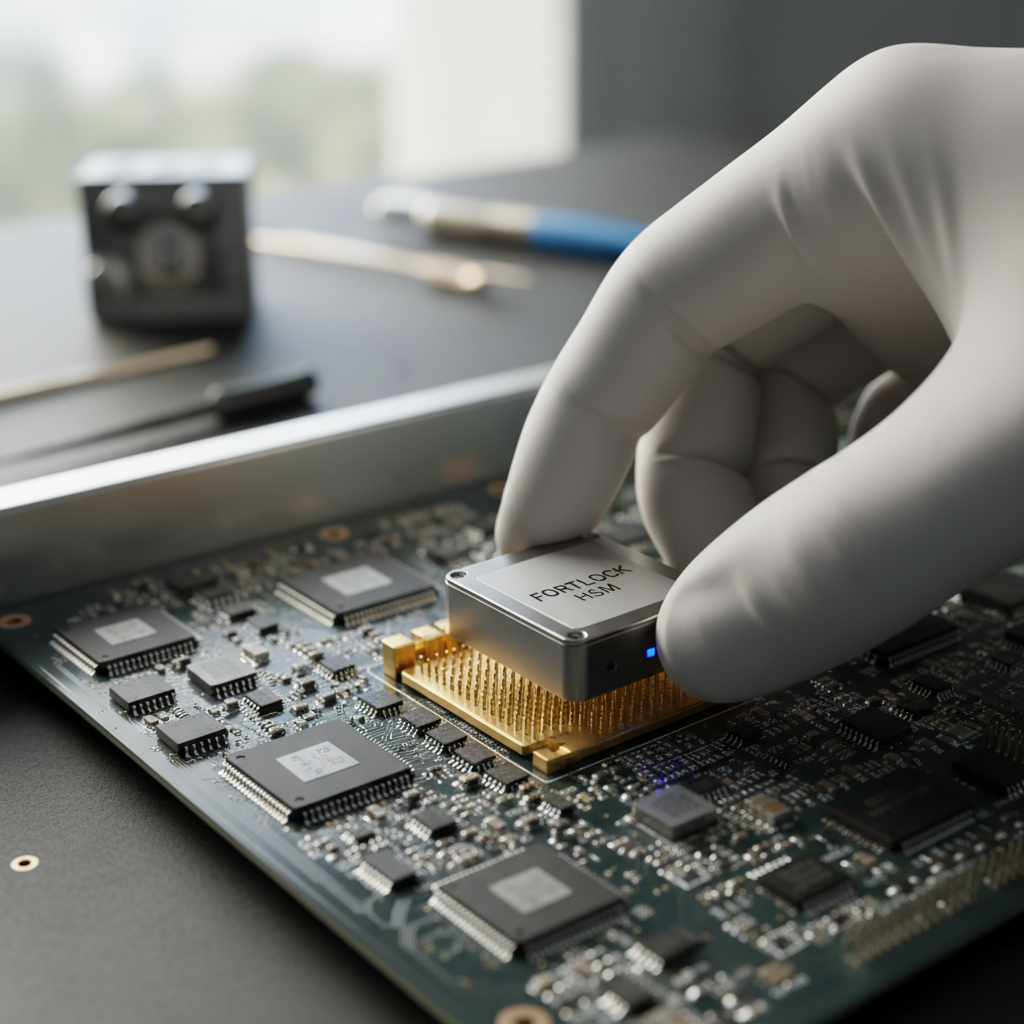
Security starts before the device ever connects. At the factory. The device needs a unique identity rooted in hardware or protected storage, a secure boot chain, signed firmware, controlled debug ports, and a mechanism to revoke trust when the device is compromised or decommissioned.
NIST SP 1800-36 describes a model where the manufacturer creates, signs, and installs unique identity credentials in secure storage during production. Without this step, you cannot distinguish a genuine device from a cloned or tampered one. In aviation MRO environments, where a rogue sensor on ground support equipment could feed bad data into maintenance decisions, that distinction isn’t academic. It’s operational.
2. Identity and zero-touch onboarding
NIST’s lifecycle model splits onboarding into five stages: factory provisioning, ownership transfer, network onboarding, application onboarding, and continuous verification. During network onboarding, the device proves its provenance and receives scoped credentials. A manufacturer authorization service validates the registrar, creates a voucher, and the device validates it before joining the production network.
Compare that to the industry default: shipping every unit with the same password. One compromised credential and the entire fleet is exposed.
Cloud platforms like Azure IoT Hub’s Device Provisioning Service and AWS IoT Core have made zero-touch provisioning more accessible. They reduce custom code, which matters. But they don’t eliminate the need to secure the device itself, the manufacturing process, or the application layer above.
3. Communications security (necessary, not sufficient)
Transport encryption protects data in transit. It doesn’t protect data after it reaches a gateway. It doesn’t prove the endpoint is authorized. It doesn’t prevent replay attacks or detect a man-in-the-middle who already has the keys.
A complete communications layer uses mutual authentication, short-lived credentials, least-privilege policies, replay protection, and application-layer encryption for sensitive payloads. LoRaWAN supports dedicated end-to-end encryption at the application layer, but as the LoRa Alliance itself notes, implementation quality determines whether that protection is real.
In asset tracking for freight and aviation, data flows through multiple intermediaries: ground handlers, freight forwarders, airline systems, customs authorities. Each handoff is a potential exposure point. Encrypting the link between the tracker and one cloud endpoint doesn’t cover the full journey.
4. Network segmentation and zero trust
NIST’s zero-trust architecture work puts it plainly: cloud, mobile, and IoT dissolve the old network boundary, and perimeter defense alone is no longer sufficient. The practical translation: authorize every device, workload, user, and data flow by context and least privilege. Segment operational technology from business systems. Deny by default.
For industrial IoT solutions in aviation environments, this means IT, OT, and IoT traffic live in separate zones. Remote maintenance sessions are time-bound and auditable. A compromised environmental sensor on a warehouse floor cannot pivot to your fleet management system or your MRO planning tools.
5. Software supply chain: updates, SBOM, and vulnerability response
A secure update system validates firmware signatures, enforces rollback protection, records deployment status, supports staged rollout, and provides a tested recovery path when things go wrong. An SBOM (Software Bill of Materials) ties each product release to a versioned inventory of every software component it contains.
CISA’s 2026 SBOM update added minimum elements including component hash algorithms, license data, tool names, and generation context. The operational consequence: when a vulnerability is disclosed, you should know which firmware versions, devices, and environments are affected within hours. Not weeks. Not “we’ll get back to you.”
6. Governance, operations, and retirement
The full control loop works like this: establish identity, authorize least-privilege access, observe behavior, detect deviation, isolate or step down privileges, patch or replace, verify recovery, retire and revoke. Most security conversations focus on the first two steps and ignore the last four.
Retirement deserves special attention. When a tracker or sensor reaches end of life, its credentials must be revoked, its data handled according to policy, and the device removed from active inventory. A decommissioned device with live credentials sitting in a recycling bin is an open invitation. I’ve seen it happen in container pool operations where retired trackers still phoned home months after the asset was scrapped.
Why Encryption Alone Fails: Incidents That Prove It
Theory is useful. Failures are more convincing.
The FBI’s 2025 BadBox 2.0 alert described compromised home internet-connected devices being used to facilitate criminal activity at scale. Earlier operations disrupted the KV Botnet (built from compromised SOHO routers) and the Flax Typhoon botnet, used by a state-sponsored actor. In every case, the common mechanism was weak identity, unsafe network exposure, and no patching. Not a failure of encryption.
CISA warned that threat actors targeted Unitronics PLCs at a U.S. water facility. Programmable logic controllers with internet exposure and default credentials, controlling actual water infrastructure. The device-to-cloud link was not the point of failure. The identity and access layer was.
The FTC’s settlement with Ring addressed employees and contractors having access to private customer videos. The FDA flagged Contec patient monitors for vulnerabilities that could permit remote control or introduce a software backdoor. In both cases, transport encryption existed. The failures were authorization, access governance, and supply chain integrity.
Every one of these incidents would have been mitigated (or prevented) by the six layers above. None would have been solved by adding another encryption certificate.
Regulation Has Moved From Advice to Deadlines
For years, IoT security guidance was voluntary. Recommendations you could nod at and shelve. That era is ending.
The EU Cyber Resilience Act entered into force on December 10, 2024. Its main obligations apply on December 11, 2027. But vulnerability and severe-incident reporting obligations begin September 11, 2026. That means manufacturers must report actively exploited vulnerabilities within 24 hours and provide fuller notification within 72 hours. If you sell products with digital elements into the EU market, this applies to you. Now.
In the United States, the FCC Cyber Trust Mark is a voluntary cybersecurity labeling program for wireless consumer IoT. Its proposed QR registry can expose information such as support periods, patch status, default-password behavior, and minimum support dates. Voluntary today, but the trajectory is clear: security is becoming a product attribute buyers can compare at the shelf.
For aviation IoT, these regulatory layers sit on top of existing certification requirements. A DO-160 approved tracker like the Thingfox T2 already meets stringent environmental and electromagnetic standards for airfreight. The CRA adds cybersecurity lifecycle requirements to that foundation. Meeting one does not exempt you from the other.
And NIST released its first three finalized post-quantum encryption standards in 2024, encouraging administrators to begin transitioning. For IoT fleets with long replacement cycles (think aviation ground equipment, ocean containers), the recommendation is crypto-agility: design key and certificate services so algorithms can change without replacing every physical device in the field.
How to Test a Vendor’s “End-to-End” Claim
Marketing decks are cheap. Run these tests instead:
- Can the vendor demonstrate how unique credentials are provisioned at manufacture? Can you verify a device’s provenance before it joins your network?
- What happens when a device changes ownership? Is there a documented, repeatable process for credential reset and re-provisioning?
- Can the device be provisioned into your environment without manual configuration of each unit?
- How are credentials refreshed over time? What happens when a certificate expires mid-deployment?
- Load unsigned firmware onto the device. Does it reject it?
- Can you trace every software component in the current firmware to a known version and vulnerability status?
- If a device is lost, stolen, or decommissioned, how quickly can you revoke its network access?
- Bring a legacy device, something ten years old or intermittently connected. Can the platform discover, classify, and apply compensating controls to it?
- If a device behaves anomalously, can the system isolate it without taking down the rest of the fleet?
- Can you export a complete compliance evidence package (onboarding records, update history, access logs) for a regulator or auditor?
If a vendor can’t demonstrate these in a live proof of value using representative devices from your actual environment, what you’re buying is a dashboard with a nice logo. Not a secure end-to-end IoT solution.
What This Means for Aviation and Industrial Asset Tracking
Most of my work sits at the intersection where IoT meets physical assets that move: ULD containers, ground support equipment, MRO tooling, freight shipments crossing three or four custody chains before they arrive. Every physical handoff in asset tracking is also a security handoff.
When a tracker on a returnable container moves from an airline to a ground handler to a freight forwarder and back, the question isn’t just “where is it?” It’s “can I trust the data this device is sending? Can I verify that nobody tampered with it at the third stop?”
That’s why we build our asset tracking solutions around devices that support secure provisioning and encrypted communications from day one. Pairing DO-160 certified hardware with proper identity management and fleet-level visibility turns a tracking device into a trustworthy data source across its full lifecycle, not just during the hours it has a cellular connection.
The same principle applies to ocean equipment tracking, where containers spend weeks at sea with intermittent connectivity. The device must remain secure when it’s offline. If it can’t, your “end-to-end” coverage has a gap the size of the Pacific.
If your current setup can’t answer “which firmware is running on device #4,217?” or “when was the last credential rotation for this fleet?”, you have a visibility gap that doubles as a security gap. That’s a conversation worth having: reach out to our team or email info@datanetiot.com.

Frequently Asked Questions
What does “end-to-end” mean in IoT security?
It means security responsibility spans the entire device lifecycle: hardware provisioning, identity, onboarding, encrypted communications, network segmentation, software updates, monitoring, incident response, and retirement. NIST SP 1800-36 defines five lifecycle processes from factory provisioning through continuous verification. Encrypting the device-to-cloud link alone does not qualify as end-to-end.
Is encryption enough to secure an IoT deployment?
No. Encryption protects data in transit but does not address device identity, authorization, firmware integrity, credential management, or physical access control. Major IoT failures, including BadBox 2.0, Unitronics PLCs, and Ring, involved compromises that encryption alone could not have prevented. Security requires all six architectural layers working together.
What is the EU Cyber Resilience Act and when does it apply?
The CRA is EU legislation requiring cybersecurity across the lifecycle of products with digital elements. Vulnerability and incident reporting obligations begin September 11, 2026. Main obligations, including CE-marking requirements, apply December 11, 2027. Any manufacturer selling qualifying products into the EU market must comply.
How do I evaluate whether an IoT vendor is truly “secure by design”?
Test, don’t trust. Request live demonstrations of factory identity provisioning, zero-touch onboarding, certificate rotation, unsigned firmware rejection, lost-device revocation, and audit export. Include a legacy or intermittently connected device in the evaluation. If the vendor can only show a dashboard, the security claim is cosmetic.
Does asset tracking require end-to-end IoT security?
Yes. Tracking assets across multiple custody chains (airlines, freight forwarders, ground handlers, ports) means the device passes through environments with varying security postures. Each handoff is a potential attack surface. Secure identity, encrypted data paths, and fleet-level credential management ensure tracking data remains trustworthy from deployment through retirement.
What role does an SBOM play in IoT security?
A Software Bill of Materials inventories every software component in a device’s firmware. When a vulnerability is disclosed, an SBOM lets operators identify affected devices within hours instead of weeks. CISA’s 2026 update requires minimum elements including component hashes, licenses, and tool identification. It is increasingly a regulatory and operational baseline for connected products.








 +1 508 292 2210