

You can buy a GPS tracker for under $50, mount it in five minutes, and watch it blink on a dashboard by lunch. None of that changes your cycle time, your purchase orders, or your utilization rate. The missing piece is asset tracking integration: the connective tissue between a physical signal and an operational decision.
Berg Insight pegs cargo-unit and cargo tracking revenue at EUR 2.7 billion in 2024, forecasting EUR 4.5 billion by 2029. That growth is not driven by cheaper tags. It is driven by organizations finally connecting those tags to purchasing, maintenance, planning, and customer communication systems.
After 15 years deploying IoT across aviation, logistics, and industrial operations, I keep seeing the same pattern. Hardware arrives, the dashboard lights up, and then nothing changes. The gap is never the device. It is always the integration nobody scoped, budgeted, or staffed.
Here is what asset tracking integration actually requires, what it looks like when it works, and where it quietly fails.
What Integration Means Beyond the Dashboard
Most tracking solutions stop at visibility. You get a map, geofence alerts, maybe a CSV export through an asset tracking dashboard. That is observation, not integration.
Integration connects an observation to an action in a system that already runs your operation. An ERP adjusts inventory. A CMMS generates a work order. A TMS recalculates an ETA. Procurement cancels a purchase order because the asset was located, not lost.
AWS’s asset tracking reference architecture makes the distinction clear: devices publish observations, location services interpret them, and event services trigger downstream processing. Three distinct layers. Most tracking purchases only address the first.
There is also a distinction that gets overlooked constantly. Shipment tracking ends at delivery: the package arrived, the job is done. Asset tracking follows the asset through deployment, use, return, dwell, maintenance, and redeployment. Integration is what makes that full lifecycle visible and actionable, not just the outbound leg.
A hospital in Ontario proved what happens when you close the gap. Orillia Soldiers’ Memorial Hospital deployed RTLS on roughly 800 mobile assets. The result was not “we can see equipment on a screen.” It was that a bladder-scanner retrieval dropped from 40 minutes to 3 minutes, and 28 idle infusion pumps were found in-house, cutting new purchases by 70%.
The dashboard did not save that money. The connection between “asset is idle in room 304” and “cancel the PO” did. That connection is integration.
Six Layers from Tag to Decision
Every working asset tracking integration, whether in a warehouse, an airline MRO facility, or a container terminal, runs on six layers. Skip one, and the system breaks down in predictable ways.
Layer 1: Identity and record ownership
Before you track anything, settle who owns the master record and how identifiers map. A physical asset has a durable business identity (serial number, fleet ID, part number). The tracking device has a separate, replaceable identity (IMEI, MAC address, tag UID). Conflating these two is the single most common source of data-quality problems in scaled deployments.
ServiceNow’s Zebra RFID integration maps reads to asset records by serial number. Assets excluded from that mapping simply do not get tracked. If your serial numbers are inconsistent across systems, no radio signal fixes that.
Layer 2: Physical observation
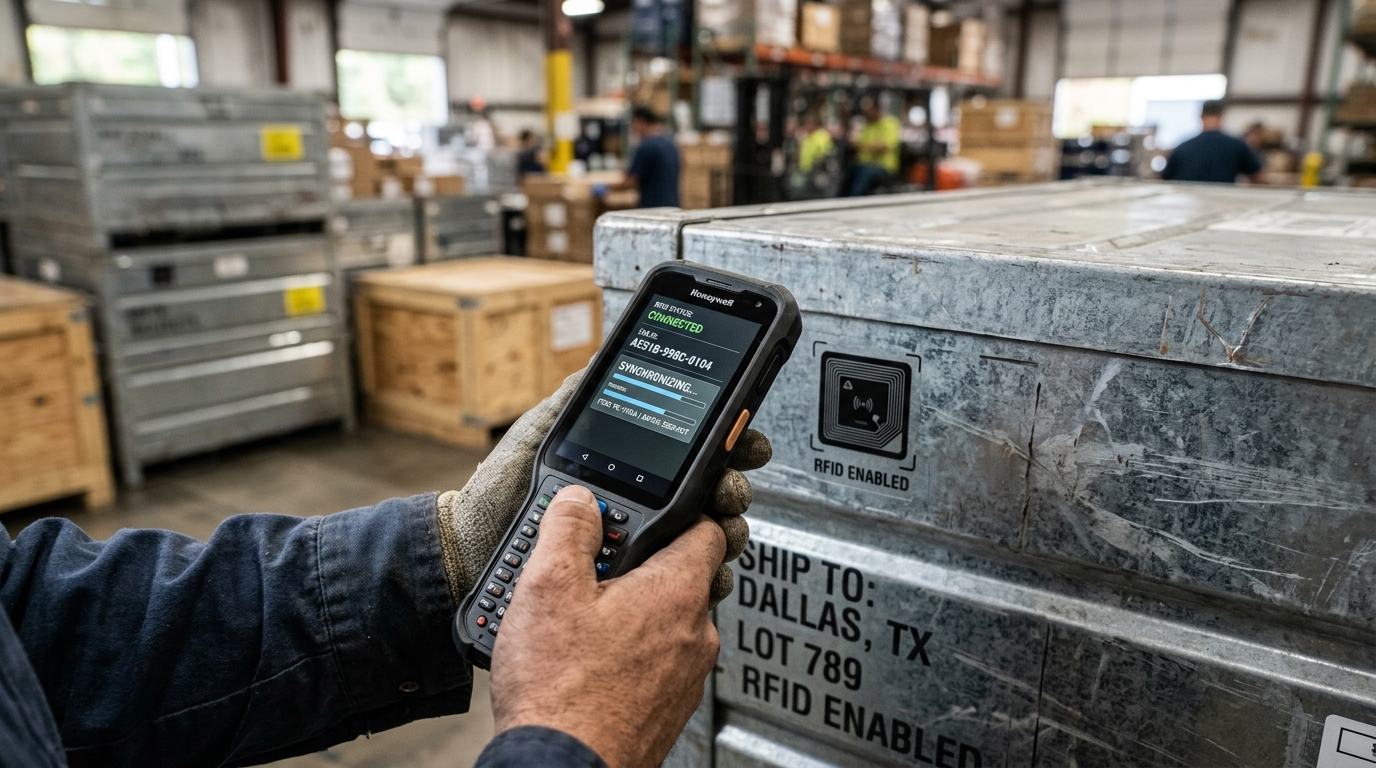
This is the layer everyone fixates on: which technology captures the event? GPS, RFID, UWB, BLE, LoRaWAN, satellite. Each one answers a different operational question. A checkpoint RFID read and a continuous GPS track are fundamentally different observations serving fundamentally different workflows.
I break down the comparison in the next section. The key principle here: observation is one of six layers, not the whole system.
Layer 3: Data transport and normalization
Raw observations arrive in different formats, at different intervals, with different metadata. This layer moves them to a common processing environment and normalizes them into a shared schema. Fields that matter: asset ID, device ID, timestamp, location coordinates, location uncertainty, and source system.
Standards like omlox (the open locating standard) address multi-technology normalization by defining a common location interface across UWB, BLE, GPS, and RFID. Without a normalization step, you end up with three systems reporting the same container in three different coordinate formats and three different time zones. I have seen this more often than I should admit.
Layer 4: Event interpretation
A coordinate is not a business event. This layer translates observations into operational meaning: “Container X entered Zone B.” “Temperature on pallet Y exceeded threshold.” “ULD Z has been idle for 72 hours.”
The GS1 EPCIS 2.0 standard provides a mature framework here, organizing events around what, when, where, why, and how. Object events, aggregation events (cases on a pallet), and sensor data each have defined structures. EPCIS 2.0 added JSON/JSON-LD and REST bindings alongside legacy XML/SOAP, making it practical for modern web-native integrations.
Layer 5: Workflow triggers
An interpreted event that triggers no action is a log entry. This layer connects events to the systems where work happens: a maintenance task in the CMMS, an updated ETA in the TMS, an alert to the dock supervisor, an adjusted reorder point in the ERP.
Mechanisms vary by platform. Some expose REST APIs, others support webhooks for real-time push. But “API available” does not mean “connector built.” Validate the specific events, data fields, permissions, and error handling each system actually supports before assuming bidirectional communication works out of the box.
Layer 6: Lifecycle operation
An integration is not a project with a completion date. It is an ongoing operation that requires duplicate-event suppression, late-event handling, retry queues, offline buffering, stale-location indicators, and reconciliation against the master record.
It also requires platform resilience. AWS retired IoT Events in May 2026. Organizations that had built event-processing logic on that service needed to migrate to a replacement architecture. Documentation existed. The migration effort was still real. Require data export, connector ownership, and migration plans from day one.
Choosing the Right Observation Technology
No technology wins everywhere. The right choice depends on the question your workflow needs answered, how frequently, and in what environment.
| Technology | What it observes | Best fit | Boundary to understand |
|---|---|---|---|
| Barcode / QR | Identity at a manual scan | Checkout, audits, low-volume inventory | Requires human action; no continuous location |
| RFID (checkpoint) | Tag read at fixed points | Baggage handoffs, portal events, item ID | Establishes an observation, not an uninterrupted path |
| UWB RTLS | Sub-meter indoor position | Manufacturing cells, MRO tool cribs | Accuracy is line-of-sight qualified; site conditions vary |
| BLE asset tags | Proximity via gateway infrastructure | Tools, indoor zones, distributed equipment | Coverage depends on gateway density |
| GNSS + cellular | Outdoor coordinates + network reporting | Vehicles, containers, dispersed fleets | Positioning and communication are separate functions |
| LoRaWAN | Low-power small-data telemetry | Remote assets, sparse reporting intervals | Communication alone does not establish precise position |
| Hybrid cellular / satellite | Coverage continuity across network gaps | Ocean, remote overland, intermodal | Adds cost and power draw; ~25% module premium |
| Battery-free BLE (ambient IoT) | High-volume sensing events | Pallet-scale supply chain, retail logistics | No battery does not mean no infrastructure |
A few real-world nuances worth noting. Current UWB portfolios claim better than 30 cm accuracy in line of sight and up to 7 years of battery life, but that longevity figure assumes a 1 Hz blink rate. If your operation needs 10-second updates, the battery math changes entirely.
On the connectivity side, the GSMA’s hybrid tracking guide notes that integrated cellular/satellite modules cost roughly 25% more than standard cellular modules. That premium buys coverage continuity for ocean-crossing and remote-territory assets. It buys neither accuracy nor integration.
On the high-volume end, Walmart has reported battery-free ambient IoT deployed at 500 locations, with a target of 90 million pallets by end of 2026. That is a massive sensing program. But deployment evidence and audited financial return are different things. The scale of sensing only pays off when events flow into inventory and fulfillment workflows, which circles right back to layers three through five.
I see companies agonize over BLE versus UWB for months, then deploy with no plan for how those coordinates enter their ERP. The radio was never their bottleneck.
What Integrated Tracking Looks Like in Practice
The clearest way to see where integration creates value is to examine organizations that connected tracking observations to workflow, not just to dashboards.
Delta Air Lines: checkpoint reads driving customer communication
Delta invested $50 million in RFID across 344 airports, reading tags at successive journey points and pushing notifications to the Fly Delta app from check-in to the carousel. They report 99.9% initial tracking success for tagged items.
Delta does not GPS-track every bag continuously. They use checkpoint reads (a simpler, cheaper observation layer) and integrate those reads into both routing logic and passenger communication. The question answered is not “where is the bag at meter-level accuracy?” It is “has the bag been handled at each expected point, and can we tell the passenger?”
Worth noting: 99.9% tracking success means the read happened. It does not guarantee every bag reached the right destination. Tracking success and transportation performance are different measurements.
Stanley Black and Decker: material location plus quality data
At a Reynosa, Mexico production line, Stanley Black and Decker piloted AeroScout RTLS with Cisco Wi-Fi. Wi-Fi RFID tags tracked material location and status. The integration extended to a quality-scale PLC transmitting final-test outcomes, so managers received production data on mobile devices in near real time.
Cisco reports 24% higher overall equipment effectiveness, approximately 10% higher throughput, and 10% lower material-holding costs from the pilot. These are supplier-reported figures from a controlled environment, not universal guarantees. But the mechanism is telling: combining location data with quality/test data created better production decisions than either stream alone.
Hapag-Lloyd: position plus transport context feeding planning
In late 2024, Hapag-Lloyd and HERE Technologies reported over 1.5 million equipped containers covering 90% of the fleet. HERE Tracking integrates into Hapag-Lloyd’s Live Position service to generate predictive inland arrival times across rail, barge, and truck.
The dot on the map was not new. What changed was the integration: position plus transport-mode context feeding planning engines. A container on a barge and a container on a truck produce fundamentally different ETA calculations. The integration layer interprets the observation through the lens of how the asset is actually moving, not just where it is.
Caterpillar and Geotab: unifying the mixed-fleet blind spot
Earlier this year, Caterpillar and Geotab announced a collaboration bringing on-highway telematics into VisionLink alongside off-highway equipment. Caterpillar estimates roughly 30% of their customers’ assets are on-highway vehicles, meaning nearly a third of the fleet was invisible in the off-highway system.
Both platforms already tracked their respective assets independently. The gap was integration: a unified operational view across mixed fleets. This is not a hardware problem. It is a data-normalization and workflow-unification problem, solved by connecting two existing observation layers through a common interface.
Three Integration Failures That Keep Repeating
For every hospital cutting pump purchases by 70%, there is a deployment where tracking hardware sits mounted and ignored because the integration was never completed. Three patterns come up again and again.
Failure 1: Tracking the assets but not the trackers
A GAO audit of the Department of Defense’s active-RFID program found that policy encouraged tag return and reuse but never required it. The result: 84% of tags had been used only once or twice. Approximately 1.1 million tags valued above $110 million had unknown status. This failure in military asset tracking illustrates broader integration challenges across defense logistics.
The devices meant to create visibility became invisible themselves.
This is not just a government problem. In commercial logistics, I see reusable trackers treated as consumables: deployed on a container, shipped out, never recovered. If you are not managing the tracker through its own lifecycle (recovery, recharge, reassignment, retirement), your unit economics degrade with every cycle.
Failure 2: Clean radios, dirty master data
The most common silent killer in asset tracking integration. RFID reads are perfect. GPS coordinates are accurate. But the master data is wrong. Serial numbers that do not match the ERP. Assets retired in the system but still physically in service. Duplicate records because someone miskeyed a digit at receiving.
No radio technology fixes a record-quality problem. Most teams discover their data quality when they attempt the integration, not before. By then, devices are deployed and the project timeline is burning.
The fix is unglamorous: audit your asset register before you deploy. Match physical identifiers to system identifiers. Retire ghost assets. Establish a single source of truth per asset class.
Failure 3: Platform dependency without an exit plan
AWS retiring IoT Events this year is a concrete case study. Organizations that built event-processing logic on that service needed to migrate to a replacement stack (IoT Core, Lambda, EventBridge). Documentation existed. The migration effort was real.
Any integration that depends on a single vendor’s proprietary pipeline without a documented exit path is a liability. The question to ask is not “will this platform exist in five years?” It is “can I move my data and logic when it changes?”
How to Scope an Integration Before You Buy Hardware
If you are evaluating asset tracking for a container pool, MRO tool crib, ground support fleet, or air cargo pipeline, the integration scope determines your outcome more than the spec sheet on the tag.
Start with the workflow, not the hardware. What specific decision will change when tracking data arrives? If the answer is “we will know where things are,” push harder. Who will know? In which system will they act? What will they do differently? If you cannot name the system and the action, the integration has no target.
Walk each of the six layers and assign an owner. Identity resolution. Observation technology. Data transport. Event interpretation. Workflow triggers. Lifecycle operation. If a layer has no owner, it will not get built. Most projects fail here: they staff layers one and two (buy hardware, mount it), then assume layers three through six will somehow happen.
Audit master data before deployment, not after. Match your physical asset population to your system records. Fix inconsistencies before you mount a single device. Deploying trackers on assets that do not exist cleanly in your ERP is expensive noise.
Specify the integration contract with your IT team and integrator in writing. Not “API available,” but: which events, which data fields, which direction (read, write, both), what latency, what happens on failure, how errors surface. This document prevents the six-month post-deployment argument about why the tracking data never reaches the ERP.
Plan for device lifecycle from day one. How will trackers be recovered, recharged or replaced, reassigned, and retired? What is the battery life under your actual reporting interval, not the vendor’s best-case spec? Budget for device management or accept the DoD outcome: expensive hardware used once and lost.
Require portability. Can you export your data in a standard format? Can you swap the middleware? Can you change the device vendor without rebuilding the entire stack? If the answer to any of these is no, you are buying a dependency, not a solution.

Frequently Asked Questions
What is asset tracking integration?
Asset tracking integration connects physical tracking observations (GPS coordinates, RFID reads, sensor data) to enterprise systems and operational workflows. The goal is automated action: updating an ERP, triggering a maintenance task, recalculating an ETA, or canceling an unnecessary purchase based on real-time asset data.
Which tracking technology is best for integration?
No single technology wins across all environments. RFID checkpoint reads work for handoff verification (Delta uses them at 344 airports). UWB delivers sub-meter indoor positioning for manufacturing and MRO. GNSS with cellular covers outdoor, geographically dispersed assets. Choose the technology that reliably answers your workflow’s specific question at the update frequency it requires.
Can asset tracking data integrate with an existing ERP or CMMS?
Yes, when the target system exposes compatible APIs and your asset identifiers are consistent across systems. Practical prerequisites include clean serial numbers, supported read/write operations, defined event types, and a reconciliation process. Validate the actual connector and its supported fields, not just the vendor’s general claim of API availability.
How much does asset tracking integration cost?
There is no universal per-asset price. Delta’s $50 million airport deployment and a 50-unit container pilot operate in entirely different ranges. Build your cost model from devices, installation, connectivity, software licensing, integration development, device replacement cycles, and ongoing operations. Compare against measurable avoided costs: unnecessary purchases, idle time, lost assets, manual search hours.
What is the difference between shipment tracking and asset tracking?
Shipment tracking ends at delivery. Asset tracking follows the asset through its full lifecycle: deployment, use, return, dwell, maintenance, redeployment, and retirement. Integration connects that full cycle to operational systems, turning a reusable asset into a managed, visible investment rather than something that goes dark after the first leg.
How do I avoid vendor lock-in with tracking platforms?
Require data export in standard formats, connector documentation, and a migration plan as part of vendor evaluation. AWS’s retirement of IoT Events in 2026 showed that even major cloud providers sunset services. Prefer architectures that separate the device layer, the data layer, and the workflow layer so each component can be replaced independently.
The tracker is the visible part of asset tracking. The integration is the part that pays for itself.
At Datanet, integration is what we do. We match tracking hardware to the observation your workflow needs, from DO-160 approved airfreight devices to rugged outdoor cellular trackers, and then build the connection to the systems where your team actually works.
If your container pool, ULD fleet, or ground equipment goes dark after handoff, that is exactly the gap asset tracking integration closes. Talk to our team about yours.



 +1 508 292 2210