

The asset tracking market hit $24.1 billion in 2024, with projections above $51 billion by 2030. Growth like that attracts every kind of vendor: QR-label makers, RFID integrators, fleet telematics providers, indoor positioning specialists, enterprise software companies. All calling themselves an asset tracking platform.
And that is exactly where buying decisions go wrong.
An IT manager counting laptops across three offices and a logistics operator tracking reefer containers across the Atlantic both search for the same term. They need entirely different architectures. Most buying guides treat them as the same buyer.
I’ve spent over 15 years deploying IoT tracking in aviation, freight, and industrial environments. The pattern repeats: teams pick a platform based on the dashboard demo, then discover six months later that the hardware, connectivity, or data model underneath can’t support the decisions that actually matter. A beautiful map rendering stale data is just an expensive screensaver.
This guide breaks down the operating models, technology layers, real deployment results, and evaluation questions that separate the right purchase from a costly mismatch.
Four Operating Models Behind One Search Term
Search “asset tracking platform” and you’ll see custody ledgers next to satellite-connected fleet systems. Same results page, similar language, completely different architectures. Understanding which model fits your operation is the first and most consequential filter.
| Operating Model | How It Works | Best Fit | Primary Limitation |
|---|---|---|---|
| Custody ledger | Records who checked an asset in or out, with timestamp and GPS coordinates at the moment of scan | IT equipment, hand tools, returnable packaging | Location goes stale between scans. A missed scan means a wrong record. |
| Instrumented indoor environment | BLE or UWB receivers detect tagged assets at room or zone level, continuously | Hospitals, warehouses, production floors | Requires installed receiver infrastructure. Coverage and cost scale together. |
| Wide-area connected tracking | GPS/GNSS devices transmit position over cellular, LoRaWAN, or satellite networks | Vehicles, trailers, containers, heavy equipment, ground support | GPS degrades indoors. Battery life, connectivity gaps, and alert delays vary widely. |
| Condition-aware supply chain | Combines location with sensor data (temperature, humidity, shock) and triggers operational responses | Cold chain, pharma, perishable freight, MRO parts | Without a defined response protocol, sensor data becomes an expensive log file. |
Most vendors market themselves as covering “all use cases.” In practice, the underlying architecture reflects whichever model they built first. A custody-ledger tool that later added GPS pins behaves very differently from a fleet-telematics platform that bolted on check-in/check-out fields. The seams show when you stress-test edge cases.
Before comparing pricing or feature lists, answer one question: which of these four models describes the decision your operation needs to make every day? Get that wrong and no amount of feature checkboxes will save the deployment.
Five Layers That Separate a Platform from a Dashboard
Regardless of operating model, every asset tracking platform depends on five layers working together. Demos typically showcase the top two. The bottom three are where deployments succeed or fail.
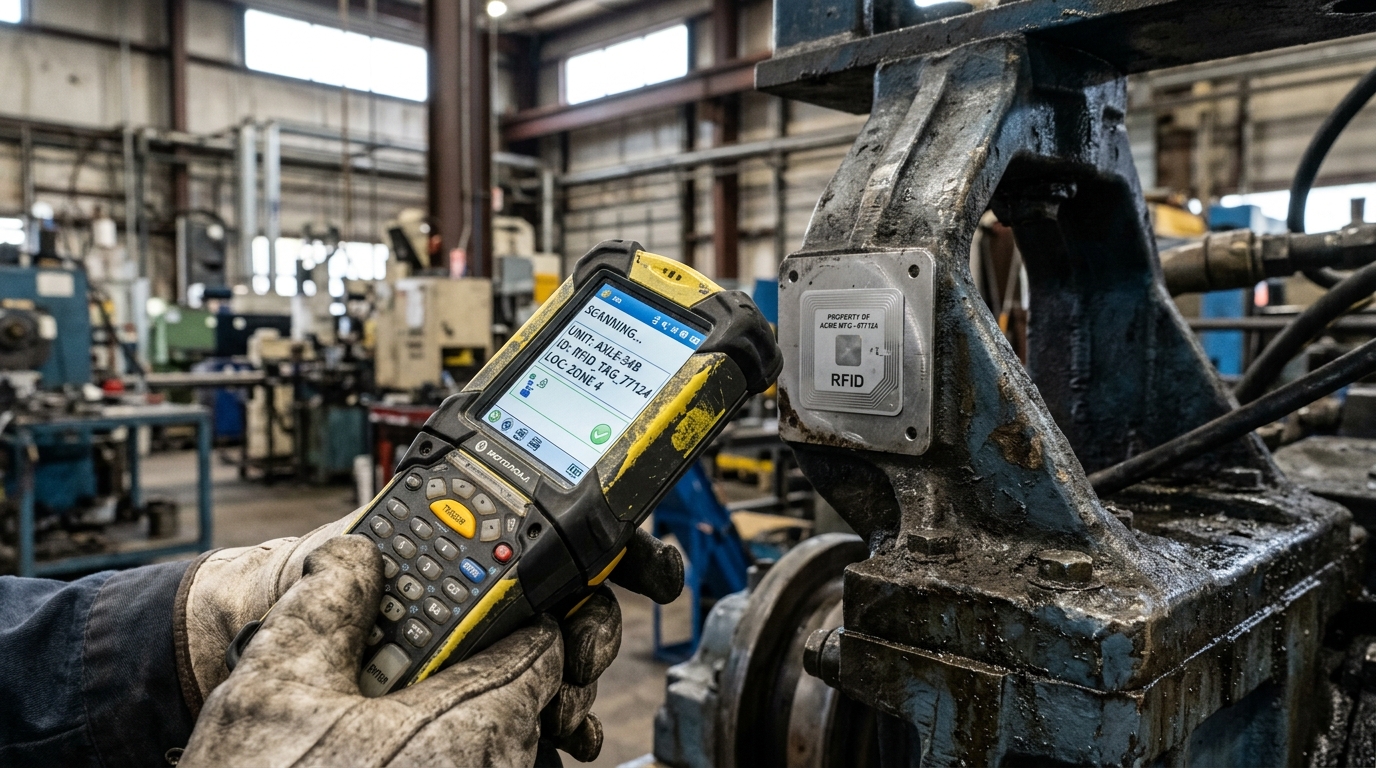
It starts with the identifier: the barcode, QR label, RFID tag, or Bluetooth beacon physically attached to the asset. Without reliable identification, the platform can’t distinguish one item from another. Sounds elementary, until labels peel in heat, RFID tags underperform on metal, and batteries die without warning. Product materials like metals, liquids, and compact form factors create tag-performance challenges that only surface during field testing. Skip the bench test and you’ll learn this lesson at scale.
The second layer is detection: the mechanism that observes the asset. A person scanning a code. A fixed RFID reader at a dock door. A BLE receiver in a hospital corridor. A GPS module reporting coordinates from a trailer roof. This is where “real-time” gets complicated. GPS accuracy deteriorates near buildings and fails indoors, which means your outdoor vehicle tracker goes functionally blind the moment a forklift enters a warehouse.
Connectivity, the third layer, carries observations from the detection point to the platform: cellular, Wi-Fi, LoRaWAN, or satellite. The choice here dictates battery life, update frequency, and geographic reach. LoRaWAN architectures favor low-power, long-duration asset journeys. Satellite-enabled integrations close gaps where cellular coverage doesn’t exist, and 3GPP Release 17 now specifies satellite access for NB-IoT and eMTC in massive-IoT scenarios including transport and logistics. Each connectivity path comes with tradeoffs in latency, cost, and power draw that need testing on your actual routes, not just the coverage marketing map.
Fourth is the data and event history. The database storing observations, custody records, maintenance logs, sensor readings. Interoperability standards like GS1’s EPCIS exist precisely because asset data trapped in a single system is only half as useful. EPCIS defines event records covering the what, when, where, why, and how of asset movements, making cross-system histories possible. If your platform can’t share data with your ERP, CMMS, or WMS, expect manual reconciliation forever.
The fifth layer is action and decision: alerts, workflows, dashboards, API integrations. This is the demo layer. Also the least differentiating, because every vendor makes this part look impressive. The hard question is whether Layers 1 through 3 can sustain the data quality that Layer 5 needs to mean anything.
The mistake I see most often: teams evaluate Layer 5 intensively and skip Layers 1 through 3 until deployment is underway. By then, the hardware is wrong for the environment, the connectivity is insufficient for the geography, and the only fix is ripping it out.
Technology by Technology: What Each Method Actually Reports
Now that the full stack is clear, the most consequential choice sits in Layers 2 and 3: which detection method and connectivity path match your assets and operating environment. Here’s what each technology actually delivers, and where it breaks down.
| Method | What It Reports | Best Fit | Where It Breaks Down |
|---|---|---|---|
| QR code / barcode | Identity and location at the moment someone scans it | Tools, IT assets, check-in/check-out workflows | If nobody scans, the location is stale. Not continuous tracking. |
| Passive RFID (RAIN) | Identity when a tag passes through reader infrastructure | Inventory counts, dock-door checkpoints, warehouse sweeps | Metals and liquids interfere with reads. Performance depends on tag placement and reader positioning. |
| BLE (Bluetooth Low Energy) | Presence at room or zone level via installed receivers | Hospital equipment, factory floor tools, campus-level visibility | Requires receiver network. Battery management adds ongoing cost. |
| UWB (Ultra-Wideband) | Precise position via timed radio signals, potentially centimeter-level accuracy according to the FiRa Consortium | High-precision indoor use: operating rooms, cleanrooms, AGV lanes | Dense anchor infrastructure required. Best-case accuracy is not your building’s accuracy. |
| GPS/GNSS + cellular | Outdoor position transmitted at configurable intervals | Vehicles, trailers, containers, construction equipment, ground support | Indoor and urban-canyon performance degrades sharply. Battery life is inversely proportional to update frequency. |
| LoRaWAN / satellite IoT | Long-range, low-power position reports beyond cellular coverage | Remote sites, transcontinental shipping, offshore equipment | Lower update frequency. Confirm actual route coverage, not the marketing coverage map. |
A practical principle: the best technology is the one that survives your operating environment and produces the alert your team can act on in time. “Real-time” is not a single spec. One vendor may sample GPS every second but transmit every five minutes. Another may update the dashboard every 30 seconds but process alerts with a two-minute delay. Compare the end-to-end interval from asset movement to human notification under identical conditions.
If your assets move between indoor and outdoor settings (aviation ground support equipment, for instance, routinely goes from hangars to ramps to cargo holds), no single technology covers both scenarios equally. You need a hybrid approach with a clear handoff between methods, and that handoff needs explicit testing.
What Real Deployments Actually Measured
Vendor case studies are marketing documents. I use them anyway, because the good ones reveal which metrics matter and what scale of improvement is possible when the deployment genuinely fits the problem.
Delta Air Lines: infrastructure behind the tag
Delta invested $50 million in RFID bag tracking across 344 airports and reported a 99.9% tracking success rate. The lesson isn’t the tag itself. It’s the infrastructure: readers at every transfer point, integration with the Fly Delta app, and a defined process for handling exceptions. A tag on a bag that never passes a reader is invisible. The system works because Delta instrumented the entire handoff chain, not because RFID is magic.
Saint Francis Medical Center: location plus equipment status
Saint Francis integrated infusion-pump tracking with real-time location and reported approximately $21,000 in annual labor savings plus at least $60,000 in avoided equipment losses. Before deployment, biomedical engineers spent up to 90 minutes a day searching for pumps. After: preventive maintenance hit 100% for over 800 devices, and drug-library update cycles dropped from as long as a year to as little as three weeks.
The value here was never the location dot. It was connecting location to maintenance schedules and compliance status in a single view.
Bohn: counting hours reclaimed
Industrial refrigeration manufacturer Bohn cut inventory-count time from six hours daily to 30 minutes using RFID in their distribution centers. A 92% efficiency gain on counting alone, with the vendor also reporting eliminated delivery errors in the specific deployment. These are vendor-published figures for a particular site, not a universal guarantee. But the metric itself (count time as a baseline) is one every warehouse can measure before and after.
M.T. Laney: recovery, not prevention
Construction company M.T. Laney recovered a stolen $30,000 Bobcat within 15 hours because the GPS tracker kept transmitting on internal battery after an attempted disable. The tracking didn’t prevent the theft. It enabled recovery and an arrest. That distinction matters for your ROI model: you’re reducing loss severity, not eliminating risk. Budget accordingly.
Maersk: condition, not just coordinates
Maersk’s Captain Peter service exposes reefer-container data including temperature, humidity, atmospheric readings, GPS, and API integration. A container can be geographically on schedule while experiencing a temperature excursion that ruins the cargo. Location alone would show “everything’s on track.” Condition monitoring shows reality.
Across all five cases, one pattern repeats: the return on investment comes not from the platform itself, but from connecting tracking data to a specific operational decision. Find the pump. Count the inventory. Recover the machine. Flag the temperature breach. The platform is the enabler. The decision is the payoff.
Shipment Tracking Ends at Delivery. Asset Tracking Doesn’t.
Here’s a distinction that most platform comparisons skip entirely, and it’s the one that costs the most money in logistics and aviation.
Shipment tracking follows a payload from origin to destination. The tracking ID closes at delivery. Everyone moves on.
Asset tracking follows the physical thing: the container, the ULD, the pallet, the ground support unit. Through its full lifecycle. Deployment, transit, delivery, dwell time at destination, return trip, maintenance, redeployment. The asset doesn’t retire when the shipment closes. It cycles.
In aviation, I see this constantly. An airline tracks a ULD from hub to spoke. Shipment delivered. Great. The ULD then sits on a ramp for weeks because nobody’s tracking the container pool after delivery. Multiply that by hundreds of units and you’re looking at millions in idle capital, unnecessary replacement purchases, and zero visibility into actual cycle time. Similar challenges appear in military asset tracking, where equipment lifecycle visibility through deployment, maintenance, and return cycles is mission-critical.
The same pattern shows up in reusable industrial containers. A manufacturer tracks outbound shipments with precision. The moment the customer receives goods, the container goes invisible. It might return in three weeks. It might not return at all. Without asset tracking through the return loop, the manufacturer keeps buying containers to replace units that are technically still in the system but functionally lost.
The metrics that matter here are different from shipment metrics:
- Cycle time: deployment to return and redeployment
- Dwell time: how long assets sit idle at customer sites or depots
- Pool utilization: what percentage of your container or equipment pool is actively working at any given moment
- Loss rate: how many assets disappear from the cycle permanently
If your current platform can’t show you these four numbers for every asset in your pool, you have shipment tracking, not asset tracking. The gap between the two is where operational dollars vanish.
This is the specific problem we solve at Datanet. We deploy IoT hardware, from cellular and satellite-connected asset trackers to DO-160 airfreight-certified devices like the Thingfox T2, designed to survive the full asset cycle and report through every leg of it. The software layer matters, but without the right hardware surviving the right environment and reporting through the right connectivity, the platform has nothing useful to display.
How to Evaluate a Platform Without Regretting It Later
After watching deployments succeed and fail across aviation, freight, and industrial operations, I’ve landed on eight questions that consistently filter out mismatches before they become six-figure mistakes.
- What decision does this platform need to support? “Visibility” is not a decision. “Reroute the truck when it’s 30 minutes late” is. “Trigger a maintenance work order when an asset hits cycle count threshold” is. Start with the decision, work backward to the data.
- Which operating model fits? Custody ledger, indoor RTLS, wide-area GPS, or condition-aware tracking. If a vendor can’t clearly state which model their architecture was built for, keep looking.
- What happens when the signal drops? Assets enter buildings, cross dead zones, and lose power. Ask the vendor to demonstrate what the platform displays during a connectivity gap. “Last known location with timestamp” is acceptable. A blank map is a dealbreaker.
- What is the actual end-to-end alert delay? Not the GPS sample rate. Not the dashboard refresh rate. The time from an unexpected asset movement to a human being notified and able to act. In a 2026 survey of nearly 900 fleet professionals, 80% reported using GPS fleet tracking. A dot on a map is now the baseline. The differentiator is how fast anomalies become action.
- Does the hardware survive your environment? Temperature extremes, vibration, moisture, chemical exposure. An asset tracker rated for an office environment will not survive a cargo ramp in summer. Ask for ingress protection ratings, operating temperature ranges, and (for aviation) certifications like DO-160.
- What does total cost actually include? Device hardware, installation labor, cellular or satellite subscriptions, platform licenses, integration with existing systems, and ongoing maintenance or battery replacement. Published per-unit prices for a single component are misleading. IT asset management hosting can start under $500 a year; fleet GPS subscriptions can run $25+ per vehicle per month. Those aren’t comparable numbers because they’re different products in different operating models.
- Can it track the asset through the full cycle? Deployment, transit, delivery, dwell, return, maintenance, redeployment. If visibility dies at the delivery confirmation, you’re buying a shipment tracker.
- Who owns the data, and who can see it? HHS guidance for connected devices recommends maintaining accurate inventories, segmenting networks, and controlling remote access. That principle applies to any IoT tracking device in your environment. Define data retention, access controls, employee-notice rules, and anti-misuse policies before collecting location histories.
Run a pilot that tests the full data-to-action path for your highest-value use case. Real conditions, not demo conditions. If the pilot works under operational stress (dead zones, extreme temperatures, missed scans, overnight battery drain), you have a viable deployment. If it doesn’t, you’ve saved yourself a rollout-scale failure.
If your assets cycle through deployment, transit, dwell, and return, and you currently lose visibility after delivery, that’s the gap we close at Datanet. Talk to our team or explore our asset tracking device catalog to see what a hardware-first approach looks like in practice.
Frequently Asked Questions
What is an asset tracking platform?
A system that links physical or IT assets to location observations, custody records, and operational data. It enables searching, alerting, auditing, and decision-making based on where assets are, where they’ve been, and what condition they’re in. Platforms range from simple QR-scan ledgers to GPS and RFID-based systems with continuous positioning and sensor integration.
Is GPS or RFID better for asset tracking?
They solve different problems. GPS provides outdoor position data for moving assets like vehicles and containers, but degrades indoors. RFID identifies assets as they pass through reader infrastructure and excels at inventory counts and checkpoint verification. Many operations need both: RFID inside facilities, GPS for assets in transit.
How much does an asset tracking platform cost?
There’s no universal answer. IT asset management software can start free (self-hosted) or under $500 per year. Fleet GPS tracking typically runs $20 to $50+ per vehicle per month. Industrial IoT deployments add hardware, connectivity subscriptions, integration, and installation. Total cost depends on asset count, operating environment, update frequency, and system integrations required.
What’s the difference between asset tracking and shipment tracking?
Shipment tracking follows a payload from origin to delivery and closes when the shipment arrives. Asset tracking follows the physical container, vehicle, or equipment through its full lifecycle: deployment, transit, delivery, dwell, return, maintenance, and redeployment. The distinction matters most for reusable containers, ULDs, ground support equipment, and any asset that cycles rather than terminates at delivery.
How do I calculate ROI from asset tracking?
Measure your baseline: time spent searching for assets, duplicate purchases from “lost” equipment, idle asset dwell time, maintenance compliance rates, and theft or loss costs. Compare those figures against total platform cost including hardware, subscriptions, integration, and labor. Published cases report outcomes from $21,000 in annual labor savings to 92% reductions in inventory-count time, but your baseline determines your actual return. For a comprehensive framework on quantifying these returns, see our detailed guide on asset tracking ROI.
Can one platform track assets both indoors and outdoors?
Not with a single technology. GPS handles outdoor movement; BLE or UWB handles indoor positioning. Some platforms support hybrid configurations that transition between methods, but the handoff between indoor and outdoor systems needs explicit testing in your actual facility, not a vendor’s demo environment.



 +1 508 292 2210

4 Responses