
“`html
Aviation asset visibility solutions have become the operational backbone of modern airlines, airports, and MRO facilities. Whether you’re tracking a $2 million engine module crossing the Atlantic or a single calibrated wrench in a hangar, the ability to know exactly where your assets are—and what condition they’re in—directly impacts safety, compliance, and profitability. This guide breaks down the technology landscape, real-world deployments, and practical decision criteria for operations leaders evaluating their options in 2025.

What Aviation Asset Visibility Actually Means in Practice
Asset visibility in aviation isn’t a single product or system. It’s an ecosystem of interconnected technologies and platforms that answer a deceptively simple question: Where is this asset, and is it ready to perform?
The answer changes depending on what you’re tracking. A baggage container needs zone-level accuracy at four handover points. A turbine blade needs a complete digital lifecycle record spanning decades. An AOG spare part needs real-time GPS coordinates over an ocean. Each scenario demands a different technology stack, different data flows, and different integration points.
The market reflects this complexity. The global asset-tracking market was valued at USD 24.14 billion in 2024, with a projected CAGR of 14.9% through 2030 according to Grand View Research. Aviation represents one of its highest-value segments because the cost of not knowing—an AOG event, a compliance failure, a mishandled bag—is disproportionately expensive.
The Five Domains of Aviation Asset Visibility
Understanding the landscape requires seeing it as five distinct but interconnected domains. Each solves a different problem, uses different technology, and serves different stakeholders.
1. Digital Records Management (DRM) and Lifecycle Asset Management
Every aircraft component carries a paper trail—or should. DRM platforms digitize the creation, verification, and exchange of airworthiness records: FAA Form 8130-3 certificates, maintenance histories, compliance with Airworthiness Directives, and lease-return packages.
Why it matters: incomplete records can reduce an engine’s market value by millions. A digitized, auditable record trail preserves asset value and accelerates lease transitions. Spirit Airlines, working with flydocs in 2025, achieved FAA approval for digital records and trained staff on complex lease-return processes in approximately two weeks—a process that previously took months of paper-based orientation.
The most significant recent development: in late 2024, GE Aerospace, Microsoft, and Accenture announced a generative AI-powered tool designed to reduce maintenance record retrieval and normalization from days to minutes.
2. Aircraft Health Monitoring and Predictive Maintenance
Modern aircraft are flying data centers. An Airbus A350 generates up to 1 terabyte of sensor data per day from thousands of onboard sensors—engine parameters, avionics, auxiliary power units, hydraulic systems. Aircraft Health Monitoring (AHM) platforms ingest this data and apply machine learning to predict failures before they happen.
The architecture follows a clear path: onboard sensors → edge processing → transmission via ACARS or ground Wi-Fi → cloud analytics → integration with MRO systems to automatically generate work orders and pre-position parts.
Quantified results from Boeing’s Aircraft Data Reasoner (ADR) on the C-17 military fleet: a 2–3% increase in aircraft availability over 10 years, a 12.1% reduction in unscheduled maintenance, and over 35,000 maintenance man-hours saved. For commercial operators, platforms like Airbus Skywise (now connecting over 12,300 aircraft) and Honeywell Forge (with 70+ analytics models) deliver similar predictive capabilities.
3. Real-Time Location Systems (RTLS) for GSE and Tooling
On the ground, the challenge shifts from telemetry to location precision. Ground Support Equipment—tugs, belt loaders, de-icing trucks—and specialized tools in MRO hangars need tracking at different levels of accuracy.
The technology choice depends on the use case:
| Technology | Accuracy | Best For | Tag Cost | Battery Life |
|---|---|---|---|---|
| Ultra-Wideband (UWB) | 10–30 cm | Precision tool tracking in hangars | $12–$60 | 1–3 years |
| Bluetooth Low Energy (BLE) | 0.5–3 meters | Zone-level GSE visibility across aprons | $8–$30 | 3–10 years |
| LoRaWAN / NB-IoT | Tens to hundreds of meters | Wide-area GSE tracking across large airports | $15–$50 | 2–10+ years |
Real-world impact: Safran Aircraft Engines deployed Quuppa’s BLE/AoA system to track over 30,000 tools across 75,000 m² of facilities, drastically reducing search times. At Frankfurt Airport, Condor Technik deployed Sensolus NB-IoT/GNSS/BLE hybrid trackers in 2025, eliminating unnecessary cross-airport GSE trips across a 3–10 km site—with the system operational within two days of installation.
A confidential pilot at a Tier-1 international hub reported a 20% increase in GSE utilization and a 12% reduction in aircraft turnaround time by eliminating “search and wait” delays.
4. Baggage and Unit Load Device (ULD) Tracking
IATA Resolution 753—the mandate requiring airlines to track baggage at check-in, loading, transfer, and arrival—has driven an industry-wide modernization effort. As of 2024, 44% of airlines had fully implemented R753, with 41% in progress. The result: a nearly 60% reduction in baggage mishandling between 2007 and 2022.
Yet the problem remains significant. In 2024, 33.4 million bags were mishandled globally—a cost estimated at $5 billion.
Passive UHF RFID is the technology of choice for high-automation deployments. Delta Air Lines’ $50 million RFID investment achieved 99.9% read accuracy across 344 airports. Major hubs implementing RFID report 25–40% reductions in lost-baggage incidents.
For ULDs—the approximately 1.2 million containers and pallets in global service with a collective value around $1 billion—annual losses from damage, loss, and replacement exceed $300 million. Smart ULD initiatives using BLE sensors and LPWAN connectivity are progressing from pilot to production, aiming to provide real-time location, temperature, and shock monitoring.
5. AOG Spares and In-Transit Shipment Visibility
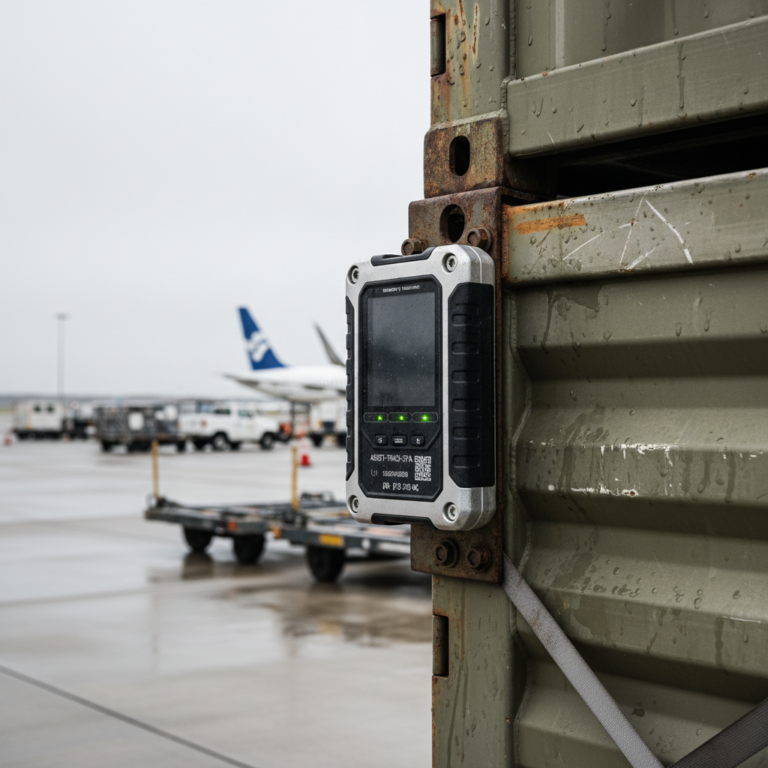
When an aircraft is grounded waiting for a critical part, every hour costs tens of thousands of dollars. Long-range shipment trackers provide continuous visibility using a hybrid technology stack: GNSS for position, multi-band cellular (with eSIM for automatic carrier switching) for transmission, and satellite fallback (Iridium, Inmarsat) for ocean crossings and remote areas.
Swiss International Air Lines’ deployment with Aeris in 2024 demonstrates the operational value: managing approximately 10,000 connected devices via the IoT Watchtower platform, the airline reduced incident diagnosis time from days to minutes through proactive anomaly detection.
The regulatory dimension is critical here. All battery-powered trackers must comply with IATA Dangerous Goods Regulations, pass UN38.3 testing, and meet individual airline acceptance policies. Failing to clear these hurdles means your tracker—and your spare part—doesn’t fly.
The Integration Challenge: Where Real Value Lives
Here’s what the top-ranking articles on this topic consistently miss: the primary obstacle to extracting value from aviation asset visibility isn’t hardware capability. It’s data coordination.
SITA’s 2025 industry report identifies data sharing reluctance as the single biggest factor preventing organizations from realizing their technology investments. The issue manifests in several ways:
- OEM lock-in: Engine manufacturers treat high-resolution telemetry as proprietary IP, often bundling access with long-term service contracts. Airlines need this data for independent maintenance decisions and asset transitions.
- Cross-partner handoffs: Baggage visibility breaks down at partner airline or ground handler boundaries because legacy Type B messaging systems are expensive and limited. IATA’s Modern Baggage Messaging (MBM) standard aims to solve this.
- Siloed platforms: An airline might have one system for baggage, another for GSE, another for maintenance records, and another for shipment tracking—with no unified visibility layer.
The solution trajectory is clear: cloud-based platforms that serve as integration layers, AI/ML analytics that normalize and correlate data across sources, and industry standards like IATA ONE Record that establish common data exchange frameworks.
How to Choose the Right Solution: A Decision Framework
For operations directors evaluating aviation asset visibility solutions, the decision matrix starts with three questions:
- What asset class are you tracking? This determines the technology tier (RFID, RTLS, GPS/cellular/satellite, or software-only for records).
- What accuracy and update frequency do you need? Centimeter-level precision every second (UWB for tool control) costs 10x more per square meter than zone-level updates every few minutes (BLE for GSE).
- What systems must it integrate with? The tracking hardware is the simple part. Value comes from feeding location and condition data into your MRO/ERP, AODB, or operations control system to trigger automated workflows.
The most successful deployments we’ve seen follow a phased approach: start with the highest-pain-point asset class, prove ROI with quantified metrics (search time reduction, utilization improvement, compliance gap closure), then expand coverage and integrate additional domains.
Emerging Trends Shaping 2025–2027
AI-powered record digitization: Generative AI tools are transforming the most labor-intensive aspect of aviation asset management—ingesting, normalizing, and validating decades of paper maintenance records.
Sensor fusion and multi-mode tags: The future isn’t choosing between UWB, BLE, and GNSS. It’s a single tag that seamlessly transitions between all three as an asset moves from hangar to apron to freight hold.
Digital twins for lifecycle planning: Full-fidelity digital replicas of aircraft and engines, continuously updated with telemetry and maintenance data, are enabling sophisticated what-if planning and predictive modeling.
Cybersecurity as a procurement criterion: As more operational data flows through shared platforms, cybersecurity posture and data governance capabilities are becoming non-negotiable requirements in vendor selection.
5G-enabled smart labels: Disposable, peel-and-ship GPS/5G trackers (like Roambee’s 2024 launch) are making per-shipment visibility economically viable for a wider range of parts, not just the most critical AOG spares.
Connecting Visibility to Operational Outcomes
The business case for aviation asset visibility ultimately rests on a handful of quantifiable outcomes:
- Reduced AOG duration: Accurate ETAs and shipment condition data prevent surprise delays.
- Higher asset utilization: You can’t optimize what you can’t see. Visibility enables dynamic allocation instead of static over-provisioning.
- Faster turnarounds: Eliminating search time for GSE and tools directly compresses the critical path.
- Preserved asset value: Complete, auditable digital records protect millions in residual value during sales and lease transitions.
- Compliance confidence: Automated tracking at mandated handover points (R753) and calibration monitoring for tools reduce audit risk.
At Datanet IoT Solutions, we work with operations teams in industrial, agribusiness, and port environments to solve similar visibility challenges—real-time asset tracking, condition monitoring, and centralized management platforms that turn sensor data into operational decisions. The principles that drive value in aviation—reducing losses, enabling data-driven resource allocation, and creating a single source of truth for asset location and condition—apply equally wherever high-value assets move through complex workflows. If your operation faces similar challenges, we’d welcome a conversation about how our IoT tracking and monitoring solutions might help.

Frequently Asked Questions
What is IATA Resolution 753 and how does it affect baggage tracking?
IATA Resolution 753 mandates that member airlines track baggage at four key journey points: check-in, loading onto the aircraft, transfer between flights, and delivery on arrival. Adopted in 2016 with enforcement beginning in 2018, it has driven widespread adoption of RFID infrastructure and modernized messaging standards. As of 2024, 44% of airlines have fully implemented it, contributing to a 60% reduction in mishandling since 2007.
What technologies are used for aviation asset tracking?
Aviation asset tracking uses a layered technology approach: passive UHF RFID for high-volume items like baggage, Ultra-Wideband (UWB) or Bluetooth Low Energy (BLE) for precise indoor location of tools and GSE, GPS with cellular and satellite connectivity for in-transit shipments, and cloud-based software platforms for digital records and analytics. The right combination depends on the asset type, required accuracy, and operating environment.
How much does an AOG event cost an airline?
AOG costs vary significantly by aircraft type, route, and duration, but estimates typically range from $10,000 to over $150,000 per hour when factoring in lost revenue, passenger re-accommodation, crew repositioning, and emergency logistics. This high cost is what makes real-time spare parts visibility solutions so valuable—even modest improvements in ETA accuracy and shipment integrity can prevent cascading disruptions.
What is the difference between UWB and BLE for airport asset tracking?
UWB provides centimeter-level accuracy (10–30 cm) and excels in metal-rich environments like hangars, making it ideal for precise tool tracking and process enforcement. BLE offers zone-level accuracy (0.5–3 meters) at lower infrastructure cost and with longer battery life, making it better suited for broad GSE visibility across large apron areas. Many deployments combine both technologies.
How does predictive maintenance relate to asset visibility?
Predictive maintenance is asset visibility applied to condition rather than location. By continuously monitoring telemetry from aircraft systems—engine vibrations, oil temperatures, hydraulic pressures—analytics platforms can predict component failures before they occur. This shifts maintenance from reactive (fix when broken) to proactive (fix before it fails), increasing aircraft availability by 2–3% and reducing unscheduled maintenance by over 12% in documented deployments.
What is a digital twin in aviation asset management?
A digital twin is a continuously updated virtual replica of a physical asset—an aircraft, engine, or component—fed by real-time telemetry and historical maintenance data. It enables operators to simulate scenarios, predict remaining useful life, and optimize maintenance timing without physical inspection. Major OEMs like Boeing, Airbus, and Rolls-Royce use digital twins as core elements of their predictive maintenance platforms.
“`






 +1 508 292 2210