

Aircraft ground damage costs the aviation industry roughly $5 billion a year. IATA estimates that number could double to nearly $10 billion by 2035 unless the industry takes preventive action. The primary culprit in most incidents? Ground support equipment moving across aprons without adequate visibility. (See also: aircraft equipment location tracking.)
Aircraft ground support equipment tracking uses IoT sensors, GNSS, BLE beacons, and RTLS infrastructure to monitor where every tug, belt loader, dolly, GPU, and air start unit actually is, how it’s being used, and when it needs service. Not just the expensive powered vehicles. The full fleet.
I’ve spent years working with airlines, MRO shops, and ground handlers deploying tracking across mixed GSE fleets. The pattern I keep seeing: operations invest in GPS for their tugs and loaders, call the fleet “tracked,” and then lose millions in turnaround delays caused by unpowered equipment nobody can locate. Dollies vanish between terminals. Stairs pile up at empty gates. GPUs sit idle on one end of the apron while dispatch scrambles at the other.
Below, I’ll break down what technology fits which asset type, what the real financial return looks like, and where most deployments go wrong.
What GSE Tracking Actually Covers
Ground support equipment splits into two categories. The divide matters more for tracking strategy than most fleet managers realize.
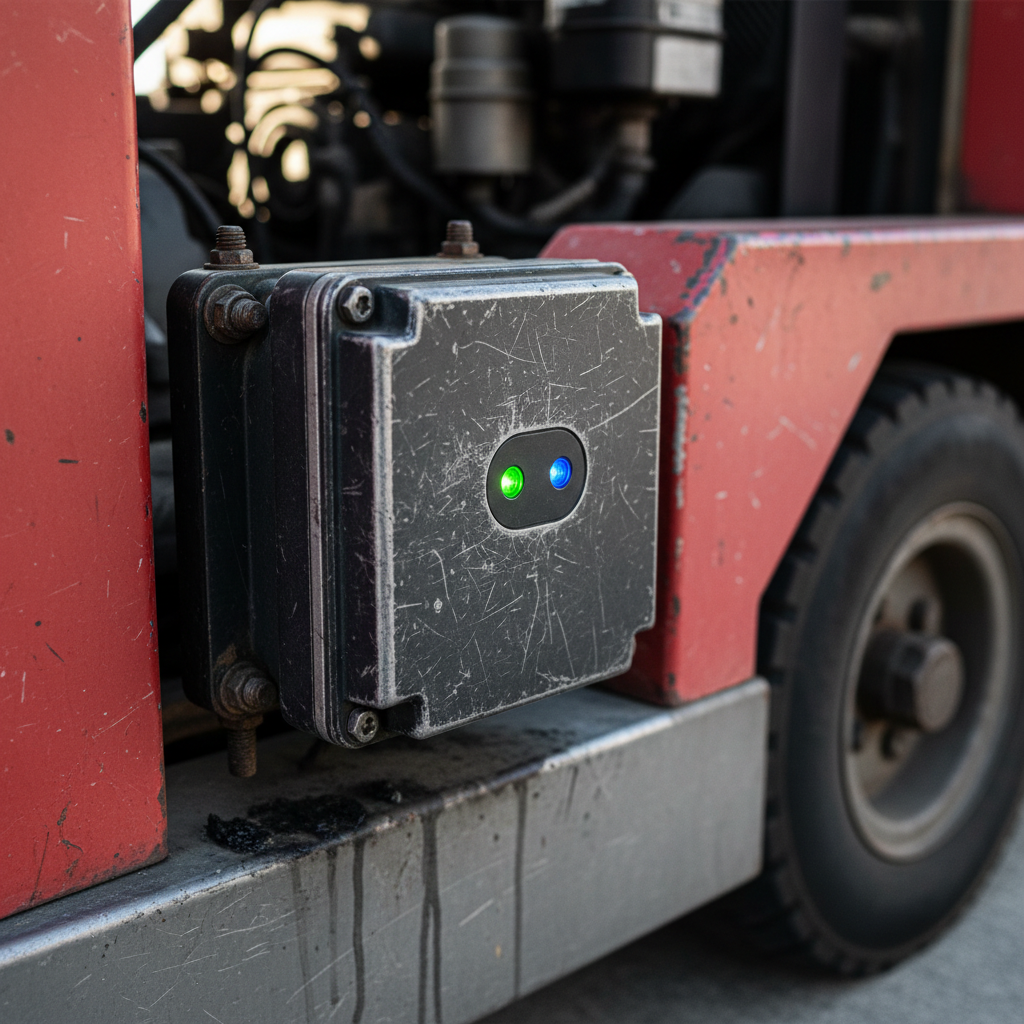
Powered GSE includes tugs, pushback tractors, belt loaders, fuel trucks, de-icing rigs, and motorized ground power units. These assets have onboard electrical systems and enough space to mount a hardwired tracker with constant power.
Unpowered GSE covers baggage dollies, cargo containers (ULDs), passenger stairs, wheel chocks, towbars, and portable ground power cables. No engine. No wiring. No convenient power source for a tracking device.
The gap between these two categories is where operational dollars disappear.
Most airports that claim to “have tracking” really mean they put GPS on their powered fleet. That’s the high-value equipment. But turnaround delays rarely happen because a pushback tractor went missing. They happen because three baggage dollies and a GPU aren’t where dispatch expects them. The unpowered assets, individually cheap but collectively critical, stay invisible.
There’s a deeper distinction worth calling out. This isn’t shipment tracking, where the job ends at delivery. GSE cycles. It goes out to a gate, returns to a staging area, gets inspected, goes back out. The right question isn’t “did it arrive?” It’s: where is it now, how long has it been sitting idle, and when is its next scheduled inspection? That’s asset tracking in the full sense of the term, and it demands a fundamentally different architecture than a one-way GPS ping.
Why GPS Alone Falls Short on the Apron
GPS is the default assumption for tracking anything that moves. For powered vehicles on an open apron, it works: 3 to 10 meter accuracy under clear sky, enough to know which zone a tractor is parked in.
But airport operations aren’t fully outdoor. And they aren’t fully powered. Three realities make GPS-only deployments insufficient.
Hangars, maintenance bays, cargo warehouses, covered ramp areas: GPS requires a clear sky view and does not function reliably indoors. When maintenance checks a vehicle into a hangar, your tracking dashboard shows a blank. You’ve lost visibility on the asset precisely when you need to know its service status.
Battery life is the second wall. Dollies and ULDs need tags that last years without a charge. GPS burns through batteries in days or weeks. When you need to tag 500 unpowered assets, that math doesn’t work.
Then there’s accuracy. Knowing a belt loader is “somewhere near Terminal 2” doesn’t prevent the turnaround delay when it’s actually needed at Gate 14. SkyLink Airport documented an average 11-minute unplanned delay every time a GPU or belt loader ended up at the wrong stand. Over a year, that added up to €2.4 million in airline penalty fees.
This is why serious GSE tracking deployments today use hybrid architectures: GPS for outdoor powered vehicles, BLE or LoRaWAN for unpowered assets, UWB for precision positioning in maintenance facilities.
The Right Technology for Each Asset Type
No single tracking modality covers the complexity of airside operations. The table below shows how the main options compare.
| Technology | Accuracy | Range | Battery Life | Best For | Key Limitation |
|---|---|---|---|---|---|
| GPS / GNSS | 3-10 m | Global (outdoor) | Days to months | Powered vehicle fleet tracking | No indoor coverage; high power draw |
| BLE | 1-3 m | 10-100 m | 1-5 years | Unpowered assets, indoor/outdoor RTLS | 2.4 GHz congestion can degrade accuracy |
| UWB | 10-30 cm | 10-50 m | 1-3 years | Precision indoor, safety zones, high-value items | Highest infrastructure cost; dense anchor deployment |
| LoRaWAN | 50-1,000 m | 2-15 km | 2-10 years | Large outdoor zones, low-resolution monitoring | Too imprecise for gate-level decisions |
| Passive RFID | Zone-level | 1-12 m | None (passive) | Choke-point check-in, inventory counts | No continuous real-time tracking |
In practice, the architecture is layered by asset type.
Powered vehicles (tugs, loaders, fuel trucks) get GPS/GNSS with cellular connectivity, hardwired into the vehicle’s electrical system. Integration with CAN bus telemetry adds engine hours, fuel levels, and battery state of charge alongside location, giving you utilization data, not just coordinates.
Unpowered assets (dollies, stairs, ULDs) need battery-powered BLE beacons or LoRaWAN tags. BLE-based tracking delivers indoor and outdoor accuracy at lower infrastructure costs than legacy RTLS approaches, with tags small enough to mount on a towbar or dolly frame. LoRaWAN trades precision for extreme range and battery longevity: worth considering when zone-level awareness is enough.
Hangars and maintenance bays call for UWB. UWB achieves the highest indoor positioning accuracy among common technologies, delivering centimeter-level precision that eliminates search time for tool carts, engine stands, and high-value jigs. The infrastructure investment is significant, but for high-throughput MRO facilities, the ROI on reduced search time alone can justify deployment.
If you’re evaluating tracking hardware for a mixed GSE fleet, the key is matching the technology to the asset, not forcing one solution across the board.
Real ROI from Real Deployments
Let me skip the theory and show what happened when airports actually deployed GSE tracking at scale.
SkyLink Airport installed 280 BLE gateways and 640 tags across their fleet. The result: €1.1 million saved in annual GSE capital expenditure, full payback in 15 months, and a 74% drop in misplaced-asset incidents. Before the system went live, every misrouted GPU or belt loader triggered an average 11-minute unplanned delay. After deployment, the airport cut roughly 9 minutes off each turnaround’s critical path.
At London Heathrow, Menzies Aviation deployed 400+ telematics units and identified excessive idling alongside underused vehicles. By redeploying or releasing those assets, Menzies reduced its active fleet size and realized an annual cost benefit exceeding £400,000. That figure doesn’t include the safety gains from flagging risky driving behaviors and targeting training where it actually mattered.
In Australia, a flag carrier tracked 5,000 ground support assets across 12 airports using an IoT/LPWAN partnership. The deployment delivered measurable efficiency gains in maintenance scheduling, capital investment planning, fleet downsizing, and daily operations.
Three patterns repeat across every successful deployment I’ve seen:
- Most operations carry 15 to 25% more equipment than they actually need but can’t prove it without utilization data. Tracking provides the proof. Fleet rightsizing was the single largest savings driver at SkyLink.
- Eliminating search time directly improves on-time performance. When a dispatcher can see every available asset on a map instead of radioing drivers, turnaround delays drop. At SkyLink, that meant 9 fewer wasted minutes per event.
- Engine hours, cycle counts, and usage patterns enable preventive maintenance before failures strand equipment on the ramp during peak operations. Reactive maintenance shifts to scheduled maintenance, and fewer unplanned breakdowns ripple through the day.
The typical payback window for a well-scoped GSE tracking deployment sits between 12 and 24 months. After that, the savings compound annually while the infrastructure is already paid for.
How Electrification Changes the Tracking Equation
Electric GSE is no longer a pilot program. 25% of Swissport’s global fleet is now fully electric. Menzies Aviation added more than 620 electric GSE assets in 2025, hitting the same 25% threshold. dnata signed $210 million in framework contracts at the Dubai Airport Show covering diesel, electric, and hybrid units.
The sustainability case is well established. According to IATA, electric GSE produces 35 to 52% less CO2 per turnaround and lowers noise by 5.5 to 8.3 dB(A) compared to diesel equivalents. For airports facing emissions mandates and noise curfews, the shift is accelerating.
But electrification adds a data layer that changes what “tracking” needs to include. Battery state of charge, charging cycles, energy consumption per trip, and charger availability all become critical fleet management inputs. A tug at 15% battery parked at Gate 22 looks available on a basic location tracker. In reality, it can’t handle the next pushback. Without state-of-charge data feeding into dispatch, your team won’t know until a driver calls it in manually.
Systems that only capture location miss half the value of an electric fleet. The ones that integrate with battery management data can optimize charger scheduling, extend battery lifespan through smarter cycling, and prevent assets from being stranded during peak hours. Tracking becomes energy management.
This convergence is one of the forces driving the GSE market’s projected growth from $5.4 billion in 2025 to $9.3 billion by 2033.
IATA’s Enhanced GSE Recognition Program
In 2024, IATA launched the Enhanced GSE Recognition Program to push ground handlers toward equipment with anti-collision technology. The program validates GSE fleets at specific stations and recognizes those that demonstrably reduce operational risk.
Traction has been strong. Since launch, IATA has received more than 450 applications, validated 187 stations, and recognized 75. The program’s ground damage study makes the financial case plain: transitioning 75% of the global fleet to Enhanced GSE could reduce expected ground damage costs by 42%.
“Enhanced GSE” in practice means equipment fitted with proximity sensors, speed limiting in geofenced zones, and tracking systems that log both movement and operator behavior. The program isn’t asking just “where is the tug?” It’s asking: how fast was it going when it approached the aircraft, did the driver brake in time, and where do near-misses cluster?
The program is voluntary today. The direction is not ambiguous. Airlines and handlers with recognized stations hold an edge in contract negotiations. And the technology baseline IATA is setting (anti-collision, tracking, telemetry) aligns directly with what a properly designed GSE tracking deployment already delivers.
The Integration Challenge on Mixed Fleets
Here’s a scenario I encounter regularly. An airport runs tugs from one OEM with built-in telematics, loaders from a second manufacturer on a different software platform, and 400 unpowered dollies with no visibility at all. Three equipment providers, two dashboards, zero unified picture.
The operations manager switches between systems, exports data into spreadsheets, and still can’t answer a basic question: “How many serviceable assets do I have available right now, all types combined, at Terminal 3?”
Vendor fragmentation quietly kills GSE tracking ROI. Each OEM sells their own fleet management software. That makes sense for the OEM. It makes no sense for the operator managing a mixed fleet across a shared apron.
The fix isn’t replacing OEM telematics. It’s layering above them: pulling data from GPS trackers on tugs, BLE tags on dollies, UWB anchors in hangars, and eGSE charging systems into one operational layer that dispatch can actually use in real time.
Infrastructure decisions made now will shape what’s possible next. Schiphol Airport has already activated a private 5G pilot with Ericsson to explore IoT-based monitoring, real-time safety systems, and predictive maintenance. The tracking layer you deploy today becomes the foundation for autonomous GSE, predictive operations, and AI-driven fleet optimization tomorrow.
The global RTLS market is growing at 18.6% CAGR, heading from $6.68 billion in 2025 to $15.67 billion by 2030. That growth isn’t one technology winning. It’s integration across technologies becoming the standard.
This is precisely the work we do at Datanet: selecting the right tracking hardware per asset type, integrating data across vendors, and delivering a single view of your GSE fleet from apron to hangar. If your fleet spans multiple OEMs and your tracking has gaps, let’s talk through what a unified architecture looks like for your operation.

Frequently Asked Questions
What is aircraft ground support equipment tracking?
It’s the use of GPS, BLE, UWB, LoRaWAN, or RFID to monitor the real-time location, utilization, and condition of powered and unpowered equipment on airport aprons, in hangars, and across terminals. The goal is full visibility into where assets are, how they’re being used, and when they’re due for maintenance.
Is GPS sufficient to track all airport ground support equipment?
No. GPS works for powered vehicles outdoors but fails inside hangars, drains batteries too fast for unpowered assets like dollies, and lacks gate-level precision. Most successful deployments combine GPS with BLE for unpowered assets and UWB for indoor environments.
What is the typical payback period for GSE tracking?
Twelve to twenty-four months is the common range. SkyLink Airport achieved full payback in 15 months with €1.1 million in annual savings. Menzies Aviation at Heathrow realized over £400,000 in yearly cost benefits through fleet optimization alone.
How does IATA’s Enhanced GSE program affect fleet requirements?
The program validates stations using GSE equipped with anti-collision sensors, geofenced speed limiting, and operator behavior tracking. It’s voluntary today, but recognized stations gain a competitive edge. IATA estimates 42% of ground damage costs could be eliminated if 75% of the global fleet reaches Enhanced status.
Does electric GSE require different tracking capabilities?
Yes. Beyond location, electric GSE needs battery state-of-charge monitoring, charge cycle tracking, and energy consumption data. Without this layer, dispatch can’t tell whether an asset is actually available or about to run out of charge at the gate.
Can different tracking technologies work together on one airport?
They can and they should. Hybrid architectures are standard practice: GPS for powered outdoor vehicles, BLE for unpowered assets, UWB for indoor precision. The challenge is integrating data from all sources into one operational view, which typically requires an integration layer or a dedicated system integrator.








 +1 508 292 2210

3 Responses