
“`html
Aviation asset visibility solutions have evolved from scattered tracking tools into unified, data-driven platforms that give operators real-time awareness of everything from engines in flight to spare parts in transit. Whether you manage a fleet of ground support equipment at a busy hub or oversee airworthiness records for a lessor, the ability to know where assets are—and what condition they’re in—directly impacts costs, compliance, and operational uptime.
This guide breaks down the five core subdomains of aviation asset visibility, compares technologies, highlights real-world results, and maps the trends shaping procurement decisions through 2026.
What Aviation Asset Visibility Actually Means
At its core, aviation asset visibility is the ability to answer three questions in real time: Where is the asset? What condition is it in? What should happen next?
The scope goes far beyond simple GPS dots on a map. It encompasses:
- Location — real-time or near-real-time positioning of aircraft, engines, GSE, tools, baggage, ULDs, and spare parts.
- Condition — telemetry from onboard sensors (temperature, vibration, shock, humidity) and health parameters from engines and avionics.
- Documentation — the digital lifecycle record that proves an asset’s airworthiness, maintenance history, and regulatory compliance.
- Predictive insight — AI-driven analytics that turn raw data into recommended actions before failures occur.
The global asset-tracking market—spanning all industries—was valued at USD 24.14 billion in 2024 and is projected to reach USD 51.59 billion by 2030, growing at a 14.9% CAGR, according to Grand View Research. Aviation represents one of the highest-value segments within that market due to the cost of downtime: a single Aircraft On Ground (AOG) event can cost an airline upwards of $150,000 per day in lost revenue, rebooking, and penalties.
The Five Subdomains of Aviation Asset Visibility
1. Digital Records Management (DRM) and Lifecycle Asset Management
Every aircraft component carries a paper trail—certificates of airworthiness (FAA Form 8130-3, EASA Form 1), maintenance logs, compliance records for Airworthiness Directives (ADs). Historically, these records lived in filing cabinets. DRM platforms digitize, index, and verify them, creating a searchable, auditable lifecycle record through aircraft component traceability systems.
Why it matters: Incomplete records can slash an engine’s resale value by millions. During lease returns, compiling a redelivery package manually can take months. Vendors like flydocs and AerData/STREAM reduce that to weeks—or days.
A notable 2024 development: GE Aerospace, Microsoft, and Accenture announced a generative AI tool designed to retrieve and normalize maintenance records in minutes instead of days, targeting one of the sector’s biggest bottlenecks.
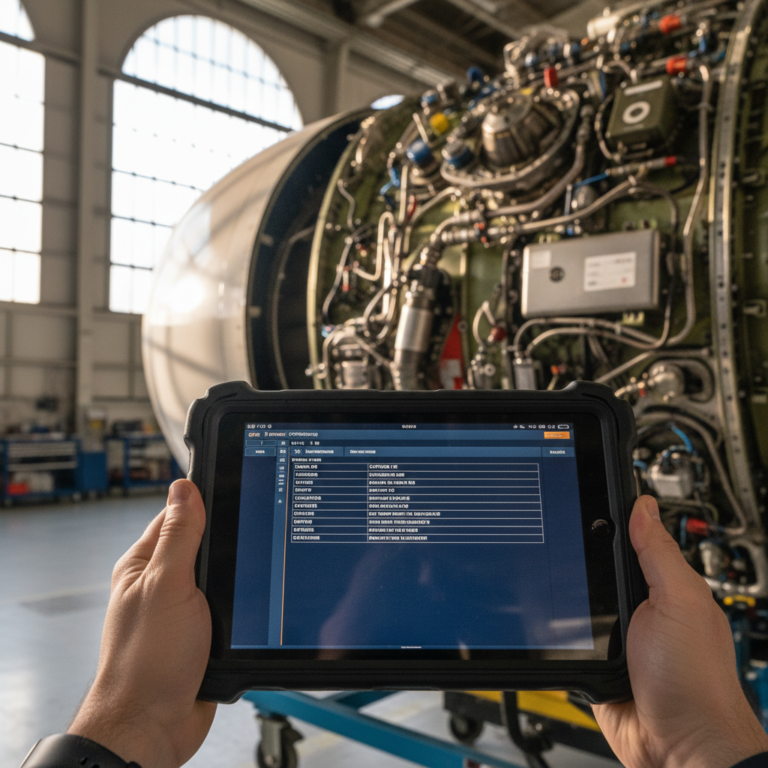
2. Aircraft Health Monitoring (AHM) and On-Wing Telemetry
Modern aircraft generate up to 1 terabyte of sensor data per day. AHM platforms from Boeing (Airplane Health Management), Airbus (Skywise), and Honeywell (Forge) ingest this telemetry, apply machine learning models, and output predictive maintenance alerts.
The goal: shift from scheduled or reactive maintenance to condition-based maintenance (CBM). Instead of replacing a component at a fixed interval, you replace it when data says it’s actually degrading—saving both parts costs and unscheduled downtime through tracking aircraft components in real time.
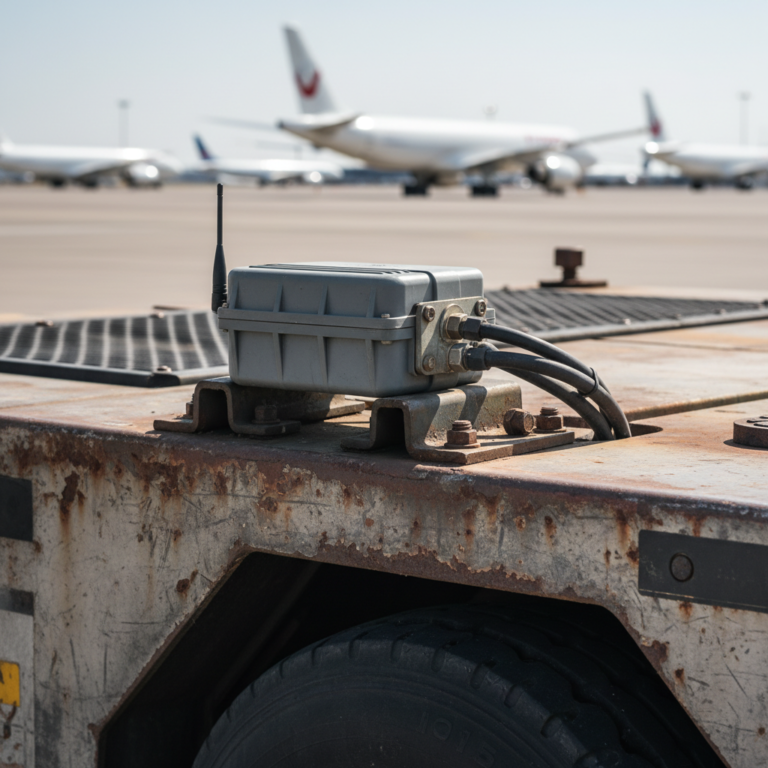
3. Real-Time Location Systems (RTLS) for GSE and Tooling
In MRO hangars and on airport aprons, knowing exactly where a torque wrench, air starter, or pushback tractor is located eliminates the “search and wait” problem. Technologies like Ultra-Wideband (UWB) deliver sub-30 cm accuracy indoors, while BLE and NB-IoT cover broader outdoor areas cost-effectively with aircraft ground support equipment tracking systems.
4. Baggage and Unit Load Device (ULD) Tracking
IATA Resolution 753 mandates that member airlines track baggage at four custody points. This has driven adoption of passive UHF RFID (achieving 99%+ read rates) and modernized messaging standards. Globally, there are approximately 1.2 million ULDs in service valued at around $1 billion collectively, with annual losses exceeding $300 million.
5. AOG Spares Shipment Visibility
When an aircraft is grounded waiting for a part, every hour counts. Multi-sensor trackers combining GPS, cellular (with eSIM for multi-carrier roaming), and satellite fallback provide continuous in-transit visibility. These devices also monitor temperature, shock, and light exposure to confirm shipment integrity on arrival through aircraft parts tracking solutions.
Technology Comparison: Choosing the Right Tool for Each Asset Type
| Technology | Accuracy | Range | Tag Cost | Battery Life | Best For |
|---|---|---|---|---|---|
| Ultra-Wideband (UWB) | 10–30 cm | Indoor (50–100 m per anchor) | $12–$60 | 1–3 years | Tooling in MRO hangars, process enforcement |
| BLE (Bluetooth Low Energy) | 0.5–3 m | Indoor/outdoor (up to 100 m) | $8–$30 | 3–10 years | GSE zone-level tracking, proximity alerts |
| Passive UHF RFID | Gate/zone-level | 1–12 m read range | $0.05–$0.50 (disposable); $5–$20 (rugged) | No battery (passive) | Baggage, ULDs, high-volume items |
| LoRaWAN / NB-IoT | Tens to hundreds of meters | Kilometers | $15–$50 | 2–10+ years | Wide-area GSE tracking, outdoor assets |
| GPS + Cellular + Satellite | 3–10 m (GNSS) | Global | $50–$200+ | Days to months (depends on reporting rate) | AOG spares, high-value in-transit cargo |
The practical takeaway: No single technology solves everything. The most effective deployments use a layered approach—UWB inside hangars, BLE/NB-IoT across the apron, passive RFID at automated scan points, and GPS/satellite for assets that leave the premises using aviation GPS tracking solutions.
Real-World Cases and Quantified Results
Boeing Aircraft Data Reasoner: 2–3% More Aircraft Availability
Boeing’s predictive maintenance platform, deployed on the C-17 military fleet and commercial customers, demonstrated a 12.1% reduction in unscheduled maintenance and saved over 35,000 maintenance man-hours in specific programs. Over a decade, fleet availability improved 2–3%—translating to millions in additional revenue-generating flight hours.
Delta Air Lines: 99.9% Baggage Read Accuracy via RFID
Delta invested approximately $50 million in deploying passive UHF RFID across 344 airports. The result: 99.9% automated read accuracy at key scan points, a dramatic reduction in mishandled bags, and real-time tracking visible to passengers via the Fly Delta app.
Safran Aircraft Engines: 30,000 Tools Tracked with BLE RTLS
Using Quuppa’s BLE Angle-of-Arrival system across 75,000 m² of facilities, Safran drastically cut the time technicians spent searching for calibrated tools—freeing skilled labor for productive maintenance tasks and ensuring tool-control compliance with aircraft tooling tracking systems.
Condor Technik at Frankfurt Airport: GSE Optimization in 2 Days
Condor deployed Sensolus NB-IoT/GNSS/BLE hybrid trackers on its ground support equipment fleet. The system went operational within two days, immediately eliminating unnecessary cross-airport trips across the 3–10 km site and optimizing vehicle routing.
Swiss International Airlines: Incident Diagnosis from Days to Minutes
Working with Aeris’s IoT Watchtower platform to manage roughly 10,000 connected devices, Swiss reduced incident diagnosis time from days to minutes through proactive anomaly detection—ensuring that connectivity issues never delayed a critical spares shipment.
IATA Resolution 753: Industry-Wide Impact
According to an IATA press release from May 2024, 44% of airlines have fully implemented Resolution 753, with 41% in progress. The broader industry effort has contributed to a 60% reduction in baggage mishandling between 2007 and 2022.
The Data-Sharing Challenge No One Wants to Talk About
Here’s what most vendor brochures won’t tell you: the biggest barrier to full aviation asset visibility isn’t hardware. It’s data coordination.
Airlines, OEMs, MROs, lessors, airports, and ground handlers all hold pieces of the puzzle. But commercial incentives create friction:
- OEMs view proprietary telemetry and algorithms as intellectual property—often bundled into long-term service contracts.
- Airlines need comprehensive data access for independent maintenance decisions and asset valuations.
- Lessors require full lifecycle records during transitions, but often find gaps because data was siloed with operators or OEMs.
This “asymmetric visibility” means that even with world-class sensors deployed, the full value of integrated analytics remains partially locked.
How the Industry Is Addressing It
- Shared-value platforms — Airbus Skywise promotes voluntary data pooling in exchange for aggregated fleet insights.
- Contractual clarity — Modern leasing and service agreements increasingly define data ownership, access rights, export formats, and API tiers explicitly.
- Open standards — IATA’s ONE Record initiative aims to create a single, digital record for each shipment, accessible to all authorized parties via standardized APIs.
- Technical controls — Anonymization, role-based access, and tiered data products allow partners to share insights without exposing raw competitive data.
2024–2026 Trends: AI, Digital Twins, and Platform Consolidation
AI and Generative AI in Operations
Large language models are entering aviation operations—not for flying aircraft, but for parsing maintenance records, normalizing unstructured text across legacy systems, and accelerating compliance checks. The GE/Microsoft/Accenture collaboration announced in late 2024 exemplifies this trend: using generative AI to process decades of paper-based records into searchable, linked digital assets.
Digital Twins for Lifecycle Planning
Digital twins—virtual replicas of physical assets updated with real telemetry—are scaling from experimental to operational. They enable “what-if” scenario modeling: What happens to remaining engine life if we extend the interval between shop visits? What’s the optimal redelivery timing for a leased aircraft based on projected component wear?
Platform Consolidation
The fragmentation of point solutions (one system for baggage, another for GSE, another for records) is giving way to consolidated platforms or at least tightly integrated ecosystems with aviation equipment tracking software. The SITA 2025 Air Transport IT Insights report identifies data coordination as the primary obstacle to realizing technology investment value—making integration the top priority for IT buyers.
Cybersecurity as a Procurement Gate
As more operational data flows through cloud platforms and across organizational boundaries, cybersecurity has moved from an IT concern to a board-level procurement criterion. Vendors that can’t demonstrate robust encryption, access controls, and compliance with aviation-specific security frameworks face exclusion from shortlists. According to the FAA’s guidance on aircraft software, security must be embedded at the design phase.
Modern Messaging Standards
Legacy Type B messaging (a format dating to the telex era) is being replaced by IATA’s Modern Baggage Messaging (MBM) and XML-based standards. The cost savings are significant: MBM messages are cheaper to transmit and carry far richer data, enabling better cross-partner visibility without expensive middleware translation layers.
How to Choose the Right Solution Stack
Selecting aviation asset visibility solutions requires matching technology to specific operational pain points. Here’s a decision framework:
Step 1: Identify Your Highest-Cost Gaps
Where are you losing money today? AOG delays from unknown spare part locations? Lease-return disputes from incomplete records? GSE underutilization from manual scheduling? The answer determines your starting point with aircraft inventory tracking solutions.
Step 2: Match Technology to Environment
- Indoor, high-precision needs (MRO tool control) → UWB RTLS
- Broad outdoor coverage (apron GSE fleet) → BLE + NB-IoT/LoRaWAN
- High-volume scan points (baggage, ULD custody transfer) → Passive UHF RFID
- Global in-transit tracking (AOG spares) → GPS + cellular + satellite IoT
- Fleet health and predictive maintenance → OEM telemetry platform (Skywise, Forge, AnalytX)
Step 3: Prioritize Integration Capability
Any solution you deploy must connect to your existing MRO/ERP system (IFS Maintenix, AMOS, TRAX, Ramco) and airport operational databases. Look for REST APIs, MQTT support, webhook capabilities, and pre-built connectors through aircraft equipment location tracking platforms. A tracker that produces data but can’t trigger a work order automatically delivers only half its potential value.
Step 4: Plan for Data Governance from Day One
Before deploying sensors, define who owns the data, who can access it, how long it’s retained, and under what conditions it can be shared. This is especially critical in multi-party environments (airline + ground handler + lessor) where contractual clarity prevents disputes later.
Step 5: Start Small, Prove ROI, Scale
The most successful deployments we’ve seen follow a pilot-then-expand model. Track 50 GSE units for 90 days. Measure search time reduction and utilization improvement. Use those numbers to justify fleet-wide rollout. Condor went operational in two days; the key was having clear KPIs defined before deployment.
At Datanet IoT Solutions, we design monitoring and tracking architectures around this exact methodology—starting with the operational pain, selecting the right sensor and connectivity mix (GPS, cellular, LoRaWAN, BLE), and integrating into a centralized management platform that gives your team real-time visibility and actionable alerts. If reducing asset losses and gaining operational control based on live data matters to your operation, we should talk.

Frequently Asked Questions
What is IATA Resolution 753 and how does it affect aviation asset visibility?
IATA Resolution 753 mandates that member airlines track baggage at four custody points: check-in, aircraft loading, transfer between flights, and arrival delivery. Adopted in 2016, it drives investment in RFID infrastructure, modern messaging standards (MBM), and data-sharing agreements between airlines, airports, and ground handlers. As of 2024, 44% of airlines are fully compliant, with 41% in progress.
What technologies are used for aviation asset tracking?
The primary technologies include passive UHF RFID (for baggage and ULDs), Ultra-Wideband and BLE (for indoor RTLS of tools and GSE), NB-IoT/LoRaWAN (for wide-area outdoor tracking), and GPS combined with cellular and satellite connectivity (for global in-transit spares visibility). Most mature deployments use a hybrid stack that combines multiple technologies based on asset type and environment.
How much does an AOG event cost an airline?
Costs vary by aircraft type, route, and duration, but industry estimates typically range from $100,000 to over $150,000 per day in direct costs (lost revenue, passenger rebooking, crew repositioning, penalty fees). High-value widebody aircraft on long-haul routes can exceed these figures significantly, making real-time spares visibility a high-ROI investment.
What is the difference between UWB and BLE for airport asset tracking?
UWB provides 10–30 cm precision using Time-of-Flight measurements and is ideal for tool control inside hangars. BLE offers 0.5–3 m accuracy at lower cost and longer battery life, making it better suited for zone-level GSE tracking across larger areas. UWB requires denser (more expensive) anchor infrastructure; BLE requires fewer gateways but sacrifices precision.
How do airlines use predictive maintenance from aircraft telemetry?
Airlines connect their fleets to cloud platforms (like Airbus Skywise or Boeing AnalytX) that ingest sensor data from engines, APUs, and avionics. Machine learning models detect anomalies and predict component degradation, generating maintenance alerts before failures occur. This shifts operations from reactive to condition-based maintenance—Boeing’s system demonstrated a 12.1% reduction in unscheduled maintenance on deployed fleets.
What is the biggest challenge in implementing aviation asset visibility?
The primary challenge isn’t technology—it’s data coordination and willingness to share. Airlines, OEMs, MROs, and ground handlers each hold fragments of asset data. Commercial tensions (data as competitive advantage), legacy system incompatibility, and undefined governance frameworks create friction. The industry is addressing this through open standards (IATA ONE Record), shared platforms, and more explicit contractual data clauses.
Can a single platform handle all types of aviation asset tracking?
No single platform covers every subdomain natively. However, the industry trend is toward integrated ecosystems where specialized tools (DRM, AHM, RTLS, shipment tracking) connect via APIs to a centralized visibility layer. The goal is a unified operational picture—even if the underlying hardware and software come from different vendors.
“`





 +1 508 292 2210