
“`html
Aviation asset visibility solutions give airlines, airports, and MROs the ability to know exactly where their assets are, what condition they’re in, and when they need attention — all in real time. Whether you’re tracking a $2 million engine component in transit, locating ground support equipment across a sprawling apron, or ensuring baggage reaches its destination, these systems turn operational guesswork into data-driven certainty.
In this guide, we break down the five core subdomains of aviation asset visibility, compare the technologies that power them, review real-world results with quantified outcomes, and outline what’s changing in the 2024–2026 timeframe.

Why Aviation Asset Visibility Matters Now
The numbers tell a compelling story. The global asset-tracking market reached USD 24.14 billion in 2024 and is projected to reach USD 51.59 billion by 2030, growing at a 14.9% CAGR. Within aviation specifically, the push toward full visibility isn’t optional anymore — it’s driven by regulatory mandates, fleet growth, and the sheer cost of not knowing.
Consider the stakes: a single Aircraft On Ground (AOG) event can cost an airline $150,000 or more per day. Mishandled baggage cost the industry an estimated $5 billion in 2024. And incomplete maintenance records can shave millions off an aircraft’s resale value. Visibility solutions directly address each of these pain points.
The Five Subdomains of Aviation Asset Visibility
Unlike what many top-ranking resources suggest, aviation asset visibility isn’t a single technology or platform. It’s an ecosystem of five interconnected subdomains, each addressing a distinct set of assets and challenges.
1. Digital Records Management (DRM) and Lifecycle Asset Management
This domain focuses on maintaining a persistent, auditable digital history for aircraft, engines, and life-limited parts. The scope includes airworthiness certificates (FAA Form 8130-3, EASA Form 1), component histories, and lease redelivery packages.
Why it matters: Incomplete records don’t just create compliance headaches — they directly erode asset value. A complete digital trail is a prerequisite for financiers and lessors evaluating an aircraft or engine.
Real-world result: Spirit Airlines partnered with flydocs for digital records management and achieved FAA approval for digital records. Staff reached competence in lease-return processes within two weeks — a process that traditionally takes months of training.
Emerging capability: In November 2024, GE Aerospace, Microsoft, and Accenture announced a generative AI-powered tool designed to reduce maintenance record retrieval from days to minutes. This represents a fundamental shift in how legacy paper records become actionable digital assets.
2. Aircraft Health Monitoring (AHM) and Predictive Maintenance
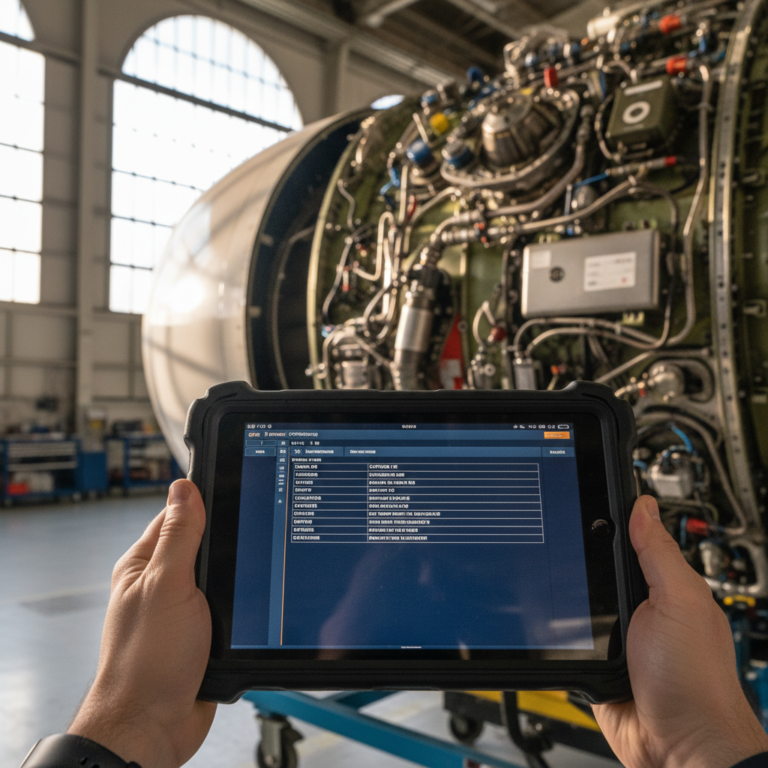
Modern aircraft are flying data centers. An Airbus A350 generates up to 1 terabyte of sensor data per day. AHM platforms collect this telemetry and apply machine learning to predict failures before they cause disruptions.
Architecture at a glance:
- Onboard: Thousands of sensors feed data via ARINC buses and FADEC systems
- Transmission: Critical alerts go via ACARS in near-real-time; full datasets offload via 4G/5G or Wi-Fi at gates
- Cloud analytics: Platforms like Boeing AnalytX, Airbus Skywise, and Honeywell Forge apply ML models and digital twins
- Ground integration: Outputs feed directly into MRO/ERP systems, automating work orders and parts pre-positioning
Quantified outcomes: Boeing’s Aircraft Data Reasoner (ADR) delivered a 2–3% increase in aircraft availability over 10 years on the C-17 fleet, a 12.1% reduction in unscheduled maintenance, and saved over 35,000 maintenance man-hours.
3. Real-Time Location Systems (RTLS) for GSE and Tooling
Ground Support Equipment and specialized tooling represent billions in capital sitting on airport aprons and in MRO hangars. RTLS provides precise, real-time location data to improve utilization, reduce search times, and enforce tool-control compliance. For comprehensive solutions in this area, aircraft ground support equipment tracking systems deliver proven results.
Technology comparison:
| Technology | Accuracy | Best Use Case | Tag Cost | Battery Life |
|---|---|---|---|---|
| Ultra-Wideband (UWB) | 10–30 cm | Precision tool tracking in hangars | $12–$60 | 1–3 years |
| BLE (Bluetooth Low Energy) | 0.5–3 m | Zone-level GSE tracking across aprons | $8–$30 | 3–10 years |
| LoRaWAN / NB-IoT | Tens to hundreds of meters | Wide-area GSE tracking (kilometers) | $15–$50 | 2–10+ years |
Real-world results:
- Safran Aircraft Engines deployed Quuppa’s BLE-based RTLS to track over 30,000 tools across 75,000 m² of facilities, drastically reducing search times. Learn more about aircraft tooling tracking systems.
- Condor Technik at Frankfurt Airport implemented Sensolus NB-IoT/GNSS trackers and eliminated unnecessary cross-airport trips for GSE within two days of deployment.
- A confidential Tier-1 hub pilot reported a 20% increase in GSE utilization and a 12% reduction in aircraft turnaround time.
Optimal approach: A hybrid architecture works best — UWB for centimeter-level precision inside hangars, BLE or NB-IoT for broad coverage across the apron. For broader positioning needs, aviation GPS tracking solutions integrate seamlessly with these indoor systems.
4. Baggage and Unit Load Device (ULD) Tracking
IATA Resolution 753 requires member airlines to track baggage at four key points: check-in, loading, transfer, and arrival. This mandate has driven massive investment in tracking infrastructure.
Current adoption (2024):
- 44% of airlines have fully implemented Resolution 753
- 41% are in progress
- The industry achieved a nearly 60% reduction in baggage mishandling between 2007 and 2022
Technology reality: Barcodes still dominate (73% of airports), but passive UHF RFID delivers read rates of 99%+ without line-of-sight — making it the technology of choice for high-automation facilities. Delta Air Lines’ $50 million RFID investment achieved 99.9% tracking accuracy across 344 airports.
ULD economics: With approximately 1.2 million ULDs in global service valued at $1 billion collectively, and annual losses exceeding $300 million, the business case for IoT-enabled “Smart ULDs” with real-time location, temperature, and shock monitoring is clear.
5. AOG Spare Parts Shipment Visibility
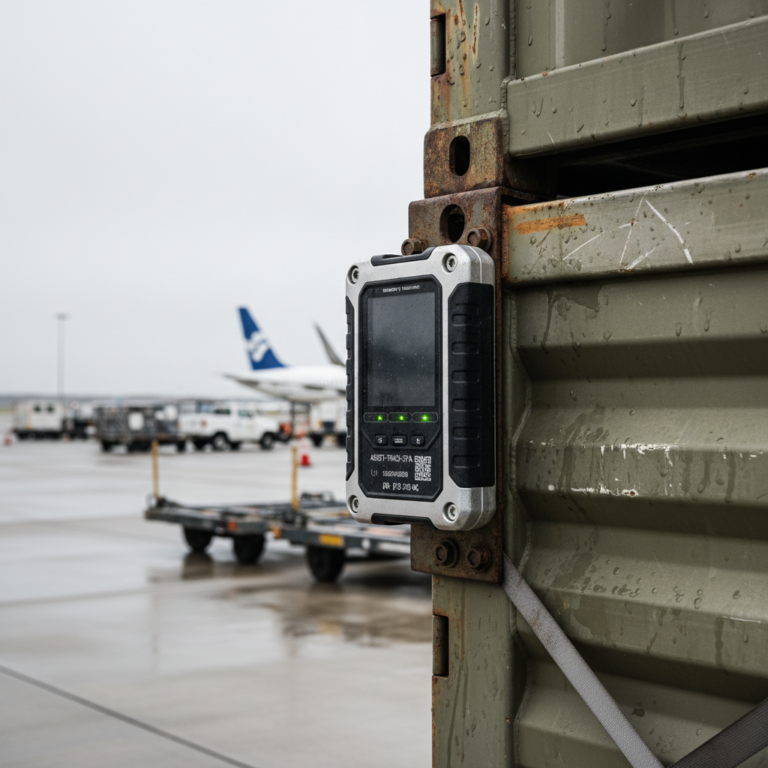
When an aircraft is grounded waiting for a part, every hour of delay compounds costs. Long-range in-transit visibility provides accurate ETAs and condition monitoring for critical shipments anywhere on earth. Advanced aircraft parts tracking systems are essential for managing these high-stakes logistics.
Technology stack:
- Primary: GNSS (GPS/GLONASS) + multi-band cellular (LTE/4G/5G) with multi-IMSI or eSIM for automatic carrier switching
- Satellite fallback: Iridium, Inmarsat, or Globalstar for ocean crossings and remote areas
- Indoor handoff: BLE beacons at facility entry points
- Condition sensors: Temperature, shock/vibration, light (tamper detection)
Case study: Swiss International Air Lines deployed Aeris’s IoT Watchtower platform to manage approximately 10,000 devices. The result: incident diagnosis time dropped from days to minutes, with proactive anomaly detection identifying issues before they impacted critical shipments.
The Integration Challenge: Data Coordination, Not Hardware
Here’s what most discussions of aviation asset visibility miss: the primary bottleneck in 2024–2026 isn’t hardware capability. It’s data coordination.
The SITA 2025 Air Transport IT Insights report identifies data sharing reluctance among stakeholders as the single largest obstacle to realizing technology investment value. Airlines, OEMs, airports, MROs, and ground handlers each hold pieces of the visibility puzzle — but commercial interests, IP concerns, and liability questions keep the data siloed.
How the industry is addressing this:
- Shared-value platforms: Airbus Skywise connects over 12,300 aircraft through a voluntary data-sharing model where airlines contribute data in exchange for aggregated insights
- Standards initiatives: IATA’s ONE Record program aims to create a single, standardized data record for cargo shipments across all partners
- Contractual innovation: Sophisticated data clauses now define ownership, access rights, anonymization requirements, and tiered API access
- Technical controls: Role-based access, data anonymization, and API gateways allow sharing insights without exposing raw competitive data
Technology Trends Shaping 2024–2026
AI and Machine Learning at Scale
AI is moving from pilot projects to production. Large Language Models (LLMs) are being applied to maintenance record digitization, operations control, and predictive maintenance. The GE/Microsoft/Accenture collaboration represents just the beginning of generative AI’s impact on records management.
Digital Twins for Lifecycle Planning
Physics-informed digital twins now model individual aircraft and engine components through their entire lifecycle, enabling more accurate predictions of remaining useful life and optimized maintenance intervals. These systems complement aircraft component traceability systems for comprehensive lifecycle management.
Technology Stack Convergence
The winning approach isn’t picking one technology — it’s blending them intelligently. Passive RFID for high-volume items, UWB/BLE for precision indoor tracking, GPS/cellular/satellite for long-haul shipments. Modern aviation equipment tracking software platforms that unify these into a single operational view are gaining rapid adoption.
Cybersecurity as a Procurement Criterion
As more operational data flows through connected platforms, cybersecurity and data governance have become non-negotiable requirements in every procurement decision — not afterthoughts. The FAA’s software certification guidance establishes critical security baselines for aviation systems.
Modern Messaging Standards
The industry is transitioning from costly legacy Type B messaging to modern standards like IATA’s Modern Baggage Messaging (MBM) and the Baggage Community System (BCS). These newer protocols are cheaper, more capable, and designed for cross-partner visibility.
Building a Business Case: ROI Drivers by Subdomain
| Subdomain | Primary ROI Driver | Typical Outcome |
|---|---|---|
| Digital Records (DRM) | Asset value preservation, accelerated lease returns | Weeks saved in redelivery cycles; FAA/EASA compliance maintained |
| Aircraft Health Monitoring | Reduced unscheduled maintenance, increased availability | 2–3% availability gain; 12% reduction in unscheduled events |
| RTLS (GSE/Tooling) | Improved utilization, reduced search time | 20% utilization increase; 12% faster turnaround |
| Baggage/ULD Tracking | Reduced mishandling costs, compliance | 99.9% read accuracy; $5B industry cost reduction potential |
| AOG Shipment Visibility | Reduced AOG duration, accurate ETAs | Diagnosis time from days to minutes; avoided charter/cancellation costs |
Implementation Considerations
Start with the Pain Point, Not the Technology
The most successful deployments begin by identifying which visibility gap costs the most. Is it AOG downtime? Tool search inefficiency? Lease-return delays? Technology selection follows from the problem definition. Solutions like tracking aircraft components in real time address specific operational pain points with measurable impact.
Plan for Integration from Day One
Any visibility solution must connect with your existing MRO/ERP, AODB, or WMS. Look for platforms that support REST APIs, MQTT, webhooks, and event-driven workflows (like geofence triggers that auto-update your operations database).
Consider Hybrid Architectures
No single technology covers every scenario. The strongest implementations combine multiple technologies — each optimized for its specific use case — under a unified platform layer. For comprehensive asset management, aircraft inventory tracking solutions serve as the foundation.
Address Data Governance Early
Define data ownership, access rights, and sharing policies before deployment. This is especially critical when multiple stakeholders (airlines, ground handlers, OEMs) contribute to or consume visibility data. Aircraft equipment location tracking systems must include robust data governance frameworks from the outset.
FAQ: Aviation Asset Visibility Solutions
What is IATA Resolution 753 and how does it affect baggage tracking?
IATA Resolution 753 mandates that member airlines track passenger baggage at four key journey points: check-in, loading onto the aircraft, transfer between flights, and on arrival. Adopted in 2016, it has driven widespread adoption of RFID and modernized messaging systems. As of 2024, 44% of airlines are fully compliant, with another 41% in progress. Compliance requires investment in tracking infrastructure, data-sharing agreements between airlines and ground handlers, and migration from legacy messaging to modern standards.
What technologies are used for real-time GSE tracking at airports?
The three primary technologies are Ultra-Wideband (UWB) for sub-meter precision in hangars and confined areas, Bluetooth Low Energy (BLE) for zone-level tracking across aprons, and NB-IoT/LoRaWAN for wide-area outdoor tracking spanning kilometers. Most airports benefit from a hybrid approach that combines two or more technologies based on the required accuracy and coverage area.
How does predictive maintenance through aircraft health monitoring work?
Aircraft Health Monitoring collects telemetry from onboard sensors (engines, APU, avionics) and transmits it to cloud-based analytics platforms. Machine learning models identify anomalies and predict component failures before they occur. Outputs — including fault alerts and prescriptive repair actions — feed directly into MRO systems to automate work order creation and parts pre-positioning. Boeing’s implementation achieved a 12.1% reduction in unscheduled maintenance.
What is the ROI of implementing aviation asset visibility solutions?
ROI varies by subdomain but is consistently strong. GSE tracking deployments report 20% utilization improvements and 12% faster turnarounds. Predictive maintenance delivers 2–3% availability gains and tens of thousands of saved man-hours. Baggage RFID achieves 99.9% tracking accuracy, reducing mishandling costs. AOG shipment trackers help avoid costs exceeding $150,000 per grounded day. The common thread: these solutions convert invisible operational waste into measurable, recoverable value.
How do IoT trackers work for AOG spare parts shipped internationally?
IoT trackers for AOG parts combine GPS for outdoor positioning, multi-carrier cellular connectivity (with eSIM for automatic network switching across borders), and satellite fallback for areas without cellular coverage. Onboard sensors monitor temperature, shock, and tampering. The tracker reports location and condition data to a cloud platform that provides real-time ETAs and alerts. When the device enters a facility, BLE handoff maintains visibility indoors.
What’s the biggest challenge in aviation asset visibility today?
Data coordination and sharing — not hardware capability. Stakeholders (airlines, OEMs, airports, ground handlers, lessors) each hold critical visibility data but are reluctant to share it due to commercial sensitivity, IP concerns, and liability questions. Industry initiatives like Airbus Skywise, IATA ONE Record, and increasingly sophisticated data governance contracts are slowly bridging this gap.

How We Approach Asset Visibility
At Datanet IoT Solutions, we’ve spent years deploying IoT-based monitoring and tracking systems in environments that share many challenges with aviation operations — complex logistics chains, high-value assets, harsh conditions, and zero tolerance for blind spots. Our platform integrates GPS tracking, environmental sensors, and centralized management dashboards designed for operations teams who need answers, not more data noise.
If you’re evaluating visibility solutions for ground support equipment, shipment tracking, or facility-wide asset monitoring, we’d welcome a conversation about how our approach to real-time IoT data can fit your operational reality.
“`





 +1 508 292 2210