

I’ve walked through factories where every CNC machine streams telemetry to the cloud, every robot reports cycle times to the millisecond, and the MES dashboard glows with real-time OEE. Then I ask one question: “Where are your tooling kits right now, between facilities?” Silence.
Connected manufacturing systems have earned their place in modern production. The global connected manufacturing market hit $260.7 billion in 2024 and is projected to reach $1.6 trillion by 2034, growing at a 20.4% CAGR. 86% of manufacturers say smart factory initiatives will define their competitiveness over the next five years. The technology works. The investment is real.
And there’s one layer the industry keeps skipping.
What Connected Manufacturing Systems Actually Mean
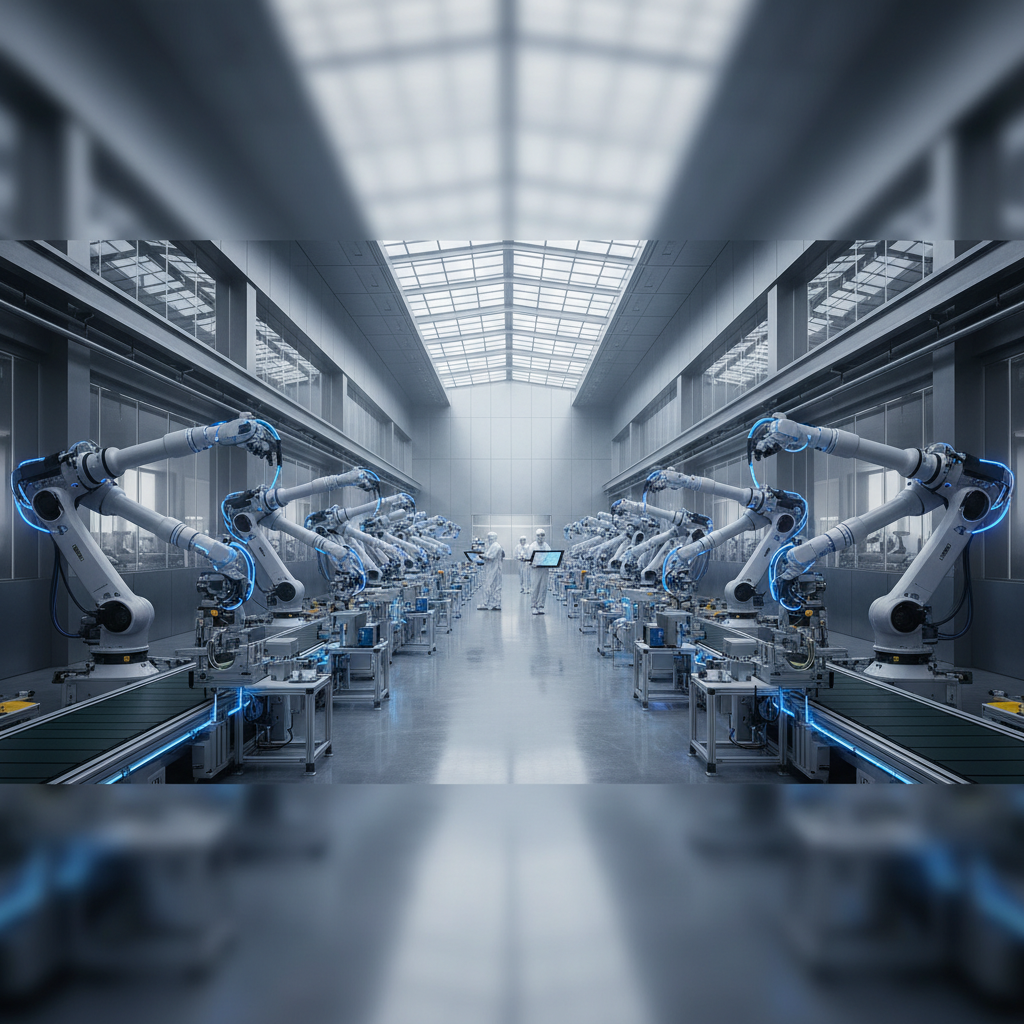
A connected manufacturing system is the integrated network of machines, sensors, software, cloud services, and people that exchange production data in real time across the shop floor, the enterprise, and the supply chain.
Rockwell Automation frames it as a cloud-based business strategy that harnesses operational and business data to improve manufacturer performance. Deloitte’s original formulation describes it as “a flexible system that can self-optimize performance across a broader network, self-adapt to and learn from new conditions.”
Both definitions share the same core: real-time data flow between machines, systems, and people, used to make faster decisions with fewer blind spots.
The term is often used interchangeably with “smart factory” and “Industry 4.0.” They overlap but aren’t identical. Industry 4.0 is the broadest umbrella: the fourth industrial revolution driven by cyber-physical systems. A smart factory is a single facility achieving those goals. Connected manufacturing is the underlying data-flow architecture that enables both. Think of it as the circulatory system. Not the organ. Not the body. The thing that keeps everything alive.
What it is not: just buying sensors. Sensors are the nervous endings. A connected manufacturing system includes physical devices, communication protocols, integration architecture, software platforms, an analytics layer, and the cybersecurity framework that keeps the whole thing trustworthy. Miss any one of those and the system has a gap. Sometimes a costly one.

Inside the Stack: From Sensor to Strategy
The NIST Smart Manufacturing Reference Architecture (AMS 300-1) provides the clearest framework. It organizes connected systems into four functional layers (Business, Activity, Capability, Service) across four integration domains (Enterprise, Site, Area, Device).
In practice, most operations work with seven layers.
At the bottom: physical devices. PLCs, distributed control systems, sensors, actuators, robots, vision systems, field gateways. This is where data originates.
Layer two: communication protocols. OPC UA handles machine-to-machine interoperability. MQTT handles lightweight pub/sub between edge and cloud. Private 5G provides deterministic wireless for mobile robots and AGVs. These aren’t competing options. You need all three.
Layer three: integration architecture. Data moves upward from the device level through area controllers to site-level systems to enterprise platforms, following the NIST domain model.
Layer four: IIoT platforms. Siemens Insights Hub, AWS IoT SiteWise, Azure IoT, PTC ThingWorx, Rockwell FactoryTalk. These ingest, normalize, and route machine telemetry at scale.
Layer five: MES and MOM applications. Plex, Opcenter, Proficy, Infor MES, Tulip, Solumina. They manage production orders, enforce quality workflows, and close the loop between planning and execution on the shop floor.
Layer six: analytics and AI. Generative AI for documentation, agentic AI for autonomous decisioning, computer vision for defect detection, digital twins for line simulation. This layer is growing faster than any other.
Layer seven, orthogonal to everything above: cybersecurity. Identity management for OT, network segmentation between IT and OT, anomaly detection on shop-floor traffic, ransomware-specific defenses. Not a feature. A prerequisite.
Microsoft’s Connected Factory Reference Architecture, published February 2026, operationalizes this stack using Fabric Real-Time Intelligence, collapsing the historical separation between historian, data lake, and analytics into a single platform. That convergence is the direction the industry is heading.
The Market in Numbers
Connected manufacturing spans multiple overlapping market categories. The numbers depend on how wide you draw the boundary.
| Market Segment | 2024/2025 Base | Forecast | CAGR |
|---|---|---|---|
| Connected Manufacturing | $260.7B (2024) | $1,668.8B by 2034 | 20.4% |
| Smart Manufacturing | $410.7B (2025) | $1,063.2B by 2033 | 12.1% |
| Industrial Internet of Things | $483.2B (2024) | $1,693.4B by 2030 | 23.3% |
| MES | $15.95B (2025) | $25.78B by 2030 | 10.1% |
Three forces explain the double-digit growth. Post-pandemic supply disruptions pushed manufacturers to instrument entire supply networks, not just internal lines. The generative AI wave repositioned spending from “collect data” to “act on data.” And cybersecurity threats drove parallel investment in OT security because the alternative is production shutdown.
What does this look like at full scale? Siemens’ Electronics Works Amberg connects roughly 1,200 machines to a single analytics layer and achieves quality rates near 99.999%. Tesla’s Gigafactory Berlin runs an in-house event-driven architecture connecting every robotic cell and production station to what’s internally called “Tesla Cloud.” Foxconn partnered with NVIDIA to build Omniverse-based digital twins that simulate entire production lines before physical commissioning. These are lighthouse cases. They prove the technology works. The question is what the path looks like without their resources.
IoT Analytics’ April 2026 ranking of the top 10 smart manufacturing vendors by global sales places Siemens first, followed by ABB, Honeywell, Rockwell, Schneider Electric, Mitsubishi Electric, Emerson, Bosch, Yaskawa, and Omron. On the MES side, Gartner Peer Insights highlights Plex (Rockwell), Proficy (GE Vernova), Opcenter (Siemens), Infor MES, Tulip, and Solumina (iBASEt) as the most evaluated platforms. Gartner’s Market Guide for MES notes the vendor community is “pivoting to newer technologies like AI and IoT to keep pace with startups.”
Three architectural paths dominate. The closed stack: buy everything from one control-systems incumbent, simpler to deploy, creates vendor lock-in. The open stack: OPC UA plus hyperscaler cloud plus best-of-breed apps, flexible, requires integration work. The build-your-own: Tesla’s approach, maximum control, requires billions in software engineering talent. Most aerospace and industrial manufacturers land somewhere between the first two.
Five Reasons Connected Manufacturing Projects Underperform
Analyses of Industry 4.0 deployments consistently find that 50 to 70% of smart factory projects miss their planned ROI. The reasons are predictable. That doesn’t make them easy to solve.
Legacy equipment doesn’t speak the language
Connected manufacturing assumes machines can communicate. Many production lines run equipment from three or four vendors, each with proprietary protocols, some decades old. A Siemens PLC doesn’t natively speak to a Rockwell controller. Retrofitting connectivity onto machines that were never designed for it is slow and expensive. In aerospace, where some CNC machines and autoclaves run for 20+ years, this is the norm.
The cost of connecting legacy equipment often exceeds the cost of the platform it connects to. That number never shows up in the vendor pitch deck.
IT and OT fight over the same network
IT teams optimize for security, patching, and standardization. OT teams optimize for uptime, stability, and minimal change. In a connected manufacturing system, those worlds must converge. Manufacturing absorbed 56% of the global ransomware surge in 2025, with LockBit and BlackCat groups specifically targeting the IT/OT boundary where security disciplines break down. The convergence isn’t optional. The ransomware groups already know it.
Talent gaps amplify every other problem
People who understand both industrial control systems and cloud data platforms are scarce. People who understand OT cybersecurity are scarcer. Bitsight’s 2025 analysis identified manufacturing as the single most targeted industry sector, yet most plants still assign cybersecurity to IT teams with no shop-floor experience.
Data silos survive inside the connected factory
Teams buy sensors, build dashboards, and then discover that the data models from the MES don’t map to the ERP’s schema. Sensor data sits in one lake. Quality data in another. Maintenance records in a third. Connection without unification isn’t connection. It’s noise with better visuals.
Nobody defined the decisions before buying the hardware
The most expensive implementations I’ve seen started with technology: “Let’s deploy 10,000 sensors.” The ones that delivered ROI started with a question: “What three decisions do we need to make faster, and what data would enable that?” Build the data flow around decisions, not around sensors. The sensors come last.
The Gap: Physical Assets Between Connected Factories
Here’s the pattern I keep running into across aerospace and industrial operations.
A manufacturer invests in connected systems inside the factory. MES tracks every work order. Sensors catch every temperature anomaly. Digital twins simulate layout changes before anyone moves a machine. Inside the four walls, visibility is excellent.
Then a tooling kit ships to another facility for MRO work. A ULD container moves from the airline’s hub to a ground handler’s warehouse. Engine rotables route through three maintenance stations across two continents.
Visibility disappears.
Connected manufacturing systems, as the industry defines them, focus on production. They instrument the line. But manufacturing in aerospace depends on a continuous flow of physical assets between facilities: tooling, spare parts, returnable containers, ground support equipment, rotable components. These assets represent real capital. When they go dark between connected factories, the cycle-time data inside those factories is incomplete.
This is the distinction between shipment tracking and asset tracking. Shipment tracking tells you where something is until delivery. Asset tracking follows it through the entire lifecycle: deployment, transit, dwell, maintenance, return, redeployment. If your connected manufacturing system generates perfect production data but can’t locate 30% of your tooling kits in transit, the system has a hole in it.
The technology to close this gap exists today. Rugged IoT trackers with multi-year battery life, cellular and satellite connectivity, GNSS positioning, and DO-160 certification for airfreight environments. The same principle applies well beyond aerospace, from cold-chain logistics to aquaculture sensor systems that need reliable data far from any factory. The hardware isn’t the blocker. The blocker is that connected manufacturing strategies stop at the factory door.
Three measurable outcomes when you extend visibility beyond the walls (principles that align closely with lean manufacturing in aerospace methodologies):
- Cycle-time data becomes end-to-end, exposing dwell time that erodes asset utilization by 15 to 25% in most container and tooling pools.
- Safety stock buffers shrink because you know where every rotable component is, not just where it was last scanned.
- MRO turn-around times improve because the tooling and parts arrive when the work order expects them, not whenever someone finally locates them.
If your container pool or tooling fleet goes invisible the moment it leaves the production facility, that’s the gap asset tracking closes.
What Comes Next: Agentic AI, Edge Compute, and the Security Reckoning
Four shifts are reshaping connected manufacturing systems right now.
Agentic AI is moving from recommendation to action. Previous AI applications generated suggestions for humans to approve. Agentic AI executes autonomously: predictive maintenance scheduling, supply chain orchestration, real-time quality adjustments. The shift is from “planning around volatility” to “operating within it.” The most cited benefit among manufacturers who’ve deployed generative AI is improved efficiency, productivity, and cost reduction, which suggests the ROI conversation is moving past the pilot stage.
Edge AI is reducing round-trip latency. NVIDIA Jetson, Siemens Industrial Edge, and AWS Greengrass push inference to the shop floor. For time-sensitive tasks like visual defect detection, data never needs to leave the facility. That matters for defense and aerospace manufacturers where data sovereignty is non-negotiable.
Private 5G is replacing wired connectivity for mobile assets. AGVs, mobile robots, and AR-assisted maintenance need deterministic wireless that Wi-Fi cannot reliably provide. Ericsson and Nokia now offer factory-grade private 5G as a turnkey service, and GSMA notes that mobile technologies increasingly tackle production inefficiencies and supply chain disruptions that wired infrastructure simply can’t reach.
Cybersecurity is becoming a first-principles design requirement. After the 56% ransomware concentration on manufacturing, “secure later” is not a strategy. Every greenfield connected manufacturing deployment should include OT network segmentation, MFA on every remote access session, and immutable backups tested quarterly.
One more: sustainability reporting is being built on the same data backbone. The IoT telemetry that tracks OEE is being reused for Scope 1, 2, and 3 emissions reporting. Siemens, Honeywell, and Rockwell have all published ESG modules that sit on top of their existing connected-manufacturing platforms. The same infrastructure that justifies the investment on productivity grounds now justifies it to the board on ESG grounds too.
Frequently Asked Questions
What is a connected manufacturing system?
It is the integrated network of machines, sensors, software (MES, IIoT platforms), cloud services, and people that exchange real-time production data across the shop floor, enterprise systems, and supply chain. The goal: faster, data-driven decisions at every layer of operations.
How is connected manufacturing different from a smart factory?
Industry 4.0 is the broadest umbrella, the fourth industrial revolution. A smart factory is a single facility that achieves Industry 4.0 goals. Connected manufacturing is the underlying data-flow architecture that enables both. You can run a smart factory that isn’t fully connected to its upstream and downstream supply chain.
How big is the connected manufacturing market?
The dedicated connected manufacturing market was valued at $260.7 billion in 2024 and is projected to reach $1.67 trillion by 2034 at a 20.4% CAGR. The broader smart manufacturing and IIoT segments each exceed $400 billion and follow similar growth trajectories.
Who are the leading vendors?
Control-systems incumbents lead: Siemens ranks first globally (IoT Analytics, April 2026), followed by ABB, Honeywell, Rockwell, Schneider Electric, Mitsubishi Electric, Emerson, Bosch, Yaskawa, and Omron. MES specialists include Plex, Opcenter, Proficy, Infor MES, Tulip, and Solumina.
Why do so many connected manufacturing projects miss ROI?
50 to 70% of smart factory projects underperform. Common causes: legacy equipment with proprietary protocols, unresolved IT/OT governance conflicts, cybersecurity gaps (manufacturing was the most ransomware-targeted sector in 2025), data silos that persist despite new platforms, and buying hardware before defining the decisions the data should support.
What role does asset tracking play in connected manufacturing?
Connected systems instrument the production line but often lose visibility when physical assets (tooling, containers, rotable parts) move between facilities. IoT-based asset tracking extends visibility across the full lifecycle: transit, dwell, maintenance, return. It closes the gap between shipment tracking, which ends at delivery, and true asset-level visibility.
If your connected manufacturing strategy ends at the factory door, the assets moving between your facilities are your blind spot. We help aerospace and industrial operations close that gap with IoT tracking solutions built for the real world. Talk to our team, or reach us at info@datanetiot.com.







 +1 508 292 2210

2 Responses