

The aerospace automation market is projected to hit USD 14.14 billion by 2031, growing at nearly 10% per year. In the first half of 2026, startups in this space raised over USD 200 million combined. Every aerospace conference deck I’ve encountered this year has “smart factory” on slide three.
And yet. Factories still lose track of tooling between shifts. Expensive parts sit in queues with zero visibility. Quality escapes make front-page news. Aerospace manufacturing automation density keeps climbing while some of the hardest problems (traceability, process governance, cybersecurity) get treated as afterthoughts.
This piece is for operations leaders, process engineers, and supply chain executives who need to separate what actually works from what just sounds good in a vendor pitch. I’ll cover the technologies delivering measurable ROI, the costs nobody quotes you, and what Boeing’s quality crisis teaches about the limits of automation without governance.
What Aerospace Manufacturing Automation Actually Covers
When most people hear “aerospace manufacturing automation,” they picture robotic arms riveting fuselage panels. That’s part of it. A small part.
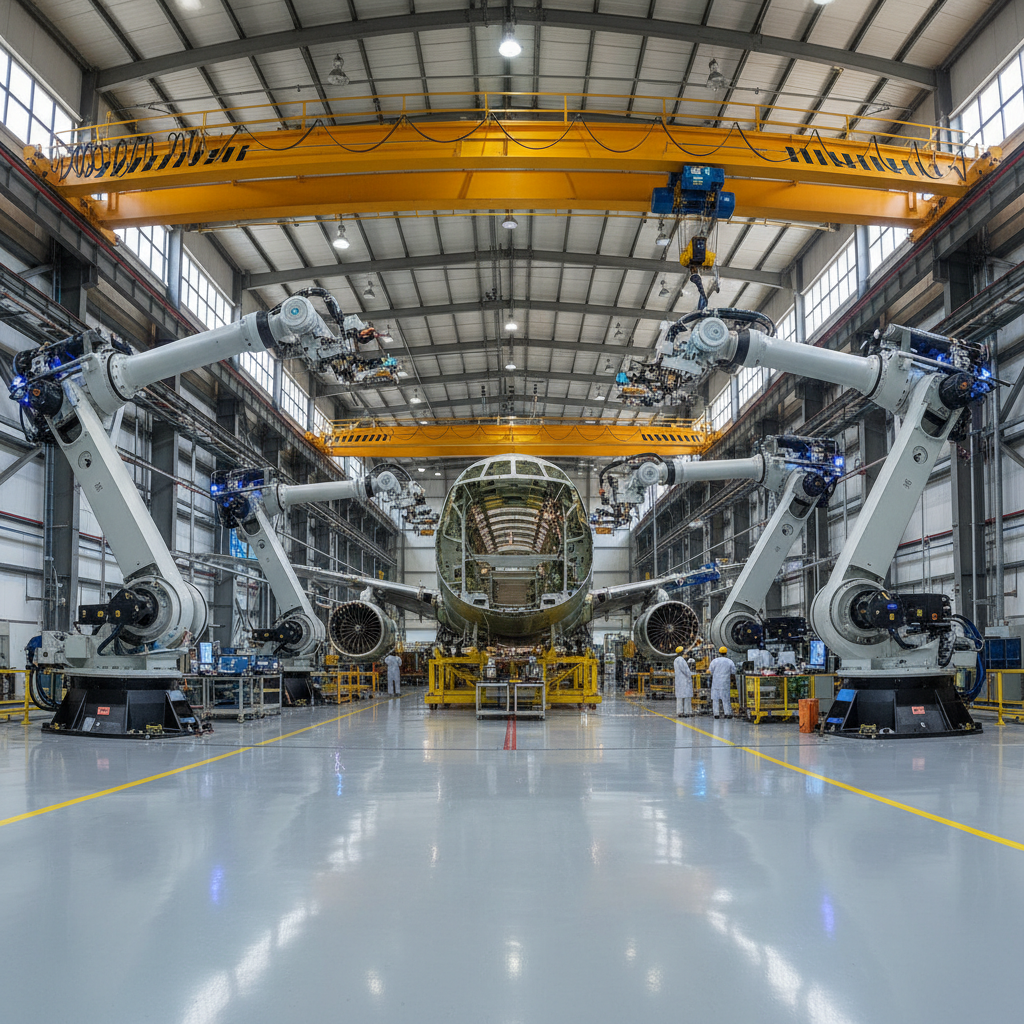
The full scope includes industrial robotics (articulated arms, cobots, SCARA, Cartesian gantry systems), CNC machining centers, automated fiber placement (AFP) for composites, additive manufacturing (metal 3D printing), digital twins, AI-driven quality inspection, predictive maintenance systems, augmented reality for guided assembly, MES platforms, and the IoT connectivity layer that ties it all together.
What makes aerospace automation fundamentally different from automotive? Three things.
First, volume. An automotive line might produce 1,000 vehicles a day. An aircraft assembly line measures output in single digits per month. Low volume, high mix means you cannot optimize for one repetitive task the way a car plant does.
Second, tolerances and traceability. AS9100 quality standards and FAA oversight demand documentation on every fastener, every composite ply, every weld. A defect in automotive triggers a recall. A defect in aerospace can trigger a catastrophic failure at 35,000 feet.
Third, qualification cycles. Introducing a new automated process for a flight-critical part can take 5 to 15 years of testing, certification, and regulatory approval. That timeline shapes every investment decision you make.
This distinction changes the ROI math entirely. You are not buying automation to go faster. You are buying it to go more precisely, more traceably, and more consistently, across a workforce that is shrinking faster than anyone projected five years ago.
The Numbers Behind the Shift
Two lenses frame the opportunity.
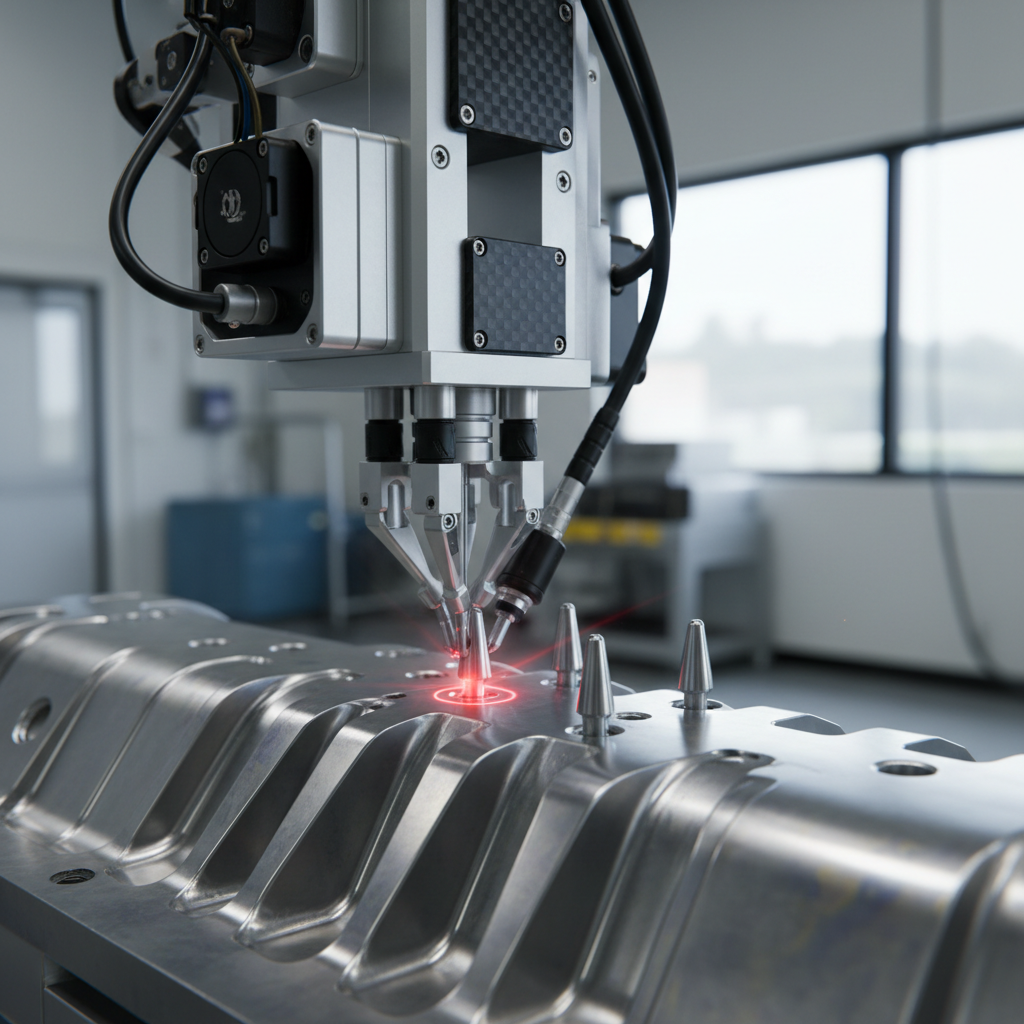
The hardware lens: aerospace robotics reached USD 3.5 billion in 2024 and is forecast to double to USD 7.01 billion by 2030, a 12.19% CAGR. These are the robots, cobots, and CNC controllers going onto factory floors.
The full-scope lens: the broader aerospace automation market (including software, MES, and integration services) stood at USD 8.09 billion in 2025 and is expected to climb to USD 14.14 billion by 2031 at 9.77% CAGR.
| Segment | 2024/2025 Value | Projected Value | CAGR |
|---|---|---|---|
| Aerospace robotics (hardware-centric) | USD 3.5B (2024) | USD 7.01B by 2030 | 12.19% |
| Aerospace automation (full scope) | USD 8.09B (2025) | USD 14.14B by 2031 | 9.77% |
Hardware is growing faster than the overall envelope. That tells you where the incremental dollar is going: bottleneck-relief robotic cells for drilling, inspection, and coating. The swing factor right now is physical equipment, not software.
On the demand side, metalworking machinery orders hit USD 593.6 million in April 2026, up 33.2% year over year, with aerospace contributing to back-to-back months of growth. The startup layer is just as active: Freeform (3D metal printing) raised USD 67 million Series B, Machina Labs closed USD 124 million Series C, and Heaviside Industries emerged from stealth with USD 28 million Series A. All three in the first six months of 2026.
The pull comes from two directions simultaneously. The global commercial fleet is projected to expand 33% by 2033, reaching roughly 36,000 aircraft. That creates production demand that manual processes simply cannot absorb. Meanwhile, U.S. manufacturing lost 78,000 jobs in the 12 months ending August 2025, while aviation MRO faces its own acute skilled-labor shortage.
The capital is there. The question is whether it’s being spent on the right things.
Technologies Delivering Measurable ROI
Not every technology in the aerospace automation stack is at the same maturity level. Here is where documented, quantifiable returns exist today.
Robotics and Cobots
Articulated robots handle drilling, fastening, painting, and sealing across fuselage and wing structures. They are the workhorses. But the faster-growing category is collaborative robots (cobots), designed to work alongside technicians without safety cages and with lower capex than full robotic cells.
The standout case: FANUC’s CRX cobot paired with the ASI 4D measurement system compressed a 12-hour aerospace safety inspection to 10 minutes. That is not incremental improvement. That is a fundamentally different process.
GE Aviation documented USD 1.3 million in savings in the first year after deploying a single robotic cell. Multiply that across a factory with dozens of candidate processes and the math becomes hard to ignore.
Automated Fiber Placement
AFP is the dominant automation technology for composite aerostructures: wings, fuselage sections, launch vehicle interstages. The technique deposits individual carbon fiber tows at precise angles, replacing hand layup with machine-controlled repeatability.
Modern AFP systems achieve 3-sigma accuracy of roughly ±0.08 mm while deploying 24 tows simultaneously. The quality advantage matters as much as the speed: every ply is data-captured automatically, eliminating the visual-inspection bottleneck inherent in manual layup.
The next frontier is thermoplastic-compatible AFP. It processes materials that hand layup physically cannot handle, unlocking structural geometries that were previously impossible to manufacture at production scale.
Additive Manufacturing
Metal 3D printing has crossed from prototyping into production parts. Airbus is now printing titanium structural aircraft parts with less material waste than traditional forging, a win that’s both economic and environmental. Rolls-Royce’s Additive Layer Manufacturing programme produces geometries previously unattainable with conventional machining for defense propulsion systems.
The economics are strongest for low-volume, high-complexity parts where traditional tooling costs are prohibitive. Freeform, built by former SpaceX engineers, predicts customers will have parts manufactured autonomously within 12 months. Even if that timeline slips, it signals where the technology curve is head See also the article: Aquaculture Automation: The Implementation Sequence Most Farms Skip.ing. See also the article: Vertical Farming Automation: What Pays and What Doesn’t.
Digital Twins
73% of aerospace and defense organizations now maintain a long-term digital twin roadmap, with investment projected to grow 40%. A digital twin is a continuously updated virtual replica of a physical asset or process, synchronized through sensor data.
Airbus uses digital twins across the full lifecycle: initial design, manufacturing simulation, and predictive maintenance during operations. The return is in rapid “what if” exploration, faster qualification, and reduced rework on parts that can cost tens of thousands of dollars each.
AI-Driven Inspection and Predictive Maintenance
AI in aerospace manufacturing operates at three layers. Vision-based quality inspection catches sub-millimeter defects that human inspectors miss after their sixth consecutive hour. Generative design produces optimized part geometries from engineering constraints. And predictive maintenance fuses sensor telemetry to forecast component failures before they ground an aircraft.
The practical impact: platforms like C3.ai extract failure predictions from aircraft telemetry, shifting MRO from scheduled to condition-based maintenance. On the factory floor, Yaskawa’s MOTOMAN NEXT series uses AI for autonomous process adaptation, adjusting parameters in real time rather than following rigid programs.
Augmented Reality and the Connected Worker
Boeing has used AR since 2009 to enable hands-free, interactive 3D wiring assembly, with documented reductions in both errors and cycle time. Technicians access diagrams, video guidance, and inspection criteria without putting down their tools.
Pair that with IoT sensor networks and MES platforms and you get what GE Aerospace calls the “Brilliant Facilities” model. Their facility sensor program produced USD 153,000 in cost savings, eliminated approximately 3,800 high-risk labor hours, and delivered a nearly 50% improvement in energy efficiency. Three return vectors from a single connected infrastructure.
The pattern is consistent: the highest-ROI automation projects are not the ones with the most expensive hardware. They are the ones where physical systems, data capture, and process governance reinforce each other.
The Costs That Don’t Make the Slide Deck
The headline ROI numbers are real. McKinsey estimates automation can cut aerospace manufacturing costs by up to 30%, while Deloitte reports defect reductions exceeding 50% in automated cells. Payback windows of 1 to 3 years appear consistently in business cases. What rarely appears: the five cost categories that show up after the purchase order is signed.
Every robotic cell running 24/7 needs its own support ecosystem. Spare drives, predictive monitoring on the automation system itself, and specialized technicians who can troubleshoot failures at 2 AM. This scales with every cell you add. It is not a one-time capex line. It is a permanent opex commitment.
Cybersecurity exposure grows with every connected machine. The September 2025 cyberattack on Collins Aerospace’s MUSE platform grounded check-in and boarding operations at multiple airlines. Smart factories introduce operational technology (OT) networks that were historically designed for closed environments, not threat-rich architectures. NIST SP 800-171 and NAS9933 set the compliance floor, but meeting them requires dedicated investment in network segmentation and continuous OT monitoring.
Qualification timelines create a hidden drag. For flight-critical components, switching to automated production means re-qualifying the part under the new process. The technology may be ready in 2026; regulatory approval may not arrive until 2030.
Workforce transition costs are real and recurring. 78,000 manufacturing jobs disappeared in a single year while automation investment climbed. Those numbers are related. But the other side: someone has to program, monitor, maintain, and optimize these systems. The 2026 “Human Advantage” blueprint for manufacturing aerospace makes the case that human talent stays central, reallocated to higher-judgment roles. Reskilling is not a nice-to-have. It is infrastructure, and budgeting for it after the robots arrive is too late.
Finally, integration debt. Most aerospace factories are not greenfield. They are legacy facilities with equipment spanning three decades. Getting a 2026 cobot to exchange data with a 2011 CNC controller through an MES platform designed for neither is where a surprising fraction of the budget disappears.
What Boeing’s Quality Crisis Teaches About Over-Automation
Boeing’s recent history should be required reading for anyone building an automation roadmap.
FAA audits documented quality-control failures at Boeing and Spirit AeroSystems, including “traveled work” (tasks performed out of sequence) and inadequate separation between supplier and OEM processes. The problems were not caused by too little automation. They were caused by a system where automation capability and process governance grew at different speeds.
In February 2026, Boeing published a Safety and Quality Plan built around four pillars: investing in workforce training, simplifying plans and processes, eliminating defects, and elevating accountability. The first two items on that list are workforce training and simpler processes. Not more robots.
Spirit AeroSystems became wholly owned by Boeing on December 8, 2025. That acquisition was a structural response to supply chain quality failures that no volume of factory automation could have prevented.
The lesson is not that automation creates risk. The lesson is that automation amplifies whatever process culture already exists. If your traceability, quality governance, and workforce training are solid, automation makes them faster and more consistent. If they are not, automation moves defects through the system at machine speed instead of human speed. And catching them gets exponentially harder.
A Practical Path for Tier 2 and 3 Suppliers
Most coverage of aerospace manufacturing automation focuses on Boeing, Airbus, Lockheed Martin, SpaceX. These programs operate with billion-dollar capex budgets and armies of systems integrators.
But the aerospace supply chain depends on a network of Tier 2 and Tier 3 suppliers. Smaller operations. Tighter margins. And their primes are increasingly requiring full AS9100 compliance, digital traceability, and process documentation that manual workflows cannot sustain. AS9100 certification is often the prerequisite for keeping contracts, not winning new ones.
If you are a mid-size supplier trying to figure out where to start, implementing digital tracking for aircraft manufacturing plants provides the foundation. Here is the sequence that consistently works:
- Visibility first. Before automating any process, know where your parts, tooling, and work-in-progress actually are. IoT-based asset tracking and environmental monitoring create the data foundation that every downstream system depends on. You cannot optimize what you cannot see, and you cannot prove traceability for an audit when parts move through blind spots.
- Cobots for inspection and repetitive tasks. Collaborative robots require lower capex than full robotic cells, skip the safety caging, and can be redeployed between tasks. The FANUC case (12 hours to 10 minutes) came from an inspection application. Start where fatigue-driven defects and cycle time compression deliver the highest contrast.
- MES for digital thread. A manufacturing execution system gives you the traceability that auditors and prime OEMs demand. It also generates the structured data that makes future AI and predictive maintenance possible.
- Scale from there. With visibility, quality data, and process control in place, adding robotic cells, AFP capacity, or additive systems extends existing infrastructure instead of creating disconnected automation islands.
The mistake I see most often: buying the robot before building the data layer underneath it. You end up with an expensive machine generating localized value, invisible to the rest of the operation.
Where This Goes by 2030
Three shifts will define the next five years of aerospace manufacturing automation.
Agentic AI moves from concept to production floor. These are AI systems that go beyond analyzing data to actually coordinating actions across manufacturing systems. Heaviside Industries’ USD 28 million Series A explicitly targets agentic AI orchestration for manufacturing, and First Resonance already serves nearly 100 aerospace customers with its MES platform. The trajectory: AI shifts from assisting individual tasks to coordinating entire production flows.
Digital twins mature from engineering tools into lifecycle platforms. Today, most twins live inside design departments. By 2030, the scope extends from manufacturing simulation into in-service predictive maintenance. Airbus and Boeing are both building toward a single digital record that follows a part from raw material through decades of operational service. That changes how everyone from OEMs to MRO shops makes decisions.
Autonomous part production becomes real for select component families. Freeform’s prediction of autonomous manufacturing “within 12 months” is aggressive, but even partial delivery changes the economics of low-volume spare parts and MRO components. The concept of “dark factories” (fully autonomous plants) stays aspirational for complex assemblies, but for specific part families, it is closer than most operators realize.
Deloitte’s 2026 aerospace outlook frames the sector as entering a new expansion phase, driven by AI, digital sustainment, and increased defense spending. But expansion without matching investment in cybersecurity governance and workforce adaptation creates fragility, not strength. The organizations that pull ahead will not be the ones with the highest automation density. They will be the ones who integrated physical automation, quality systems, and data visibility into a single coherent architecture.
At Datanet, that foundational visibility layer (knowing where your assets are, what condition they are in, how they move through the operation) is what we build through aerospace production asset monitoring. If your factory floor or supply chain has blind spots, that’s where the conversation starts. Reach us at datanetiot.com/contact-us or info@datanetiot.com.
Frequently Asked Questions
What is aerospace manufacturing automation?
It is the application of robotics, CNC machining, automated fiber placement, additive manufacturing, digital twins, AI, augmented reality, and connected-worker systems in factories that produce aircraft, engines, and spacecraft. It differs from general industrial automation primarily in its extreme tolerance requirements, mandatory AS9100 quality traceability, and multi-year qualification cycles for flight-critical parts.
How much can automation reduce aerospace manufacturing costs?
McKinsey and Deloitte studies indicate cost reductions of up to 30% and defect reductions exceeding 50% in automated cells. Individual cases vary: GE Aviation saved USD 1.3 million in year one from a single robotic cell, while FANUC cobots compressed a 12-hour inspection to 10 minutes. Actual ROI depends on the process being automated and the maturity of existing infrastructure.
How large is the aerospace automation market?
The aerospace robotics hardware segment reached USD 3.5 billion in 2024 with a 12.19% CAGR toward USD 7.01 billion by 2030. The broader automation market (including software and integration) was USD 8.09 billion in 2025, projected to reach USD 14.14 billion by 2031. North America holds the largest share.
What are the biggest risks of automating aerospace manufacturing?
Cybersecurity exposure (the 2025 Collins Aerospace cyberattack disrupted airline operations at scale), quality governance gaps (Boeing’s FAA audits show automation without process control creates safety risk), long regulatory qualification timelines for flight-critical changes, and workforce displacement without adequate reskilling investment.
Where should smaller aerospace suppliers start?
With IoT-based asset visibility and environmental monitoring to establish a data foundation. Then add cobots for inspection and repetitive tasks that drive defects. Implement an MES for traceability, AS9100 compliance, and asset audit automation. Scale into full robotic cells and additive systems once the data and governance layer is mature.
How is AI being used in aerospace manufacturing in 2026?
AI operates at three layers: vision-based quality inspection for sub-millimeter defect detection, generative design that produces optimized part geometries from engineering constraints, and predictive maintenance that fuses sensor telemetry to forecast component failures. Emerging “agentic” AI systems aim to orchestrate full production flows autonomously, not just assist individual tasks.




 +1 508 292 2210

5 Responses