

You’re choosing between RFID and GPS for asset tracking, and every article you’ve found gives you the same encyclopedia definition of each technology before telling you “it depends.” Let me skip that part.
Here’s the short version: RFID and GPS solve different physics problems. RFID tells you what is in a zone. GPS tells you where something is on the planet. Passive RFID tags cost roughly GBP 0.15 to 0.40 each, while GPS devices run GBP 150 to 400 per unit. That’s a 1,000x gap per asset, and it should be the first thing shaping your decision, not the last.
The longer version is that most real deployments in 2026 don’t pick one. They layer both. But knowing when each earns its place (and when it’s burning money) is the part that actually matters for your business case. That’s what we’ll cover here.
What RFID and GPS Actually Do (in Plain Operational Terms)
Forget satellite diagrams for a moment. Think about what question each technology answers for the person staring at a dashboard at 6 AM.
RFID answers: “Is this specific item inside this zone right now?” A reader sends out electromagnetic energy. A tag reflects it back with an identifier. Passive tags operate on LF, HF, or UHF frequencies with a read range of 1 to 12 meters and no battery. Active tags broadcast at 433 MHz or 2.4 GHz, reach 30 to 100 meters, and carry a battery that lasts 2 to 5 years. The result: you know what crossed a doorway, what’s sitting on a shelf, what left a cage. You don’t know where it went after it left your reader’s range.
GPS answers: “Where on Earth is this thing right now?” A receiver locks onto at least four orbiting satellites and triangulates its position using time-of-flight calculations. You get 5 to 10 meter accuracy outdoors, anywhere on the planet. The tradeoff: it draws real power (think vehicle battery or frequent recharging), and it goes blind the moment the asset moves under a roof, into a container stack, or below deck.
This is the distinction I keep coming back to in client conversations. RFID is a checkpoint system. GPS is a continuous-position system. Both track assets, but they track different phases of an asset’s life.
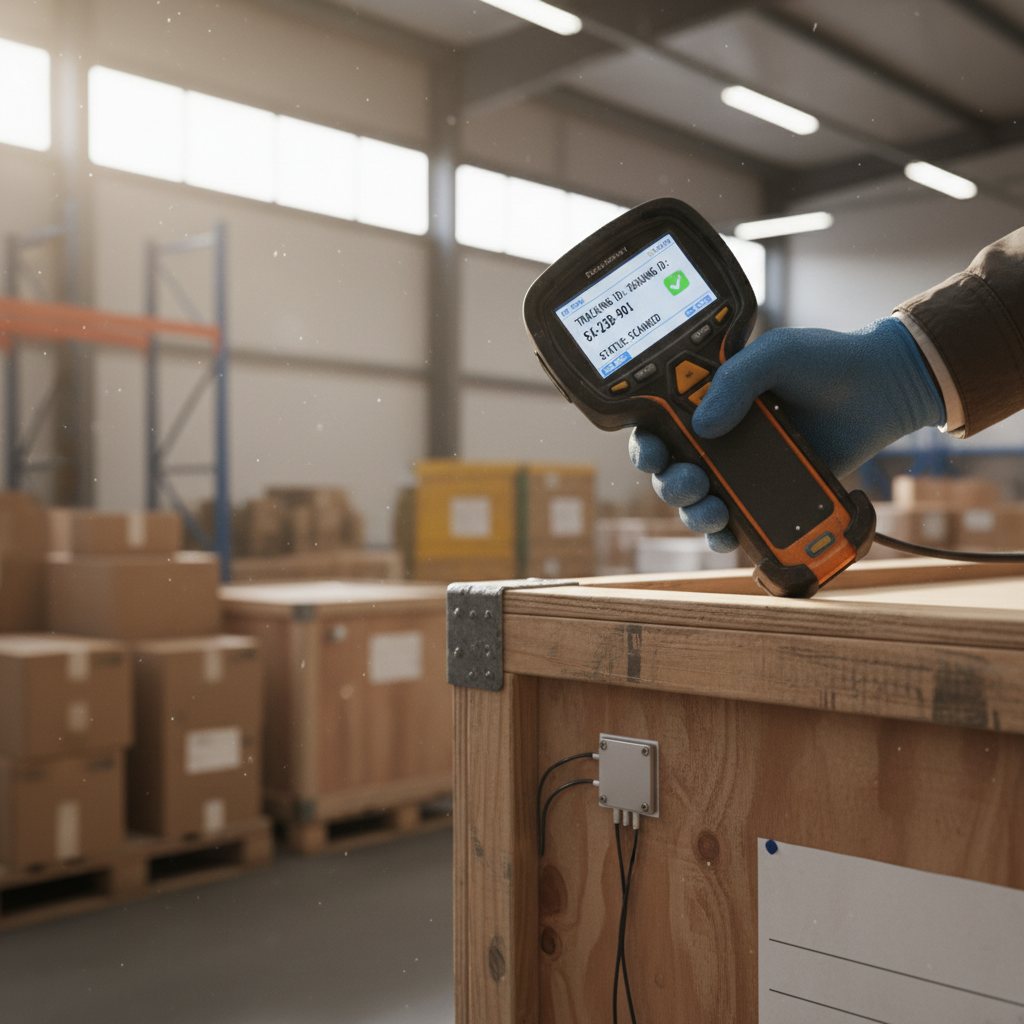
The Cost Equation That Drives Every Decision
The 1,000x cost gap between passive RFID and GPS is real, and it’s the single most important data point in this comparison. But the per-unit tag price is only the first layer, and understanding the passive vs active asset tracking tradeoff sharpens the picture further.
High-volume passive UHF inlays run around USD 0.09 to 0.12 each. Active RFID tags sit at USD 20 to 100+ depending on ruggedization and sensor payload. GPS trackers with cellular backhaul range from USD 150 to 400+ per unit, and most carry a monthly connectivity subscription on top.
Now add the infrastructure math:
- RFID requires readers. Fixed portal readers at warehouse doors, handheld readers for floor staff, antennas tuned to your environment. That’s a capital investment, but it’s shared across thousands of tags. The per-asset cost of infrastructure drops fast once you pass about 500 tagged items.
- GPS requires nothing on-site (satellites are free to receive), but each device carries its own cellular modem, antenna, battery, and data plan. The per-asset cost stays roughly flat no matter how many you deploy.
This means RFID economics improve with scale. GPS economics stay linear. If you’re tracking 50 high-value containers crossing oceans, GPS makes sense. If you’re tracking 10,000 parts in a warehouse or MRO facility, passive RFID wins on total cost of ownership by an order of magnitude.
Where GPS Wins and RFID Can’t Compete
GPS earns its price in three scenarios. I’ve seen all three in our client base.
1. Assets in transit between cities or countries. A ULD moving from Brussels to Singapore, a container on a vessel, a trailer crossing state lines. RFID readers don’t exist along the highway. GPS does. Orkin’s deployment of GPS fleet tracking across 5,500 trucks cut claims frequency by 60% and saved more than USD 3.5 million. That ROI came from continuous position data during transit, something RFID could never provide.
2. Theft recovery and geofence enforcement. When a piece of ground support equipment leaves an airport perimeter or a generator walks off a construction site, you need real-time coordinates to get it back. GPS paired with cellular connectivity gives you that. RFID would only tell you it passed the gate.
3. Sparse, high-value assets spread across large geographies. Mining equipment across remote sites, aviation GSE dispersed across 30 airports, mobile medical units. When you can’t install reader infrastructure everywhere, GPS is the only option that gives you visibility without physical proximity.
For these use cases, we typically recommend devices like the Oyster Edge or Oyster3 from Digital Matter. Battery-powered, ruggedized, and designed for assets that move through environments where no reader infrastructure exists.
Where RFID Wins and GPS Fails
GPS doesn’t work indoors. Full stop. Every GPS spec sheet will mention “requires line of sight to satellites,” and every warehouse, aircraft hangar, MRO shop, and hospital ward blocks that line of sight.
RFID owns three scenarios:
1. High-volume inventory identification. A luxury goods warehouse moved from 75% to 99.5% inventory accuracy and cut tracking time by 60% after deploying RFID. When you need to scan thousands of items per shift, passive RFID readers sweep an entire shelf in seconds. GPS couldn’t even see those items.
2. Controlled-environment compliance. MRO shops tracking tools and rotable parts. Pharmaceutical warehouses under serialization mandates. Sanofi’s passive RFID rollout lifted inventory accuracy from 75% to 95%. In aerospace MRO, knowing which tool entered and left a work zone isn’t optional. It’s an audit requirement. Passive RFID handles this at cents per tag.
3. Assets that never leave a facility (or rarely do). Wheelchairs, infusion pumps, surgical instrument sets, warehouse bins, returnable packaging within a closed loop. Gateshead Health NHS Foundation Trust achieved 10x faster medical-device audits using BLE combined with passive RFID. The University Hospitals Plymouth NHS Trust tracks 40,000 medical assets with RFID across their campus.
RFID can also push out-of-stock reductions up to 80.3% and bring inventory accuracy to 99.9% in retail and manufacturing. No GPS deployment has ever claimed those numbers, because that’s not the problem GPS solves.
The Comparison That Actually Matters
| Decision Factor | Passive RFID (UHF) | Active RFID | GPS + Cellular |
|---|---|---|---|
| Per-unit cost (2026) | USD 0.09 to 0.40 | USD 20 to 100+ | USD 150 to 400+ |
| Battery life | No battery (indefinite) | 2 to 5 years | Weeks to months (rechargeable) or vehicle-powered |
| Read range | 1 to 12 meters | 30 to 100 meters | Global (satellite coverage) |
| Indoor performance | Strong | Strong | None |
| Outdoor performance | Limited to reader zones | Limited to reader zones | Strong |
| Position accuracy | Zone-level (reader proximity) | Room-level | 5 to 10 meters outdoors |
| Infrastructure needed | Readers, antennas, cabling | Readers or access points | None on-site (cloud platform) |
| Ongoing data costs | Minimal (local network) | Minimal to moderate | Cellular subscription per device |
| Best for | High-volume ID, inventory, compliance | Indoor real-time location, yards | In-transit tracking, fleet, theft recovery |
Notice the pattern. There’s no column where one technology wins on every row. That’s the clearest signal that framing this as “RFID vs GPS” misses the point. The question isn’t which is better. It’s which phase of your asset’s lifecycle you’re trying to see.
Why Most 2026 Deployments Use Both
The Real-Time Location Systems (RTLS) market is expanding at 18.6% CAGR, faster than either the standalone RFID market (11.83%) or the GPS tracker market (12.8%). That growth rate tells you where the money is going: into hybrid architectures that combine multiple technologies under a single platform.
Here’s what that looks like in practice. An airline MRO operation might use:
For a deeper look at how these technologies integrate in aviation environments, see our guide on asset tracking in aircraft manufacturing.
- Passive RFID tags on every rotable part and tool for inventory accountability at the bench
- Active RFID or BLE beacons on high-value GSE in the hangar
- GPS cellular trackers on assets that transfer between airports or go out for calibration
The part gets a 12-cent passive tag. The towbar gets an active beacon. The engine stand that ships to another continent gets a GPS tracker. Each technology matches the visibility gap it’s filling.
The architectural direction is clear across the vendor landscape. Multi-technology RTLS stacks that blend passive RFID for identification, active RFID or BLE for indoor real-time location, and GPS for outdoor transit are becoming the default for enterprises with assets that move between regimes.
This is exactly the integration challenge we help clients solve at Datanet. Our asset tracking device catalog spans GPS cellular trackers, BLE tags, and environmental sensors precisely because no single technology covers the full asset lifecycle.
What Nobody Tells You: The Day After Installation
Every article in the search results covers how RFID and GPS work. Almost none cover what happens after deployment. This is where I’ve seen more projects stall than at any other stage.
Battery management is an operations problem, not a tech problem. GPS trackers need recharging or replacement on a cycle. If you have 200 GPS-tracked containers and the battery life is 90 days, someone needs to manage a rotation schedule for ~2 devices per day. Passive RFID avoids this entirely. Active RFID pushes it out to 2 to 5 years. Factor this labor cost into your business case.
Reader infrastructure changes your facility layout conversations. RFID portal readers at dock doors work beautifully until someone decides to add a new loading bay. Fixed-reader deployments need to be part of facility planning, not an afterthought bolted to a doorframe. Plan for expansion from day one.
Data integration is the hidden cost. RFID generates scan events. GPS generates coordinate streams. Both need to land in your ERP, WMS, or asset management platform in a format your operations team can act on. If your RFID vendor and GPS vendor don’t share a common data model, you’re building middleware. That’s a cost nobody quotes upfront.
Environmental durability matters more than spec sheets suggest. A passive RFID tag rated for “industrial use” might survive a warehouse shelf but delaminate in an engine wash bay. A GPS tracker rated IP67 might handle rain but not the vibration profile of a container on a vessel. In aerospace, we specify devices like the Thingfox T2 specifically because it carries DO-160 airfreight certification. The question isn’t “is it waterproof?” It’s “will it survive the actual conditions my assets face?”
Security and Privacy: Different Risks for Each Technology
RFID and GPS carry different threat profiles, and most comparison articles gloss over this entirely.
RFID is vulnerable to cloning, skimming, eavesdropping, and relay attacks if tags lack encryption. A bad actor with a reader can interrogate unprotected passive tags from several meters away and clone the identifier. For inventory tracking in a closed warehouse, the risk is low. For access control or high-value pharma tracking, it demands encrypted tags with authentication protocols.
GPS carries a surveillance risk. The US v. Jones Supreme Court case established that warrantless long-duration GPS tracking raises Fourth Amendment questions. If your GPS-tracked assets travel with employees or contractors, you’re collecting location data about people, not just things. That has GDPR, CCPA, and labor-law implications depending on jurisdiction.
Any deployment handling sensitive assets (medical devices with PHI exposure, government equipment, high-value cargo) needs explicit encryption, access-control layers, and data retention policies baked in from the start. This isn’t a feature comparison issue. It’s a governance issue.
A Decision Framework You Can Actually Use
Forget the “it depends” conclusion. Here’s a concrete decision tree based on what we’ve deployed across aviation, logistics, and industrial clients:
If your assets mostly stay inside a building and you have more than 500 of them: start with passive RFID. The cost per tag is negligible, the readers pay for themselves in one inventory cycle, and you’ll see accuracy jump to 95%+ within weeks.
If your assets move between buildings on a single campus or yard: add active RFID or BLE beacons for real-time location within the campus. Passive RFID handles identification at checkpoints. The combination gives you both “what” and “where” without GPS subscription costs.
If your assets leave your premises and travel between cities or countries: GPS with cellular connectivity is the only option that provides en-route visibility. Reserve it for assets whose value or criticality justifies the per-unit cost and the battery management overhead.
If your assets do all three (and in aviation, they often do): build a hybrid stack. Passive RFID for the tool crib. BLE/active RFID for the hangar floor. GPS for the ULDs and containers that fly. The broader asset tracking market is projected to reach USD 71.55 billion by 2034, and the growth is concentrated in exactly these multi-technology architectures.
If you’re mapping out which technology fits which asset class in your operation, it helps to know which asset tracking technologies actually pay back. That’s the conversation we have with clients every week. Reach out to our team and we’ll walk through it with you.

Frequently Asked Questions
Can RFID work outdoors?
Yes, but only within range of a reader. Passive RFID reads at 1 to 12 meters, active RFID at 30 to 100 meters. If you install readers at gate entries or yard checkpoints, RFID works fine outdoors in those zones. It will not track an asset once it drives off-site. For that, you need GPS.
Does GPS work inside warehouses or hangars?
No. GPS requires line-of-sight to at least four orbiting satellites. Roofs, metal structures, and container walls block the signal. For indoor asset visibility, use RFID, BLE, or UWB.
How long do RFID tags and GPS trackers last?
Passive RFID tags have no battery and last indefinitely under normal conditions. Active RFID tags last 2 to 5 years on a single battery. GPS trackers with rechargeable batteries last weeks to months between charges depending on reporting frequency, or run continuously when wired to vehicle power.
What is the real cost difference between RFID and GPS per asset?
In 2026 pricing, passive UHF RFID inlays cost around USD 0.09 to 0.12 each. GPS cellular trackers range from USD 150 to 400+ per device, plus monthly data subscriptions. Active RFID tags sit between at USD 20 to 100+. The passive-to-GPS gap is roughly 1,000x per unit.
Can I use Apple AirTags for business asset tracking?
AirTags use Bluetooth and Ultra-Wideband, not RFID or built-in GPS. They rely on nearby Apple devices to relay location. For personal items, they work well. For enterprise asset management with thousands of items, auditability requirements, and non-Apple environments, industrial RFID or GPS trackers are the appropriate choice.
Is a hybrid RFID and GPS deployment worth the complexity?
For operations where assets transition between indoor and outdoor environments (airports, ports, large manufacturing campuses), hybrid stacks consistently deliver the best asset tracking ROI. The key is choosing a platform that integrates scan events from RFID and coordinate streams from GPS into a single dashboard, avoiding disconnected data silos.








 +1 508 292 2210

3 Responses