

Every conversation about cold chain air freight monitoring eventually lands on the same number: roughly 12% of pharmaceutical shipments experience a temperature excursion during air transit. Not during last-mile delivery. Not in a warehouse. During the flight and the ground handling around it.
That 12% translates to an estimated $35 billion in annual losses across the pharma industry. Biologics degraded by two degrees too warm. Vaccines destroyed by 40 minutes on a sun-exposed tarmac. Cell therapy batches rejected because a data logger showed a three-hour gap during a hub transfer.
The technology has improved fast. IoT-based cargo monitoring usage grew 200% in a single twelve-month period through 2025. And yet, the blind spots that cause multi-million-dollar losses often have nothing to do with the sensors themselves. They sit in the handoffs, the connections, and the decisions made (or not made) when an alert actually fires.
This is what a working cold chain air freight monitoring system looks like, where it still breaks down, and what the ROI looks like when the deployment is right.
The Four Layers of a Working Monitoring System
Cold chain air freight monitoring is not a single device. It is four interdependent layers. A failure in any one compromises the entire shipment.
The first layer is temperature-controlled packaging. Active containers run electric compressors to maintain set temperatures continuously. Passive containers use vacuum-insulated panels and phase-change materials for a fixed hold time, typically 96 to 120 hours. The right choice depends on route length and product sensitivity, with comprehensive temperature monitoring for air freight ensuring both container types perform within validated ranges.
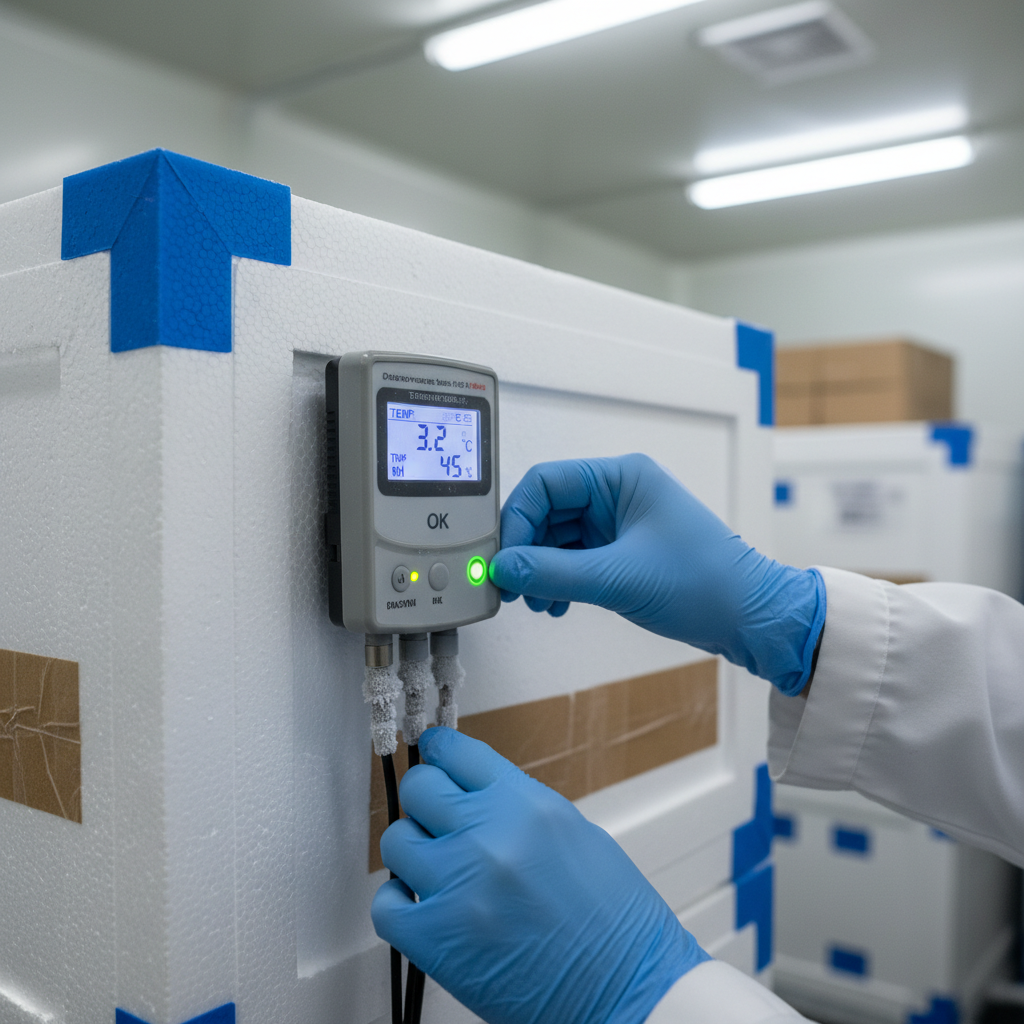
The second layer is sensors and data loggers. These are your evidence trail. Modern loggers capture temperature, humidity, shock, light exposure, and GPS position at 60- to 120-second intervals. They range from single-use USB devices costing a few dollars to reusable cellular trackers with multi-year battery life.
The third layer is connectivity and software. Cellular at airports, Bluetooth and Wi-Fi for local reads, satellite over oceans. A cloud platform sits on top, with API connections to ERP, WMS, or TMS systems. Data only matters if it reaches someone who can act on it before the product degrades.
The fourth layer is regulatory compliance. IATA CEIV Pharma, EU GDP, USP <1079>, DSCSA, and IATA’s own Temperature Control Regulations all apply to pharmaceutical air freight. There is also an overlooked fifth constraint: the lithium batteries inside your IoT trackers make them Class 9 dangerous goods under IATA DGR. More on that in a moment.
Knowing the four layers is straightforward. Knowing where they fail is where the money is.
Where the Chain Actually Breaks
When I talk to logistics managers and QA teams who have lost shipments, the root cause is almost never “the sensor didn’t work.” It is almost always a process gap in one of three places.
The tarmac
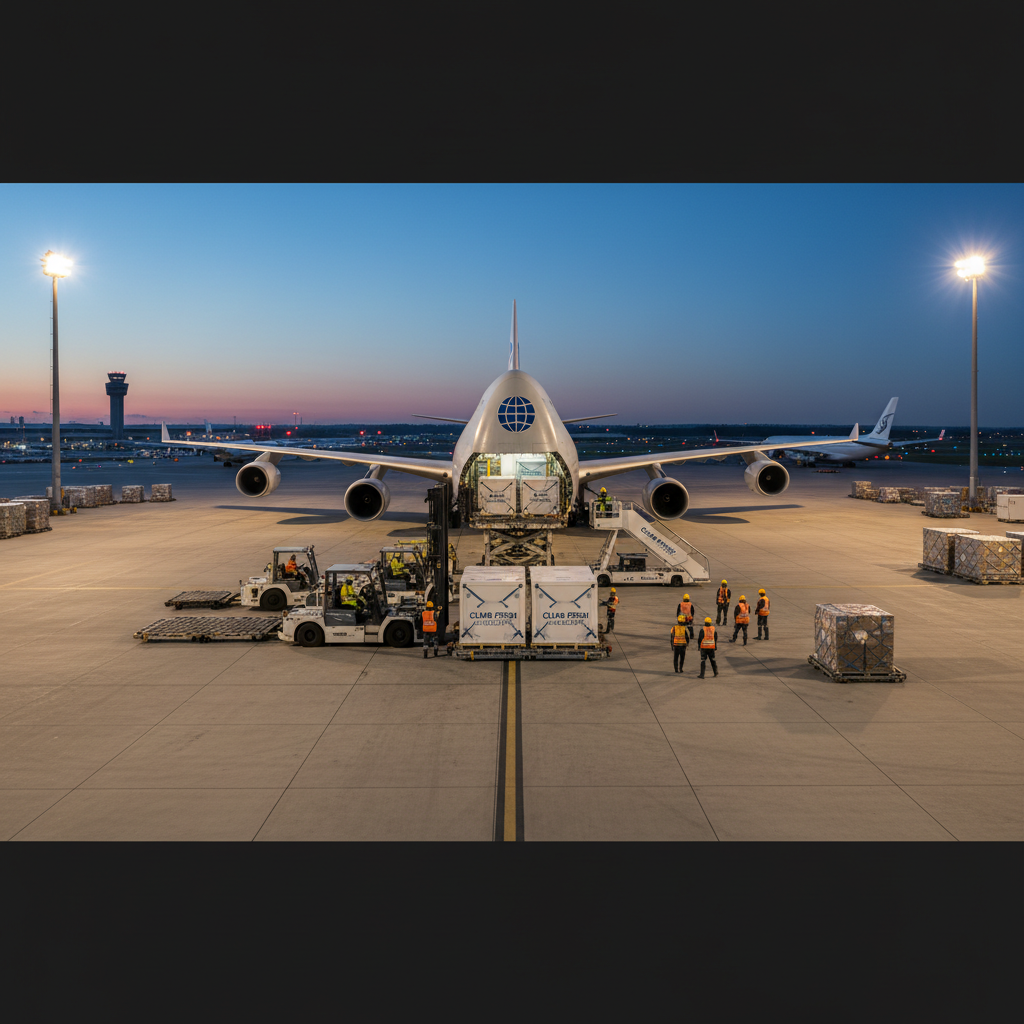
An aircraft sits on the apron in Dubai, Doha, or Miami. The cargo door opens. A ULD with pharma product rolls onto the tarmac and waits. Sometimes 20 minutes, sometimes two hours. Ambient temperature: 45°C. The container’s thermal envelope was designed for a conditioned cargo hold, not direct sun exposure. This is the single most common cause of temperature excursions in air freight, and it happens at the world’s busiest pharma hubs.
The hub connection
A biologic leaves Indianapolis on a CEIV Pharma certified carrier. It connects through London Heathrow. Between landing and reloading onto the second aircraft, the shipment passes through the ground handler’s warehouse, possibly sits in a non-temperature-controlled staging area, and gets re-scanned into a different system. During that window the data logger may lose cellular signal, the chain of custody shifts, and the temperature record shows a gap. That gap is where a significant share of the $35 billion hides.
The handoff between agents
Responsibility for a temperature-sensitive shipment transfers multiple times in a single air journey: shipper to freight forwarder, forwarder to ground handler, ground handler to airline, airline to destination handler, handler to customs broker, broker to consignee. Each handoff is a potential failure point. Not because people are negligent, but because the monitoring system often does not follow the shipment across organizational boundaries, creating critical gaps in air cargo chain of custody. The airline’s platform does not talk to the forwarder’s platform. The ground handler’s SOP assumes someone else called for the dedicated cold room. Nobody did.
Active vs. Passive Containers: A Decision Framework
This is one of the most common questions in cold chain air freight planning. The honest answer: it depends entirely on the route.
| Active Containers | Passive Containers | |
|---|---|---|
| Mechanism | Electric compressor or thermoelectric module maintains set temperature continuously | Vacuum-insulated panels and phase-change materials hold temperature for a fixed duration |
| Typical hold time | Unlimited with power and recharge | 96 to 120 hours at 2-8°C |
| Best suited for | Intercontinental, long-haul, multi-connection routes | Short-haul, direct flights, last-mile distribution |
| Cost model | Lease, typically $1,500-$5,000+ per shipment | Lower, mix of single-use and reusable |
| Major players | Envirotainer (RAP e2, Releye), CSafe (RKN, APS), SkyCell | Sonoco ThermoSafe (Pegasus ULD), va-Q-tec, Cold Chain Technologies |
The industry is moving toward hybrid fleets. Passive pallet shippers handle routes under roughly 2,500 km. Active containers cover the intercontinental hauls. The smart operators are not choosing one technology; they are matching the container to the lane.
Here is the part most cold chain content skips: those active containers are expensive, reusable assets. An Envirotainer RAP e2 or a CSafe RKN is worth tens of thousands of dollars. After delivery, it needs to be returned, recharged, and made available for the next shipment. Many companies track the drug shipment meticulously and then lose visibility on the container the moment it is emptied. That is an asset tracking problem, not a shipment tracking problem, and it costs the industry millions in lost or stranded containers every year.
The Monitoring Layer
Five parameters, not one
Temperature is the obvious metric. But the best monitoring programs track five things simultaneously:
- Temperature, logged every 60 to 120 seconds. The non-negotiable baseline.
- Humidity. Levels below 95% can visibly wilt small fruits within hours. Uncoated pharmaceutical tablets and certain APIs show similar sensitivity.
- Shock and vibration. Drops during ground handling can compromise packaging seals, turning a passive container into an uncontrolled one.
- Light exposure. An unexpected light event means the container was opened. Which means the cold chain may have been interrupted.
- GPS/GNSS location. Confirms the shipment is where it should be, and flags when it is stationary on a tarmac longer than planned.
Getting data out of an airplane
At cruise altitude, there is no cellular signal. That is the fundamental connectivity challenge. Three approaches exist, each with a clear trade-off.
Single-use and BLE loggers store data internally and transmit nothing until scanned at the destination. Cheap, widely accepted, zero real-time visibility. You find out about an excursion after it happened.
Cellular trackers (LTE-M, NB-IoT, 5G) transmit whenever they find a signal: origin, tarmac, cargo warehouse, destination. Over the ocean or at altitude, they store and forward. The air cargo IoT tracker market hit $1.52 billion in 2024 and is projected to reach $4.38 billion by 2033, growing at 13.2% annually. That growth is almost entirely in this segment.
Satellite-connected trackers maintain a link everywhere, including mid-flight. They are the only devices that provide true in-flight visibility. The trade-off: higher cost, larger form factor, and stricter regulatory requirements for operating a satellite transmitter inside an aircraft cargo hold.
The lithium battery paradox
Almost every real-time IoT tracker contains a lithium cell. Under IATA Dangerous Goods Regulations, that cell classifies the tracker as a Class 9 dangerous good. The device you use to protect a pharmaceutical shipment is, technically, a hazardous material itself.
IATA allows Section II excepted quantities (lithium-ion cells up to 20 Wh, lithium metal cells up to 1 g) with proper marking and documentation. Devices that meet RTCA DO-160 Section 21 Category H radiated emissions limits, or that have two independent means to disable cellular transmission during flight, face fewer restrictions. During COVID-19 vaccine distribution, IATA temporarily waived Section II marking requirements for data loggers accompanying vaccine shipments, which normalized tracker use in air freight and accelerated adoption across the industry.
If you are deploying trackers on air freight in 2026, DO-160 certification is not optional. It is the difference between a device that moves freely across any carrier and one that triggers a dangerous goods incident report. That regulatory reality is exactly why airfreight-approved hardware like the Thingfox T2 exists: designed from the ground up for the inside of an aircraft cargo hold, not repurposed from a ground logistics use case.
The Regulatory Stack
Pharma cold chain air freight is governed by overlapping frameworks. Here is what each one requires of your monitoring program in practice.
IATA Temperature Control Regulations (TCR) set the operating baseline: packaging validation, temperature range specifications, handling instructions. They apply to every temperature-sensitive air shipment.
IATA CEIV Pharma is a voluntary certification for airlines, ground handlers, and airports. It validates that a facility meets pharmaceutical handling standards end to end. American Airlines Cargo now has over 30 CEIV or GDP certified stations globally, covering more than 180 markets. Lufthansa, Emirates, DHL, and Delta maintain comparable certified networks.
EU Good Distribution Practice (GDP) is binding for any shipment entering the European Union. It requires documented, continuous temperature monitoring for the entire distribution chain, including transit. This is the single biggest driver of demand for cellular data loggers on Europe-bound routes.
USP General Chapter <1079> defines risk factors and mitigation strategies for US pharmaceutical storage and transport. It is the reference standard most US pharma QA teams cite when specifying monitoring requirements for their logistics partners.
DSCSA drives serialization and end-to-end traceability. With enhanced requirements now fully in effect, the convergence of temperature evidence and serialization data onto a shared digital backbone (GS1 standards paired with blockchain pilots like MediLedger) is one of the defining trends of 2026.
When an Alert Fires at 35,000 Feet
Most cold chain guidance tells you how to prevent excursions. Almost none tells you what to do when one happens. It will happen.
Here is the decision sequence that the best-run pharmaceutical logistics operations follow.
First, confirm the alert is real. Sensor malfunctions, cellular reconnection artifacts, and condensation on the probe can all create false positives. A single data point outside range is not an excursion. A sustained reading outside the validated window, confirmed by the logger’s internal clock and corroborated by location data, is.
Second, determine whether intervention is possible. If the shipment is on the ground at a hub, the ground handler can move it to a temperature-controlled holding area immediately. If it is airborne, no intervention is possible until landing. Your ability to act in time depends entirely on having real-time data rather than a post-delivery log download.
Third, assess the product’s stability budget. Every validated pharmaceutical shipment has a documented stability profile specifying how long the product can tolerate a deviation of X degrees before efficacy is compromised. A 2-8°C biologic that spikes to 10°C for 15 minutes may still be within its stability budget. The same product at 25°C for 90 minutes almost certainly is not. The monitoring system should map the excursion against the product’s mean kinetic temperature (MKT) specification automatically.
Fourth, document everything. Whether the product is saved or rejected, the temperature record, the alert timestamps, and the decisions made form the compliance trail that regulators will review. GDP, USP <1079>, and CEIV Pharma all require excursion events to be documented, investigated, and formally reported.
This protocol only works if the monitoring system delivers data during transit, not after delivery. A USB logger gives you a post-mortem. A cellular or satellite tracker gives you a chance to intervene.
The ROI Equation
The economics of cold chain air freight monitoring are deeply asymmetric. The cost of not monitoring is so high that almost any reasonable investment in visibility pays for itself within months.
The most cited public benchmark comes from Iceland. Before deploying IoT monitoring across 52 health clinics and 59 refrigerators, baseline audits found that over 30% of storage units exceeded recommended temperature boundaries. After twelve months of continuous monitoring with automated alerts, cold chain waste dropped to 0.3%. A 99% reduction in spoilage from a deployment that cost a fraction of the product it saved.
At a larger scale, the Vodafone-Controlant pharma logistics partnership reports a successful delivery rate above 99.9% and 16,700 tonnes of avoided CO2 emissions in a single fiscal year.
For pharma shippers, the math is blunt. A single biologic shipment can be worth $5 million to $10 million. An annual monitoring program (devices, platform, connectivity) runs in the low five figures per lane. One prevented loss pays for years of monitoring across every route you operate.
Three measurable outcomes that a properly deployed cold chain monitoring program delivers:
- Excursion-related product waste drops from double-digit percentages to below 1% (Iceland: 30% to 0.3%)
- Delivery success rate exceeds 99.9% on monitored lanes (Vodafone-Controlant benchmark)
- One prevented biologic loss ($5M to $10M) pays for the entire monitoring program for years
The sustainability dimension
Air freight generates 30 to 60 times more CO2 per ton-kilometer than ocean shipping. For pharma, switching to ocean is rarely viable. Patients cannot wait 30 days for a life-critical therapy. The realistic path to lower emissions runs through three levers: Sustainable Aviation Fuel (up to 80% emissions reduction), reusable container adoption projected to climb from 30% to 70%, and monitoring that eliminates the need to reship rejected product.
Every excursion that forces a replacement shipment doubles the carbon footprint of that delivery. Monitoring does not just protect the product. It protects the emissions budget.
Closing the Blind Spots
The sensor technology is reliable. The container engineering is proven. The regulatory frameworks are clear. What still causes losses is the space between those layers: the tarmac wait nobody planned for, the hub connection where data goes dark, the handoff where nobody confirmed the cold room was reserved, the alert that fired but reached the wrong inbox.
Closing those gaps takes hardware certified for the air environment, connectivity that persists across organizational boundaries, and a deployment partner who understands how airfreight actually moves.
If your temperature-controlled containers go dark after handoff, or your current tracking devices trigger DGR paperwork headaches with every shipment, those are solvable problems. Talk to our team, or browse the airfreight-certified tracking hardware we deploy for airlines, freight forwarders, and pharma logistics operators.
Frequently Asked Questions
What is cold chain air freight monitoring?
It is the integrated system of temperature-controlled containers, IoT sensors, real-time connectivity, cloud software, and regulatory compliance that ensures pharmaceutical, biologic, vaccine, or perishable cargo stays within its validated temperature range throughout air transit. Much like a broader air quality monitoring system, the goal is a continuous, tamper-evident data trail from origin to final delivery.
What temperature ranges apply to pharmaceutical air freight?
The most common range is 2-8°C for vaccines, biologics, and insulin. Frozen shipments (-15°C to -25°C) cover certain vaccines and mRNA intermediates. Ultra-cold (-60°C to -80°C) applies to mRNA-based products. Cell and gene therapies can require -150°C or colder. Active containers handle continuous temperature control; passive containers hold stable for 96 to 120 hours.
Why do 12% of pharma shipments still experience excursions?
The most frequent causes are tarmac exposure during loading and unloading, temperature gaps during hub connections, and handoff failures between agents operating separate monitoring systems. The hardware to prevent excursions exists. The process gaps between organizations are where most failures occur.
Do IoT trackers on air cargo require dangerous goods classification?
Yes. Nearly every real-time tracker contains a lithium cell, classifying it as Class 9 dangerous goods under IATA DGR. Devices meeting Section II excepted quantity thresholds (lithium-ion cells up to 20 Wh, lithium metal up to 1 g) with proper marking are permitted. DO-160 certified devices face the fewest operational restrictions.
What is CEIV Pharma certification?
CEIV Pharma is IATA’s voluntary certification for airlines, ground handlers, and airports. It validates that a facility meets pharmaceutical handling standards for temperature-controlled air cargo. Major carriers including DHL, Lufthansa, Emirates, American Airlines, and Delta maintain CEIV-certified station networks.
How do I calculate ROI on cold chain monitoring?
Compare the annual cost of monitoring (devices, platform, connectivity) against the value of product at risk. A single lost biologic shipment can exceed $5 million. Iceland’s national deployment cut pharmaceutical waste from over 30% to 0.3% within twelve months. In pharma air freight, one prevented loss typically pays for several years of monitoring across all routes.





 +1 508 292 2210