

Air cargo condition monitoring sounds like a hardware decision. Pick a sensor, attach it, get alerts. Done.
It’s not that simple. 71.5 million tonnes of cargo moved by air in 2025. August 2026 showed 4.4% year-over-year growth in cargo tonne-kilometers. Volume isn’t the problem. The problem is that most monitoring programs produce data nobody acts on in time.
A sensor measures. A logger records. A tracker transmits. None of them, by themselves, prevent product loss. What prevents loss is the chain between a reading and a human decision: who sees the alert, how fast, whether they can act, and whether that action is documented well enough for a quality review or an insurance claim.
This article covers how to build a condition monitoring program where data actually reaches the right hands before it’s too late. Not a spec-sheet comparison. A system-level view of what it takes to turn environmental readings into operational outcomes.
What Condition Monitoring Actually Measures
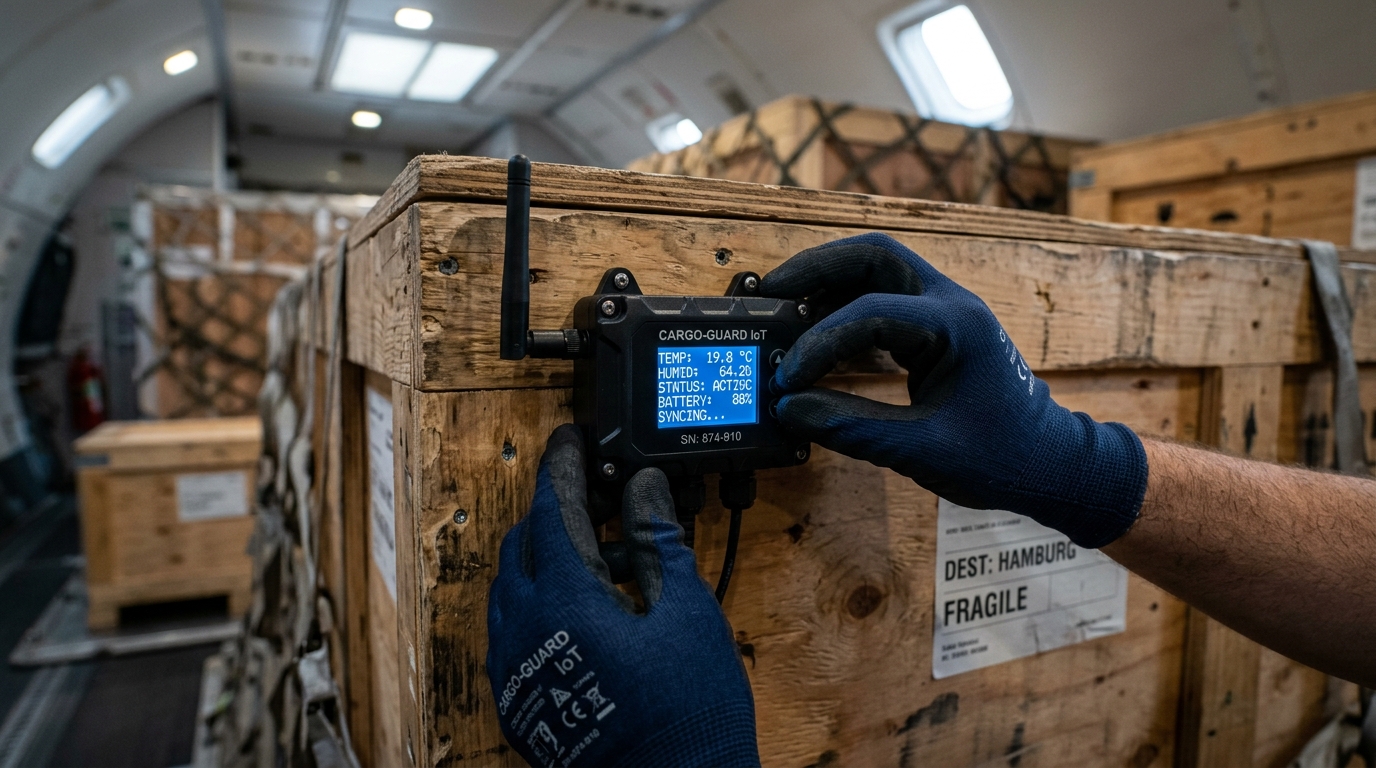
Condition monitoring tracks environmental and handling variables inside a shipment as it moves through the air cargo chain. Five parameters dominate:
- Temperature (the dominant concern for pharma, biologics, and perishables)
- Humidity (relevant for electronics, paper-based products, and certain chemicals)
- Light exposure (indicates whether packaging was opened or compromised mid-transit)
- Shock and vibration (critical for lab equipment, precision instruments, project cargo)
- Location (helps reconstruct where a deviation happened, but does not prove the product stayed within spec)
Two distinctions matter early. First, this is not aircraft health monitoring. Boeing’s Airplane Health Management tracks engine performance, system faults, and predictive maintenance for the airframe. It has nothing to do with whether a biologic shipment stayed between 2°C and 8°C.
Second, condition monitoring is not shipment tracking. A GPS ping tells you where a container is. It does not tell you whether the temperature inside drifted six degrees above threshold during a three-hour sit on a tarmac in Doha. Location gives you logistics data. Condition monitoring gives you quality data. Confuse the two and you’ll build a system that pinpoints a pallet to a specific warehouse bay but can’t confirm the product inside is still viable.
Where Cargo Actually Gets Damaged
The flight segment is often the safest part of the journey. Aircraft cargo holds are pressurized and temperature-managed. The exposures that wreck shipments happen on the ground, during transfers, in the gaps between facilities that nobody instruments carefully enough.
A 2025 Taiwan study on air cold-chain risk identified five critical locations: shipper facility, warehouse, apron, customs, and aircraft. The apron and warehouse ranked highest for temperature-related risk. A July 2026 preprint reinforced this finding by highlighting ground-transfer dwell (the time cargo spends moving between an aircraft and a temperature-controlled facility) as the most under-monitored exposure window in pharmaceutical air logistics. The preprint is preliminary, not yet peer-reviewed, but the directional finding aligns with what operators see daily on the ground.
The physics make this obvious. Tarmac surfaces exceed 60°C in summer. At cruising altitude, external temperatures drop below minus 50°C. The flight is thermally predictable. The ground is where variability, human error, and scheduling delays converge.
If your monitoring program covers origin-to-destination without granularity on individual transfer points, you are measuring the easy part and missing the part that actually kills product.
Three Monitoring Approaches and What Each One Cannot Do
| Approach | What it does | Strength | What it cannot do |
|---|---|---|---|
| Standalone data logger | Records conditions locally; data downloaded after delivery | Creates a calibrated time series for post-shipment review or excursion investigation | Cannot alert anyone during transit. You learn about the problem after the product arrives. |
| Connected multi-sensor tracker | Transmits readings via cellular or satellite during transit | Enables in-transit alerts; combines condition data with location for faster root-cause analysis | Does not control the thermal environment. An alert is useless if nobody has authority or procedure to respond. |
| Active temperature-controlled container | Manages the thermal environment around the cargo | Controls exposure rather than only reporting it | Requires operational coordination, container availability, and proper handling at each station. Higher cost per lane. |
These solve different problems. A connected tracker reports conditions. An active container controls them. A logger preserves evidence. They are not interchangeable, and treating them that way is where most procurement mistakes begin.
For a high-value biologic on a 14-hour journey with two transfers, an active container plus a connected tracker for independent verification makes sense. For a controlled-room-temperature pharmaceutical on a direct flight, a calibrated logger might be enough. In practice, pharmaceutical shipments commonly span a wide range of requirements—some held at 2-8°C, others at 15-25°C controlled room temperature. The product’s stability profile drives the monitoring architecture, not the other way around.
What doesn’t make sense: buying connected trackers for every lane and calling that a monitoring program when nobody on the ground has been trained to respond to the alerts those trackers generate.
Compliance: Calibration, Carrier Approval, and ONE Record
Hardware gets the procurement attention. Compliance infrastructure gets neglected. That’s backwards.
Calibration comes first. WHO guidance requires multi-use transport temperature monitors to be calibrated against a certified, traceable standard at least annually unless a different interval is justified with documented evidence. “Calibrated” does not mean “turned on and seemed to work.” It means traceable to a recognized metrological standard, with records. Skip this step and your excursion data carries no evidentiary weight in a regulatory review.
Carrier approval is a separate gate. IATA’s RP 1693 device assessment covers electromagnetic compatibility and battery safety, but IATA is explicit: this assessment does not replace an airline’s own approval. A device that passes the assessment still requires per-carrier, per-route validation. Every airline retains authority over what goes on their aircraft. Don’t ship first and ask permission later.
IATA’s CEIV Pharma program covers the procedural backbone: handling processes, quality management, trained personnel, documentation, equipment, supplier oversight, and audits. A temperature reading from an uncertified facility, handled by untrained staff, documented in an unaudited spreadsheet carries zero regulatory weight. CEIV Pharma is what makes sensor data defensible.
Then there’s interoperability. ONE Record became IATA’s preferred air cargo data-sharing standard effective January 1, 2026. Progress, yes. Universal implementation, no. A December 2025 survey found over 70% awareness but only about 50% readiness among respondents. Awareness and readiness are not the same thing. If your forwarder, your ground handler, and your destination warehouse aren’t connected, standardization doesn’t help your specific shipment. Test the actual data path with your actual partners.
The pattern across every compliance element is consistent: procurement alone doesn’t solve it. Operational validation does.
From Alert to Action: The Gap That Costs Real Money
I see this repeatedly in the field. A shipper invests in connected trackers, sets up a dashboard, configures temperature thresholds, and calls the project complete. Six months later: thousands of data points and no measurable reduction in product loss.
The reason is almost always the same. The alert fires. Nobody knows who owns the response. Or the person who receives it has no authority to quarantine, reroute, or escalate. Or the alert arrives at 3 AM and the SOP says “contact the quality team during business hours.”
WHO guidance says unacceptable temperature excursions should be evaluated for their effect on the product. Not treated as automatic proof of damage. Not treated as safe by default. That evaluation requires a quality-authorized person, access to stability data, knowledge of the product’s excursion history, and a documented disposition. A dashboard alert accomplishes none of that.
Before deploying a single device, your team should define:
- Who receives each alert type (temperature, shock, light, geofence breach)
- What authority that person holds: hold, reroute, escalate, or release
- Maximum acceptable response time for each product category
- How the disposition decision gets documented and stored
- Who owns the data after the shipment closes
This is also where monitoring data starts generating financial return. A clean, timestamped, calibrated dataset covering every transfer point, dwell time, and environmental condition creates leverage in three places.
Insurance claims become evidence-based. Instead of splitting losses by negotiation, you demonstrate exactly which handler or facility broke the chain. Carrier negotiations gain teeth: consistent data on tarmac dwell times and warehouse deviations gives you objective grounds for SLA penalties or route changes. Quality release accelerates: when monitoring data proves a shipment stayed within spec across every leg and transfer, you release product faster instead of holding it for precautionary testing. That’s working capital recovered.
None of these outcomes materialize if the data is uncalibrated, incomplete, or disconnected from a documented quality decision. The ROI lives in the workflow, not in the sensor.
Building a Monitoring Program That Scales
Start with one lane. Pick the route with the highest product value, the most transfers, or the worst loss history. Instrument it completely: every handoff, every facility dwell point. That lane becomes your baseline.
Define success before you deploy. Acceptable temperature range. Maximum dwell at each transfer. Target alert-to-response time. Disposition turnaround. If you can’t state these numbers before the pilot, you won’t know whether the pilot succeeded.
Match hardware to the segment. A DO-160 approved device like the Thingfox T2 is built specifically for the airfreight environment, meeting electromagnetic compatibility and environmental standards that aviation demands. For ground-side visibility across your container pool, ULD fleet, or ground support equipment, longer-battery cellular devices like the Oyster Edge or Oyster3 cover the asset tracking layer. Different segments of the custody chain typically need different hardware. That’s normal, not a sign of architectural failure.
Validate carrier acceptance per route. Get written confirmation from each airline. Document it. Don’t assume IATA’s device assessment equals blanket authorization.
Measure the pilot against your baseline. Excursion frequency (before vs. after). Alert-to-response time. Product disposition rate. Documented avoided losses. If the pilot can’t show improvement on at least two of these, the problem usually isn’t the hardware. It’s the workflow around it.
Then scale by risk priority, not geography. The second lane should be the one where the pilot’s workflow improvements would produce the highest impact.
If your air cargo condition monitoring data isn’t changing decisions, the sensor isn’t the bottleneck. Talk to our team about the architecture, or reach out at info@datanetiot.com.

Frequently Asked Questions
What is air cargo condition monitoring?
It is the measurement and reporting of environmental and handling conditions (temperature, humidity, shock, light, location) inside a shipment as it moves through the air cargo chain. It tracks the cargo’s exposure, not the aircraft’s mechanical health.
Is condition monitoring the same as shipment tracking?
No. Shipment tracking tells you where cargo is. Condition monitoring tells you what is happening to it: temperature drift, impact events, light exposure. Location helps reconstruct where an excursion occurred, but it does not confirm whether the product remained within its specified range.
Does every air cargo shipment need real-time monitoring?
Not necessarily. A calibrated data logger may suffice when the primary need is a post-delivery record. Real-time connected monitoring adds value when an in-transit alert can trigger a handling decision or early disposition. The expected response capability should justify the connectivity cost.
Can any tracking device be placed on an aircraft?
No. IATA’s RP 1693 assessment evaluates electromagnetic compatibility and battery safety but does not replace airline approval. Each carrier retains authority over devices on their aircraft. Validate acceptance with every airline on your routing before shipping.
What should happen after a temperature excursion is detected?
Preserve the time-series data. Verify sensor calibration and placement. Establish likely duration and location of the excursion. Refer the event to the responsible quality authority for evaluation against the product’s stability profile. An alarm alone does not prove a product is damaged or safe.
How do I measure ROI on a condition monitoring program?
Establish a baseline on a single lane: excursion frequency, alert-to-response time, product disposition outcomes, and loss rates. After deploying monitoring with a defined response workflow, compare. Returns typically come from reduced product loss, faster quality release, evidence-based insurance claims, and data-driven carrier negotiations.








 +1 508 292 2210

One Response