

A 1.5-unit pH jump killed about 50% of channel catfish fry in one SRAC-documented trial. A 2.2-unit increase killed nearly all of them. The operator’s instinct to pour acid into the water would have made things worse.
High pH in aquaculture is a symptom. The underlying problem is almost always biological: algae consuming dissolved CO2 during daylight, stripping the water’s natural buffer, and pushing pH toward 9 or 10 by mid-afternoon. Learning how to reduce pH in aquaculture means understanding that cycle and choosing an intervention that does not trade a pH spike for an oxygen crash, an alkalinity collapse, or a nitrite surge.
This guide covers the biology behind pH spikes, species-specific targets, six interventions ranked by safety, three popular “fixes” that reliably backfire, and a protocol you can apply tomorrow at dawn. Whether you manage earthen ponds, vannamei shrimp, or a recirculating system, the logic is the same: measure, diagnose, treat the driver, verify.
Why pH Climbs in Aquaculture Systems
pH in a pond or tank is not static. It follows a daily cycle driven by two biological processes pulling in opposite directions.
During daylight, phytoplankton and aquatic plants photosynthesize. They consume dissolved CO2, which removes hydrogen ions from the water and pushes pH upward. After sunset, photosynthesis stops but respiration continues. Fish, shrimp, bacteria, and plants all produce CO2 through respiration, adding hydrogen ions back and pulling pH down. The result is a predictable swing: pH reaches its lowest point a few hours after dawn and its highest in late afternoon.
The amplitude of that swing depends on how much photosynthesis is happening and how well the water resists pH change. The resistance comes from the carbonate buffering system, which relies on dissolved CO2, bicarbonate (HCO3-), and carbonate (CO3–). Higher total alkalinity and hardness provide stronger buffering. A well-buffered pond with moderate algae barely moves. A pond with low alkalinity and a dense bloom can swing three or four units in a single day.
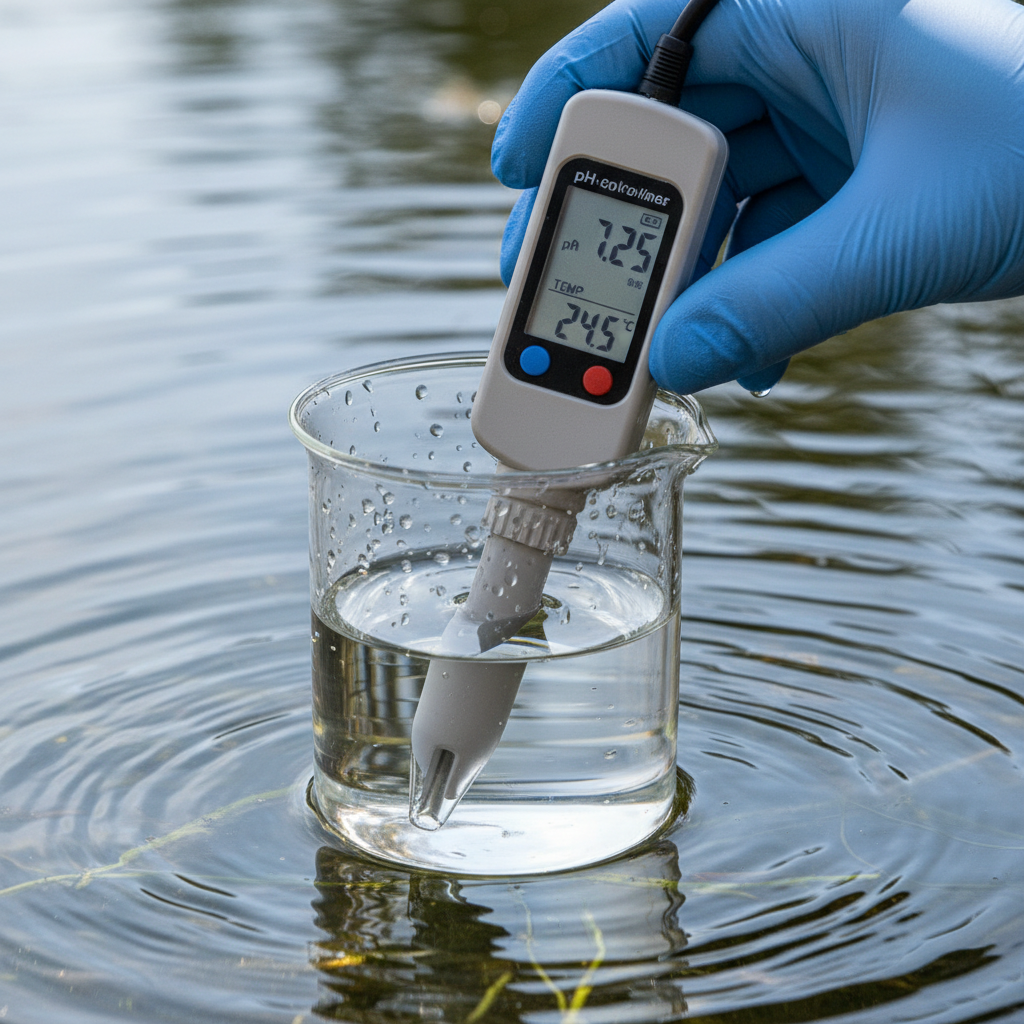
A reading of 9.2 in the afternoon might be normal in one pond and a red flag in another. You cannot tell without knowing the alkalinity, the hardness, and the full daily range. That is why treating pH as a number to fix, rather than a signal to read, is the first mistake most operators make.
Set the Right Target Before You Treat
There is no universal “correct” pH for aquaculture. The target depends on species, system type, and life stage.
General guidance for freshwater pond fish places the suitable sunrise range at pH 6.5 to 8.5, with impaired performance below 6.5 and above 8.5, and broad mortality risk below 4.5 or at 10 and above. Marine shrimp guidance centers on pH 7.5 to 8.5. Vannamei-specific guidance identifies 7.8 to 8.5 as ideal and flags daily fluctuations above 0.5 as dangerous.
These ranges are not interchangeable. Treating a catfish pond to hit shrimp targets wastes money and chemistry. Allowing a vannamei pond to swing 1.5 units daily because “freshwater fish tolerate it” costs stock. RAS systems introduce yet another dynamic: biofilter nitrification produces acid, which tends to push pH down rather than up. In those systems, adequate alkalinity (often cited at 200 mg CaCO3/L) is critical to sustain nitrification, and the urgent problem may be falling pH, not rising pH.
Before choosing any treatment, define your target range, your acceptable daily amplitude, and the life stage currently in the water. A hatchery holding fry has zero margin. A grow-out pond with juveniles has more, but not as much as most operators assume.
The Ammonia Connection Most Operators Miss
pH does not just affect fish directly. It controls how toxic your ammonia is.
Total ammonia nitrogen (TAN) in water exists as ionized ammonium (NH4+), which is relatively harmless, and unionized ammonia (NH3), which is 300 to 400 times more toxic. The split depends on pH and temperature. At 25°C in freshwater, the toxic NH3 fraction is 5.38% at pH 8.0, jumps to 15.3% at pH 8.5, and reaches 85.1% at pH 10.0.
Put that in practical terms. A TAN reading of 1.0 mg/L produces about 0.054 mg/L of toxic NH3 at pH 8.0. At pH 8.5, the same TAN produces 0.153 mg/L of toxic NH3. Nearly three times the toxicity from a half-unit pH shift. This is why operators sometimes want to lower pH: it directly reduces ammonia toxicity without removing a single milligram of ammonia from the water.
But there is a trade-off the same FAO source warns about: nitrite toxicity increases as pH falls. Lowering pH can reduce one toxin while amplifying another. The practical lesson? Measure TAN and nitrite alongside pH. Do not use pH manipulation as a substitute for reducing nitrogen load through better feeding, solids removal, and biological filtration.
Six Methods to Lower pH, Ranked by Safety
Not all pH corrections carry the same risk. These six documented approaches are ordered from the least likely to cause collateral damage to the most.
Sustainable management practices also align with broader environmental goals—learn more about how to reduce carbon footprint in aquaculture operations.
1. Reduce phytoplankton density and light penetration
If photosynthesis is driving the spike, reducing it is the most logical first move. Options include approved water dyes or increased turbidity to limit light penetration, reducing nutrient inputs that feed algae growth, and managing stocking density to lower organic loading. The SRAC protocol supports light-reduction strategies but warns that killing algae with herbicides can trigger oxygen depletion, ammonia release, and toxicity in juveniles.
2. Manage feed inputs
Excess feed decomposes, adds nutrients, and fuels algae blooms. Feed trays, feeding schedules aligned to actual consumption, and regular bottom siphoning reduce the organic load that eventually becomes an afternoon pH spike. This is the cheapest intervention and the one most commonly skipped.
3. Gradual water exchange
Replacing a portion of high-pH water with tested, compatible source water provides relatively quick relief. Vannamei guidance recommends 10% exchange when the daily pH increase exceeds 0.5, and 25 to 50% when excessive ammonia is also involved. The replacement water must be tested for pH, salinity, temperature, and pathogens before it enters the system. A careless water exchange can introduce salinity shock, temperature shock, or a different pH problem entirely.
4. Organic matter addition
Adding organic material (hay, cottonseed meal, rice bran) stimulates microbial decomposition, which produces CO2 and lowers pH over days rather than hours. The SRAC protocol recommends 15 pounds per acre per day for about one week, with a hard ceiling of 50 pounds per acre per day. The catch: decomposition consumes dissolved oxygen. Aeration and continuous DO monitoring are mandatory. Skip this approach if you cannot track DO reliably.
5. Alum (aluminum sulfate)
Alum is the documented emergency tool for freshwater ponds. It acidifies the water, binds phosphorus, and can remove algae. The SRAC protocol starts at 10 mg/L (27 pounds per acre-foot), followed by 5 to 10 mg/L increments, and warns against using alum when total alkalinity is below 20 mg/L as CaCO3 because pH can crash to dangerous lows. Stage the dose. Remeasure after each increment. Never dump the full calculated amount at once.
6. Controlled CO2 injection (RAS only)
In recirculating systems, injecting CO2 directly lowers pH by adding carbonic acid. This is precise and controllable, but demands gas monitoring and adequate degassing capacity. CO2 above 20 mg/L harms fish; adequate levels generally stay below 10 mg/L. This method does not belong in earthen ponds or open shrimp systems. It is an engineered control for an engineered environment.
Three “Fixes” That Reliably Backfire
Household acid and vinegar top the list of wrong answers. No cited aquaculture guide provides a household-vinegar recipe for pond pH reduction. Acid can lower pH temporarily, but pond bases buffer it, requiring large quantities for a meaningful change. Meanwhile, the operator creates a localized low-pH zone near the application point that can damage gills, consumes alkalinity the pond needs, and leaves the photosynthetic driver completely untouched. pH will climb again tomorrow afternoon.
Baking soda confuses operators because bicarbonate is sometimes recommended for pH management. But sodium bicarbonate is a buffering agent, not an acidifier. Adding 100 mg/L of sodium bicarbonate to water at pH 10.0 reduced pH only to about 9.6 to 9.8 in the SRAC trial. If your pH is already high, baking soda is not the tool. If your alkalinity is dangerously low and pH is swinging wildly, bicarbonate might help stabilize the swings, but that is a different problem with different dosing logic.
Lime is the subtlest trap. Calcium carbonate and calcium hydroxide are standard alkalinity amendments. They belong in ponds with low alkalinity and low buffering capacity. They do not belong in a pond where afternoon pH already exceeds 9. Hydrated lime in particular can cause a sudden pH spike and increase ammonia risk, especially in biofloc and RAS systems. The confusion arises because lime solves a low-alkalinity problem, which can look similar to a high-pH problem on a test strip. They are not the same thing.
Why Continuous Monitoring Changes the Equation
Most pH problems in aquaculture are detected late. An operator tests the water once in the morning, sees pH 7.8, and moves on. By 3 PM, pH has climbed to 9.4. By the next morning test, it is back to 8.0. The operator never saw the spike. The stock felt every minute of it.
A daily or twice-daily grab sample captures a snapshot, not a trend. It cannot tell you how fast pH is rising, how long the spike lasts, or whether the amplitude is growing week over week. That context is what separates a stable pond from one approaching a crisis.
Connected sensor systems close this gap. Recent IoT implementations in aquaculture automation combine pH, dissolved oxygen, temperature, ammonia, and turbidity sensors with cellular connectivity, cloud storage, and mobile alarms. A 2024 study demonstrated real-time aquaculture monitoring with a maximum pH validation error of 4.87%, including alerts and remote access to historical data. A follow-up study in early 2026, combining six sensors, reported 94.8% pH accuracy and an approximately 85% reduction in end-user cost versus earlier systems.
The commercial trajectory matches. The precision aquaculture market is projected to grow from USD 847.9 million in 2025 to USD 1.43 billion by 2030, at an 11.1% CAGR, driven by monitoring, control systems, and smart feeding. That growth reflects a fundamental shift from reactive chemistry to continuous, multi-parameter awareness. With global aquaculture production at 130.9 million tonnes and USD 312.8 billion as of 2022, and farmed output expected to exceed 111 million tonnes by 2032, the operational case for better measurement keeps compounding.
A pH probe alone is a weak control system. A pH probe connected to dissolved oxygen, temperature, ammonia, turbidity, trend data, and threshold alarms is a diagnostic platform. The difference between the two is the difference between reacting to a crisis and preventing one.
Step-by-Step Protocol for a High pH Event
- Confirm the reading. Calibrate or cross-check the pH probe. Record time, temperature, salinity, and sampling depth. A fouled or uncalibrated sensor is the most common source of a false alarm.
- Map the daily cycle. Test at dawn and again in late afternoon for at least three consecutive days. Log pH, dissolved oxygen, and temperature at both points. You are looking for the amplitude and trajectory, not a single number.
- Test alkalinity and hardness. If total alkalinity is below 20 mg/L as CaCO3, do not add alum or acid. If alkalinity is low and pH swings are extreme, the buffering system is the first problem to solve.
- Inspect the biological load. Check water color, Secchi depth, phytoplankton density, feed consumption, and bottom sediment. High afternoon pH paired with green water and low Secchi depth points directly at a photosynthesis-driven spike.
- Reduce the driver. Cut excess feed. Increase aeration to improve CO2 diffusion. Apply approved dye or adjust turbidity to reduce light. If compatible source water is available, begin a gradual exchange (10% as a starting point for shrimp ponds).
- Apply one chemical correction if justified. Choose alum, organic matter, or controlled CO2 based on your system type, alkalinity, and oxygen capacity. Stage the dose. Remeasure pH, DO, and alkalinity after each increment before applying more.
- Verify over the next 72 hours. Continue dawn and afternoon measurements. If the daily amplitude is shrinking and the peak stays below your species threshold, the intervention is working. If not, reassess the biological driver before adding more chemical.
The sequence matters. Operators who skip to step 6 without completing steps 1 through 5 are treating a number, not a system. That is how a pH problem becomes an oxygen problem.
Frequently Asked Questions
What is the fastest safe way to lower aquaculture pH?
There is no universal fastest method. Confirm the reading, check alkalinity and dissolved oxygen, then address the biological driver. For freshwater ponds with adequate alkalinity, alum at 10 mg/L is a documented emergency option, but staged dosing and remeasurement are required before repeating.
Can I use vinegar to lower pond pH?
No cited aquaculture protocol recommends household vinegar. Acid creates a temporary, localized pH drop without addressing the photosynthetic cause. It consumes buffering capacity the pond needs and will not prevent pH from climbing again the next afternoon.
Does lowering pH reduce ammonia toxicity?
Partially. At 25°C, the toxic NH3 fraction drops from 15.3% at pH 8.5 to 5.38% at pH 8.0. But nitrite toxicity increases as pH falls, and total ammonia concentration stays the same. Lowering pH is one tool for ammonia risk management, not a substitute for reducing nitrogen load.
What pH range is safe for shrimp?
Marine shrimp generally require pH 7.5 to 8.5. Vannamei-specific guidance targets 7.8 to 8.5, with daily fluctuations kept below 0.5 units. Exceeding these ranges increases ammonia toxicity and causes direct physiological stress that can reduce growth or trigger mortality.
Why does pH rise in the afternoon and drop at night?
Algae and aquatic plants consume dissolved CO2 during photosynthesis, removing hydrogen ions and raising pH through the daylight hours. After sunset, respiration produces CO2, adding hydrogen ions back and lowering pH. The result is a daily cycle with the lowest reading at dawn and the highest in late afternoon.
Should I add lime to lower pH?
No. Lime raises pH, not lowers it. It is an alkalinity amendment for ponds with low buffering capacity. Adding lime to a system where afternoon pH already exceeds 9 will likely worsen the spike and can increase ammonia toxicity, particularly hydrated lime in biofloc or recirculating systems.
The diagnostic approach outlined above depends on one thing: having enough data at the right time. If your current setup captures one pH reading per day with no concurrent dissolved oxygen, ammonia, or temperature data, the protocol is difficult to execute at the speed a spike demands. Continuous, connected water quality monitoring is what turns reactive chemistry into prevention. That is what we build at Datanet IoT Solutions. Our environmental tracking devices deliver real-time water quality visibility, deployed as turnkey systems designed to work from day one. If that sounds like the gap your operation needs to close, reach us at info@datanetiot.com.







 +1 508 292 2210

One Response