

If you need to know how to track a pallet, the first question isn’t which tracker to buy. It’s which job you’re solving.
Checking on a freight delivery that left this morning? You need a carrier reference and 30 seconds on a website. Managing a fleet of reusable pallets that vanish after reaching customers? That takes a persistent identity on every pallet and capture points at every handoff.
Most guides mash these two jobs into one. People buy GPS trackers when a PRO number would do, or slap barcodes on returnable pallets and wonder why they never come back. Let’s separate the problems, then solve each one.
Tracking a Pallet That’s Already in Transit
If a pallet is on a truck right now and you want to know where it is, you don’t need new hardware. You need the shipment reference your carrier assigned at pickup.
In US freight, that’s typically a PRO number. FedEx Freight lets you look up to 30 PRO numbers at once and pull proof-of-delivery documents. Other carriers (XPO, Old Dominion, Estes) have equivalent portals. The reference comes from the shipper, so if you don’t have it, call them first.
In UK and European pallet networks, the equivalent is a consignment number, typically 13 digits on networks like Palletforce or Pallet-Track. Enter it on the carrier’s site and you’ll see status updates as the pallet moves through distribution hubs.
What those updates actually show is scan data: the pallet was logged at Hub A at 06:14, loaded at 07:30, arrived at Hub B at 11:02. Between scans, the system interpolates. “Real-time tracking” in pallet freight almost always means “updated at the last scan,” not continuous satellite positioning.
If tracking shows no movement longer than expected, skip the portal and call the carrier’s operations desk directly. Status pages can tell you where a pallet was scanned last. They can’t tell you why it’s still sitting there.
Shipment Tracking vs. Asset Tracking: The Fork Most People Miss
Everything above solves one job: finding a specific shipment. For a pool of reusable pallets, that’s the wrong job entirely.
Shipment tracking answers: “Where is my delivery?” The carrier assigns a reference, updates it at scan points, and the job ends when the consignee signs. The tracking number dies. It tells you nothing about the pallet’s return, reuse, or location three weeks later.
Asset tracking answers a fundamentally different question: “Where are my pallets, how many do I have, how long are they dwelling at each customer site, and when are they coming back?” The identity lives on the physical pallet. It survives across loads, trips, warehouses, and return cycles. These principles apply whether you’re tracking fleet vehicles or returnable transport equipment.
This distinction has real financial weight. Reported cargo theft losses in the US and Canada hit $304.6 million in Q2 2026 alone. And those are just reported incidents involving stolen goods. Unreported pallet attrition, where pallets simply don’t come back from customer sites, often exceeds theft in total cost to the business.
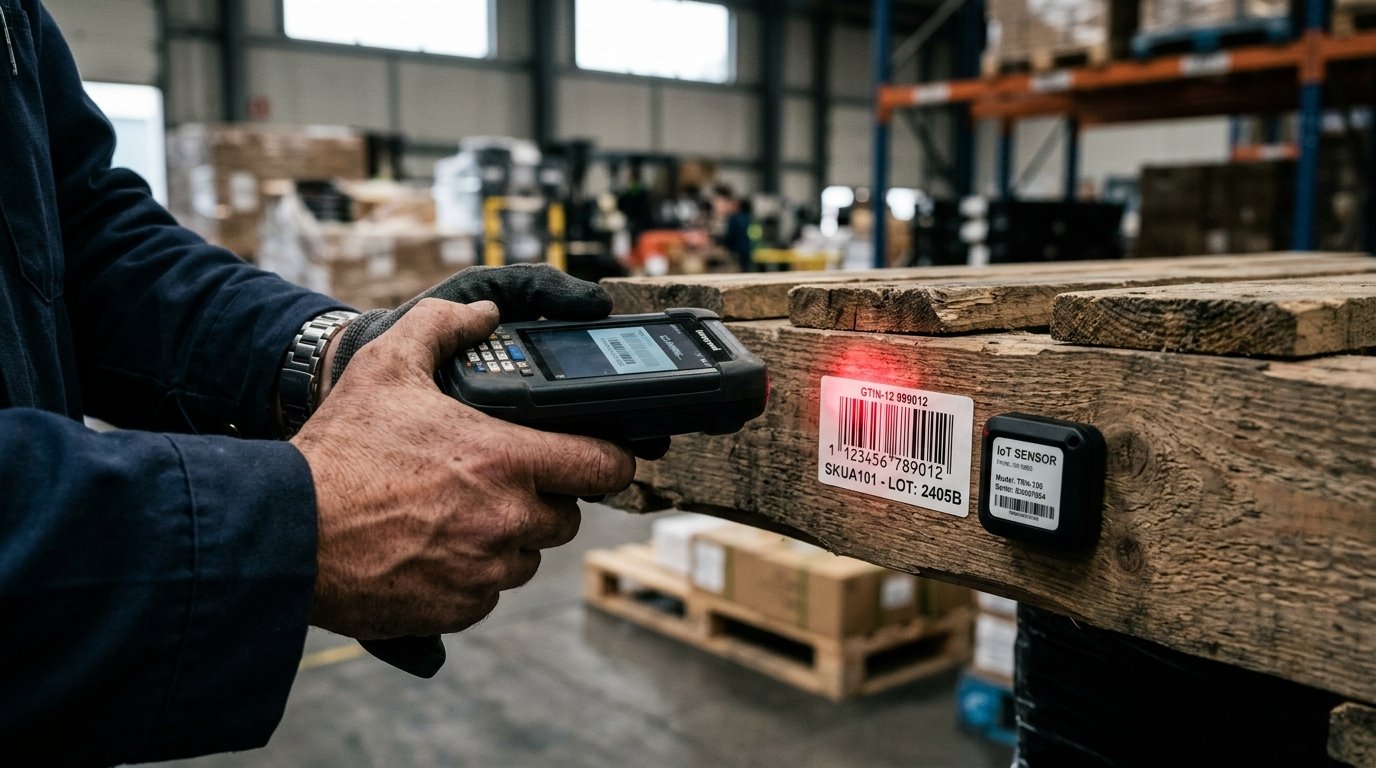
GS1 formalized the split years ago. An SSCC (Serial Shipping Container Code) identifies a logistic unit: one palletized load, shipped once, received once. A GRAI (Global Returnable Asset Identifier) identifies the reusable pallet itself, following it through multiple loads and return cycles.
Apply only SSCCs and you know what shipped. Apply only GRAIs and you know where pallets sit. Link both, and you know which load is on which pallet, and can separate the two when the load delivers and the pallet begins its return journey.
Most pallet loss doesn’t happen because a pallet vanishes mid-transit. It happens because nobody recorded the pallet leaving the customer’s site. The shipment tracking ended at delivery. The asset tracking never started. That gap between proof-of-delivery and return pickup is where returnable pallets go to die.
Tracking Technologies: What Works and What Breaks
Once you know which job you’re solving, the technology choice narrows fast. Here’s what each approach actually delivers.
| Technology | How It Works | Best For | Main Limitation |
|---|---|---|---|
| Barcode / QR code | Printed label scanned by hand or camera at each checkpoint | Low-cost identification, audits, partner check-ins | No data between scans. Damaged labels mean invisible pallets. |
| Passive UHF RFID | Tags powered by reader energy at dock doors or handheld | High-volume dock movements, returnable fleet counting | Portal infrastructure cost. Signal degrades near water or metal. |
| BLE (Bluetooth Low Energy) | Battery beacons detected by fixed or mobile receivers | Zone-level indoor visibility, yard management | Receiver coverage required. Battery maintenance at scale. |
| Cellular / GNSS | GPS position transmitted over LTE-M, NB-IoT, or 2G fallback | In-transit monitoring, high-value or theft-prone loads | Battery life vs. reporting frequency tradeoff. No signal in metal enclosures. |
| LoRaWAN | Low-power radio to gateways, with GNSS or Wi-Fi positioning | Non-powered assets in yards with LoRaWAN coverage | Network dependency. Not GPS-level precision. |
| UWB RTLS | Ultra-wideband timing from fixed anchors | Precision indoor positioning (sub-meter) | Anchor infrastructure and site engineering. Obstructed paths degrade accuracy. |
| Ambient IoT | Energy-harvesting tags powered by reader signals | Massive fleets where battery replacement is impractical | Requires compatible reader infrastructure. Standards still maturing. |
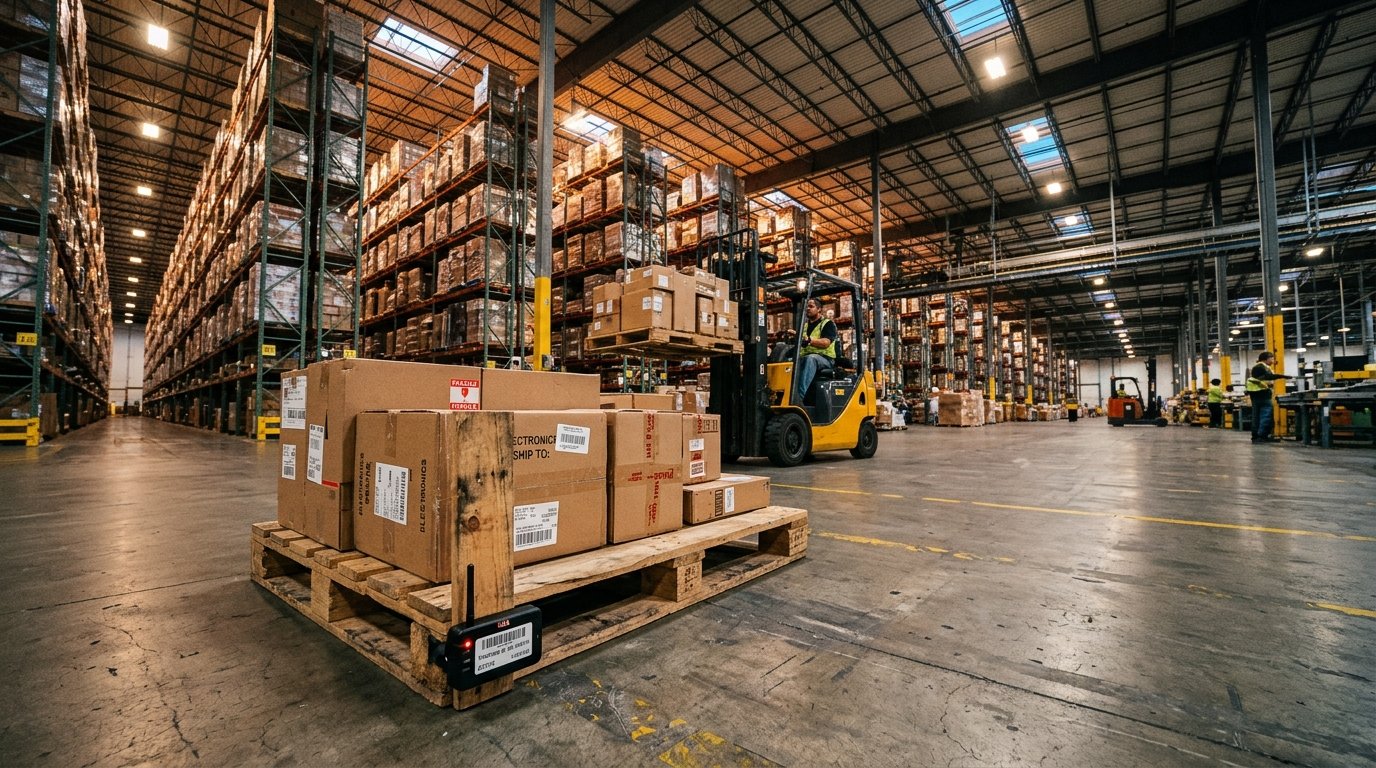
These aren’t mutually exclusive. The strongest deployments layer them: a QR code as the permanent fallback identity, RFID portals to automate dock-door reads, and a cellular tracker designed for non-powered assets on high-risk shipments where in-transit visibility matters.
A staged returnable asset tracking approach illustrates this layering well: automate shipping and receiving doors with RFID first, then add internal portals only where extra visibility changes a decision. Not every pallet needs sub-meter indoor positioning. Most need reliable confirmation that they left one site and arrived at another.
A hard-earned cautionary example: JBS tried RFID on pallets of meat and the system failed required performance thresholds. Dense, water-rich stacked product attenuated the RF signal. Potential interference with metal-detection equipment made things worse. The team pivoted to optical imaging, using custom labels read by cameras on forklifts, and demonstrated core functionality at their Bordertown facility in May 2026. The lesson applies broadly: test your actual products, wrapping, racks, and handling speed before committing to any radio technology.
Building a Pallet Tracking System That Pays for Itself
Technology is the last decision, not the first. Here’s the sequence that works.
Start by defining the events that trigger action. Not “track everything everywhere.” Instead: “Confirm the pallet left our dock.” “Alert me when a pallet has dwelled at the customer for more than 14 days.” “Flag any pallet entering an unauthorized zone.” Each event implies a specific capture point and a specific response. If nobody acts on the data, the system is overhead, not insight.
Give every pallet a persistent identity. For reusable assets, that means a GRAI or equivalent serial number tied to the physical pallet, not the load on top. EPAL has proven this works at scale: 4 million Euro pallets now carry serialized QR codes, readable by any smartphone or industrial scanner. The cost per label is negligible. The real challenge is getting every partner in the chain to actually scan it.
Link the pallet identity to the load identity. EPCIS 2.0 supports exactly this relationship: items to cases to pallets to containers, with movement, custody, and sensor events attached. When a pallet gets broken down and rebuilt with new product, the old load identity must be replaced. Stale associations are how phantom inventory gets created.
Install capture points at minimum viable locations. For most returnable pallet operations, dispatch and receipt are enough to calculate cycle time, dwell time, and loss rate. Add intermediate checkpoints (cold room entry, staging area, return dock) only when they change a decision. The temptation to instrument everything is strong. Resist it until the first two checkpoints prove the value.
Pilot under your worst conditions. Include loaded pallets and empties. Include the cold room, the stretch wrap, the metal rack, the dock door where forklifts move at speed. Measure successful reads, missed reads, false alerts, battery drain, and manual corrections. A pilot that only tests ideal conditions will produce a rollout that disappoints.
Secure and maintain. IoT device governance covers identification, data protection, interface access, and software updates. Apply the same rigor to tracking data: customer routes, location histories, and dwell patterns are commercially sensitive. If your tracked assets move through air freight, IATA’s device assessment program addresses battery safety and electromagnetic compatibility, though it does not replace individual airline approval.
What Large-Scale Deployments Actually Prove
Vendor case studies make tracking sound like pure upside. Here’s what several major deployments actually demonstrate, with the parts the brochures skip.
Brambles (the company behind CHEP) reported in its August 2026 results that Serialisation+ has tracked over 18 million pallet trips, with operational testing continuing in North America and the UK. In Chile, service changes built on tracking data reduced customer portal transactions by roughly a third and cut queries by more than half, with a nine-point NPS increase. The biggest gains didn’t come from knowing where pallets sat. They came from eliminating manual declarations and simplifying billing. Tracking enabled a service redesign. It was not the whole story by itself.
Bunzl Healthcare tells a similar lesson with different specifics. The project reported a 99% reduction in lost equipment, 60% less recovery vehicle space, and 60% less storage space. But it simultaneously replaced wooden pallets with trackable recycled-plastic pallets and overhauled recovery logistics. Trying to isolate what the tracker alone produced misses the point. The system change is what worked.
One widely cited ambient-IoT deployment announced in October 2025 spans 500 retail locations, with national expansion planned and a target of 90 million pallet-tracking deployments by the end of 2026. That’s a target, not a confirmed result. The announcement describes automated alerts and inventory-discrepancy resolution but provides no quantified accuracy or waste-reduction outcomes. Scale is interesting. Measured impact is what matters for your business case.
Where Pallet Tracking Budgets Get Wasted
AirTags are not pallet trackers. They transmit Bluetooth signals to nearby iPhones, which relay the tag’s approximate location. For a warehouse full of pallets heading to different customers, the problems stack up: anti-tracking alerts notify recipients that an unknown device is present, the tag can be disabled by anyone, reporting intervals aren’t guaranteed, and there’s no WMS integration. Consumer hardware fills a consumer use case. Industrial assets need industrial infrastructure.
“Real-time tracking” is the second budget drain. A cellular tracker reporting every 15 minutes might last a few weeks. The same device reporting every 6 hours could last months. Before demanding real-time updates, answer one question: what decision changes if you know the location 4 hours later instead of immediately? For most returnable pallet fleets, the answer is nothing. You need confirmation that the pallet arrived, how long it sat at the customer, and when it started returning. Checkpoint visibility handles that job. Reserve continuous positioning for high-value, time-sensitive, or theft-prone loads where a delay means real losses.
And the cheapest tag is almost never the cheapest system. A passive RFID tag costs under a dollar. The portal to read it at a dock door costs thousands. A cellular tracker costs more per unit but needs no fixed infrastructure. The only honest comparison is total cost of ownership: devices, readers or gateways, installation, connectivity, software subscription, system integration, ongoing maintenance, and device replacement. A $0.50 tag that requires $200,000 in portal infrastructure isn’t cheaper than a $25 cellular device on existing networks, especially when you’re tracking 500 pallets rather than 50,000.
Frequently Asked Questions
How do I track a pallet that has already shipped?
Ask the shipper for the carrier’s tracking reference (a PRO number in US freight, a consignment number in European pallet networks). Enter it on the carrier’s website to see scan-based status updates. If tracking stalls, call the carrier’s operations desk directly. Waiting for the portal to refresh rarely helps.
Can a QR code on a pallet show real-time location?
Not by itself. A QR code identifies the pallet; a scan records where and when it was observed. Between scans, the system shows the last known position. EPAL’s serialized QR pallets support smartphone and scanner capture with WMS integration, but continuous positioning requires a powered tracker.
How much does a pallet tracking system cost?
It depends on the technology and scale. Printed QR labels cost cents. Passive RFID tags cost under a dollar each, but dock-door portals cost thousands. Cellular GPS trackers range from $15 to $60 per unit with monthly connectivity fees. The meaningful metric is total cost of ownership, including infrastructure, software, and maintenance over the full asset lifecycle.
Does RFID work on every type of pallet load?
No. Passive RFID performance degrades around water-rich products (meat, beverages) and metallic loads. A 2026 JBS project documented RFID failure on stacked meat cartons, leading the team to pivot to an optical imaging alternative. Pilot with your actual products and handling conditions before committing to RFID at scale.
What is the difference between tracking a pallet and tracking a shipment?
Shipment tracking follows a specific delivery from pickup to receipt, then stops. Asset tracking follows the physical pallet across its entire lifecycle: outbound loads, customer dwell time, return trips, and reuse. One uses carrier references. The other requires a persistent identity (like a GRAI) attached to the pallet itself.
How long do battery-powered pallet trackers last?
Battery life varies by device, reporting interval, and conditions. A cellular tracker reporting hourly may last 30 days; the same device at six-hour intervals may last 90 days or more. Some LoRaWAN devices designed for non-powered assets advertise battery life measured in years. Always compare specs at the same reporting frequency.
If your pallets go dark after delivery and the next time you hear about them is at a loss audit, that’s the gap asset tracking closes. At Datanet, we design end-to-end tracking systems for freight, aviation, and industrial operations, from device selection through platform integration. Talk to our team if you’re ready to stop counting what’s missing and start tracking what you own.





 +1 508 292 2210