

RTCA DO-160 is the environmental qualification standard for airborne equipment. Full name: Environmental Conditions and Test Procedures for Airborne Equipment. If a piece of electronic hardware needs to fly on an aircraft, DO-160 defines the laboratory tests that prove it can handle the environment up there: temperature swings, vibration, humidity, lightning transients, RF interference, altitude pressure, and 17 more categories of physical stress.
Published by RTCA, a private nonprofit founded in 1935, the standard has been the qualification baseline since its first edition in 1975. The current published version is DO-160G, released in 2010. Its European equivalent, EUROCAE ED-14, is technically identical.
Here is the part most people get wrong: passing DO-160 does not “certify” your equipment for flight. It qualifies the hardware against a defined set of environmental conditions. Installation approval, software assurance, and system safety are separate milestones entirely. If you stop at “we passed DO-160,” you are roughly halfway to getting your product on an aircraft.
What RTCA DO-160 Actually Defines
DO-160 answers one question: can this equipment perform acceptably under these specific environmental conditions?
That is a narrower scope than most people assume. The standard does not address software quality (that is DO-178C), hardware design assurance (DO-254), or battery-specific failure modes (DO-311A). It does not replace aircraft-level safety analysis. It does not even tell you which tests apply to your product. Your installation environment and certification program determine that.
The FAA’s Advisory Circular AC 21-16G describes DO-160 as an accepted, nonmandatory means of compliance. Read that again: nonmandatory. The AC strongly encourages version G for new articles, but the standard itself is not a federal regulation. A particular TSO, aircraft certification plan, or contract can require specific DO-160 evidence. The distinction matters when you are writing procurement language. A supplier claiming “FAA-mandated DO-160 testing” and the FAA calling the same document “nonmandatory” can both be correct, because the mandate comes from the specific approval program, not from the advisory circular.
The standard’s 26 sections break down like this: Sections 1 through 3 cover purpose, definitions, and general test conditions. Sections 4 through 26 contain the 23 environmental tests. Not every product faces all 23.
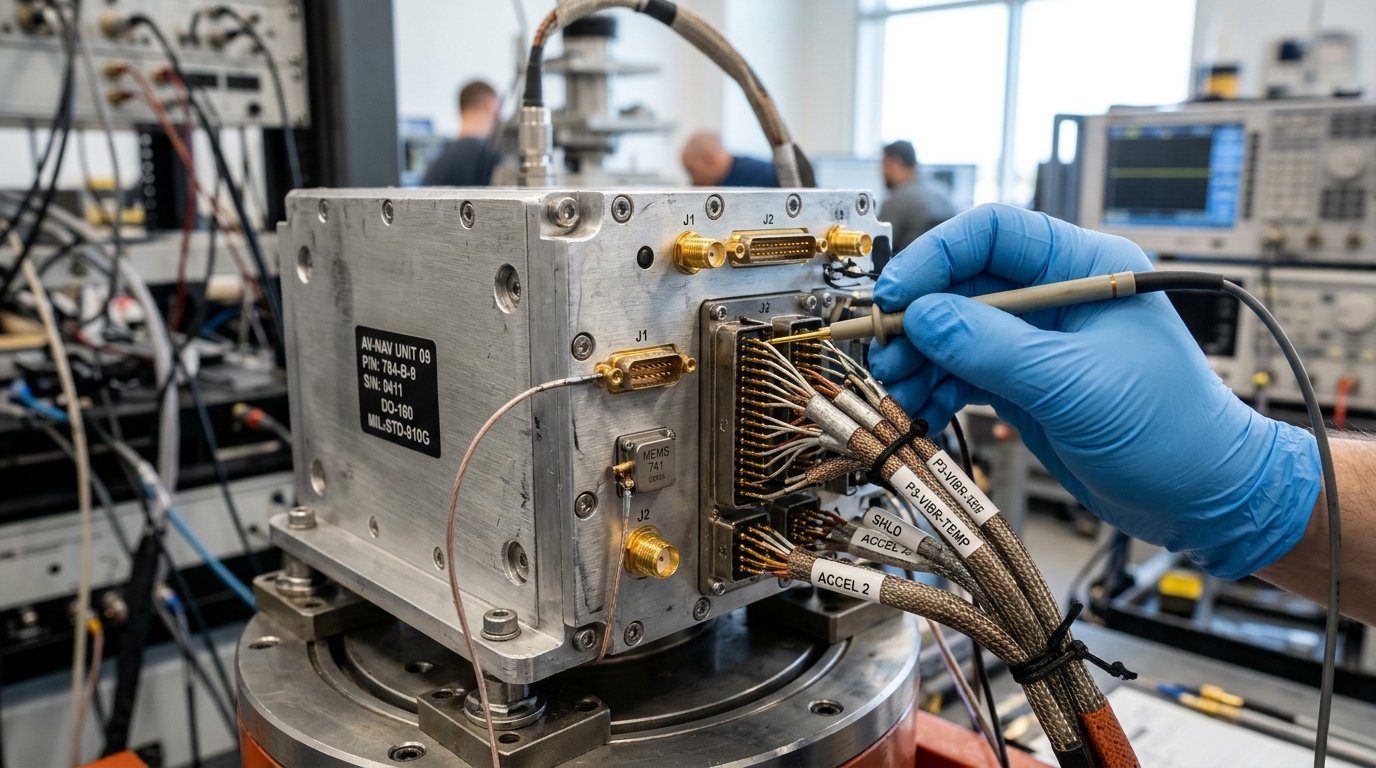
All 23 Environmental Test Sections at a Glance
Below is the complete map of DO-160’s test sections. Think of it as the full menu of environmental exposures an airborne product might need to survive.
| Section | Subject | What you are proving |
|---|---|---|
| 4 | Temperature and altitude | Performance holds across thermal and pressure extremes |
| 5 | Temperature variation | Rapid temperature changes do not cause failures |
| 6 | Humidity | Moisture exposure does not impair function |
| 7 | Operational shocks and crash safety | Equipment tolerates mechanical shocks and crash loads |
| 8 | Vibration | Sustained airframe vibration does not degrade operation |
| 9 | Explosion proofness | Safe operation in explosive-atmosphere zones |
| 10 | Waterproofness | Water ingress does not cause failure |
| 11 | Fluids susceptibility | Contact with aviation fluids (fuel, hydraulic, de-ice) is tolerated |
| 12 | Sand and dust | Particulate exposure does not impair function |
| 13 | Fungus resistance | Materials resist fungal growth |
| 14 | Salt spray | Corrosion from salt exposure stays acceptable |
| 15 | Magnetic effect | Magnetic emissions do not interfere with nearby instruments |
| 16 | Power input | Equipment tolerates aircraft electrical supply conditions |
| 17 | Voltage spike | Transient voltage spikes do not cause damage |
| 18 | Audio-frequency conducted susceptibility | Low-frequency interference on power lines does not impair operation |
| 19 | Induced signal susceptibility | Signals coupled into wiring do not cause malfunctions |
| 20 | RF susceptibility (radiated and conducted) | The aircraft’s RF environment does not disrupt function |
| 21 | Emission of RF energy | The equipment’s own RF emissions stay within limits |
| 22 | Lightning-induced transient susceptibility | Lightning-coupled transients in wiring do not cause failure |
| 23 | Lightning direct effects | Externally mounted equipment survives direct lightning attachment |
| 24 | Icing | Ice accumulation does not prevent function |
| 25 | Electrostatic discharge | ESD events do not cause damage or malfunction |
| 26 | Fire, flammability | Materials meet fire resistance criteria |
Two distinctions are easy to miss. Sections 20 and 21 test opposite directions of the same problem: Section 20 asks “can your box survive the RF energy around it?” while Section 21 asks “does your box pollute the RF environment for everyone else?” Sections 22 and 23 split lightning into indirect effects (transients coupled through wiring) and direct effects (the strike itself hitting the equipment).
A cabin-mounted display and an externally mounted antenna will never face the same test matrix. That is where categories come in.
Why “DO-160 Compliant” Alone Tells You Nothing
Every test section in DO-160 has categories that define the severity level. Temperature ranges, vibration profiles, RF field strengths, lightning waveform levels: all vary by category. The category you need depends on where the equipment sits on the aircraft, the aircraft type, electrical system characteristics, and the operational environment.
Category X does not mean “extra tough.” It means compliance was not demonstrated for that test. An EQF (more on that in a moment) with several Category X entries is not necessarily incomplete. It simply means those specific tests were outside the agreed scope. Whether that matters depends entirely on your installation.
The document that makes all of this traceable is the Environmental Qualification Form (EQF), found in Appendix A of the standard. The EQF lists every test section, the category tested, and the result. When you are evaluating a supplier’s hardware for airborne use, the EQF and the supporting test reports are the evidence. A marketing claim of “DO-160 qualified” without reference to specific sections and categories is like saying a vehicle “passed crash testing” without mentioning the speed, angle, or occupant configuration.
Consider power input testing alone. Section 16 categories include 400 Hz constant frequency, 360 to 650 Hz narrow variable frequency, and 360 to 800 Hz wide variable frequency. Claiming a product “handles aircraft power” without identifying the applicable category tells the procurement team nothing useful.
The rule is simple: ask for the EQF. Not the datasheet. Not the brochure. The form.
DO-160G vs. the Coming DO-160H Revision
DO-160G, published in 2010, is the current baseline. Change 1, issued in December 2014, relocated user-guide material to a separate supplement (DO-357) without altering the test procedures.
The H revision has been in active development for several years. RTCA’s 2025 year-in-review reported over 2,000 comments during the review process, with improvements spanning all 26 sections. Specific changes include revised power-input testing for usability, updated flammability provisions aligned with the FAA Fire Test Handbook, standardized Environmental Test Report Requirements to support TSO applications, and more consistent formatting throughout.
Timing, though, has shifted. RTCA’s DO-160 page had originally indicated a March 2026 publication. The September 2026 SC-135 committee terms now push the DO-160H completion milestone toward March 2027. Committee completion and formal publication are separate stages, so the standard may not be available for purchase until later in 2027.
What should you do right now? Qualify to DO-160G. Do not wait for H. If your approval timeline extends 18 months or more, discuss with your certification authority how to handle a potential mid-program edition change. Build your test reports and configuration documentation to be traceable enough that delta-qualification against new H requirements remains feasible without starting over.
SC-135’s work items for H include conditions for 540 V DC generators, hybrid wire-bundle lightning testing, higher-frequency RF susceptibility, volcanic ash, conductive carbon dust, and Integrated Modular Avionics. These reflect where aircraft architectures are heading: higher voltages for electric and hybrid propulsion, new composite and conductive materials, and denser RF environments. If your product roadmap touches any of those areas, track the H development closely.
DO-160 and Its Sibling Standards
DO-160 occupies one specific lane in a broader framework of aviation assurance standards. Confusing them (or assuming one substitutes for another) is a common and expensive mistake.
| Standard | What it covers | Relationship to DO-160 |
|---|---|---|
| EUROCAE ED-14 | Environmental conditions and test procedures for airborne equipment | Technically identical European counterpart, co-developed with RTCA |
| DO-178C | Airborne software life-cycle assurance | Covers software development processes, not physical endurance |
| DO-254 | Airborne electronic hardware design assurance | Covers hardware design confidence, not environmental testing |
| DO-311A | Rechargeable lithium battery and battery system performance | Adds battery-specific hazard tests alongside environmental qualification |
| MIL-STD-810 | Environmental qualification for military equipment | Different applicability and tailoring; not an automatic substitute |
| MIL-STD-461 | Military EMC requirements | Overlaps EMC topics but misses DO-160’s full environmental scope |
The practical takeaway is complementarity. An environmentally qualified computer still needs applicable software assurance (DO-178C), hardware design assurance (DO-254), and installation evidence for its intended role. And military standards like MIL-STD-461 share some EMC territory with DO-160, but their procedures, severity conventions, and applicability criteria diverge enough that a product qualified to MIL-STD-810 does not automatically earn DO-160 credit.
What the Qualification Workflow Actually Looks Like
The mistake most programs make is treating DO-160 as something that happens at the end of development. “Build the product, then send it to the lab.” That sequence is expensive. Products fail. Redesigns happen mid-campaign. Schedules slip by months.
A sequence that works better:
- Define the installation and build a requirements matrix. Which sections apply? Which categories? This comes from the aircraft environment, the certification basis, and the installation design. Get this wrong and the entire test campaign answers the wrong questions.
- Control the test article configuration. Document hardware revision, software version, wiring, connectors, mounting. Anything that differs between the test article and production must be assessed for qualification impact.
- Run pre-compliance testing. Use bench-level or development lab testing to catch problems before formal qualification. A vibration issue found in pre-compliance costs engineering hours. The same issue found during witnessed testing costs months and six-figure retesting fees.
- Execute formal qualification per the agreed test plan, with functional monitoring during and after each exposure.
- Deliver the evidence package: EQF, test reports, configuration records, and documented anomalies. This package feeds the installation approval process.
Gogo’s Galileo HDX antenna program illustrates the full arc. In November 2024, Gogo announced the HDX electronically steerable antenna had passed DO-160 qualification, covering temperature variation, vibration, RF, lightning, moisture, and other exposures. Developed with Hughes Network Systems for LEO satellite connectivity on business aircraft, the antenna still needed Supplemental Type Certificates (STCs) before it could fly on any specific airframe.
By October 2025, Gogo reported 19 completed HDX STCs covering 24 aircraft types and more than 150 antennas shipped. That is the cadence: qualification enables STCs, STCs enable installation, installation enables revenue. Conflating any of those stages creates procurement risk.
When Environmental Qualification Alone Is Not Enough
Passing every applicable DO-160 section does not mean you have addressed every safety concern. Three real cases make this concrete.
On January 7, 2013, a Japan Airlines 787-8 suffered an APU battery fire while parked at Boston Logan. The NTSB investigation found that the certification plan had not included a cell internal-short-circuit abuse test. Thermal runaway propagated from one cell to adjacent cells. This was not a DO-160 test failure. It was a gap in the broader battery-safety demonstration that environmental endurance testing alone could never have caught. Environmental stress and internal failure-mode containment answer different questions.
Contrast that with H55, which completed a six-month propulsion battery module test campaign in December 2025, including authority-witnessed thermal-runaway tests that demonstrated no propagation. Reports were being prepared for EASA acceptance. This layered approach (environmental qualification plus failure-containment testing) reflects where the industry is heading, especially as electric propulsion scales.
FAA AC 20-184A, issued in September 2026, formalizes this thinking. It pairs DO-160G environmental qualification with DO-311A battery-specific requirements and emphasizes life-cycle and installation-specific conditions. If your product includes lithium batteries, DO-160 alone is not the complete evidence package.
Even portable devices face scrutiny. FAA AC 120-76E requires electronic flight bags to meet DO-160 Section 21 RF-emission limits at Category L, M, or H. Category B is explicitly called out as insufficient. Active wireless transmitters (Wi-Fi, cellular, Bluetooth) need interference evaluation at maximum output. “It is just a tablet” does not work as a compliance argument on an aircraft.
What This Means for Aviation Asset Tracking
If you track containers, ULDs, ground support equipment, or any asset moving through the air cargo chain, DO-160 is the line between hardware that can legally enter an aircraft environment and hardware that cannot. This is not abstract for us at Datanet. The Thingfox T2 tracker we provide is DO-160 airfreight approved, qualified to the sections and categories required for air cargo condition monitoring inside aircraft cargo compartments. That qualification is what allows airlines and freight forwarers to deploy tracking on shipments without pulling devices at the aircraft door.
For fleet managers and logistics operators evaluating freight container visibility solutions with air segments in the chain: ask for the EQF. Confirm which sections and categories were tested. Verify the tested configuration matches what you will actually deploy. A tracker that passed vibration and temperature but lacks the required RF emission category is not airfreight-ready, regardless of what the marketing says.
If your asset visibility needs include the aircraft environment, talk to our team or reach us at info@datanetiot.com.
Frequently Asked Questions
Is RTCA DO-160 mandatory for all aviation equipment?
Not universally. FAA AC 21-16G is expressly nonmandatory and describes an accepted means of compliance. However, specific certification programs, TSOs, or contracts can require DO-160 evidence for particular equipment. The mandate comes from the approval program, not from the standard itself.
What is the difference between DO-160 and DO-178C?
DO-160 qualifies hardware against environmental conditions like temperature, vibration, and lightning. DO-178C assures software development processes. They answer different questions and are frequently both required for the same product. One tests physical endurance; the other verifies development rigor.
Which version should I use for a new product?
DO-160G is the current published baseline and the version the FAA strongly encourages for new articles. DO-160H remains in committee development with a completion milestone of March 2027. Use G unless your certification authority specifies otherwise. Build traceable documentation so delta-qualification against H is feasible later.
Does equipment need to pass all 23 test sections?
No. Applicability depends on installation location, function, aircraft type, electrical characteristics, and certification requirements. The Environmental Qualification Form (EQF) documents which sections and categories were tested. Category X means that test was not demonstrated, not that the product achieved a higher performance tier.
How long does DO-160 qualification typically take?
There is no universal answer. Duration depends on the number of applicable sections, category severity, test article readiness, laboratory scheduling, and whether pre-compliance work uncovers redesign needs. The right question is: what is the cost and timeline for my specific test matrix, including preparation, execution, and potential rework?
Can MIL-STD-810 or MIL-STD-461 testing replace DO-160?
Not automatically. Military standards overlap with DO-160 in some areas but use different procedures, severity conventions, and applicability criteria. A requirement-by-requirement comparison against the specific civil certification program is needed. EUROCAE ED-14 is the only standard that qualifies as a direct equivalent, being technically identical to DO-160.







 +1 508 292 2210

One Response