

Through September 2026, cargo theft incidents in the U.S. and Canada dropped 25% compared to the same period in 2025, while estimated losses climbed 39%. Fewer thefts, larger hits per incident. Nearly $719 million gone in nine months.
If you’re figuring out how to track trailers, that trend frames the stakes. Whether you park a single utility trailer in a public lot or dispatch hundreds of dry vans across multiple states, the question is no longer whether you need visibility. It’s what kind of visibility actually moves the needle.
This guide covers the technology, installation, real costs, and the part most articles skip: what to do with tracking data once you have it.
Why trailer tracking is a different problem than truck tracking
A tractor has its own engine, its own electrical system, an ELD, and a cellular connection. A trailer has none of that. The moment it uncouples, it goes silent.
FMCSA’s ELD rule does not require real-time tracking of commercial vehicles. An ELD records hours of service, not equipment location. A fully compliant fleet can still lose sight of every disconnected trailer the second the tractor pulls away.
C.R. England, one of the largest refrigerated carriers in North America, experienced exactly this. Their previous tractor-dependent equipment became untraceable when disconnected. Trailers sitting at shipper docks, overflow yards, or maintenance queues vanished from the system entirely.
This is the baseline test for any trailer tracking solution: does it keep reporting after the tractor drives away? If the answer is “no” or “sometimes,” you’re tracking tractors, not trailers.
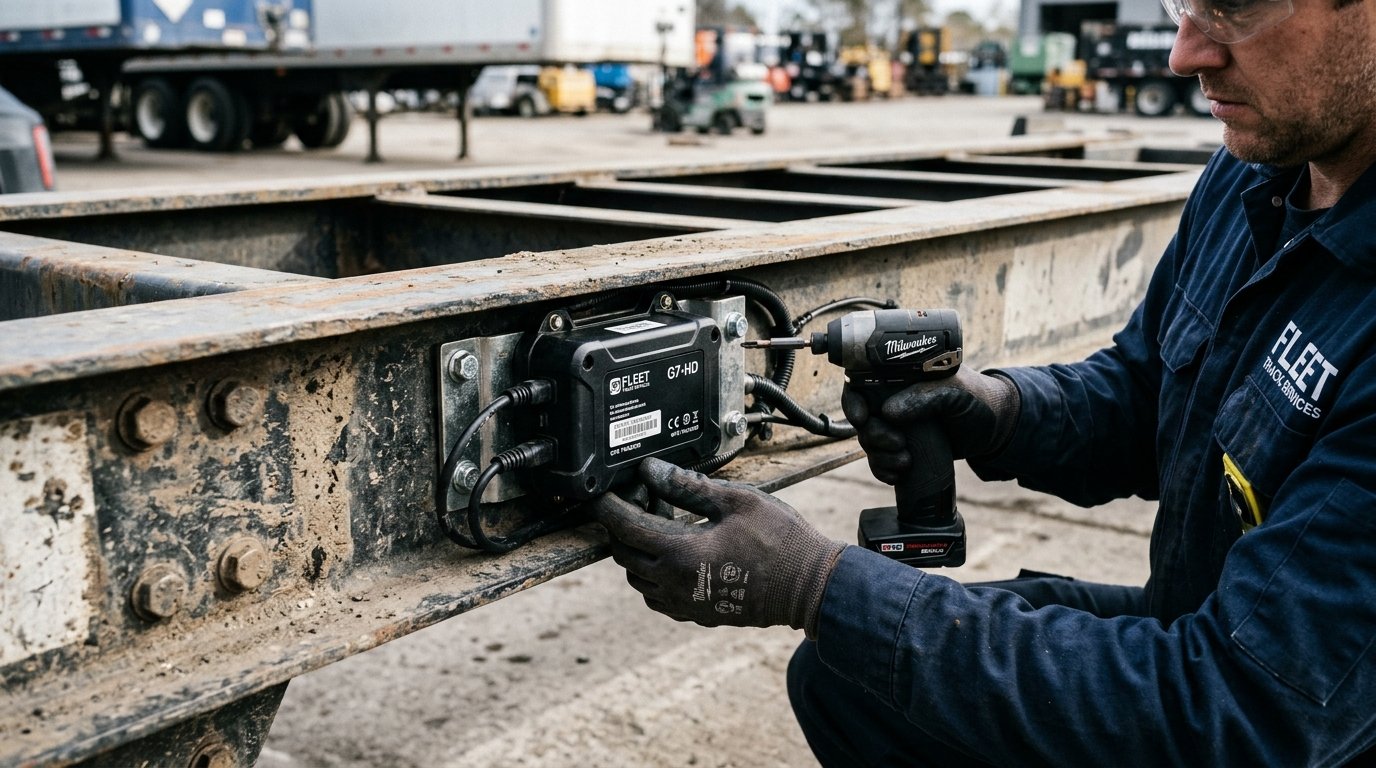
Six approaches to trailer tracking
Not every trailer needs the same solution. A horse trailer parked in your driveway has different requirements than a reefer running cross-country routes. Here’s what’s available, and where each fits.
| Approach | How it works | Best for | Key trade-off |
|---|---|---|---|
| Battery-powered cellular tracker | Internal batteries power a GNSS receiver and cellular modem (LTE-M, NB-IoT, or Cat-1). Reports position on a schedule or when movement is detected. | Disconnected trailers, utility trailers, mixed fleets | Battery life depends heavily on reporting frequency and signal conditions |
| Powered cellular gateway | Wired to the trailer’s electrical system via a J560 or auxiliary connector. Supports richer sensor arrays: cargo cameras, TPMS, door sensors, ABS data. | Frequently used commercial trailers with reliable power access | Loses functionality when power is disconnected unless backup battery is included |
| Solar-powered telematics | Solar panel maintains an internal battery for long-term deployments without manual battery swaps. | Large commercial fleets, trailers parked outdoors for extended periods | Panel exposure and mounting angle affect the energy budget; covered or indoor trailers won’t charge |
| Satellite tracker | Uses GPS for position and a satellite network (e.g., Globalstar) for data transmission where cellular doesn’t reach. | Routes crossing remote or rural areas with no cellular infrastructure | Higher service cost, sky-visibility requirements, sometimes lower update frequency |
| Bluetooth tag (e.g., AirTag) | Broadcasts a Bluetooth signal picked up by nearby participating devices in a crowdsourced network. No independent cellular or satellite modem. | Supplemental theft recovery for personal trailers, boats, equipment | Location depends entirely on nearby devices; not scheduled fleet telemetry |
| Passive RFID / yard RTLS | Tags on trailers read by fixed or mobile readers within a controlled area. Often combined with GPS for broader coverage. | Yard management, distribution centers, port operations | Requires reader infrastructure; no independent nationwide tracking |
These approaches aren’t mutually exclusive. A fleet might use solar gateways on active-route trailers, battery trackers on seasonal equipment, and RFID for yard positioning. PINC’s yard-management deployments combine passive RFID with GPS for exactly this reason. The question isn’t which technology is “best.” It’s which combination matches your trailers’ actual operating cycle.
How to choose the right system
Ignore the spec sheet for a moment. Start with four questions about your operation.
1. What’s the trailer’s power situation?
Trailers with regular tractor connections and reliable electrical access can support powered gateways with richer sensor packages. Trailers that sit disconnected for days or weeks need independent power: replaceable batteries or solar.
2. Where does the trailer operate?
Routes through Montana, rural Canada, or Northern Mexico will test cellular coverage. If your trailers regularly pass through dead zones, evaluate satellite fallback. For urban and interstate corridors, LTE-M or NB-IoT is generally sufficient.
3. What decision does the data need to support?
This is the question most buyers skip. “Knowing where my trailer is” isn’t a decision. “Dispatching the nearest empty trailer to a shipper in Memphis” is. “Getting a movement alert at 2 AM when nothing should be moving” is. Define the decision first, then spec the reporting frequency, sensor package, and integration requirements.
4. How many trailers, and what’s the maintenance budget?
A single utility trailer with a $30 device and a $12/month subscription is a different purchase than 200 dry vans needing integration with a TMS. At scale, total cost of ownership (hardware, subscriptions, installation, battery replacement, platform fees, and eventual data migration) matters more than unit price.
One more factor: signal reliability. Metal-walled trailers can attenuate GPS and cellular signals significantly, which affects geolocation accuracy. SPOT’s own installation guidance warns against mounting under metal roofs and near obstructions. And in a documented case, the FCC proposed a $31,875 penalty against a truck driver whose personal GPS jammer interfered with Newark airport navigation equipment. Mounting location and signal path aren’t afterthoughts.
On legal boundaries: tracking your own trailers is straightforward. Tracking leased, subcontracted, or third-party-operated trailers introduces consent and privacy questions that vary by state. Virginia, for example, prohibits deceptive, nonconsensual installation of tracking devices while carving out a fleet-owner exception. When in doubt, disclose.
Installing and commissioning a trailer tracker
Most guides cover “attach the device.” The steps that actually determine whether tracking works happen before and after that.
Step 1: Bind the tracker to the correct trailer identity. Record the device serial number against the trailer’s fleet ID and VIN. This sounds obvious. In practice, mismatched records create phantom trailers on the dashboard and real trailers that appear nowhere. Activate the service, confirm account ownership, assign alert recipients.
Step 2: Mount according to the manufacturer’s instructions, not wherever it’s convenient to hide. GPS needs sky visibility. Cellular antennas need a clear signal path. Hiding a tracker deep inside a steel-walled tool compartment defeats the purpose. Follow the device’s specific orientation and placement guidelines. Test reception in the intended location before permanent mounting.
Step 3: Test the disconnected condition. This is the step people skip, and it’s the most important one. Uncouple the tractor. Confirm that location reports and movement alerts continue arriving as expected. If the tracker goes quiet when the tractor leaves, you’ve installed an expensive paperweight for every hour the trailer sits alone.
Step 4: Configure actionable exceptions, not a default map view. Set up alerts for unexpected movement, geofence departures, prolonged dwell, low battery, and (where sensors support it) door openings, temperature deviations, or cargo-area changes. The system should tell you when something needs attention. You shouldn’t have to remember to check.
Step 5: Exercise the response workflow. Trigger a test movement alert. Does it reach the right person? Does that person know what to do? Can dispatch act on the information without re-entering data into another system? A tracking system that delivers perfect alerts to an inbox nobody checks has zero operational value.
For powered installations, use qualified support and follow the manufacturer’s electrical instructions. The legacy SAE J560 connector between tractor and trailer has known bandwidth and conductor limitations. Don’t improvise wiring on safety-critical systems.
Battery life claims vs. battery life in the field
Every battery-powered tracker ships with an impressive headline number. “Up to 5 years.” “8+ years.” These numbers are real. They’re also based on assumptions that may not match your operation.
Take a concrete example. The Digital Matter Remora3 publishes a longevity estimate assuming two hours of movement per day, five days a week, with GPS fixes every three minutes but uploads only every 30 minutes. Change any of those variables and the battery life changes with it.
Three factors that drain batteries faster than spec-sheet projections:
- Poor cellular signal. When the modem can’t connect easily, it retries. Each retry burns power. A trailer parked in a signal-weak area consumes battery faster than one on an open highway.
- Extreme temperatures. Cold reduces available battery capacity. Sustained heat accelerates chemical degradation. A reefer trailer in Minnesota winters and Arizona summers is not operating under lab conditions.
- Aggressive reporting schedules. Reporting frequency is the single biggest lever on battery life. Requesting a GPS fix every 30 seconds instead of every 3 minutes doesn’t give you 6x the value, but it does give you a fraction of the runtime.
The practical approach: increase reporting frequency during meaningful movement (when the trailer is on the road and you need updates) and reduce transmissions when it’s parked (when knowing it hasn’t moved is enough). Most modern trackers support adaptive scheduling. Budget for battery replacements based on your actual reporting profile, not the best-case number on the box.
The real ROI: utilization, not just location
The installed base of tracking devices across cargo-carrying equipment reached 13.8 million units globally in 2024, with projections of 26.9 million by 2029. That 14.3% annual growth isn’t driven by theft anxiety alone. The bigger pull is operational: fleets discovering that the same device preventing a $40,000 loss also eliminates six figures in unnecessary trailer leases.
Here’s the distinction I make with every fleet manager I talk to: there’s a difference between tracking a shipment and tracking an asset.
Shipment tracking ends at delivery. The freight arrives, the job is done, the tracking data expires. Asset tracking follows the trailer through its entire cycle: loaded, in transit, unloaded, empty, repositioned, parked, idle, returned to service. It’s the difference between knowing where your freight went and knowing whether your equipment is earning.
The numbers support this shift in thinking.
Sibley Transportation reported a 17% monthly increase in trailer utilization and 28,560 fewer empty miles annually after implementing dwell-time analytics. The mechanism was straightforward: identifying idle trailers and rotating them back into service instead of buying or leasing additional units.
ReedTMS, a 3PL operating 85 trucks and 400 trailers, initially deployed basic tracking to find missing equipment. After upgrading to pool-management capability, they reported more than $1 million in avoided capital costs by right-sizing their trailer pool. They didn’t need more trailers. They needed to know which ones were available.
For broader fleet visibility strategies, see how to track my fleet.
C.R. England’s transition to independent trailer connectivity resulted in 53% fewer trailers sitting idle for more than 30 days and a 44% reduction in total claims in the first year.
A word of caution: scrutinize vendor-reported ROI figures carefully. In the Sibley case, the vendor headline calls one component “additional profit” while the detailed analysis calls it “additional revenue.” Those are different things. Build your own business case from your own dwell times, repositioning costs, and fleet utilization data.
The market is accelerating in this direction. In early 2025, Amazon Freight deployed smart-trailer technology across its North American surface transportation operation, monitoring tire, brake, electrical, and cargo conditions simultaneously. The trailer is becoming an intelligent node in the supply chain, not just a box on wheels. Whether that level of capability makes sense for your operation depends on the value of what’s inside and how many cycles per month that trailer runs.
Can an AirTag track a trailer?
Yes. With clear limitations.
In January 2025, two AirTags hidden among tools helped South Jordan, Utah police recover a stolen trailer and equipment valued at nearly $40,000. The location data supported a search warrant, and officers recovered everything at a Kearns address.
Genuine success. But AirTag is a crowdsourced Bluetooth finding network, not dedicated GPS telemetry. Its accuracy depends on nearby Apple devices participating in the Find My network. In a dense urban area, coverage is reasonable. In a rural storage lot or remote job site, there may be no nearby devices at all.
There’s also a detection problem. Apple’s unwanted-tracking safeguards notify anyone carrying an unknown AirTag, and the tag itself plays a sound after prolonged separation from its owner. A thief with an iPhone gets an alert. A thief without one eventually hears beeping.
For a personal trailer, boat, or equipment hauler, an AirTag is a useful, low-cost supplement. For accountable commercial tracking with scheduled reporting, sensor data, and dispatch integration, it’s not the right tool.
What trailer tracking actually costs
Hardware is the number everyone asks about first. It’s the smallest part of the total expense.
The real cost lives in the subscription. And the subscription price depends almost entirely on how often you want updates. Consumer-grade trackers commonly range from roughly $12 to $50 per month depending on reporting interval — the same hardware can carry a 2.5x price difference simply because faster pings consume more network resources. Activation fees of $25–$35 are typical, and month-to-month flexibility often adds a surcharge over annual contracts.
These are consumer and small-fleet examples. Enterprise telemetry platforms with cargo cameras, TPMS, door sensing, and TMS integration cost more per unit but often deliver more value per actionable data point at scale.
The complete ownership cost includes:
- Hardware purchase
- Activation and setup fees
- Monthly or annual connectivity subscription
- Replacement batteries (for battery-powered units; schedule depends on actual reporting profile)
- Mounting hardware or professional installation
- Platform access or software licensing
- Data export or migration costs if you switch providers
Request a line-item quote covering all of these before committing. The cheapest tracker with an expensive subscription often costs more over three years than a better device with a lower service rate.
Frequently Asked Questions
Can I track a trailer when it’s disconnected from the truck?
Yes, if the tracker has its own power source (replaceable batteries or solar) and its own cellular or satellite modem. This is the fundamental purpose of trailer-specific tracking. Always test by uncoupling the tractor and confirming that reports continue arriving as expected.
Does trailer tracking work without cellular coverage?
Satellite-based trackers can report in areas without cellular service. Some cellular devices buffer GPS fixes locally and upload them when coverage returns. The trade-off is typically higher cost and a need for clear sky visibility. Evaluate coverage maps against your actual routes before committing.
Is an AirTag enough to track my trailer?
It’s a useful, low-cost supplement for personal trailers. It helped police recover a $40,000 stolen trailer in Utah in 2025. But it relies on nearby Apple devices for location, can alert thieves to its presence, and provides no scheduled telemetry or sensor data. For commercial fleets, it’s not a substitute for dedicated tracking.
Can I track a trailer using its VIN or license plate?
No. A VIN encodes manufacturing information (make, model, year, plant), not live location. There is no public service that returns a trailer’s current position from its VIN. You need a tracking device physically installed on the trailer.
How often should a trailer tracker report its location?
Match reporting frequency to the decision the data supports. For theft detection, a movement-triggered alert is more useful than constant pings. For dispatch optimization, updates every 15 to 30 minutes during transit often suffice. Faster reporting means shorter battery life and higher subscription costs. Spec the interval to your actual response capability, not to a marketing claim.
Will a GPS tracker lower my insurance premiums?
Some insurers offer discounts for verified tracking and recovery capabilities, but there’s no universal rule. Ask your insurer what documentation or system specifications qualify before assuming savings. The stronger financial case is often reduced claims from faster recovery and better utilization, not a line-item premium reduction.
If your trailers disappear from the system every time they uncouple, that’s the gap purpose-built asset tracking closes. We help fleet operators and logistics teams select, deploy, and integrate the right tracking hardware for their specific operation. Talk to our team, or explore our asset tracking device catalog to find what fits.






 +1 508 292 2210

3 Responses