

A 1.25-meter borescope turning tool sat inside a Qantas A380 engine for 34 flights and 294 hours before anyone found it. Engineers missed it during foreign-object checks. Nobody initiated the lost-tool procedure. The aircraft kept flying. That is not a minor process gap. That is tool accountability failing at the one moment it exists for.
Whether you run an MRO hangar, a CNC shop floor, or a manufacturing line, the fundamentals are the same. Tools disappear. Operators waste time searching. Stock runs out at the worst moment. And the reflexive fix (buy software, install vending machines) often builds an expensive layer of data without changing a single outcome on the floor.
I’ve spent over fifteen years working with operations teams across aviation, manufacturing, and industrial supply chains. The pattern repeats: technology gets deployed, dashboards light up, and the same tools still go missing because nobody designed the system around exceptions. This guide covers what tool crib management actually requires, where most operations break down, and how to build a system that earns measurable returns.
What Tool Crib Management Actually Means
Tool crib management is the disciplined control of tools, gauges, consumables, and shared equipment through every stage of their lifecycle: receipt, storage, issue, use, return, inspection, maintenance, calibration, and disposal.
The word “crib” traces back to industrial shop floors, a secured room or cage where an attendant stored and issued tools against a sign-out sheet. Ferris State University describes the core function as obtaining, storing, and issuing tools for temporary use, with the attendant managing access and checking condition on return. Modern systems extend that with digital records, automated replenishment, calibration scheduling, and integration into ERP or maintenance platforms.
The lifecycle loop runs through seven stages:
- Receive and catalog the tool with its identity, serial number, supplier, replacement value, and calibration status.
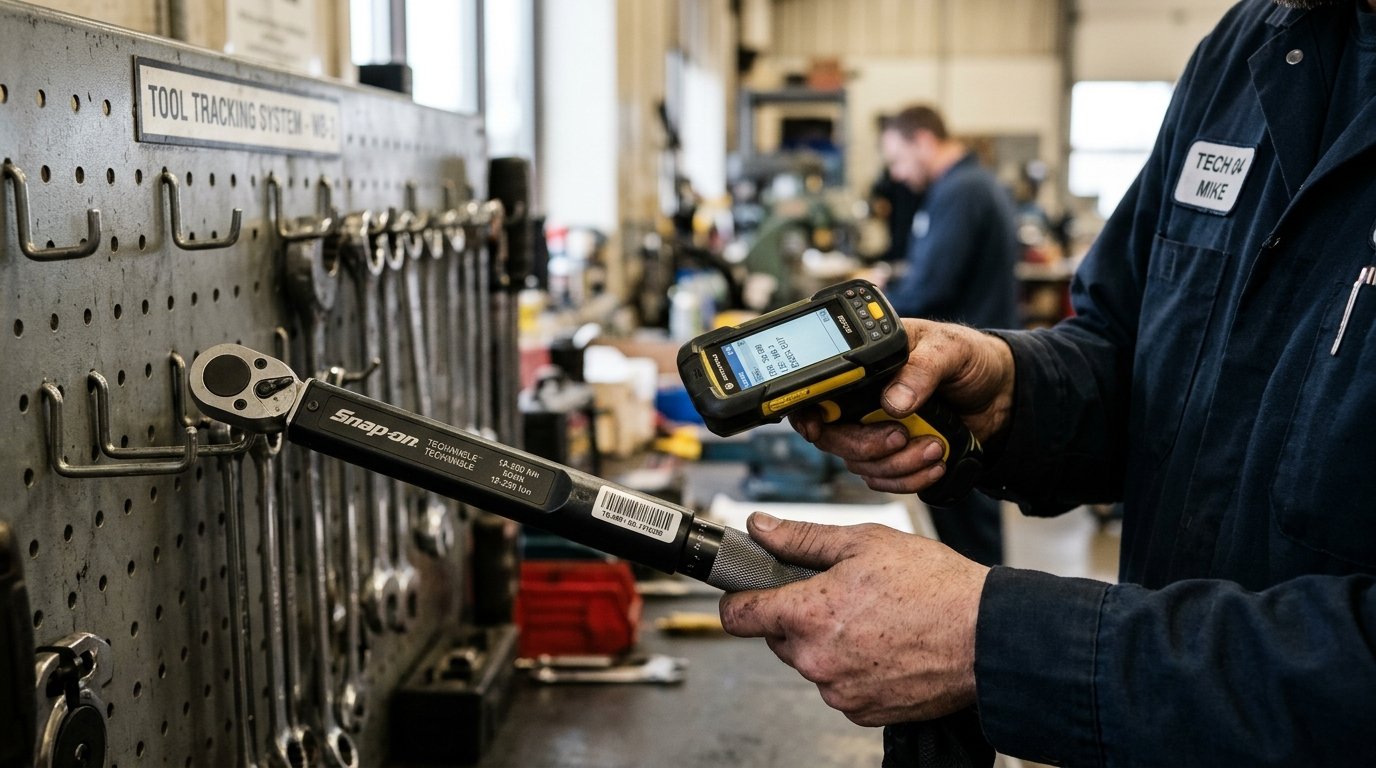
- Store it in a defined, labeled location: cabinet, shadow board, vending machine, or crib shelf.
- Issue it to an authorized person against a job, machine, or work order.
- Track its location, condition, and due time while it’s in use.
- Accept the return, inspect condition, and reconcile against the issue record.
- Maintain, repair, recalibrate, or retire based on condition and policy.
- Replenish when stock hits defined thresholds.
Skip any step, and you create a blind spot. In a machine shop, that blind spot costs money. In an MRO hangar, it can cost airworthiness.
And scope matters more than most teams realize. A tool crib doesn’t just control cutting inserts. Depending on the operation, it manages calibrated gauges, torque wrenches, jigs, fixtures, powered equipment, PPE, and serialized instruments. Each class has different identification, accountability, and lifecycle requirements. Treating a $3 drill bit the same as a $12,000 calibrated torque wrench is one of the fastest ways to build a system that looks organized on paper but isn’t.
Understanding the lifecycle is straightforward. Seeing what happens when it breaks tells the real story.
What a Broken Tool Crib Actually Costs
The costs are both obvious and hidden. The hidden ones do more damage.
Financial waste you can measure
Start with time. Research from Procore and IDC found that construction crews lose an average of 80 minutes per day to inventory inefficiencies. Machine shops are no different. Every minute an operator spends hunting for a tool, waiting on a crib attendant, or working around a stockout is a minute the machine isn’t cutting.
Then look at inventory. Catamount Machine Works carried $350,000 in excess tool inventory before its overhaul, with duplicate orders, overstocked items, and no visibility into what was actually on the floor. After implementing managed inventory with vending and vendor-managed replenishment, it reported $60,000 in annual labor savings and $75,000 in annual tool-spend reduction. Important context: that intervention also bundled carbide tooling improvements, so not all gains came from crib controls alone.
In another case, Allied Mechanical reported $40,000 per month in perishable tooling savings after installing point-of-use dispensers. That is vendor-reported, not independently audited. But the direction is consistent across cases: unmanaged cribs bleed money through overstock, stockouts, duplicate purchasing, and idle labor.
Safety costs you can’t afford
Return to that Qantas A380. Engineers forgot the borescope tool inside the engine. The foreign-object check missed it. Nobody triggered the lost-tool procedure. The aircraft flew 34 cycles with a 1.25-meter metal tool sitting against engine components. The ATSB reported no observed engine damage. This time.
In a separate event in January 2026, a maintenance work light was left inside an A380 wing following air-conditioning system work. It stayed there through flights to Dallas and back. The end-of-shift unreturned-tool process failed to catch it. The maintenance system did not prompt the certifier about the unreturned-tool report. Qantas formed a tooling working group. The ATSB stressed the need for safeguards that detect and recover from human error under operational pressure.
These are extreme cases. But they reveal a principle that applies everywhere: a tracking record that doesn’t trigger an action is just documentation of what already went wrong.
The hidden cost: false confidence
Partial systems create a dangerous middle ground. Data exists, so management assumes control exists. Dashboards show issue and return counts, so the tool crib looks healthy. But if the system doesn’t escalate when a tool doesn’t come back, doesn’t block a work-order closure with an open tool issue, doesn’t flag a calibration expiry before the tool goes out, the data is decorative.
False confidence is worse than no system at all. With no system, people know they’re guessing. With a half-built system, they think they know. That gap is where tools vanish and money evaporates.
So what does a system that actually works look like? It comes down to three layers, and all three have to hold.
Three Layers That Make or Break a Tool Crib
Layer 1: Physical organization
Before any software, the crib needs physical order. The EPA’s 5S framework (Sort, Set in Order, Shine, Standardize, Sustain) provides the foundation: remove what doesn’t belong, assign every tool a labeled home, keep the space clean, make the system repeatable, and audit it regularly.
Shadow boards make missing tools visible at a glance. Foam cutouts in drawers, color-coded zones, and labeled bins reduce search time. Layout should follow usage patterns: high-frequency tools near the point of use, low-frequency or high-value items in a central locked crib, consumables in vending or coil dispensers on the floor.
No digital location record can fix an overcrowded cabinet, an unmaintained shadow board, or a crib where three different people each have their own filing “system.”
Layer 2: Digital infrastructure
The digital layer handles what humans can’t do reliably at scale: recording every transaction, flagging exceptions, connecting tool status to purchasing and maintenance, and maintaining an audit trail.
This includes identification technology (barcode, RFID, imaging), transaction software (check-in, check-out, reconciliation), exception handling (overdue alerts, missing-tool escalation, calibration expiry warnings), integration with ERP or MES, and reporting that shows consumption trends, tool life, and cost per job.
The design question that matters most isn’t which features the software has. It’s what happens when something goes wrong. Does the system surface an unreturned tool at end of shift? Does it flag a calibration-expired gauge before issue? Does it block a sign-off when a serialized tool is unaccounted for? If the answer is “it sends a notification someone might see,” you have a reporting tool, not a control system.
Layer 3: Human process and culture
This is where most implementations stall. The technology works in the demo. The pilot goes smoothly with the team that volunteered. Then it hits the broader floor, and operators bypass the barcode scan because it’s faster to grab the tool and go. The attendant stops enforcing return checks because production pressure wins. The calibration alert gets acknowledged, but the tool goes out anyway because there’s no replacement ready.
Adoption isn’t a training problem. It’s a design problem. If following the process is slower or harder than ignoring it, people will ignore it. The system has to make compliance the path of least resistance: vending machines that require a badge before dispensing, RFID portals that log movement without requiring a deliberate scan, exception escalation that goes to a supervisor rather than relying on the operator to self-report.
OSHA holds employers responsible for the safe condition of tools used by their employees. A software platform can support that responsibility. It cannot replace it. Someone has to own the reconciliation, the override decisions, and the escalation. If nobody does, the system decays regardless of the technology behind it.
Within the digital layer, the choice of identification technology is usually where teams spend the most time and budget. Here’s how to think about it without getting sold on features you don’t need.
Choosing the Right Identification Technology
There’s no universal winner. The right approach depends on what you’re tracking, the transaction volume, the accountability level required, and how far tools travel from the crib.
| Technology | Best Fit | Strength | Limitation |
|---|---|---|---|
| Barcode / QR code | Mixed assets, modest budgets, deliberate custody transfer | Explicit item ID, low cost per label, straightforward check-in/out | Requires deliberate scan; labels degrade in harsh environments |
| RFID (cabinets, portals, shadow boards) | Serialized assets, movement zones, high-accountability environments | Hands-free detection of multiple items; portal-based movement tracking | Read-zone design is critical; tag selection varies by tool material and size |
| Smart cabinets / vending machines | High-volume consumables, PPE, controlled returnables | Restricted access, automatic transaction logging, vendor-managed replenishment | Physical capacity limits, packaging constraints |
| Machine vision / imaging | Tools in fixed drawer positions (ATC toolboxes) | Identifies removed and replaced tools without individual scanning | Sensitive to layout changes, occlusion, mixed storage |
| Cellular / GNSS / BLE trackers | Mobile equipment, inter-site transfers, field operations | Location visibility beyond the crib, works across facilities and in transit | Battery life, network coverage; answers “where” rather than “who has custody” |
Avianor Aerospace uses RFID across storage cabinets, cribs, shadow boards, and portals, with distinct tag types for small metal tools, larger equipment, and open-area movement. The system links tool identity and movement events to technician assignments and check-out/return records. But even Avianor’s vendor cautions that RFID alone doesn’t create compliance: poor read-zone design, inconsistent tag placement, or weak event logic will undermine the entire installation.
For tools that never leave the building, cabinet-based and portal-based RFID can deliver tight accountability. But many operations (especially aerospace MRO) deal with tools that move between hangars, ship to field locations for AOG support, or cycle through external calibration labs. Fixed-infrastructure systems lose visibility the moment the tool passes through the door.
That’s where cellular or GNSS-enabled trackers come in. Compact asset tracking devices attached to high-value or mobile tooling extend the control loop beyond the facility. They answer a different question than RFID: not “who checked this out,” but “where is this asset right now, and how long has it been there?”
The practical move is to layer approaches by asset class. Consumables go in vending. Serialized hand tools get barcodes or RFID. High-value mobile equipment gets a tracker. Calibrated instruments get serialized tracking with expiry enforcement. One technology does not cover the full range.
Nowhere is this layered approach more consequential than in aerospace.
Tool Crib Management in Aerospace and MRO
Aviation takes every tool crib failure mode and raises the stakes. A missing tool isn’t just a cost event. It’s a potential foreign object damage (FOD) hazard that can compromise flight safety.
FOD prevention starts at the crib
Both Qantas A380 incidents traced back to the same root cause: the tool accountability system did not force a resolution before the aircraft was released. In the borescope case, the ATSB found that engineers missed the tool during foreign-object checks and did not initiate the lost-tool procedure. In the 2026 work-light case, the end-of-shift tool count failed, the unreturned-tool report was filed but not linked to the release authorization, and the maintenance system did not prompt the certifier about the outstanding discrepancy.
The lesson: in aviation, a tool crib system must connect to the release-to-service gate. A missing tool should create a hard stop, not a notification. If the certifier can sign off without resolving an open tool discrepancy, the system has a hole where the barrier should be.
Calibration and serialized accountability
NOAA’s aircraft tool control policy illustrates strict calibration accountability: specified tasks require calibrated tools, lost tools can ground the aircraft until found or confirmed absent, and the escalation procedure is documented and enforced. While this is a specific institutional policy (not a universal regulation), it reflects the standard aviation culture demands.
Serialized tools need individual tracking throughout their service life: issue history, calibration dates, maintenance records, and retirement triggers. Generic quantity-based inventory management does not cut it for instruments that need to prove their accuracy before use.
Beyond the crib: tracking tools across the operation
Aerospace MRO is not a single-room operation. Tools move between line maintenance stations, heavy-check hangars, back shops, calibration labs, and sometimes to AOG sites hundreds of miles away. A crib system that tracks issue and return inside one facility misses everything that happens after the tool leaves.
This is the gap between tool crib management and asset tracking. The crib manages custody. Asset tracking manages location and lifecycle across the full operational footprint. For high-value or safety-critical tooling, you need both.
Devices like the Thingfox T2 (DO-160 airfreight approved) or the Oyster3 can extend real-time visibility to tools and ground support equipment that travel beyond the crib’s four walls. The goal isn’t replacing crib-level controls. It’s closing the gap where those controls end and operational movement begins.
Whatever the industry, any tool crib investment needs a business case that holds up under scrutiny. Here is how to build one that does.
Measuring and Proving ROI
The biggest mistake in building a tool crib ROI case: combining vendor-reported savings from different companies and presenting them as a general benchmark. They aren’t. Catamount’s results bundled crib management with carbide tooling changes. Allied Mechanical’s numbers came from point-of-use dispensers in a specific operation. Neither predicts your outcome.
Instead, build a local case across five dimensions:
| ROI Dimension | What to Measure | How to Baseline |
|---|---|---|
| Inventory reduction | Total tool/consumable inventory value before and after | Physical count + current purchase records |
| Consumption savings | Monthly spend on tools and consumables | 12-month purchasing history by category |
| Labor savings | Time spent searching, counting, ordering, managing stock | Time study on current process (even one week helps) |
| Downtime reduction | Machine/line stoppages caused by missing tools or stockouts | Maintenance logs, production records, supervisor interviews |
| Compliance and safety value | Audit findings, FOD incidents, calibration failures, regulatory risk | Audit history, incident reports, corrective action records |
Inventory reduction is a one-time working-capital release. Consumption and labor savings are recurring. Downtime reduction flows to throughput. Compliance value is harder to quantify but often the most compelling argument for leadership, especially in regulated industries like aerospace and defense.
The practical sequence: pick one area or cell. Install the simplest system that addresses the biggest pain point. Measure for 90 days against the baseline. Then use those numbers (your numbers, not a vendor case study) to build the case for scaling.
Published data gives directional confidence. The broader industrial vending market is estimated at $2.78 billion in 2025 and growing at double digits. Fastenal reported 143,878 weighted device installations in Q3 2026, up 7.4% year over year. The market is growing because the ROI is real. But your ROI depends on your baseline, your process design, and your follow-through.
If your tool accountability ends at the crib door, you’re only managing half the lifecycle. That’s the gap where real-time asset tracking makes the difference. If you want to explore how that works for your operation, reach out to our team or drop a line at info@datanetiot.com.
Frequently Asked Questions
What is tool crib management?
Tool crib management is the organized control of tools, gauges, consumables, and shared equipment from receipt and storage through issue, use, return, inspection, maintenance, calibration, and replenishment. It combines physical storage, digital tracking, and human processes to ensure the right tool is available, accountable, and serviceable when needed.
What is the difference between tool crib software and industrial vending?
Software records transactions, manages inventory data, and integrates with ERP or maintenance systems. Industrial vending is a physical dispensing mechanism that restricts access and automates the issue transaction. They often work together, but software can manage a staffed crib without vending, and vending machines may dispense MRO supplies or PPE rather than tools.
Should I use barcodes or RFID for tool tracking?
Use barcodes when deliberate scan-based custody is acceptable and label durability is manageable. Consider RFID when you need to detect multiple tagged items without line-of-sight scanning, track movement through defined zones, or support FOD-prevention workflows in aviation. Many operations use both: barcodes for general items, RFID for serialized or safety-critical tools.
How much can a managed tool crib save?
There is no universal benchmark. Published vendor cases report inventory reductions of $350,000, monthly tooling savings of $40,000, and annual labor savings of $60,000. These figures come from specific operations with bundled interventions. Establish your own baseline (inventory value, monthly spend, search time, downtime events) and measure against it after implementation.
Does a tool crib system satisfy OSHA or aviation safety requirements?
Not by itself. OSHA holds employers responsible for the safe condition of tools. Aviation authorities require documented tool control, calibration, and FOD-prevention procedures. A crib system supports compliance by providing transaction records, calibration tracking, and exception handling. It does not replace the organizational responsibility, training, and procedural enforcement those regulations require.
What should happen when a tool goes missing?
The system should flag the discrepancy, identify the last custodian and location, trigger a documented search, and escalate if unresolved. In aviation, a missing tool should block aircraft release until found or confirmed absent. In manufacturing, it should at minimum generate a supervisor alert and require documented disposition before closing the job or shift.








 +1 508 292 2210