

Four retention bolts. Removed during manufacture, never reinstalled. On January 5, 2024, a door plug blew off an Alaska Airlines 737-9 at 16,000 feet. The NTSB investigation (report AIR-25-04, issued June 2025) traced the failure through Spirit AeroSystems and Boeing Renton: no torque-wrench serial numbers captured, installation steps performed out of sequence, surveillance footage overwritten before anyone thought to check.
Tool control in aerospace manufacturing is not a process layer you adopt for compliance points. It is production security. When it breaks down at a tier-one OEM, the consequences are measured in lives, grounded fleets, and billions in liability. Across the broader industry, FOD-related losses run between $4 billion and $22.7 billion per year, with tools and equipment accounting for roughly 19% of those reports.
What “Tool Control” Actually Means: Four Layers
Most people hear the phrase and picture a shadow board with foam cutouts. That is one layer. Aerospace manufacturing demands four, and they interlock.
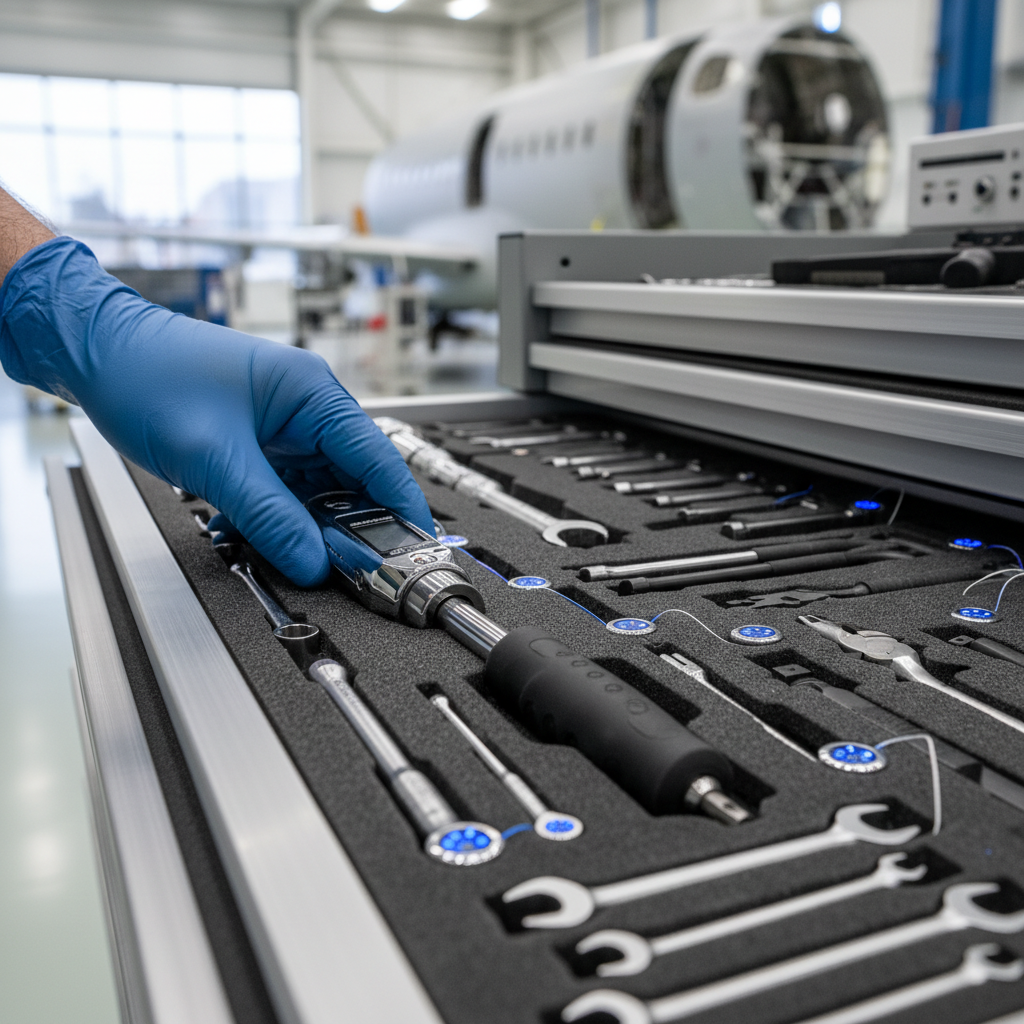
Physical accountability. Shadow boards, Consolidated Tool Kits (CTKs), foam inserts, Master Inventory Lists. Every tool has a home. Every home is visually obvious when something is missing. NASA’s Policy 221-13 codifies the baseline: etching, color coding, bar codes, shadow boards, tool tags, and designated monitors per tool category. The cheapest layer, still the most widely deployed.
Digital tracking. RFID tags, BLE beacons, UWB positioning systems, and barcode/RFID hybrids layered on top of the physical system. A technician walks through a gate; the system knows what left the tool room and what didn’t come back. This is where passive check-and-count becomes active, real-time visibility.
Presetting and tool management software. In CNC environments, presetters measure tools off-machine, feed geometry data into controllers, and eliminate the setup time that once consumed spindle uptime. Platforms like WinTool, CribMaster, and Zoller’s zidCode connect the tool room to CAM, ERP, and CNC workflows in a single digital record.
Condition monitoring. The newest layer. Sensors (force, vibration, acoustic emission, spindle current) paired with machine-learning models that predict tool wear in real time. Digital twins mirror the geometry and stress state of the physical tool. Published research reports prediction accuracies above 97%. The practical impact: replacing conservative fixed-life replacement intervals with condition-based decisions, so tools get used to their actual limit instead of being pulled early as insurance.
Most tool-control breakdowns happen not because one layer is absent, but because the layers aren’t connected. A perfect shadow board means nothing if the digital system doesn’t flag that a wrench moved from Bay 3 to Bay 7 and never returned.
The Standards That Make It Mandatory
Aerospace tool control is governed by a specific regulatory hierarchy. Every manufacturer and supplier in the chain must satisfy it.
AS9100 is the overarching aerospace Quality Management System. It requires documented provisions for preventing, detecting, and removing foreign objects.
AS9146 sits underneath, targeting FOD prevention directly. It mandates formal risk assessments, continuous-monitoring mechanisms, routine tool-and-part controls, and embedded personnel training. Boeing enforces AS9146 across its supply chain alongside NAS 412 and the IAQG Supply Chain Management Handbook Section 3.4.
AS9102 governs First Article Inspection, verifying the first part from any new tool or setup against design specifications before production continues. Nadcap accredits special processes (heat treatment, welding, NDT, coatings) and is mandatory for suppliers to Airbus, Boeing, Rolls-Royce, and Honeywell.
On paper, the stack is thorough. In practice, it creates a documentation burden that paper-based systems struggle to carry under production pressure. That gap between what auditors expect and what the shop floor can produce in real time is exactly where compliance failures take root.
What It Costs When Tools Go Unaccounted
Alaska Airlines Flight 1282 deserves a detailed look, because it illustrates systemic failure, not a one-off incident.
The NTSB timeline: Spirit AeroSystems completed final closure of the left mid-exit door plug on July 28, 2023. The fuselage shipped to Boeing on August 20 and arrived at the Renton facility on August 31. Boeing initiated its Shipside Action Tracker on September 1. At some point in that handover, four bolts (including vertical movement arrestor bolts and the forward upper guide track bolt) were removed and never reinstalled. Spirit’s production records failed to capture torque-wrench serial numbers. At Renton, insulation blankets were installed before the “OK to Install Blankets” step was completed. The plug was closed during a second shift with no authorized door-team members present.
The warning signs were not new. Internal Boeing audits between 2018 and 2024 had repeatedly flagged unauthorized part removals and ineffective part control. A November 2021 audit cited insufficient review of work instructions. An October 2023 audit, three months before the blowout, cited missing removal records. Those findings sat unresolved.
Consequences: a six-week FAA audit in March 2024 faulted both companies. Boeing completed its $8.3 billion acquisition of Spirit AeroSystems in December 2025, explicitly to absorb the supplier and bring quality control back in-house.
At the macro level, the numbers are equally blunt. The U.S. Air Force recorded roughly 800 FOD events between 1995 and 2004, costing about $240 million at an average of $300,000 per event. U.S. commercial airlines spend an estimated $26 per flight in direct FOD repair and $312 per flight in indirect costs from delays and gate returns. Multiply across hundreds of thousands of annual flights, and the math explains the $4 billion floor.
The Concorde disaster of July 2000, where runway debris killed 113 people, remains the textbook historical case. But Alaska Airlines 1282 matters more for this discussion. It happened inside the factory, caused by bolts removed and never put back, with paper-based records that failed to catch the gap. That is a tool-control failure, not a runway hazard.
From Shadow Boards to UWB: How Tracking Methods Compare
Tool tracking in aerospace has evolved from visual to wireless. Each method has a real use case. The right choice depends on facility scale, tool value, and regulatory exposure.
| Method | How It Works | Effective Range | Best For | Key Limitation |
|---|---|---|---|---|
| Shadow boards / foam inserts | Visual outline; missing tool is immediately obvious | Line-of-sight, single station | Small kits, point-of-use carts | No digital record, no alerts, no audit trail |
| Barcode | Printed label scanned at check-in/check-out | Inches (line-of-sight) | Tool cribs with controlled access | Manual scanning required; labels degrade in harsh conditions |
| Passive RFID | Tag powered by reader signal at choke points | Up to ~30 ft | Tool-room exits, automated inventory audits | No continuous location data; short read range |
| BLE (Bluetooth Low Energy) | Battery-powered beacon broadcasts continuously | Up to ~300 ft | Real-time location across large floors (25,000+ sq ft) | Battery replacement cycle; higher per-unit cost |
| UWB (Ultra-Wideband) | Time-of-flight signals for precise indoor positioning | Centimeter-level accuracy | High-value jigs, fixtures, calibrated instruments | Most expensive infrastructure; dense anchor network needed |
In practice, aerospace facilities increasingly combine technologies. The Airbus A320 final assembly line in Tianjin runs passive RFID: PICO Mini tags on individual tools, on-metal labels on toolsets, and washable tags on consumables like rags and gloves. That handles tool-room accountability—the foundation of aerospace production asset monitoring.
For broader visibility, Airbus deployed BLE-based IoT tracking across European production sites to follow jigs and transport fixtures, reporting near 100% uninterrupted asset-journey data and locating misplaced tools in minutes instead of hours. This exemplifies digital tracking for aircraft manufacturing plants at enterprise scale.
The pattern is clear. RFID handles the tool crib and choke-point scanning. BLE or UWB handles shop-wide, real-time location. They solve different problems. The mistake is treating them as either/or when hybrid deployments outperform both.
Where the ROI Shows Up
Tooling runs between 3% and 6% of top-line revenue in most manufacturing. In aerospace, with titanium and Inconel workpieces, that percentage runs higher. The good news: documented upgrades consistently pay back within 12 months.
Korin Iron Works installed a Zoller venturion presetter for manufacturing turbine blades. Setup time dropped 70% across roughly 150 tools measured per month. Axial deviation held at 5 micrometers. Defective products per month fell to zero. Average monthly savings exceeded €20,000 for nearly a year.
Applied Engineering, a tier-2 aerospace shop, moved from mechanical collet toolholding to Haimer shrink-fit. Tool life jumped from 80 parts to over 600 parts per spindle. The $40,000 annual spend on replacement holders disappeared. Scrap was halved. Full payback under one year.
Allied Mechanical deployed CribMaster automated inventory management and reported $40,000 per month in tooling cost savings through automated tracking and reorder logic.
On the tracking side, Airbus facilities running BLE across European sites reported locating displaced jigs in minutes instead of the hours manual searches required. Across hundreds of tool movements per shift, that search-time overhead compounds into real operational dollars.
At the OEM level, GE Aerospace committed $1 billion to U.S. manufacturing investment for 2026, including over $100 million earmarked specifically for external-supplier tooling and equipment. A prime OEM is now directly funding tool upgrades at its own supply base, because supplier tool-quality gaps have become a direct threat to production schedules and airworthiness.
The Floor-Level Problem Nobody Writes About
Here is what the vendor brochures skip: the best tracking system in the world fails if the people on the floor won’t use it.
I’ve watched this pattern across industries. A company installs a new system, runs a two-hour training session, then wonders why adoption stalls at 40% three months later. The issue is almost never the technology. It’s the friction the technology introduces.
A passive RFID cabinet that scans everything automatically when the door closes adds zero work to a technician’s routine. That gets adopted. A barcode scanner that requires each tool to be individually waved past a reader before shift handoff adds 10 minutes. That gets resisted. Shortcuts emerge. The audit trail develops gaps that look exactly like the ones Boeing’s internal auditors flagged year after year.
Three things separate successful deployments from expensive shelf-ware:
- Reduce steps, don’t add them. Bulk-read RFID and BLE beacons that need no manual interaction will always outperform systems that demand constant scanning.
- Make the benefit visible to the user, not just management. A technician adopts a system that finds a missing torque wrench in 30 seconds. That same technician resists a system that only produces compliance reports for the quality office.
- Train in context, not in a conference room. Lockheed Martin’s FOD prevention program states that “FOD prevention is everyone’s responsibility.” True. But responsibility without practical workflow integration is a poster on a wall.
A $200,000 tracking deployment used at 40% capacity delivers less value than a $50,000 system used at 95%.
Where Tool Control Is Heading
Three shifts are converging to reshape this space over the next 12 to 24 months.
AI-driven wear prediction is leaving the lab. Machine-learning models using sensor fusion (force, vibration, acoustic emission, spindle current) now achieve wear-prediction accuracies above 97% in published research. The practical outcome: condition-based tool replacement instead of conservative fixed-interval swaps. For shops running expensive PCD and carbide tooling on nickel superalloys, this stretches tool life without raising the risk of catastrophic in-cut failure.
Lights-out machining demands full automation of accountability. Acutec Precision Aerospace runs a 24/7 lights-out facility with lean cells, automated tool handling, and in-machine inspection. That model only works when tool tracking is fully automated. There is no operator to verify a shadow board at 3 AM.
Digital tracking is moving from passive to active. The trajectory: passive RFID for tool cribs, BLE and UWB for real-time shop-floor location, hybrid deployments for facilities that need both. Deloitte’s 2026 aerospace outlook describes the industry entering “a new phase of expansion driven by advancements in AI, digital sustainment, and increasing” capital investment. The infrastructure choices made today determine whether the next wave of capability drops into place or requires another costly retrofit.
If your tool and asset fleet goes invisible the moment it leaves the tool room, that is the gap real-time tracking closes. It is the connective layer we build at Datanet, helping aerospace and industrial operations move from periodic manual counts to continuous, automated asset visibility. If your operation could use that kind of upgrade, reach out or explore the tracking hardware we integrate.

Frequently Asked Questions
What does tool control mean in aerospace manufacturing?
Tool control refers to the programs, technologies, and standards that account for every tool, consumable, jig, and fastener throughout production and maintenance. It operates across four layers: physical accountability (shadow boards, CTKs), digital tracking (RFID, BLE, UWB), tool presetting and management software, and cutting-tool condition monitoring using sensors and AI models.
Which standards govern aerospace tool control?
The primary standards are AS9100 (aerospace QMS), AS9146 (FOD prevention program), AS9102 (First Article Inspection), and Nadcap (special-process accreditation). Boeing additionally requires NAS 412 and IAQG SCMH Section 3.4. NASA operations follow Policy 221-13 for tool accountability.
How much does FOD cost the aerospace industry?
Estimates range from $4 billion to $22.7 billion globally per year in combined direct and indirect losses. Tools and equipment cause roughly 19% of FOD reports. U.S. commercial airlines average about $26 per flight in direct repair costs and $312 per flight in indirect costs from delays and disruptions.
What is the difference between RFID, BLE, and UWB for tool tracking?
Passive RFID is lowest-cost with short read range, suited for tool cribs and choke-point scanning. BLE uses battery-powered beacons for continuous real-time tracking across large areas (25,000+ sq ft). UWB provides centimeter-level indoor positioning at the highest infrastructure cost. Most aerospace facilities now deploy hybrid setups combining two or more.
What ROI can I expect from tool control upgrades?
Published cases show payback periods under 12 months. Korin Iron Works saved over €20,000/month with a Zoller presetter. Applied Engineering extended tool life from 80 to 600+ parts with shrink-fit holders. Allied Mechanical reported $40,000/month in savings with automated inventory management. Actual ROI depends on current losses, facility scale, and tooling spend.
How do I start digitizing tool control?
Map current losses first: tools replaced because they went missing, hours spent on manual shift-end counts, findings from your last AS9146 review. That data sets the baseline. Then evaluate whether your gap is tool-room accountability (RFID), shop-wide real-time location (BLE/UWB), or both. A phased hybrid approach typically delivers the best adoption curve and fastest return.







 +1 508 292 2210

2 Responses