

Unplanned downtime costs aerospace manufacturers more than $50 billion every year. Not from exotic failures. From the mundane kind: a missing calibrated wrench, a CNC machine nobody knew was degrading, a composite panel parked at the wrong staging area for 72 hours.
Aerospace production asset monitoring is supposed to fix this. The technology exists. The ROI math checks out. And yet, most plants I visit still rely on phone calls and tribal knowledge to find critical tooling on a million-square-foot production floor.
The gap isn’t technology. It’s how the technology gets deployed. Wrong tracking modality for the asset class. Alert systems that generate noise instead of signal. Rollouts that demand a full production stop nobody can afford. The difference between monitoring that pays for itself and monitoring that becomes expensive shelf-ware comes down to three decisions: technology selection, alert architecture, and deployment strategy.
What Production Asset Monitoring Actually Covers
Production asset monitoring is the continuous, sensor-driven tracking of physical assets across the manufacturing and MRO floor: tools, machines, jigs, fixtures, work-in-progress (WIP), ground support equipment, and components. It combines location data (where is it?) with condition data (what state is it in?) and utilization data (how is it being used?).
This is not the same as Aircraft Health Monitoring Systems (AHMS), which track airborne aircraft during flight operations using onboard sensors for structures, avionics, and engines. It’s also not shipment tracking, which ends when the package arrives. Production monitoring covers the full cycle: from receiving dock to assembly line to MRO bay and back again. The asset doesn’t stop being your problem at delivery. It loops.
The technology stack typically layers three things. Tracking hardware (RFID tags, BLE beacons, UWB anchors) for location. Condition sensors (vibration, temperature, pressure, acoustic) for equipment health. And a software layer that integrates this data with enterprise systems (MES, ERP, CMMS) so it reaches the people who can act on it. When any of these three layers is missing, you don’t have monitoring. You have data collection. The distinction matters more than most vendors will admit.
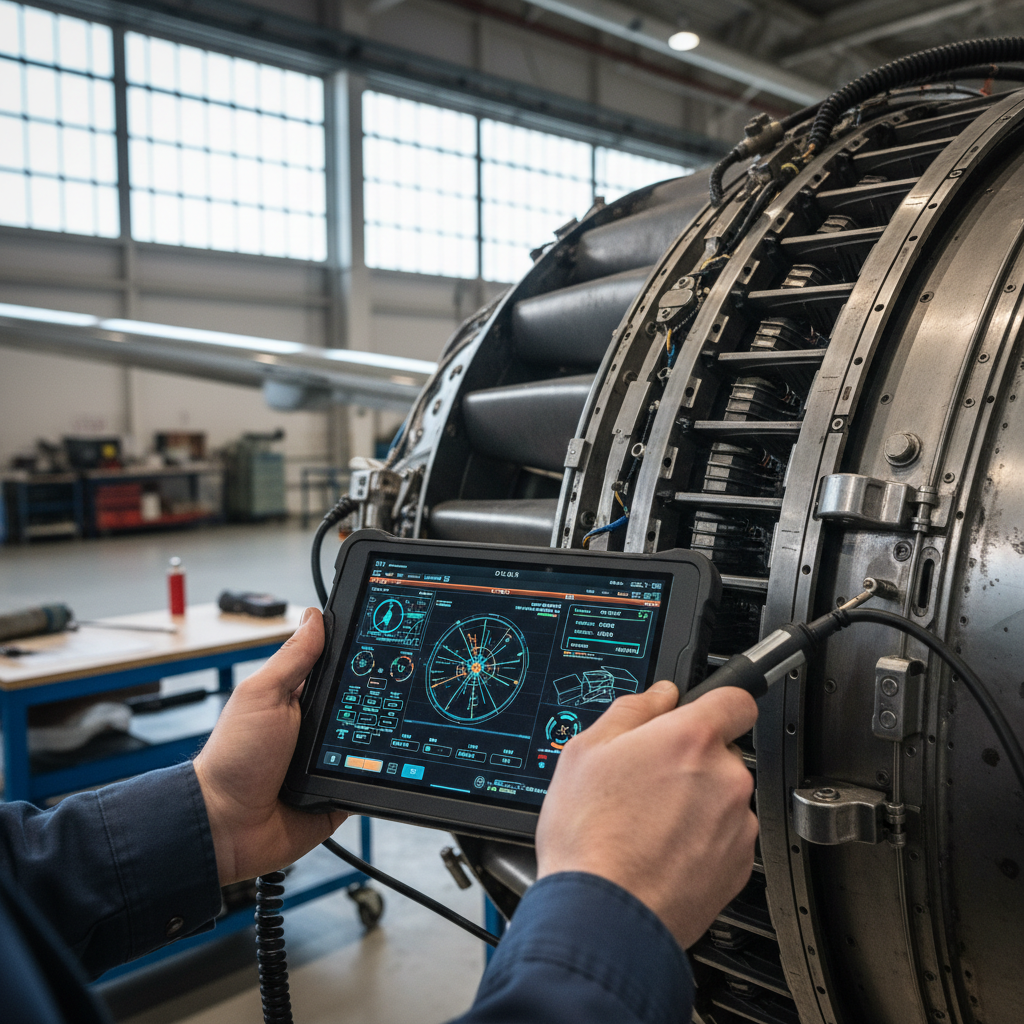
Choosing a Tracking Technology Before Your Vendor Chooses for You
Three technologies dominate asset location tracking on aerospace production floors. Each solves a different problem, and deploying the wrong one for the wrong asset class is the single most common mistake in failed implementations.
| Technology | Accuracy | Tag Cost | Battery | Infrastructure Cost | Best For |
|---|---|---|---|---|---|
| Passive RFID | 1–3 m | $0.05-$0.50 | None | Low (readers only) | High-volume WIP, consumables |
| BLE | 1–5 m | $5-$30 | 18-24 months | Medium (gateways) | Mid-value tooling, continuous location |
| UWB | 10–30 cm | $10-$50+ | Months to years | High (3-5x RFID) | High-value precision instruments |
RFID requires fixed readers or handheld scanners with zero per-tag power cost, which makes it the default for tracking thousands of components and WIP items. BLE delivers continuous real-time location updates at moderate cost, ideal for tooling that moves between work cells. UWB provides centimeter-level accuracy but at 3-5x the infrastructure investment.
The mistake: treating this as an either/or decision. Most effective deployments layer all three. RFID for volume. BLE for mid-range visibility. UWB for the $40,000 calibrated instruments where centimeter precision justifies the cost.
Beyond location, condition monitoring sensors (vibration, temperature, pressure, acoustic emission) track equipment health in real time. Piezoelectric sensors monitor assembly quality during riveting and joining operations. Data flows through edge gateways for pre-processing, then via lightweight protocols like MQTT into cloud platforms (AWS IoT, Azure, ThingWorx, MindSphere) for advanced analytics. The integration point that most deployments get wrong: this data must flow bidirectionally into your MES, ERP, and CMMS. A sensor that talks to a dashboard but doesn’t trigger a work order in your maintenance system is a toy, not a tool.
The Numbers Behind Real Deployments
The predictive maintenance market hit $14.09 billion in 2025 with a 34.14% CAGR. That growth rate is not hype. It’s being pulled by results like these.
RTX connected tens of thousands of shop floor machines across approximately 60 factories representing over 75% of its total production. At Collins Aerospace’s Kilkeel plant in Ireland, combining sensor data streams with simulation modeling identified bottlenecks that freed 4,000 square feet of floor space and reduced overall production time. AI analysis on 50 million hours of Pratt & Whitney GTF engine data optimized MRO parts allocation and maintenance scheduling. Their Chief Digital Officer’s operating principle: “Value beats volume every time.” Twenty high-impact AI initiatives that scale beat two hundred that nibble.
Airbus uses IoT-based tracking to monitor nearly 100% of its manufacturing assets as they move between production sites in France, Germany, the UK, and beyond. In assembly plants exceeding one million square feet, finding a specific production asset without IoT would be a daily exercise in frustration. Airbus decided it wouldn’t be.
A leading aerospace manufacturer deployed LeanDNA’s supply chain analytics and achieved $20 million in savings within 90 days through inventory reductions and efficiency improvements. The program started at a single site, then expanded. The savings came not from predictive maintenance but from inventory optimization: knowing what you have, where it is, and what you actually need.
And then there’s the European aircraft component supplier that only invested in monitoring after a catastrophic milling machine failure halted production entirely. Edge sensors connected via PLCs to a cloud analytics platform minimized future downtime risk. The pattern is universal: most organizations invest in production monitoring after absorbing the cost of not having it. The smart ones learn from someone else’s failure.
Across these cases, the outcomes are consistent: maintenance cost reductions of 10-40%, unplanned downtime cuts of 70-90%, cloud-based platforms reducing total cost of ownership by 30-50% versus on-premise builds.
The False Alarm Problem That Kills Monitoring Programs
AI/ML models now achieve 85-95% precision in predicting bearing, pump, and motor failures 30-60 days in advance. That sounds excellent until you do the math on the other side.
On a production floor monitoring 20,000 assets, even a 5% false positive rate generates hundreds of phantom alerts per day. Maintenance teams respond to the first wave. They start questioning the second. By month three, they’re ignoring genuine alerts along with the false ones. This is alarm fatigue, and it has killed more monitoring programs than budget cuts ever have.
Better algorithms alone won’t fix it. The fix is context-aware alerting. A vibration anomaly on a milling machine means something different during a roughing cycle than during finish machining. An alert at 2 AM on an idle machine doesn’t need the same escalation as the same reading during peak production. Risk-severity scoring, combined with operational context (is the asset in use? what’s its maintenance history? what’s the downstream production impact?), filters signal from noise.
If you’re evaluating a monitoring platform and nobody mentions false alarm management in the first conversation, walk away. The technology that generates the alert is only half the system. The other half is ensuring the right person sees the right alert at the right time, and trusts it enough to act.
Deploying Without Shutting Down the Line
The biggest myth in smart asset monitoring: you need a full production stop to install it.
You don’t. The approach that works is phased and layered. Start with passive RFID on high-volume WIP items. Tags cost pennies. Readers install without touching the production line. Data starts flowing within days, not months. Once you’ve demonstrated value (and earned buy-in from the floor), add BLE for tooling visibility. UWB comes last, targeted at the high-value assets where sub-meter precision justifies the infrastructure cost.
Subscription pricing has changed the economics entirely. At $50-100 per asset per month, a mid-tier aerospace supplier can pilot monitoring on 200 assets for under $20,000/month and hit positive ROI within 12-18 months. No capital expenditure. No multi-year lock-in. A test that either proves itself or gets cut.
The human factor matters more than technology vendors will admit. More than one-third of manufacturing executives say equipping workers with smart manufacturing skills is their top concern. A monitoring system your maintenance crew doesn’t understand, doesn’t trust, or wasn’t trained on will be circumvented within six months. Pair every technology deployment with structured upskilling. Not a two-hour webinar. Actual hands-on training. This is non-negotiable.
What’s Changing the Game Right Now
Edge AI is pulling inspection forward in the production sequence. Instead of catching defects after the fact, researchers are combining edge computing with machine learning to identify structural flaws in thermoplastic composites during manufacturing. No cloud round-trip latency. No post-process quality hold. Defects get caught as they form, before they’re embedded in a $500,000 airframe component.
Digital twins are crossing from visualization to prediction. The digital twin market reached $35.8 billion in 2025 and is on track to exceed $328 billion by 2033. In aerospace production, this means simulation engines that model the cascade effect of changing a maintenance window, rerouting a production sequence, or delaying a part delivery. Not a 3D rendering on a screen. A working model of your entire production system.
Agentic AI represents the next structural shift. The Deloitte 2026 manufacturing outlook identifies autonomous AI systems (ones that reason, plan, and act with human approval) as the frontier moving from pilot to production scale. Detect a bearing anomaly. Check parts inventory. Schedule replacement during the next planned downtime window. Generate the work order. All before a human opens a laptop.
Regulators are accelerating. The European Defence Agency launched a Prognostic Health Management project for aircraft batteries in early 2025. The Indian Air Force issued a call for collaboration on real-time in-flight health monitoring. These are signals that continuous asset monitoring is shifting from competitive advantage to compliance requirement. The organizations building monitoring infrastructure today won’t be scrambling to retrofit tomorrow.
Where This Leaves You
Aerospace production asset monitoring is not a technology problem. The sensors, platforms, and analytics exist at every price point. The problem is execution: picking the right technology for each asset class, building trust between your monitoring system and the people who act on its output, and deploying incrementally instead of demanding a production shutdown nobody can approve.
At Datanet, we build exactly these systems for aerospace and aviation operations, from DO-160 approved airfreight trackers to full asset tracking deployments across MRO facilities and production floors, including high-value cargo monitoring, offshore energy asset monitoring, and air cargo security monitoring for the assets you can’t afford to lose. If your production assets become invisible between the receiving dock and the assembly line, that’s the visibility gap we close. Talk to our team, or reach us directly at info@datanetiot.com.

Frequently Asked Questions
What is aerospace production asset monitoring?
It is the continuous, sensor-driven tracking of physical assets (tools, machines, jigs, WIP, ground equipment, components) across aerospace manufacturing and MRO floors. It combines location tracking (RFID, BLE, UWB), condition sensors (vibration, temperature, pressure), and software integration with MES, ERP, and CMMS systems to deliver real-time visibility and predictive maintenance insights.
How does it differ from Aircraft Health Monitoring Systems?
AHMS monitors aircraft systems during flight using onboard sensors for structures, avionics, and engines. Production asset monitoring focuses on the manufacturing floor, tracking tools, equipment, and components during production and MRO. They are complementary: production monitoring ensures assets are built and maintained correctly, AHMS monitors their performance in service.
What ROI can manufacturers realistically expect?
Plants deploying predictive monitoring report maintenance cost reductions of 10-40% and unplanned downtime cuts of 70-90%. Cloud-based platforms reduce total cost of ownership by 30-50% versus on-premise systems. One aerospace manufacturer saved $20 million in 90 days through analytics-driven inventory optimization alone.
Which tracking technology should I start with?
Passive RFID offers the lowest-risk entry point. Tags cost $0.05-$0.50, require no battery, and reader infrastructure is minimal. Layer BLE for mid-value tooling, then UWB for high-value precision assets. Starting with the technology that covers your highest-volume, lowest-risk assets builds organizational buy-in before scaling.
Can monitoring be deployed without stopping production?
Yes. Phased rollouts begin with passive RFID, which installs without touching the production line, then layer additional modalities as value is proven. Subscription pricing ($50-100 per asset per month) eliminates the capital expenditure barrier. Start small, prove ROI at one site, then expand.
What is the biggest risk in monitoring implementations?
Alarm fatigue. False positives erode operator trust, and within months maintenance teams begin ignoring alerts entirely, including genuine ones. Context-aware alerting with risk-severity scoring is the difference between a system the floor trusts and one they work around.







 +1 508 292 2210

6 Responses