

Earlier this year, maintenance crews in Sydney found a work light lodged inside the wing of a Qantas A380 after a round trip to Dallas. In a separate incident back in 2024, a 1.25-meter nylon turning tool sat inside another A380 engine for 34 flights and 293.74 flight hours before anyone found it.
Both times, EASA Part-145 tool control procedures were in place. Both times, they failed at the decisive moment: when someone needed to escalate a missing item and physically verify the aircraft before release.
If you manage tooling compliance at an approved maintenance organisation, these cases aren’t distant news. They’re the scenario that makes you recheck your MOE chapter at midnight. The regulation itself is fairly clear. Making your procedures survive a real shift, a real hangar, and a real audit is where the work actually lives.
What Part-145 Actually Requires for Tool Control
The legal framework sits in Commission Regulation (EU) No 1321/2014. Four provisions carry most of the weight. While EASA Part-145 governs European maintenance organisations, operators under different jurisdictions face parallel requirements—FAA tool control requirements establish similar accountability standards for U.S.-certificated repair stations.
145.A.40(a) says your organisation must have and use the tools and equipment needed for its approved scope. When maintenance data names a specific tool, you use that tool. If you want an alternative, your competent authority has to accept it. And if a tool is used so infrequently that permanent on-site availability isn’t justified, you document that exception in the MOE.
145.A.40(b) requires that appropriate tools, and especially test equipment, be controlled and calibrated to an officially recognised standard. Calibration intervals must preserve serviceability and accuracy. Records stay on file with traceability to the standard used.
145.A.48(c)(1) is the one that bites. After maintenance is complete, a general verification must confirm the aircraft or component is clear of tools, equipment, and extraneous parts or materials. This is a physical check. No dashboard replaces it.
145.A.70 brings it together: the Maintenance Organisation Exposition documents how you do all of this. Acceptance. Issue. User and location tracking. Calibration management. Return. Missing-tool escalation. Closeout.
Notice what’s absent from the regulation: RFID. Barcodes. Smart cabinets. Brand names. Part-145 is outcome-based. It tells you what to achieve. Your MOE tells the competent authority how you achieve it. Their assessment is whether your method actually delivers.
That flexibility is a strength. It’s also exactly where things start to break.
Two A380 Incidents That Prove Paper Compliance Isn’t Enough
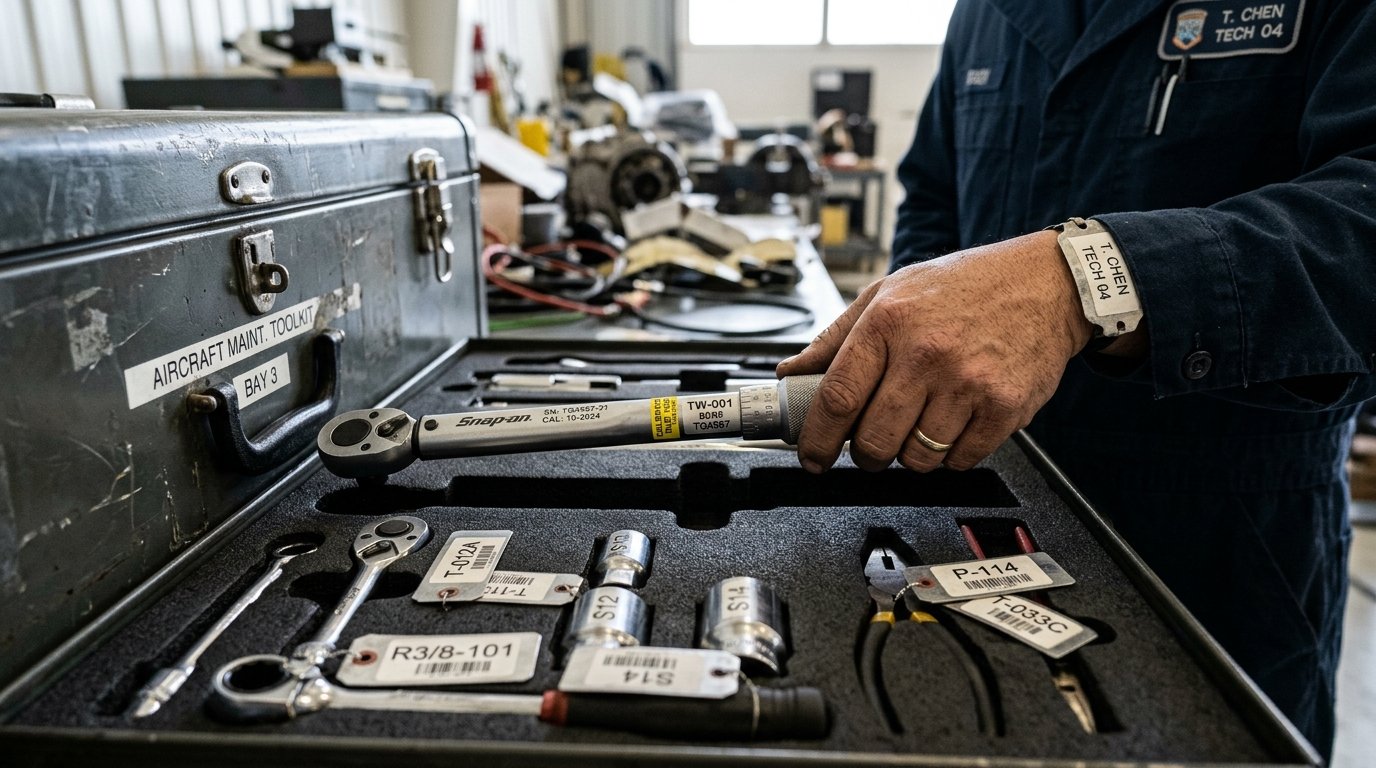
The ATSB investigation of Qantas A380 VH-OQI tells a specific, uncomfortable story. During a scheduled check at Los Angeles in December 2023, a nylon turning tool was used on the outboard left engine. After maintenance concluded, the tool wasn’t accounted for, the aircraft wasn’t searched, and the lost-tool procedure wasn’t initiated before release to service. The tool was found in the low-pressure compressor on January 1, 2024, after 34 cycles and 293.74 hours. No engine damage was reported. That was luck, not process.
The second case is fresher. On January 7, 2026, maintenance on VH-OQK’s air-conditioning system required access inside the left wing. A work light was left there. The aircraft flew to Dallas and back before the light was discovered on January 9 in Sydney. The ATSB found breakdowns in foreign-object control, tool accountability, and clearance inspections.
Two lessons matter here:
First, in both cases procedures existed. The failure wasn’t a missing rule. It was a missing action. Someone didn’t escalate. Someone didn’t search. Someone signed off a clearance that wasn’t actually clear.
Second, the work light wasn’t a numbered, calibrated tool. It was temporary equipment brought to the job for illumination. If your control boundary only covers what’s listed in the tool register, you’ve already created the gap that gets you in trouble.
Qantas responded to both incidents with safety directives and a dedicated tooling working group. These are Australian investigations, not EASA enforcement actions. But the maintenance-control lesson transfers directly to any Part-145 operation: the decisive safety barrier isn’t the register. It’s the physical verification, the escalation discipline, and the culture that treats a missing item as a stop-work condition.
So where, specifically, do auditors find the cracks? Let’s look at the technical details that generate the most findings.
Calibration, Alternatives, and the Details That Trip You Up
Not every tool needs calibration. Part-145 says tools and equipment should be calibrated “as appropriate,” with specific emphasis on test equipment. A standard wrench used for general fastening typically doesn’t need a calibration certificate. A torque wrench does. A multimeter does. The distinction comes from whether the tool’s measurement function affects the airworthiness determination.
Where organisations get caught is at the edges. Three areas generate the most audit findings I see discussed across the industry:
Interval management. Calibration intervals must preserve accuracy and serviceability. That means the interval should reflect the tool’s usage, environment, and manufacturer guidance. Not a blanket “12 months for everything.” An overdue calibration on a critical test instrument is a non-compliance. But so is a calibration program that can’t demonstrate how intervals were actually established.
Lab accreditation. Calibration must be traceable to an officially recognised standard. EASA’s foreign Part-145 tooling guide addresses the distinction between ILAC-accredited laboratories and non-accredited ones. Using a non-accredited lab isn’t automatically prohibited, but it requires the organisation to audit and validate that lab’s capability. That audit trail is where many come up short.
Alternative tools. When maintenance data calls for a specific tool, you can use an alternative only with competent authority acceptance. EASA guidance is clear that a supplier’s own equivalency statement doesn’t automatically count, especially when the supplier isn’t the OEM that wrote the maintenance data. You need a defined technical specification, an incoming acceptance process, and a validation or equivalence assessment. Skip any step, and the auditor flags it.
These requirements are well documented. The real challenge is building them into a workflow that people actually follow at 2 AM during an AOG event. That’s where the MOE chapter becomes the instrument that matters most.
Writing the MOE Chapter That Actually Controls Tools
The MOE is where regulation meets the hangar floor. UK CAA’s CAP2375 exposition guidance provides a solid framework: cover acceptance, calibration, staff distribution, return, and verification that the aircraft or component is clear of tools after maintenance.
In practice, your tool control chapter should address these operational steps as a minimum:
- Incoming acceptance and validation for new, replacement, leased, or borrowed tools
- Tool identification method (serial number, barcode, RFID tag, or otherwise)
- Issue and return protocol, covering who, when, and where
- User and location tracking across shifts and work packages
- Calibration status management, including due-date alerts and quarantine for overdue items
- Missing-tool escalation procedure with defined stop-work triggers
- Post-maintenance general verification (the 145.A.48 physical check)
- Record retention: minimum three years after the tool or equipment is withdrawn from service, per EASA guidance
Two elements deserve more attention than they usually get.
The first is scope of controlled items. If your procedure covers only numbered tools in the main store but ignores work lights, inspection mirrors, borescopes brought from personal kits, or tooling leased for a single job, you have blind spots. The Qantas work-light case is a direct example of this gap.
The second is escalation authority. A missing-tool report that sits in a queue while someone releases the aircraft defeats the entire system. Your procedure should specify who can authorise release when a tool is unaccounted for. Ideally: no one, until the item is found or the aircraft is physically verified clear. Make the escalation path short. Make the stop-work trigger explicit. And make sure it applies on night shifts and weekends, not just during business hours.
Once your MOE chapter defines the process, the question becomes: what technology (if any) supports it reliably?
Technology Options: From Clipboard to RFID
I’ve walked through hangars where organisations invested heavily in RFID cabinets but still had no reliable way to account for temporary equipment at the aircraft. The cabinet knew what left the store. Nobody knew what entered the wing. That’s the core tension when choosing a technology layer for tool control.
Here’s an honest comparison of what’s available:
| Approach | What it does | Strengths | Limitations |
|---|---|---|---|
| Manual issue/return log | Paper or spreadsheet records custody by name, date, and work order | Low cost, no infrastructure, works offline | Depends entirely on disciplined entries; audit coverage is sporadic; no real-time visibility |
| Barcode/QR scan | Scans create digital transaction records for each checkout and return | Simple digital trail, low per-unit cost | Requires every handoff to be scanned; no continuous location; line-of-sight required |
| Passive RFID smart cabinet | Cabinet readers identify tagged tools at a fixed issue/return point | Automates store-level reconciliation; fast inventory counts | Only covers the cabinet boundary; doesn’t track tools at the aircraft |
| Mobile RFID trolley | Portable reader identifies tagged tools in the hangar, linked to user and work order | Extends identification to the work area; supports hangar-side reconciliation | Read performance varies in metal-rich environments; requires deployment discipline |
| Tagless digital systems | Vendor-specific approaches claiming tool tracking without physical tags | No retrofit of individual tools; potentially faster onboarding | Detection method and coverage limits need independent validation; fewer field-proven references |
None of these replaces the 145.A.48 physical verification. A smart cabinet confirms what left the store. It does not confirm what entered the aircraft. A mobile RFID trolley gets closer, but it still relies on someone deploying it, configuring it correctly, and acting on the exceptions it flags.
The practical decision isn’t “which technology is best.” It’s which combination matches your tool volume, hangar layout, shift patterns, and risk profile. A small component shop with 200 controlled tools and a single issue point may get reliable results from a well-managed sign-out sheet and a disciplined kit check. A multi-building facility with 60,000+ tools is a fundamentally different problem.
Whatever you choose, test it under real conditions. Vendor claims about “virtually eliminating FOD” or reducing tool loss by 30-40% are marketing numbers, not independent validations. Run a pilot with your actual tools, your metal-heavy environment, your shift handovers, and your exception workflow. Measure what actually matters: unreturned-tool detection rate, time to resolve a missing item, false-positive rate, and whether the system changes the release decision when it should.
If you’re evaluating digital systems now, there’s a compliance dimension from this year that most organisations are still catching up with.
Part-IS: The Cybersecurity Layer That Took Effect in 2026
Regulation (EU) 2023/203, known as Part-IS, applied from February 22, 2026, to most Part-145 maintenance organisations. It requires identifying and managing information-security risks with potential aviation-safety impact, detecting relevant events, and maintaining response and recovery capabilities.
If your tool control system runs on networked readers, cloud dashboards, mobile apps, or connects to your MRO database, Part-IS applies to it. Data integrity, access control, system availability, and recovery planning are now compliance requirements, not optional features.
This doesn’t mean you should avoid digital tooling systems. It means you should plan for them properly. Include your tool-control IT in your information-security risk assessment. Define what happens when the system goes down during a check (manual fallback procedures belong in the MOE). And make sure your vendor can answer specific questions about data storage, access controls, and failover, not just walk you through a feature list.
Between Part-145 and Part-IS, the picture is now complete: control the tools, verify the aircraft, and secure the systems that support both. The question is how to put all of these layers together in a way that actually works under operational pressure.
Building a Tool Control System That Survives Audit Night and Third Shift
The strongest tool control implementations I’ve seen share a common structure: they’re layered. No single barrier carries the full load.
Map tools to tasks. Start from your approved scope and maintenance data. Identify which tools require calibration, which are task-specific, which are general purpose, and which temporary items (lights, mirrors, stands) should enter the controlled boundary. If you don’t know what should be tracked, no technology helps.
Define custody end-to-end. From incoming acceptance through issue, use, return, and closeout, every tool should have a documented chain of custody. Leased and borrowed tools get the same treatment as owned ones. EASA’s tooling guide calls for identifying permanently available versus leased or loaned items and controlling both.
Set hard escalation triggers. A missing tool is a stop-work event until the aircraft is physically verified clear. No exceptions. No “we’ll check it in the morning.” The Qantas investigations are case studies in what happens when escalation is deferred.
Automate where risk and volume justify it. If your calibration register has 500 items and due dates are managed in a spreadsheet, an automated alert system isn’t gold-plating. It’s basic risk management. If your hangar processes 40 tool checkouts per shift, digital reconciliation pays for itself in time savings alone.
Keep the physical check independent. Whatever digital system you deploy, the 145.A.48 general verification stays manual and visual. This is your last line of defense. Never let a dashboard green light replace it.
The MRO industry is spending north of $139 billion globally in 2026, with engine turnaround times stretching past 180 days and material costs climbing nearly 10% year over year. In that environment, losing a tool isn’t just a compliance issue. It’s a production issue. Every hour spent searching for an unaccounted item is an hour an aircraft sits.
At Datanet, we work with airlines, MRO providers, and aviation operators on asset tracking solutions that bring real-time visibility to equipment across facilities and operations. If your tool accountability process has gaps that a tracking layer could close, talk to our team. We’ll tell you honestly whether our solutions fit your problem.
Frequently Asked Questions
Does EASA Part-145 require RFID for tool control?
No. Part-145 is outcome-based and does not prescribe any specific technology. The organisation chooses its method, documents it in the MOE, and demonstrates to the competent authority that it achieves reliable tool accountability, calibration control, and post-maintenance verification.
Which Part-145 clauses cover tool control?
The primary provisions are 145.A.40(a) for tool availability and acceptable alternatives, 145.A.40(b) for calibration and traceability, 145.A.48(c)(1) for post-maintenance clearance verification, and 145.A.70 for the MOE procedures that document how it all works in practice.
Does every hand tool need calibration under Part-145?
No. Calibration applies “as appropriate,” particularly to test equipment whose measurement function affects airworthiness. A standard wrench typically doesn’t need calibration. A torque wrench or multimeter does. The organisation must document which items require calibration and how intervals are determined.
Can I use an alternative to the OEM-specified tool?
Yes, with competent authority acceptance. EASA guidance requires a defined technical specification, incoming acceptance, and an equivalence assessment. A supplier’s own equivalency claim is not automatically sufficient, especially when that supplier isn’t the OEM responsible for the maintenance data.
What should happen when a tool goes missing during maintenance?
Follow the approved missing-tool procedure. Prevent release until the aircraft or component is physically verified clear. Search the affected area. Document the outcome. Report through internal safety channels. The Qantas A380 investigations demonstrate that deferring escalation is the highest-risk failure mode in tool control.
Does Part-IS affect digital tool control systems?
If your tool control system uses networked readers, cloud platforms, mobile apps, or connects to maintenance databases, yes. Part-IS (Regulation 2023/203), effective February 2026, requires managing information-security risks with potential aviation-safety impact. That includes availability, access control, and data integrity for those systems.







 +1 508 292 2210

3 Responses