

In late 2023, mechanics in Los Angeles left a 1.25-meter nylon turning tool inside the engine of a Qantas A380. Nobody started the lost-tool procedure. The aircraft flew 34 cycles and 294 flight hours before anyone found it, wedged against low-pressure compressor vanes. That story, detailed in a 2024 ATSB investigation report, is what happens when tool accountability breaks down. Not because someone forgot to buy an RFID system. Because the process meant to prove custody never triggered.
Tool accountability is the discipline of proving, at any point, where a tool is, who has it, and whether it came back in acceptable condition. If you manage MRO operations, run a tool crib, oversee quality in manufacturing, or coordinate construction crews, this is the concept separating a minor paperwork gap from an engine teardown, a grounded aircraft, or a six-figure replacement cycle.
Here is what tool accountability means in practice, where programs fail, and what actually closes the gap.
Tool Accountability vs. Tool Control: The Distinction That Matters
People use these terms interchangeably. They shouldn’t.
Tool accountability is the ability to prove which tools an organization owns, where each one is, who has custody, whether its use is authorized, and whether it was returned or formally transferred. It goes beyond knowing a tool was purchased. It follows the tool from issue through return, documenting every handoff and exception along the way.
Tool control is the daily procedure that makes accountability possible: marking tools, issuing them, returning them, reconciling at shift end. Operational guides draw the same line. Control is the action. Accountability is the evidence the action happened. You can have a written control procedure and still fail an accountability audit if nobody recorded the handoffs.
Tool management is broader still: procurement, calibration, repair, replacement, lifecycle cost. Think of it as three layers. Management sets the inventory. Control moves items in and out. Accountability proves the chain of custody at every step.
When someone searches “what is tool accountability,” they usually need the middle layer. Not “do we own this wrench?” but “who had it last, where is it now, and can we prove it?”
That proof becomes non-negotiable when the consequence of a missing tool isn’t a purchase order. It’s a foreign object inside a turbine.
When Accountability Breaks Down, Engines Break Too
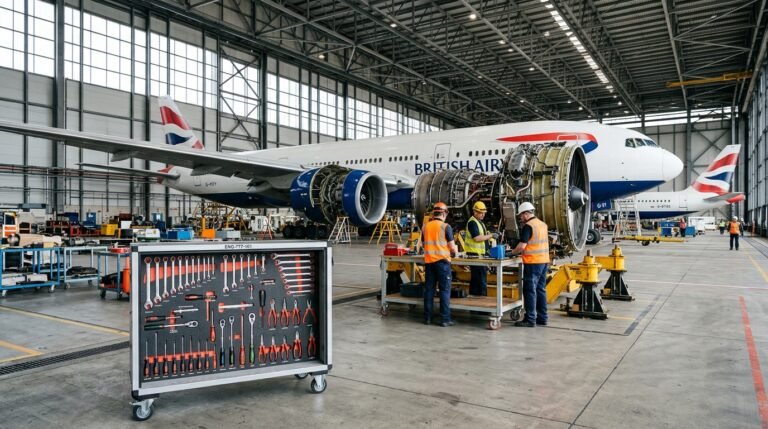
Foreign Object Debris (FOD) is the term aviation uses for anything that doesn’t belong in, on, or near an aircraft. A forgotten wrench. A loose bolt. A screwdriver tip that snapped and nobody noticed.
The A380 case is not an outlier. In October 2020, a Jetstar A320 departing Brisbane experienced engine power loss and a rejected takeoff after a replaceable screwdriver tip, left during maintenance, entered the high-pressure compressor and damaged rotor blades and stator vanes. ATSB Director Stuart Macleod pointed out the obvious: tool control matters even for seemingly insignificant components. A one-dollar screwdriver bit did what years of deferred maintenance couldn’t.
The regulatory framework reflects the stakes. NASA’s FOD prevention standard requires an accountability system for tools, small parts, and consumables in defined work areas. The NTSB’s safety alert on controlling FOD recommends inventorying tools before aircraft work and accounting for every item afterward. The FAA’s advisory circular on airport FOD management calls for proper control, accountability, and care of all maintenance items, down to nuts, bolts, washers, and safety wire.
This year, the Department of the Air Force issued updated guidance (DAFI 21-101, March 2026) that explicitly addresses maintaining tool accountability and control when tools transfer between individuals. For federal contractors, FAR 52.245-1 requires complete, auditable records of Government property accountable to a contract, including physical inventories.
Outside regulated environments, the costs are financial rather than catastrophic, but still material. TrueLook and Noonlight reported 2,639 confirmed break-ins across monitored U.S. construction sites in 2025, a 50% increase from the prior year. That is site-security data, not a full census of tool theft. But the signal is clear: unaccounted tools are easier to lose, easier to steal, and harder to replace because nobody notices they are gone until someone needs them.
So what does a program that actually prevents these failures look like on the inside?
Anatomy of a Tool Accountability Program
Whether you are running an MRO hangar or a 200-person construction site, the structure is the same. The rigor scales with risk. Five elements separate a real program from a binder on a shelf.
The first is a defined boundary. Accountability starts with a perimeter: a tool crib, a maintenance bay, a jobsite, a vehicle. You cannot account for tools if you have not defined where they are supposed to be.
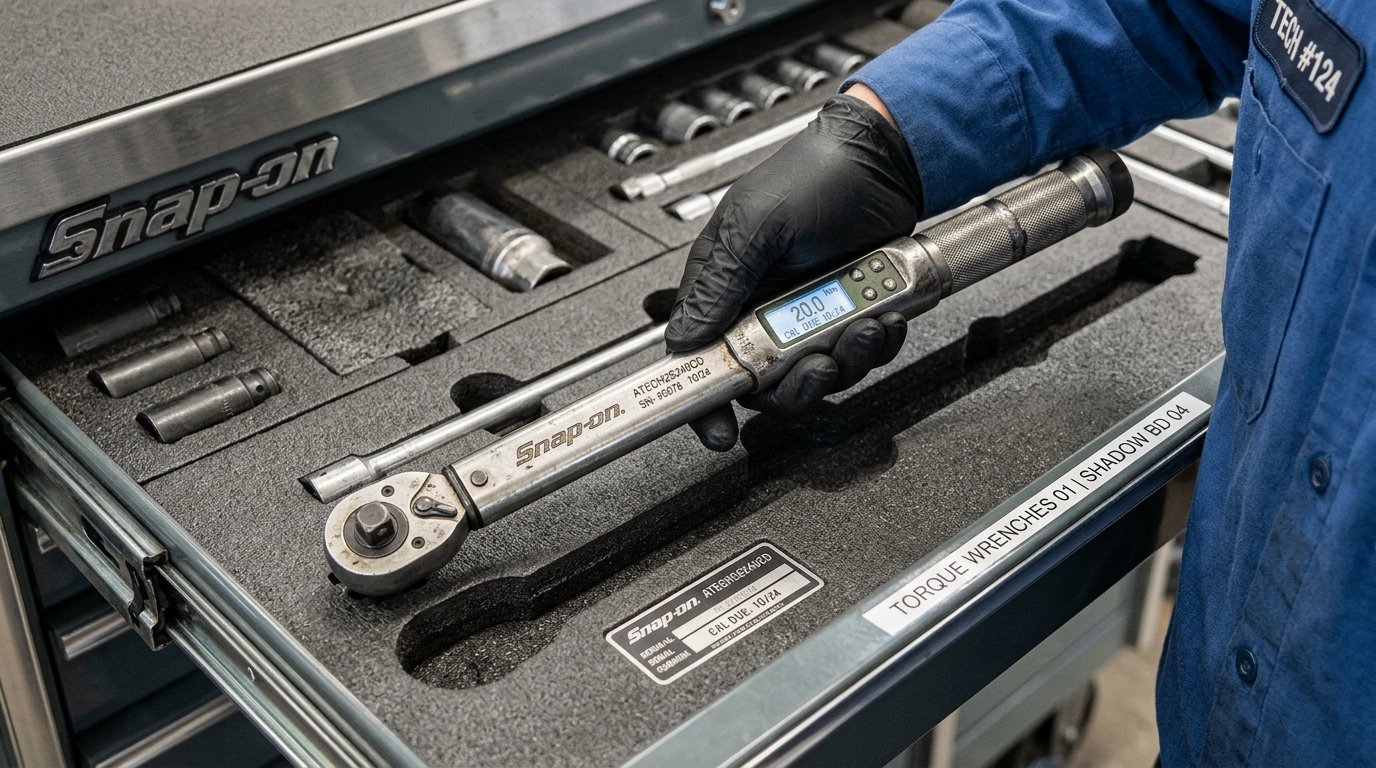
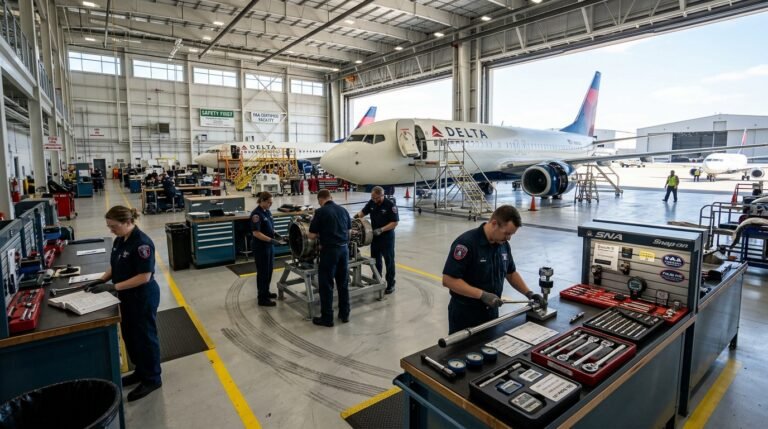
The second is a complete, identified inventory. Every tool gets a unique identifier (etching, barcode, RFID tag, whatever fits the environment). Shadow boards and foam inserts work for fixed stations. The point is that you can tell, visually or digitally, which specific tool is present or missing.
The third, and where most programs fail, is a named custodian for every handoff. The tool leaves the crib, it is “checked out.” But who has it? If it passes from one technician to another mid-shift, is that transfer recorded? The Air Force’s 2026 guidance memo flags tool transfers between individuals as a control point for good reason. If your system does not capture custodian changes, you have inventory management, not accountability.
The fourth is time-stamped issue, return, and condition records. When did it leave? When did it come back? In what condition? Is calibration current? These records turn accountability from a concept into evidence. During an audit or incident investigation, “we think Dave had it” is not a record.
The fifth is an exception process with teeth. When a tool is missing during aircraft maintenance, it is not a note for tomorrow’s shift. It is a work stoppage. The A380 flew 294 hours because the lost-tool procedure was not started before the aircraft was released. For safety-critical operations, an unresolved tool discrepancy must be a release gate, not an optional follow-up.
All five elements still need something to execute them reliably at scale. That is where technology enters, but with a caveat worth repeating until it sticks.
Technology Enables Accountability. It Does Not Create It.
I see this confusion constantly. Organizations buy RFID cabinets, Bluetooth tags, or GPS trackers and assume the accountability problem is solved. It is not. A tag can record that a tool left a drawer. It cannot ensure a technician logged a handoff to a colleague, started a missing-tool search, or cleared a work area before sign-off.
That said, the right technology dramatically reduces friction and human error. Here is what each approach actually does, and where it stops:
| Approach | What it records | Best fit | Where it stops |
|---|---|---|---|
| Paper log / shadow board | Visual presence, manual issue/return | Fixed tool stations, small kits | Depends entirely on staff discipline; no automatic alert if someone skips the log |
| Barcode scanning | Tool identity, check-in/check-out timestamp | Tool rooms, cribs, structured environments | Requires a deliberate scan at each event; misses informal handoffs |
| RFID (passive or active) | Bulk inventory, proximity detection | Hangars, warehouses, mobile gang boxes | An early comparison study found only a possible time advantage over barcode, not a proven universal result |
| Bluetooth / BLE | Last-known location, crowdsourced finding | Distributed crews, field service, jobsites | Not continuous real-time for every item; range-limited; depends on device density |
| GPS / cellular | Location of larger equipment, movement history | Heavy equipment, mobile toolboxes, fleet assets | Overkill for small hand tools; battery life and per-unit cost limit scale |
| Automated crib / vending | Authenticated access, transaction records per item | Consumables, controlled supplies, calibrated instruments | Records dispensing but not what happens after the tool leaves the crib |
The practical choice depends on what you are preventing. Aviation FOD prevention needs item-level reconciliation before aircraft release. A construction megaproject needs crew-to-crew handoff tracking across multiple trailers. A manufacturing tool crib needs controlled dispensing and calibration compliance. A United Rentals case study from a $5.8 billion project describes a mechanical subcontractor achieving 0% tool loss using barcode-based personal accountability combined with Bluetooth location tracking. That is a vendor-reported result tied to a managed service and a specific site, not a universal guarantee. But it shows what is possible when custody records and technology work together.
Federal contractors managing Government property follow yet another path: FAR 52.245-1 requires auditable records for receipt, issue, use, and periodic physical inventory. The obligation applies to covered contract property, not every privately owned hand tool, but the evidence standard is high.
Across all of these environments, the pattern converges: tags identify items, software records custody, and physical procedures close the loop when something is missing. No single sensor replaces the exception process. And when the exception process itself is weak, that is where the real breakdowns happen.
Where Programs Fail (and the Question Nobody Asks)
Three failure modes appear repeatedly in incident reports and field experience.
Schedule pressure overrides process. The A380 case is the textbook: the lost-tool procedure existed. It just was not started before the aircraft was released. When production schedules collide with accountability, accountability loses every time, unless the organization makes the exception process a hard gate. Not a recommendation. A gate.
Technology without workflow. Deploying RFID tags on 10,000 tools and calling it “accountability” is like installing smoke detectors without an evacuation plan. The tag tells you a tool moved. It does not tell you the technician acknowledged the alert, searched the area, or escalated the discrepancy. Pilot your process and exception handling before scaling the technology.
Custody gaps at shift changes and crew transfers. A tool signed out to Crew A at 6 AM is used by Crew B at 2 PM. If the transfer is not recorded, neither the system nor the people know who is responsible. This is exactly the gap the Air Force’s March 2026 memo addresses.
And then there is a question most vendors will not raise: worker surveillance. A GAO review found that 33 stakeholders reported employers using digital-surveillance software to track worker locations, including geolocation in construction. A tool-location system that records which employee has which tool, plus their movement history, can easily become a worker-monitoring system. If you are deploying location technology, define its purpose, limit data access, set retention periods, and tell workers what is being captured. Separating tool-recovery data from performance monitoring is not just good ethics. In many jurisdictions, it is becoming law.
So with these failure points mapped, the question becomes practical: how do you build a program that actually holds up?
Building Your Program: Risk First, Tags Second
Start with risk classification, not technology selection.
Classify every tool category by four factors: safety criticality (can it cause FOD or injury if lost?), replacement cost, mobility (does it stay at a station or travel across sites?), and loss exposure (how often does it go missing today?). That classification determines the control level.
- High safety, high mobility (aircraft maintenance tools, calibrated instruments): item-level custody, pre- and post-task reconciliation, automated identification, mandatory lost-tool escalation before aircraft release.
- High value, moderate mobility (power tools, specialized equipment): assigned custodian, check-in/check-out with barcode or RFID, periodic physical inventory.
- Low value, high turnover (consumables, commodity hand tools): controlled dispensing or supervised access, aggregate inventory checks, replenishment triggers.
- Low risk, stationary (shop-floor fixtures, bench tools): shadow board or visual management, periodic count.
Then measure your baseline before buying anything. How many tools went missing last quarter? How much time do technicians spend searching? How many calibration lapses occurred? What did replacement cost? Without a baseline, you cannot distinguish a useful improvement from a vendor’s optimistic case study.
When you are ready for technology, match it to the custody event you need to capture. For tool rooms: barcode or RFID with structured check-in/check-out. For distributed crews: mobile inventory apps with Bluetooth tags. For heavy equipment and high-value mobile assets: GPS-cellular trackers built for industrial environments. For aviation tooling moving between hangars and line stations: ruggedized devices with the certifications your operation requires, such as DO-160 approved trackers designed for air transport environments.
Three outcomes a well-built program should deliver within the first operating year:
- A measurable drop in missing-tool incidents, because reconciliation gates catch discrepancies before they become safety events.
- Reduced technician search time, because location technology eliminates the “walk around and ask” cycle that eats 10 to 20 percent of a technician’s shift in poorly managed environments.
- Lower replacement and procurement costs, because captured custody transfers expose where tools actually disappear, rather than just when someone notices.
The goal is not tracking everything all the time. It is risk-tiered accountability: the right level of visibility at each point where custody changes or a tool could be lost.
From Tool Crib to Full Asset Visibility
Tool accountability is, at its core, a subset of a larger operational question: do you know where your physical assets are across their full lifecycle?
The same principle that applies to a torque wrench in a maintenance bay applies to a ULD on a ramp, a container at a port, or a ground support cart between flights. The question is always the same: who has custody, where is it, and can you prove it?
At Datanet, this is what we do. We design and deploy IoT-based asset tracking systems for aviation, MRO, logistics, and industrial operations. If your tool accountability challenge extends beyond the tool crib (into fleet equipment, containers, or reusable assets that cross organizational boundaries) that is a conversation worth having.
Frequently Asked Questions
What does tool accountability mean in simple terms?
Tool accountability means being able to prove which tools you have, where each one is, who has custody, and whether it was returned in acceptable condition. It is the evidence layer on top of tool control, documenting every handoff and exception rather than just counting inventory.
Is tool accountability the same as tool control?
No. Tool control is the daily practice of marking, issuing, returning, and counting tools. Accountability is the documented proof that control procedures were followed: who had the tool, when, where, and whether it came back. You can have control procedures on paper and still lack accountability if handoffs go unrecorded.
Is there a law requiring every employer to track tools?
There is no single universal tool-tracking law. Requirements depend on your industry, operation, and contracts. FAA and NASA guidance governs FOD-sensitive aviation environments. Military instructions cover Department of Defense maintenance. FAR 52.245-1 applies to Government property on federal contracts. Employers should identify the specific regulations and contract clauses that apply to their operations.
What should happen when a tool goes missing during aircraft maintenance?
Treat it as an unresolved safety discrepancy. Stop affected work, initiate the lost-tool procedure, search the work area systematically, escalate per your approved process, and do not release the aircraft while the discrepancy remains open. The ATSB’s A380 investigation shows the consequence of skipping this step.
Which tracking technology is best for tool accountability?
No single technology wins in every scenario. Barcodes and RFID work well for structured tool rooms. Bluetooth tags suit distributed field crews. GPS-cellular trackers fit high-value mobile equipment. Automated cribs handle consumables. Choose based on the custody event you need to capture, item value, operating environment, and how much friction your workers will tolerate.
How do you measure whether a tool accountability program works?
Track missing-tool incidents and resolution time, replacement costs, technician search time, unrecorded handoffs, calibration compliance rates, and audit findings. Compare these metrics against your pre-implementation baseline. Vendor case studies are useful references, but your own data is the only reliable measure of your program’s performance.




 +1 508 292 2210