
Here’s a number that should make any aviation logistics or MRO director pause: cargo theft losses hit nearly USD $725 million in 2025, with the average value per incident jumping 36% year-over-year to $273,990. Now consider that a single CFM56 engine is worth $10–15 million. If you’re responsible for tracking high-value aviation assets — engines, APUs, landing gear, GSE, or flight-critical LRUs — the question isn’t whether you need visibility. It’s whether what you have today actually gives you visibility at all.
Most organizations confuse shipment tracking with asset tracking. They know where a crate is until it’s delivered. After that? Silence. The asset enters a black hole of MRO shops, lease pools, storage facilities, and transit corridors — invisible until someone physically scans it or, worse, discovers it’s missing.
This article breaks down the full landscape: regulatory forces reshaping in-flight tracking, the technologies that matter on the ground, the security threats that compromise both, and the operational gap that costs operators millions every year.
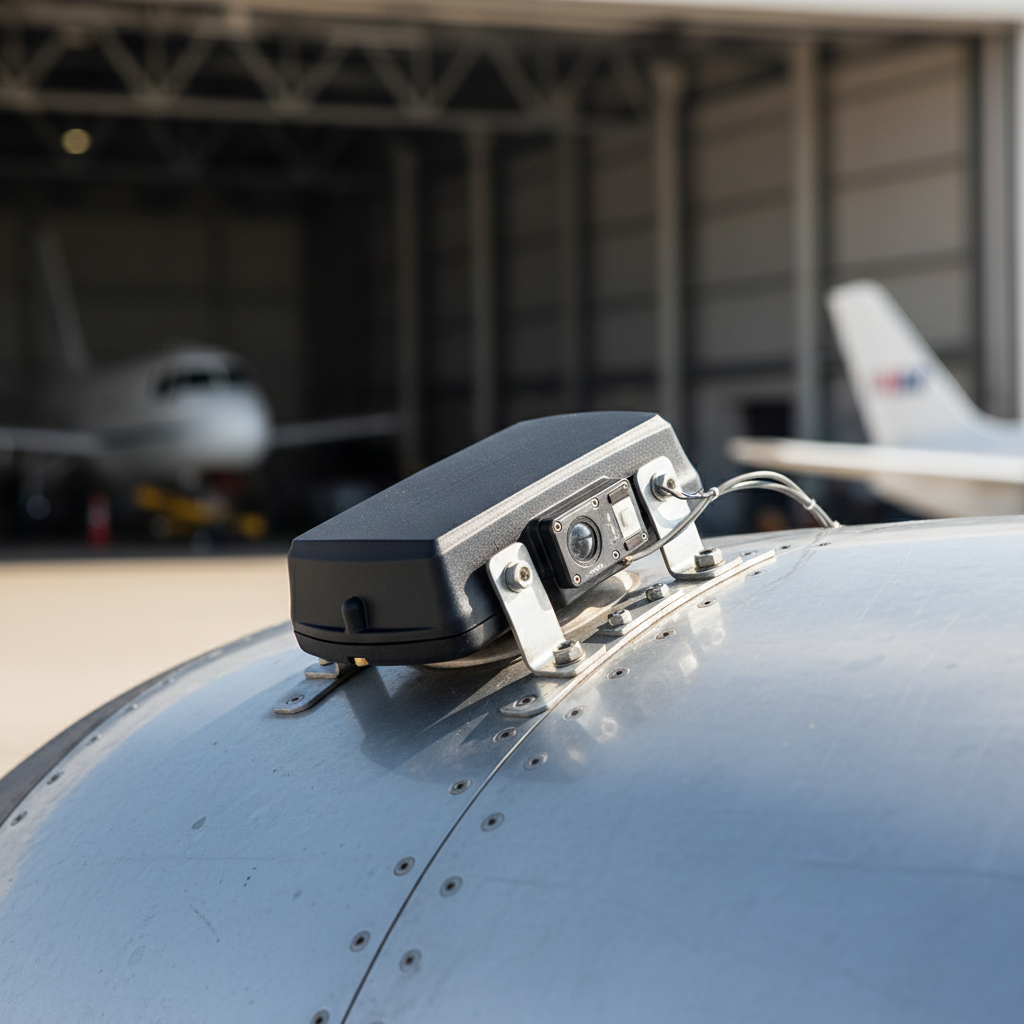
Two Distinct Tracking Problems, One Industry
When we say “tracking high-value aviation assets,” we’re actually addressing two fundamentally different challenges:
1. In-Flight Position Tracking
Real-time monitoring of an aircraft’s latitude, longitude, and altitude for safety, ATC situational awareness, and search-and-rescue. This is the domain of ADS-B, SATCOM, and regulatory frameworks like ICAO’s GADSS.
2. Lifecycle Asset Tracking
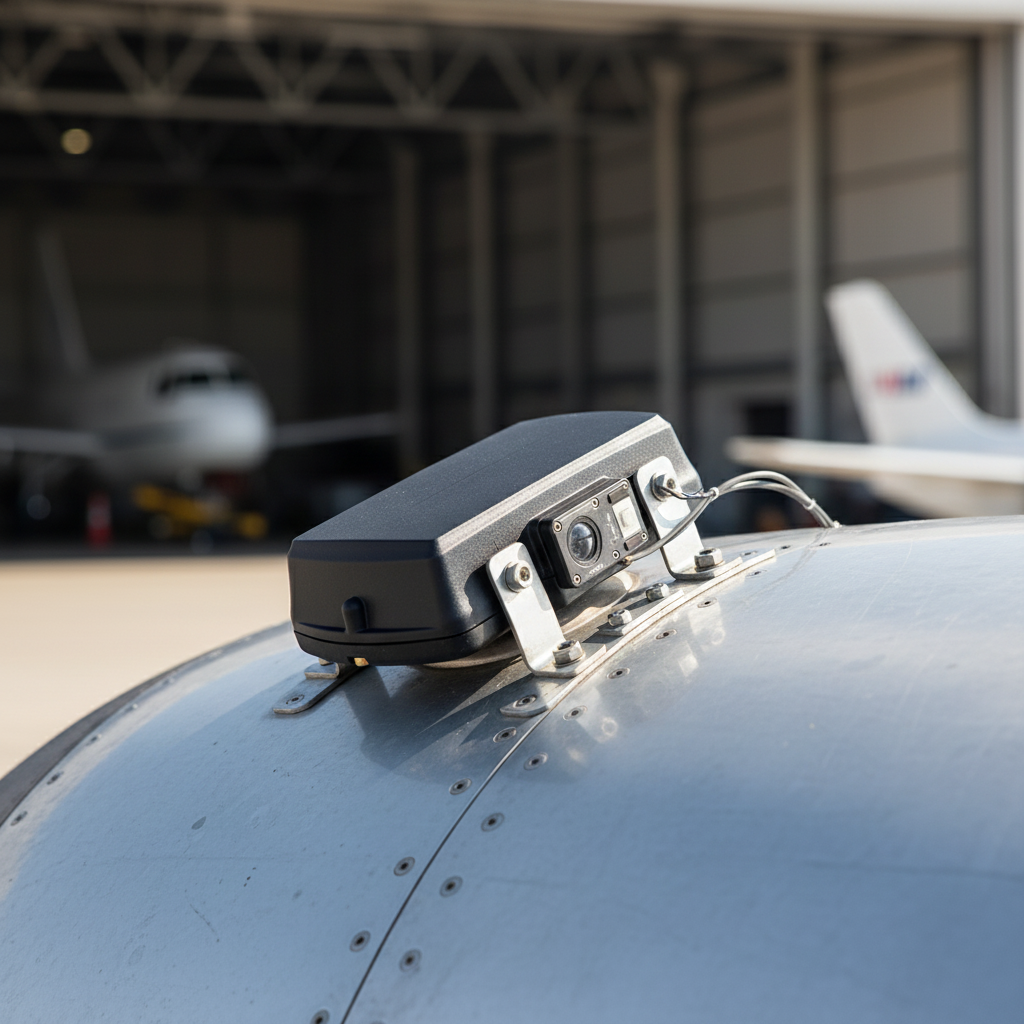
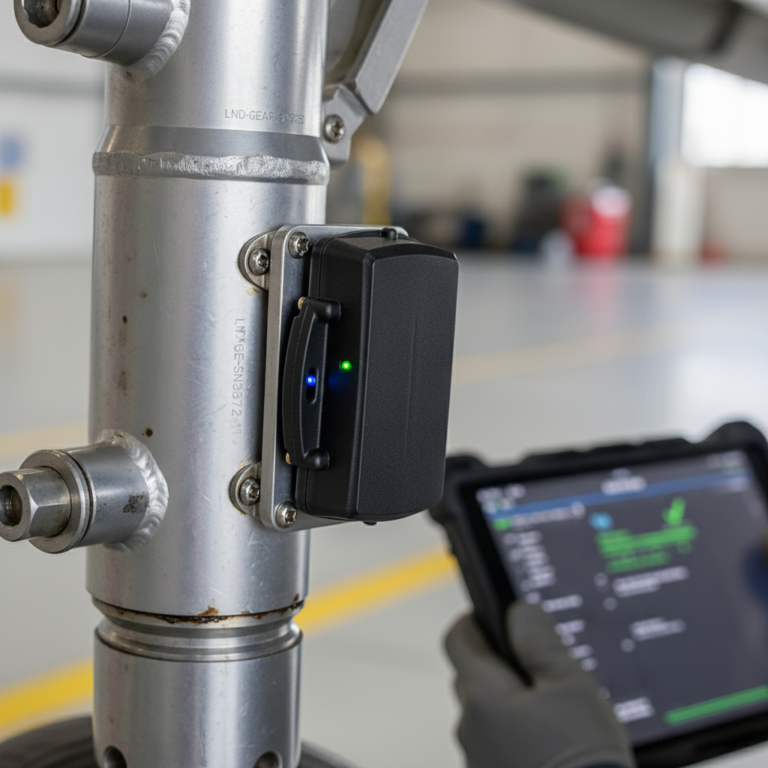
Monitoring the location, custody, and status of components and equipment throughout their entire lifecycle — from active service through MRO, lease transitions, storage, transit, and eventual retirement. This is where IoT devices, RFID, cellular trackers, and integration with ERP/MRO platforms come in.
The top-ranking content on this topic tends to focus on one or the other. The reality is that operators need both — and the gap between them is where assets disappear, fraud happens, and operational dollars evaporate.
The Regulatory Shift: GADSS and the 2025 Mandate
The disappearance of Malaysia Airlines Flight MH370 in 2014 wasn’t just a tragedy — it was a systemic indictment. The world’s aviation infrastructure could not locate a Boeing 777 carrying 239 people. That failure catalyzed ICAO’s Global Aeronautical Distress and Safety System (GADSS), the framework that now defines how aircraft must be tracked.
The critical mandate: as of January 1, 2025, newly manufactured aircraft over 27,000 kg must autonomously transmit their position at least once per minute when in distress — without pilot intervention. This Autonomous Distress Tracking (ADT) requirement means the aircraft reports itself even if main electrical systems fail.
Compliance pathways include distress-tracking emergency locator transmitters (ELT-DTs), automatic deployable flight recorders (ADFRs), and high-rate SATCOM streaming. But here’s the reality check: this mandate covers new aircraft. Retrofit obligations differ between EASA and the FAA — and the existing fleet remains largely dependent on older surveillance methods.
EU vs. US: Different Compliance Paths
EASA has codified GADSS into binding EU law. The FAA has filed for differences, arguing its existing infrastructure — radar, ground-based ADS-B, and space-based ADS-B — already provides adequate coverage. The practical result: operators flying transatlantic routes must navigate two overlapping but non-identical regulatory regimes.
In-Flight Tracking Technologies: What Actually Works
Space-Based ADS-B
The most significant leap in aircraft surveillance. Receivers hosted on Iridium’s LEO satellite constellation capture 1090 MHz ADS-B Out broadcasts directly from aircraft transponders — even over oceans and polar regions where no ground station exists. Median detection rates: approximately once every 2 seconds. Latency from satellite to ground: under 400 milliseconds. Global availability: over 99%.
This is what enables services like Aireon ALERT, which has assisted in over 100 search-and-rescue requests since 2019, narrowing search areas from thousands of square kilometers to as little as 1–2 km².
The Vulnerability Nobody Wants to Discuss
Standard ADS-B messages are unauthenticated and unencrypted. And because the position data originates from onboard GNSS, the entire system is vulnerable to jamming and spoofing. This isn’t theoretical. According to an IATA report cited by the FAA, the rate of GNSS signal loss per 1,000 flights increased 65% in H1 2024 compared to H1 2023.
Hotspots: Eastern Mediterranean, Black Sea, Baltic region, India-Pakistan border. Spoofing can create ghost aircraft or cause real aircraft to broadcast false positions. The mitigation playbook — multi-constellation/dual-frequency receivers, RAIM/ARAIM, inertial aiding, cross-validation with radar — adds layers but doesn’t eliminate the fundamental vulnerability of an open protocol.
On the Ground: Where Most Asset Value Actually Lives
Here’s the uncomfortable truth the in-flight tracking conversation misses: most of an aviation asset’s life isn’t spent in the air. Engines sit in MRO queues. Landing gear rotates through lease pools. APUs transit between continents on flatbeds. GSE moves across ramps and between airports.
This is where the shipment tracking vs. asset tracking distinction matters most.
Shipment Tracking: The Job Ends at Delivery
A freight forwarder’s tracking number tells you the crate arrived. It doesn’t tell you where the engine stand sits six weeks later, whether it’s been moved without authorization, or how long it dwelled at a customs facility.
Asset Tracking: Visibility Through the Full Cycle
True asset tracking follows the component through every custody handoff, every storage location, every return trip. It measures dwell time, cycle time, and utilization. Modern aircraft equipment location tracking integrates with AMOS, TRAX, or Maximo so your MRO system reflects reality — not the last manual scan from three weeks ago.
Technology Stack for Ground-Based Aviation Asset Tracking
| Technology | Best For | Accuracy | Battery Life | Limitation |
|---|---|---|---|---|
| Passive RFID | Warehouse inventory, tool control, kitting | Read/no-read (proximity) | N/A (passive) | No real-time location; requires manual scan or fixed gates |
| BLE Beacons | Indoor zone-level tracking, MRO shop floors | 3–5 meters | 1–3 years | Limited range; requires beacon infrastructure |
| Cellular IoT (LTE-M/NB-IoT + GNSS) | Long-distance transit, engine stands, GSE across airports | 3–5 meters (outdoor GNSS) | Multi-year (10+ years possible with adaptive duty cycles) | Cellular coverage dependent; reduced accuracy indoors |
| Satellite IoT | Ocean transit, remote/off-grid locations | 10–50 meters | 1–5 years | Higher cost per message; latency |
The practical answer for most aviation asset tracking programs is a hybrid stack: RFID at fixed points (receiving docks, tool cribs), BLE for shop-floor awareness, and cellular IoT trackers for anything that leaves your four walls.
The Fraud and Theft Dimension
If you think tracking is just about operational efficiency, consider two recent cases that changed the industry’s risk calculus:
AOG Technics Parts Fraud (2019–2023)
A London-based broker distributed thousands of CFM56 engine components with forged documentation. Aircraft were grounded. Network-wide inspections followed. The founder was convicted and sentenced in 2026. The failure: inadequate verification of parts provenance at custody handoffs.
Spain Turbofan Parts Theft (January 2026)
Twelve containers — over 600 turbofan parts for CFM56, V2500, PW1100G, and RB211 engines — were stolen by thieves impersonating the contracted disposal provider. EASA issued an emergency alert declaring all parts unapproved and ineligible for installation.
Both cases share a common thread: the chain of custody broke because no continuous, independent tracking existed on the assets themselves. Paper documentation was either forged or insufficient. A $2 tracker on each container would have flagged the diversion in minutes.
Five Myths About Aviation Asset Tracking
Myth 1: “Our ERP already tracks everything.”
Reality: Your ERP tracks what humans enter. If nobody scans, nobody updates. The system reflects intent, not reality. True asset tracking feeds your ERP automatically with location and status data — closing the gap between planned and actual.
Myth 2: “Tracking is too expensive for assets that aren’t engines.”
Reality: Cellular IoT trackers with multi-year battery life cost less than one hour of AOG downtime. If a $5,000 test bench disappears for three weeks because nobody knows which hangar it’s in, the search cost alone exceeds the tracker’s entire lifecycle price.
Myth 3: “We only need tracking during transit.”
Reality: Transit is when you’re most likely to have visibility — because the freight forwarder provides it. The gap hits after delivery, during storage, during MRO dwell, and during return. That’s where cycle time balloons and assets become invisible.
Myth 4: “RFID solves our problem.”
Reality: RFID solves the “is it here?” problem at a fixed read point. It does not solve the “where is it now?” problem between read points. For mobile, high-value assets, you need active tracking — not passive presence detection.
Myth 5: “Airfreight doesn’t allow trackers.”
Reality: Trackers certified to DO-160 environmental testing standards are explicitly approved for air transport. The regulatory path exists. The constraint is choosing the right hardware — not a blanket prohibition.
Three Outcomes That Justify the Investment
- Cycle time reduction of 15–30%: When you can see where every reusable container, engine stand, and tooling kit sits in real time, you stop over-purchasing to compensate for invisible inventory. Assets return faster because you know when they’re idle.
- Fraud and theft prevention: Continuous, independent location data creates an unforgeable custody record. If an asset deviates from its planned route — like those 12 containers in Spain — alerts fire immediately, not weeks later.
- MRO integration that reflects reality: When your tracker feeds position and status directly into AMOS, TRAX, or Maximo via API, your maintenance planning operates on ground truth instead of hopeful estimates.
What to Look for in an Aviation Asset Tracking Solution
Not all trackers or platforms are built for aviation’s unique demands. Here’s what separates purpose-built solutions from generic fleet management:
- DO-160 certification for devices that fly with the asset (airfreight-approved)
- Multi-year battery life with adaptive reporting — high frequency during transit, low power during storage
- Global cellular + GNSS coverage for cross-border, multi-region operations
- Open APIs that integrate with MRO/ERP platforms without custom middleware
- Geofence and motion alerts that trigger on unauthorized movement, not just scheduled check-ins
- Scalability from 50 assets to 50,000 without platform re-architecture
The Market Is Growing — Is Your Visibility Keeping Pace?
The global aviation asset management market reached USD $273 billion in 2025 and is projected to hit $465 billion by 2034 at a 6.08% CAGR, according to Fortune Business Insights. The specific asset tracking technology segment is growing even faster — nearly 15% CAGR — driven by exactly the fraud, theft, and efficiency pressures described above.
Organizations that still rely on manual scans, paper-based custody logs, or “call the warehouse” as their tracking methodology aren’t just behind the technology curve. They’re exposed to the same risks that cost the industry hundreds of millions annually.
Closing the Gap
At Datanet IoT Solutions, we build asset tracking programs for aviation operators, MROs, and freight forwarders who need visibility beyond the delivery receipt. Our hardware portfolio — including DO-160-certified airfreight trackers and multi-year cellular devices from Digital Matter and Thingfox — pairs with integration support that connects real-time location data to your operational systems.
If your container pool, engine stands, or GSE fleet feels invisible after the freight forwarder’s job ends, that’s the gap asset tracking closes. We’d welcome the conversation — info@datanetiot.com.
Frequently Asked Questions
What qualifies as a “high-value aviation asset” for tracking purposes?
Any component or equipment with significant financial or operational criticality: complete aircraft, engines, APUs, landing gear, avionics LRUs, ground support equipment, engine transport stands, and high-value cargo like spare engines in transit. If losing visibility of it creates AOG risk or financial exposure, it qualifies.
What is GADSS and how does it affect aviation asset tracking?
GADSS (Global Aeronautical Distress and Safety System) is ICAO’s framework requiring newly manufactured large aircraft to autonomously transmit position at least once per minute during distress — effective January 2025. It addresses in-flight tracking gaps exposed by MH370 but does not cover ground-based component and equipment tracking.
Can IoT trackers legally be used on air cargo and airfreight shipments?
Yes, provided the device meets DO-160 environmental testing standards for airborne equipment. Certified trackers are approved for use during flight. Not all commercial trackers carry this certification — selecting DO-160-compliant hardware is essential for airfreight applications.
How does asset tracking differ from shipment tracking in aviation logistics?
Shipment tracking ends at delivery — it tells you the package arrived. Asset tracking follows the physical asset through its entire lifecycle: storage, MRO, lease transitions, reuse, and return. It measures dwell time, cycle time, and custody — giving visibility long after the freight forwarder’s job is done.
What is the biggest security threat to aviation tracking systems in 2025?
GNSS jamming and spoofing. Incidents rose 65% in H1 2024 versus H1 2023. Because ADS-B relies on unauthenticated GPS signals, spoofing can cause aircraft to broadcast false positions. For ground assets, cellular/GNSS trackers with multi-sensor validation and geofence alerting mitigate diversion risks.
What ROI can operators expect from implementing aviation asset tracking?
Typical outcomes include 15–30% reduction in asset cycle time, elimination of “lost” inventory requiring replacement purchases, immediate theft/diversion detection, and reduced manual labor for audits and searches. Payback periods are often under 6 months for high-value asset pools.






 +1 508 292 2210