
Tracking high-value aviation assets isn’t a single problem — it’s two distinct challenges that converge around one goal: knowing exactly where your most expensive equipment is, at all times. Whether that’s a commercial airliner crossing the Pacific or a CFM56 engine sitting on a transport stand in a logistics yard, the cost of losing visibility is measured in millions of dollars, regulatory penalties, and sometimes human lives. This guide covers both dimensions in depth: the technologies, the regulations shaping the field, the real-world failures that exposed systemic gaps, and the practical approaches that actually reduce risk.
What Counts as a “High-Value Aviation Asset”?
The term covers far more than complete aircraft. Here’s the full scope:
- Complete aircraft — commercial airliners, business jets, cargo freighters
- Engines and APUs (Auxiliary Power Units) — a single widebody engine can exceed $30 million
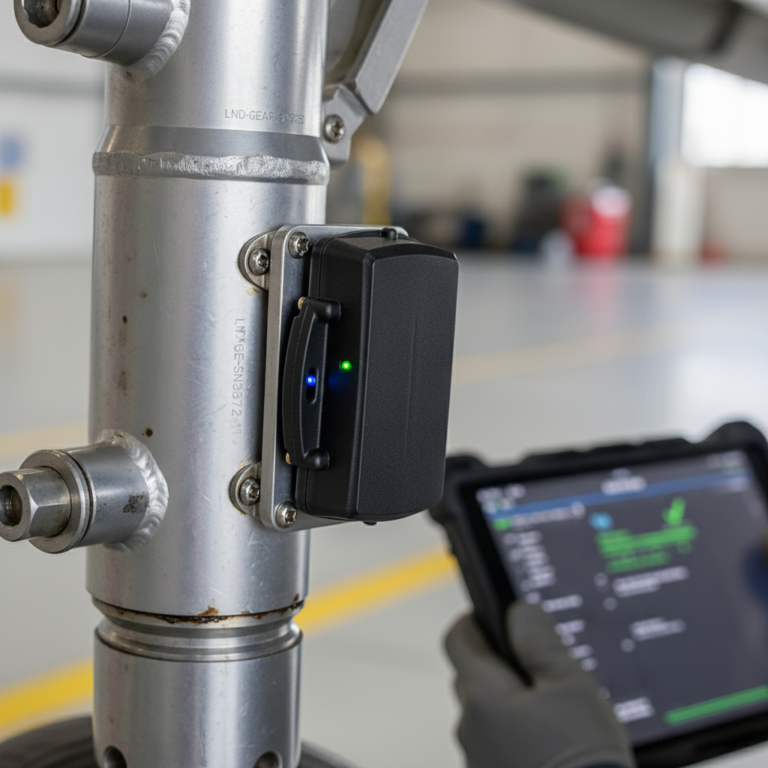
- Landing gear assemblies — complex, heavy, and worth millions per set
- Avionics and LRUs (Line-Replaceable Units) — expensive modular components swapped during maintenance
- Flight recorders — FDRs (Flight Data Recorders) and CVRs (Cockpit Voice Recorders)
- Ground Support Equipment (GSE) — tugs, loaders, power units, de-icing trucks
- High-value consignments — spare engines in transit, pharmaceuticals, and other premium cargo transported by air
Each category has different tracking requirements. An aircraft in flight demands real-time positional surveillance. An engine on a transport stand needs custody-chain verification and location monitoring across continents. The technology stack for each is fundamentally different.
Two Tracking Problems, One Industry
In-flight position tracking means monitoring an aircraft’s latitude, longitude, altitude, and time in real-time (or near-real-time) for air traffic control, safety, and search-and-rescue purposes. This is what regulators focus on when they write rules about aircraft tracking.
Inventory, custody, and logistics tracking means knowing where individual parts, engines, and equipment are throughout their lifecycle — from active service through MRO (Maintenance, Repair, and Overhaul) to end-of-life disposal. This is what operators and MROs focus on when they worry about theft, fraud, and compliance.
The top-ranking articles on this topic tend to cover one or the other. We’ll cover both, because in practice, the people responsible for aviation asset management deal with both problems simultaneously.
In-Flight Tracking: From Radar Gaps to Space-Based ADS-B
For decades, air traffic control relied on primary and secondary radar. The problem: radar can’t see over oceans, polar regions, or remote terrain. Aircraft crossing the Atlantic or Pacific were essentially invisible for hours at a time, tracked only by periodic voice reports from pilots.
ADS-B: The Foundation
ADS-B (Automatic Dependent Surveillance-Broadcast) changed the game. Aircraft equipped with ADS-B Out transponders continuously broadcast their GPS-derived position, altitude, speed, and identity on the 1090 MHz frequency. Ground stations receive these broadcasts and feed them to air traffic controllers.
The limitation: ground stations still only cover land and coastal areas. Oceans remained a blind spot.
Space-Based ADS-B: True Global Coverage
The breakthrough came with space-based ADS-B, most notably from Aireon, which hosts ADS-B receivers on Iridium’s constellation of 66 Low Earth Orbit (LEO) satellites. These receivers capture the same 1090 MHz signals that ground stations do — but from space, meaning they work everywhere on Earth.
The performance numbers are impressive:
- Update rate: approximately every 2 seconds, even over oceans
- Latency: less than 400 milliseconds from satellite to ground
- End-user latency: under 30 seconds for packaged data products
- Global availability: over 99%
This system requires no additional onboard hardware — it uses the aircraft’s existing ADS-B Out transponder. That’s a critical advantage, because retrofitting avionics is expensive and slow.
SATCOM and ADS-C
Satellite communication (SATCOM) provides another tracking layer. Systems from providers like Inmarsat enable ADS-C (Automatic Dependent Surveillance-Contract), where the aircraft transmits position reports at intervals agreed upon with ATC. Services like Inmarsat’s SwiftBroadband and Iris support safety-certified datalinks for messaging (CPDLC, ACARS) and position reporting.
Unlike ADS-B, which broadcasts openly, ADS-C messages are contract-based and directed to specific recipients, adding a layer of control over who receives the data.
GADSS: The Regulation That Changed Everything
On March 8, 2014, Malaysia Airlines Flight MH370 disappeared from radar over the South China Sea. The aircraft was never found through active tracking. The search lasted years, cost hundreds of millions of dollars, and ultimately failed to locate the main wreckage. It was the most dramatic demonstration of a systemic failure in global aviation: we didn’t have the ability to continuously track commercial aircraft everywhere on the planet.
The direct result was ICAO’s Global Aeronautical Distress and Safety System (GADSS), a comprehensive framework covering four functions:
- Aircraft tracking during normal operations — position reports at least every 15 minutes
- Autonomous Distress Tracking (ADT) — automatic position transmission at least once per minute during emergencies
- Post-flight localization — identifying accident sites quickly
- Timely recovery of flight recorder data
The 2025 ADT Mandate
The most consequential element is the ADT requirement, codified in ICAO Annex 6, Part I, Standard 6.18.1. As of January 1, 2025, all new aircraft over 27,000 kg (with an airworthiness certificate issued on or after January 1, 2024) must autonomously transmit position data at least once per minute when in distress — without pilot intervention.
The system must have its own independent power source, operating even if the aircraft’s main electrical systems fail. Compliance can be achieved through multiple technical paths:
- Distress-tracking Emergency Locator Transmitters (ELT-DTs)
- Automatic Deployable Flight Recorders (ADFRs)
- High-rate data streaming via SATCOM
EU vs. US: Different Approaches
EASA has closely aligned with ICAO, codifying GADSS requirements into EU law through Commission Implementing Regulation (EU) 2022/2203. The FAA has taken a different path, asserting that its existing surveillance infrastructure — radar, ground-based ADS-B, and space-based ADS-B — already provides adequate tracking capability. The FAA is still finalizing its rulemaking but has signaled it will accept EASA-approved installations as a valid compliance method.
For operators with mixed fleets registered in different jurisdictions, this divergence creates compliance complexity that needs careful management.
Eurocontrol’s Supporting Infrastructure
Eurocontrol supports GADSS through two key systems: the OPS CTRL Directory (a centralized database of airline emergency contacts for SAR services) and the LADR (Location of an Aircraft in Distress Repository), a secure repository for storing and sharing the last known position of aircraft in distress. An initial LADR prototype became operational in March 2024.
Ground-Based Tracking: IoT for Parts, Engines, and GSE
While in-flight tracking gets the headlines, the daily operational challenge for most aviation managers is knowing where their ground-based assets are — and proving chain of custody.
Technology Options
| Technology | Best For | Accuracy | Range | Battery Life |
|---|---|---|---|---|
| Passive RFID | Warehouse inventory, tool control, parts kitting | Gate-level (read zone) | Up to ~10 meters | No battery (powered by reader) |
| BLE (Bluetooth Low Energy) | Indoor asset location in MRO hangars | 1–3 meters | Up to ~100 meters | 1–5 years |
| UWB (Ultra-Wideband) | Precision indoor tracking (tool/part level) | 10–30 centimeters | Up to ~200 meters | Months to years |
| Cellular IoT (LTE-M, NB-IoT, 4G/5G + GNSS) | Mobile assets over long distances — engine stands, GSE, consignments in transit | 3–5 meters outdoors (GNSS) | Global (where cellular coverage exists) | Multi-year (10+ years possible with adaptive duty cycles) |
| Satellite IoT | Assets in remote areas without cellular coverage | Varies (GNSS-dependent) | Global | Variable |
The Integration Challenge
Hardware is only half the equation. The real value comes from integrating tracker data with enterprise systems — MRO platforms like AMOS, TRAX eMRO, or IBM Maximo, and ERP systems that manage procurement, finance, and logistics.
Modern IoT platforms handle this through REST APIs, webhooks, and SFTP data transfers. A middleware or visibility platform normalizes telemetry data from different tracker types and maps it to specific maintenance or logistics transactions. The goal: a single source of truth for asset location and status, accessible to operations, maintenance, and finance teams simultaneously.
Cellular IoT for Transit Tracking
For high-value assets moving between facilities — spare engines shipped to MRO shops, landing gear assemblies traveling to overhaul centers — cellular IoT trackers with GNSS provide the most practical solution. They offer:
- Outdoor accuracy of 3–5 meters
- Multi-year battery life using low-power protocols (LTE-M, NB-IoT)
- Temperature and humidity sensing for condition monitoring
- Geofencing alerts when assets leave designated zones
- Cloud-based dashboards with historical movement data
When assets move indoors — into a cargo hold or warehouse — these trackers can fall back to cell tower triangulation or scan for nearby Wi-Fi and BLE beacons, providing coarser but still useful location data.
Theft, Fraud, and the Chain of Custody Crisis
This is where the conversation shifts from safety to security — and where many existing guides fall short. The aviation industry is facing a dual crisis: rising physical theft and sophisticated documentation fraud.
Cargo Theft by the Numbers
According to CargoNet’s 2025 analysis, estimated losses from cargo theft reached nearly USD 725 million in 2025. The average value per incident climbed to approximately $273,990 — a 36% increase from $202,364 in 2024. These aren’t petty thefts. They’re organized, targeted operations.
Case Study: The Spain Engine Parts Theft (2026)
In January 2026, twelve containers holding over 600 turbofan engine parts — for CFM56, V2500, PW1100G, and RB211 engines — were stolen in Spain. The parts had been declared non-airworthy and were being shipped for mutilation and destruction. The thieves impersonated the contracted mutilation provider and diverted the entire shipment.
EASA issued an alert in March 2026, declaring the stolen parts unapproved and ineligible for installation. The lesson: chain of custody must extend to the very end of an asset’s life, including verified destruction. Failure to secure end-of-life logistics can reintroduce dangerous, unapproved parts into the supply chain.
Case Study: The AOG Technics Fraud (2019–2023)
A London-based parts broker distributed thousands of engine components with forged documentation. The fraud wasn’t detected by tracking systems — it was a documentation problem. Purchasers failed to adequately verify parts provenance, exposing vulnerabilities in the secondary parts market. The UK’s Serious Fraud Office secured a conviction in 2026.
The impact was severe: aircraft grounded for inspection, network-wide checks to quarantine suspect parts, and millions in direct costs to airlines and MROs.
What Both Cases Reveal
Physical tracking alone isn’t enough. You need:
- Continuous location monitoring — real-time GPS/cellular tracking of shipments in transit
- Identity verification — confirming that the entity receiving or transporting assets is who they claim to be
- Digital provenance — electronic Authorized Release Certificates (e-ARCs), blockchain-backed records, or equivalent systems that create an immutable chain of custody from manufacture through disposal
- Geofencing and anomaly detection — automated alerts when an asset deviates from its expected route or appears at an unauthorized location
GNSS Jamming and Spoofing: The Growing Threat to Position Data Integrity
Between 2024 and 2026, the aviation industry confronted a threat that moved from theoretical to operational: the deliberate jamming and spoofing of Global Navigation Satellite System (GNSS) signals.
Jamming floods the frequency band with noise, causing receivers to lose the GPS signal entirely. Spoofing is more insidious — it feeds false position and timing data to the aircraft’s navigation system, which then broadcasts an incorrect ADS-B position. Air traffic controllers see “ghost” aircraft or real aircraft in the wrong locations.
Scale of the Problem
The FAA cited an IATA report documenting a 65% increase in the rate of GNSS signal loss per 1,000 flights in the first half of 2024 compared to the same period in 2023. Hotspots include the Eastern Mediterranean, Black Sea, Baltic region, Russia (Kaliningrad), the India-Pakistan border, and Myanmar.
The root vulnerability: standard ADS-B messages are unauthenticated and unencrypted. If the underlying GNSS data is corrupted, every downstream system — ATC displays, collision avoidance, tracking platforms — inherits the error.
Mitigation Strategies
- Multi-constellation GNSS receivers — using GPS, Galileo, GLONASS, and BeiDou simultaneously makes spoofing harder
- Dual-frequency receivers (DFMC) — cross-checking signals on multiple frequencies detects single-frequency interference
- RAIM/ARAIM (Receiver Autonomous Integrity Monitoring) — onboard algorithms that detect and exclude corrupted satellite signals
- Inertial Reference System (IRS) integration — provides short-term navigation backup during signal loss
- Multi-sensor fusion — cross-validating ADS-B positions against radar, multilateration (WAM), and ADS-C
- Crew training — developing contingency procedures for GNSS outage scenarios
Cryptographic authentication for ADS-B messages remains a long-term research goal, not a near-term solution. The interim strategy is layered defense — no single technology trusted alone.
Privacy and Data Governance
ADS-B is an open, unencrypted broadcast. Anyone with a ~$25 receiver can capture flight data. This creates tension between safety transparency and operational privacy.
FAA Privacy Programs
- LADD (Limiting Aircraft Data Displayed) — requests that your aircraft’s registration be withheld from FAA data feeds to participating vendors
- PIA (Privacy ICAO Address) — assigns a temporary, alternate ICAO 24-bit address not linked to the public registry
Both have limitations. They don’t stop the physical radio transmission. Independent aggregators — particularly community-driven, unfiltered platforms — can still capture and display flight data.
Operational and Maintenance Data
Ownership of telemetry data (engine health, flight performance metrics) is governed by contracts between airlines, OEMs, and MROs — not by universal law. When this data involves personal information or crosses borders, frameworks like the EU’s GDPR apply, requiring valid legal basis, transparent policies, and approved transfer mechanisms like Standard Contractual Clauses (SCCs).
Market Size and Growth
The broader aviation asset management market was valued at USD 273.41 billion in 2025 and is projected to reach USD 465.06 billion by 2034, growing at a CAGR of 6.08% (Fortune Business Insights). The more specific aviation and airport asset tracking sub-market — encompassing the IoT hardware and software platforms discussed in this guide — is smaller but growing faster, with CAGRs near 15%.
Key growth drivers include GADSS compliance requirements, rising cargo theft, the proliferation of IoT-enabled tracking devices, and increasing demand for digital provenance and supply chain visibility.
Practical Recommendations by Stakeholder
For Operators and Lessors
- Ensure applicable aircraft meet GADSS/ADT standards through certified equipment or accepted operational mitigations
- Register with SAR services like Aireon ALERT
- Mandate OEM traceability for all parts and adopt digital provenance solutions
- Develop and train crews on GNSS interference contingency procedures
For MROs and Maintenance Providers
- Implement a hybrid technology stack: RFID for tool control and kitting; active cellular/satellite IoT trackers for high-value components in transit
- Integrate real-time tracking data into MRO/ERP systems for a single source of truth
- Enhance security protocols at logistics handoffs — the point of greatest vulnerability for theft and diversion
For Regulators and Standards Bodies
- Harmonize international ADT and LADR standards to reduce compliance friction
- Increase public-private collaboration on GNSS interference monitoring and advisories
- Accelerate standardization of e-ARCs and digital provenance solutions
A Note on Our Approach
At Datanet IoT Solutions, we work with industrial, agribusiness, and port operators on exactly the ground-based tracking challenges described above — real-time asset location, condition monitoring, and centralized management platforms that integrate with existing enterprise systems. If you’re evaluating IoT-based tracking for high-value assets in transit, MRO environments, or logistics yards, we’d welcome the conversation. Our solutions are built around GPS tracking devices, temperature and humidity sensors, and a centralized management platform designed for operational visibility and loss reduction.

Frequently Asked Questions
What is GADSS, and what are the 2025 aircraft tracking requirements?
GADSS (Global Aeronautical Distress and Safety System) is an ICAO framework created after the MH370 disappearance. A key requirement, effective January 1, 2025, mandates that newly manufactured large aircraft (over 27,000 kg, certified on or after January 1, 2024) must autonomously transmit their position at least once per minute when in distress — without pilot intervention and with an independent power source.
Are all commercial airplanes tracked in real-time everywhere in the world?
No. While space-based ADS-B has dramatically improved global coverage, continuous real-time tracking is not yet universal for all aircraft. GADSS was created specifically to address distress tracking over oceanic and remote regions where traditional surveillance cannot reach.
How serious is the threat of GPS/GNSS jamming and ADS-B spoofing?
Very real and growing. The FAA cited a 65% increase in GNSS signal loss per 1,000 flights in H1 2024 vs. H1 2023. Because ADS-B is unencrypted and relies on GNSS, spoofed signals can cause aircraft to broadcast false positions. Mitigation relies on multi-constellation receivers, inertial system backup, and multi-sensor cross-validation.
How do airlines and MROs track valuable parts like engines and landing gear on the ground?
Through a combination of aircraft parts tracking technologies: passive RFID for warehouse inventory; active cellular or satellite IoT trackers with GPS for assets in transit; and integration with MRO/ERP software (AMOS, TRAX, IBM Maximo) to maintain chain of custody and a single source of truth across the asset lifecycle.
What is the financial impact of cargo and parts theft in aviation?
Cargo theft losses reached nearly USD 725 million in 2025, with the average value per incident rising 36% year-over-year to ~$274,000 (CargoNet). High-profile cases like the 2026 theft of 600+ turbofan engine parts in Spain illustrate the scale and sophistication of the threat.
Can I make my private jet’s flight data invisible to the public?
You can reduce visibility through FAA programs like LADD and PIA, which block your data from official feeds. However, ADS-B is a public broadcast, and independent aggregators with their own receiver networks can still capture and display your flight information.
What was the main lesson from the MH370 disappearance?
That continuous, autonomous global aircraft tracking — especially during emergencies — was not optional. MH370 was the direct catalyst for ICAO’s GADSS framework, which introduced mandatory autonomous distress tracking to prevent another search lasting years across thousands of square kilometers of open ocean.
Are tracking rules different in the US versus Europe?
Yes. EASA has closely codified ICAO’s GADSS mandates into EU law. The FAA has filed differences, relying on existing U.S. surveillance infrastructure (radar, ground-based and space-based ADS-B) and offering different compliance pathways rather than mandating specific new equipment for all aircraft.
What is being done to prevent fraudulent or unapproved aircraft parts from entering the supply chain?
Following scandals like AOG Technics, regulators have issued alerts for operators to quarantine suspect parts and verify serial numbers. The industry is exploring blockchain-based provenance records and electronic Authorized Release Certificates (e-ARCs) through aircraft component traceability systems to create immutable, auditable chains of custody from manufacture through disposal.
What technologies are available for tracking ground support equipment at airports?
GPS-enabled cellular IoT trackers are the most common solution for GSE on the ramp, providing outdoor accuracy of 3–5 meters with multi-year battery life. For indoor environments like hangars, BLE beacons and UWB offer higher precision. Data from all these sources can be consolidated on a centralized platform for fleet-wide visibility.






 +1 508 292 2210