
Here’s a number that should keep fleet managers up at night: cargo theft losses hit nearly $725 million in 2025, with the average value per incident jumping 36% year-over-year to roughly $274,000. Now layer in the fact that 600+ turbofan engine parts were stolen in Spain in early 2026 — parts that were supposed to be destroyed, not resold. If you’re responsible for tracking high-value aviation assets, the question isn’t whether your current system has gaps. It’s how big those gaps are and what’s slipping through them.
We work with airlines, MROs, freight forwarders, and lessors who all face the same tension: they know where their aircraft is in the sky (mostly), but lose visibility the moment an engine stand, APU, or landing gear assembly hits the ground logistics chain. That disconnect — between in-flight surveillance and ground-level asset tracking — is where millions of dollars in value quietly disappear.
This guide breaks down what actually works for tracking high-value aviation assets across the full lifecycle: airborne, on the ramp, in transit, and through MRO. We’ll cover the technologies, the regulatory realities, and the operational gaps that most articles on this topic gloss over.

Two Types of Tracking — and Why Confusing Them Costs You
The phrase “aviation asset tracking” covers two fundamentally different problems. Conflating them leads to the wrong technology choices, the wrong vendors, and the wrong expectations.
In-Flight Position Tracking
This is about knowing where an aircraft is in real-time — latitude, longitude, altitude, time. It serves air traffic control, search and rescue, and safety compliance. Technologies here include ADS-B (ground-based and space-based), SATCOM (ADS-C, ACARS), and primary/secondary radar. The regulatory driver is ICAO’s GADSS framework, which we’ll unpack below.
Ground-Level Asset & Logistics Tracking
This is about knowing where your engines, GSE, LRUs, tools, and high-value cargo are on the ground — in the warehouse, on a truck, at a third-party MRO, or sitting on an airport ramp. Technologies here include cellular IoT trackers (LTE-M, NB-IoT), GNSS, RFID, BLE, and UWB. The driver is operational: reduce cycle time, prevent theft, prove chain of custody, and feed your MRO/ERP system with real data instead of guesswork.
Most top articles on this topic focus heavily on one side or the other. The reality is that high-value aviation asset tracking demands both — and the handoff between them is where most organizations bleed money.
The GADSS Mandate: What Changed in 2025
The disappearance of Malaysia Airlines Flight MH370 in 2014 exposed a systemic failure: the world’s aviation infrastructure could not continuously track a wide-body airliner over the ocean. That single event catalyzed the ICAO Global Aeronautical Distress and Safety System (GADSS), a framework that fundamentally redefined what “tracked” means in aviation.
GADSS isn’t a single technology. It’s a set of standards covering four functions:
- Normal operations tracking: Aircraft must report their 4D position (lat, lon, altitude, time) at intervals of 15 minutes or less.
- Autonomous Distress Tracking (ADT): As of January 1, 2025, newly certified aircraft over 27,000 kg must autonomously transmit position at least once per minute when in distress — without pilot intervention.
- Post-flight localization: Identifying the accident site quickly.
- Timely flight recorder data recovery.
The ADT mandate is the critical piece. It requires onboard systems with independent power sources — so even if main electrical systems fail, the aircraft keeps broadcasting. Compliance paths include distress-tracking ELTs (ELT-DTs), automatic deployable flight recorders (ADFRs), or high-rate satellite data streaming.
EASA vs. FAA: Not the Same Playbook
Here’s where it gets nuanced. EASA transposed GADSS into binding EU law (Regulation 2022/2203) with specific mandates for new aircraft. The FAA? Different approach. The FAA argues its existing surveillance infrastructure — radar, ground-based ADS-B, and space-based ADS-B — already provides adequate tracking. It hasn’t mandated the same specific new equipment for all aircraft, though it’s indicated it will accept EASA-approved installations.
If you operate transatlantic fleets, you’re dealing with two different compliance regimes. Plan accordingly.
Space-Based ADS-B: The Closest Thing to Global Coverage
Traditional ADS-B depends on ground receivers, which means no coverage over oceans, poles, or remote terrain. Space-based ADS-B — with receivers hosted on Iridium’s LEO satellite constellation — changed that equation. The system captures standard 1090 MHz ADS-B transmissions from aircraft transponders and relays them to the ground.
The performance numbers are compelling:
- Update rate: Approximately once every 2 seconds, even over mid-ocean.
- Latency: Under 400 milliseconds from satellite to ground.
- Availability: Over 99% globally.
Real-world validation matters more than spec sheets. Since 2019, space-based ADS-B has supported over 100 search-and-rescue assistance requests, narrowing search areas from thousands of square kilometers down to 1–2 km². In one case — a Pilatus PC-12 ditching in the mid-Pacific — minute-level position data at sea level enabled a timely rescue. That’s a capability that didn’t exist a decade ago.
The Cybersecurity Problem Nobody Wants to Talk About
Here’s the uncomfortable reality: ADS-B messages are unauthenticated and unencrypted. Every position broadcast is a public, plaintext radio signal. And the GNSS data feeding those broadcasts? Equally vulnerable.
Between 2024 and 2026, GNSS jamming and spoofing went from theoretical risk to daily operational reality. According to a report cited by the FAA, the rate of GNSS signal loss increased 65% per 1,000 flights in the first half of 2024 versus the same period in 2023. Hotspots include the Eastern Mediterranean, Black Sea, Baltic region, and parts of South Asia.
What does this mean practically? Jamming causes loss of GPS signal. Spoofing feeds false positions — creating ghost aircraft on ATC screens or making real aircraft appear in wrong locations. For operators depending on ADS-B-based tracking, this directly undermines data integrity.
The mitigation strategy is multi-layered:
- Multi-constellation GNSS receivers (GPS + Galileo + GLONASS + BeiDou)
- Dual-frequency receivers for better spoofing resistance
- Inertial Reference System (IRS) integration as a short-term backup
- Cross-validation against radar, multilateration (WAM), and ADS-C
- RAIM/ARAIM integrity monitoring
Authenticated ADS-B remains a long-term goal, not a near-term solution. In the meantime, over-reliance on a single positioning source is a quantifiable risk.
Ground-Level Tracking: Where the Real Operational Dollars Disappear
Let’s shift from the sky to the supply chain — because this is where most aviation organizations have the biggest visibility gap and the most to gain.
An engine worth $15 million sitting on a transport stand. A set of landing gear cycling between an airline, an MRO in Singapore, and a lessor’s pool. An APU shipped to a third-party repair station with a 90-day turnaround promise that stretches to 140. Sound familiar?
The industry calls this “shipment tracking” — but what you actually need is asset tracking. The difference matters:
| Shipment Tracking | Asset Tracking |
|---|---|
| Visibility ends at delivery | Visibility continues through full lifecycle |
| Answers “where is the package?” | Answers “where is the asset, how long has it been there, and when is it coming back?” |
| One-way journey | Manages dwell time, return, reuse, and pool optimization |
| Freight forwarder’s job | Your operational imperative |
If your container pool feels invisible after delivery, that’s the gap asset tracking closes.
The Technology Stack That Works
There’s no single device that solves every aviation ground-tracking scenario. The right approach is a layered stack matched to use case:
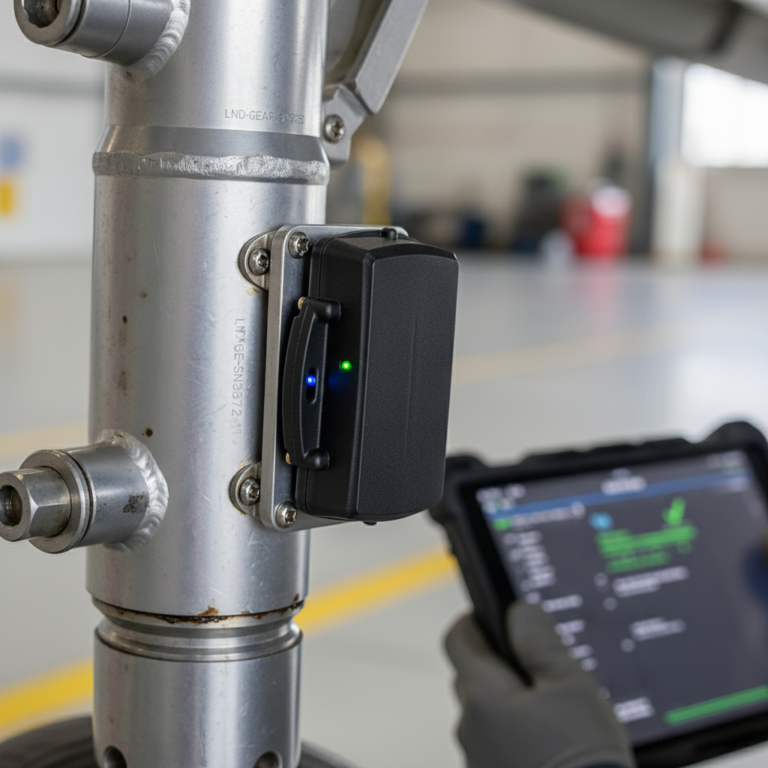
Cellular IoT trackers with GNSS (LTE-M / NB-IoT) are the workhorse for high-value mobile assets. Modern devices achieve 3–5 meter outdoor accuracy via GNSS, with multi-year battery life (some exceeding 10 years on standard batteries) through adaptive duty cycles that reduce power draw when the asset is stationary. These are purpose-built for tracking engine stands, GSE, and high-value consignments across regions.
RFID remains the standard for parts inventory management inside warehouses and MRO bays — tool control, kitting verification, and work-in-progress tracking.
BLE beacons fill the indoor gap where GNSS can’t reach, providing zone-level location inside hangars or cargo facilities.
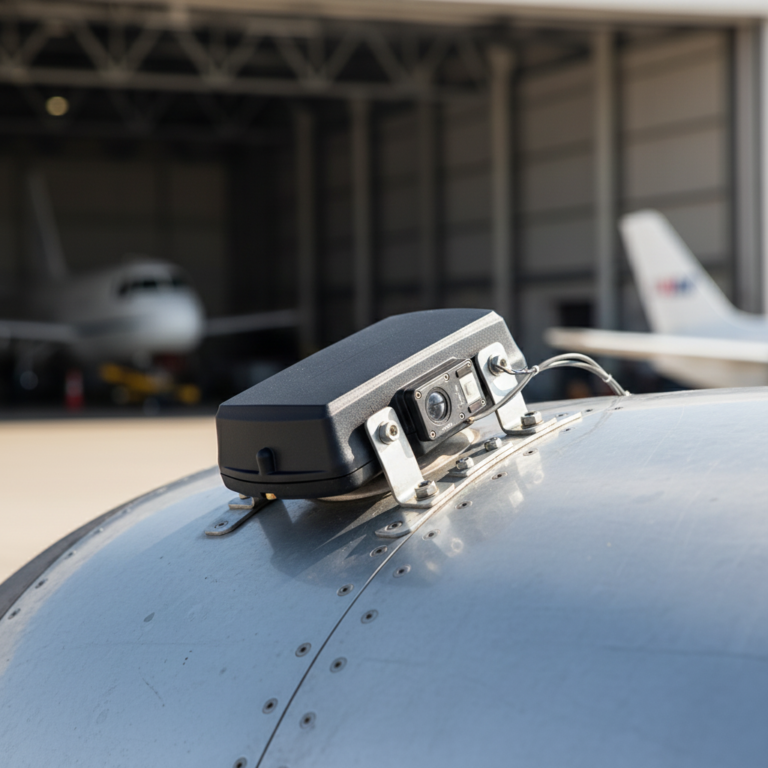
Air-freight approved trackers (DO-160 certified) handle the specific challenge of tracking assets while they’re in transit aboard aircraft — a regulatory requirement that most consumer-grade IoT devices can’t meet.
The critical integration point: your trackers are only as valuable as their connection to your MRO/ERP backbone — AMOS, TRAX eMRO, IBM Maximo. Telemetry data needs to flow into maintenance transactions, not sit in a standalone dashboard nobody checks.
The Parts Fraud Problem: Why Chain of Custody Is Non-Negotiable
The AOG Technics scandal drove this point home with brutal clarity. Between 2019 and 2023, a London-based broker distributed thousands of CFM56 engine components with forged documentation. The result: aircraft pulled from service, network-wide inspections, and a conviction in 2026.
Then came the Spain theft — 12 containers, 600+ turbofan parts across CFM56, V2500, PW1100G, and RB211 engine lines. Parts designated for destruction, stolen by someone impersonating the mutilation contractor. EASA issued an alert declaring them all unapproved and ineligible for installation.
Both cases share the same root cause: broken chain of custody. The asset left one custodian’s hands, entered a gap in visibility, and either became fraudulent or disappeared entirely.
The fix isn’t just better paperwork. It’s continuous, verifiable tracking from acquisition through service life to confirmed destruction. Digital provenance — whether through IoT-tracked custody, electronic Authorized Release Certificates, or blockchain-backed records — closes the gap that paper alone cannot.
3 Measurable Outcomes of Getting This Right
- Reduced cycle time: When you see exactly where every engine, APU, and rotable is — and how long it’s dwelling — you compress repair-and-return cycles by weeks, not days. That translates directly to fewer spare assets needed in your pool.
- Theft and fraud mitigation: Continuous asset tracking creates a verifiable digital trail that deters diversion and catches anomalies before they become $725 million industry problems. If a container deviates from its planned route, you know immediately — not 90 days later.
- Regulatory readiness: GADSS compliance, EASA parts provenance requirements, and airline audit demands all converge on the same need: documented, real-time proof of where your assets are and where they’ve been. A connected asset provides that proof automatically.
Reality Check: 3 Myths That Persist
Myth 1: “We already track our aircraft, so we track our assets.”
ADS-B tracks the airframe in flight. It tells you nothing about the engine stand sitting at a third-party facility for six months, or the GSE fleet scattered across three airports. In-flight tracking and asset lifecycle tracking are separate capabilities requiring separate solutions.
Myth 2: “RFID solves the problem.”
RFID is excellent for read-range inventory management — inside a warehouse, during a tool check, at a parts kitting station. It does not provide autonomous, long-range, global location data. For tracking assets in transit across continents, you need cellular or satellite IoT with GNSS.
Myth 3: “IoT trackers aren’t approved for air transport.”
Standard consumer devices? Correct — they’re not. But DO-160 certified aviation trackers exist specifically for this use case. They meet the environmental and electromagnetic standards required for operation aboard aircraft during freight transport. The technology gap closed years ago; the awareness gap hasn’t.
Putting It Together: A Practical Tracking Architecture
For operators, lessors, and MROs serious about end-to-end visibility, the architecture looks like this:
- In-flight layer: ADS-B Out (mandatory), supplemented by SATCOM (ADS-C/ACARS) for oceanic segments. Space-based ADS-B for global coverage and SAR readiness. Compliance with GADSS/ADT as applicable.
- Ramp and facility layer: BLE or UWB for indoor zone tracking of GSE and tools. RFID for parts inventory and kitting. Integration with maintenance management systems.
- Transit layer: Cellular IoT trackers (LTE-M/NB-IoT with GNSS) on high-value assets — engine stands, rotable containers, APU transport cases. DO-160 approved trackers for in-air cargo segments. Real-time alerts for route deviation, geofence violations, and dwell time thresholds.
- Data integration layer: All telemetry normalized and fed into MRO/ERP systems (AMOS, TRAX, Maximo) via APIs or middleware. Single source of truth for asset location, status, and custody history.
This isn’t a theoretical framework. It’s what operational teams are building right now to close the visibility gap.
The Aviation Asset Management Market: Where It’s Heading
The broader aviation asset management market was valued at $273 billion in 2025 and is projected to reach $465 billion by 2034, growing at a 6.08% CAGR. The asset tracking sub-segment is smaller but growing faster — roughly 15% CAGR — driven by exactly the pressures outlined above: theft, fraud, regulatory compliance, and the operational cost of not knowing where your assets are.
Meanwhile, GNSS interference isn’t going away. The next 3–5 years will see accelerated investment in multi-constellation receivers, inertial aiding, and multi-sensor fusion. Operators who depend on single-source positioning will face increasing risk. Those building resilient, layered tracking architectures will be the ones who maintain both compliance and operational continuity.
What We Do
At Datanet IoT Solutions, we’re an IoT integrator specializing in asset tracking for aviation, port logistics, and ocean freight. We deploy cellular trackers (Digital Matter Oyster3, Remora2, Hawk), air-freight approved devices (Thingfox T2, DO-160 certified), and environmental monitors — configured as complete, turn-key solutions that integrate with your existing systems.
We don’t do shipment tracking. We do asset tracking — full lifecycle, from dispatch through MRO through return. If your high-value aviation assets go dark after handoff, we should talk.
Reach us at info@datanetiot.com or call us in the US at +1 508 292 2210 | Belgium at +32 499 44 52 95.
Frequently Asked Questions
What is GADSS and how does it affect aviation asset tracking?
GADSS (Global Aeronautical Distress and Safety System) is an ICAO framework created after the MH370 disappearance. Since January 2025, it requires newly certified large aircraft to autonomously transmit position once per minute during distress. It sets the regulatory baseline for in-flight tracking but doesn’t address ground-level parts and equipment tracking.
What’s the difference between shipment tracking and asset tracking in aviation?
Shipment tracking ends at delivery — it tells you a package arrived. Asset tracking follows the asset through its full lifecycle: transit, dwell time at a facility, return, reuse, and disposal. For high-value components like engines and landing gear, asset tracking provides the cycle-time data and chain-of-custody proof that shipment tracking cannot.
Can IoT trackers be used on cargo during air transport?
Yes, but only devices certified to DO-160 environmental standards are approved for use aboard aircraft during flight. Standard cellular trackers are not permitted in air. Purpose-built aviation trackers like the Thingfox T2 meet these requirements and provide continuous tracking during airfreight segments.
How serious is the GNSS spoofing threat to aviation tracking accuracy?
Very serious. GNSS jamming and spoofing incidents increased 65% per 1,000 flights in early 2024 versus 2023. Because ADS-B broadcasts unencrypted GNSS-derived positions, spoofed signals can create false aircraft locations. Multi-constellation receivers, inertial backup, and cross-validation with radar are the primary mitigations.
What types of aviation assets benefit most from IoT tracking?
The highest ROI comes from tracking assets that are expensive, mobile, and cycle between multiple custodians — spare engines, APUs, landing gear, rotable components, engine transport stands, and GSE fleets. These items frequently sit in logistics blind spots where neither in-flight ADS-B nor warehouse RFID provides visibility.
How does parts fraud relate to asset tracking?
Scandals like AOG Technics and the 2026 Spain turbofan theft demonstrate that broken chain of custody enables fraud. Continuous IoT-based tracking creates a verifiable digital record of where an asset has been and who had custody — making it far harder to substitute, divert, or fraudulently re-certify components.





 +1 508 292 2210