
Here’s a number that should keep aviation operations leaders up at night: cargo theft losses hit nearly $725 million in 2025, with the average value per theft climbing 36% year-over-year to roughly $274,000. Now consider that a single CFM56 engine is worth upward of $10 million — and 600+ turbofan parts were flagged by EASA in early 2026 after being stolen from a logistics chain in Spain. The thieves didn’t hack a system. They impersonated the contracted disposal company and simply drove the containers away.
Tracking high-value aviation assets isn’t an unsolved problem. It’s a mis-solved one. The industry has poured billions into in-flight surveillance — ADS-B, SATCOM, space-based tracking — and rightly so. But on the ground, where engines, APUs, landing gear, and GSE actually move between hangars, MRO shops, freight forwarders, and bonded warehouses, visibility often evaporates the moment an asset leaves the ramp. That’s the gap. And it’s where real operational dollars disappear.

Two Kinds of Tracking — One Industry Conflating Them
The phrase “aviation asset tracking” gets used to describe two fundamentally different activities, and collapsing them into one conversation creates blind spots.
In-Flight Position Tracking
This is about knowing where an aircraft is in the sky — latitude, longitude, altitude, time — for air traffic control, situational awareness, and search-and-rescue. Technologies like ADS-B (ground-based and space-based), SATCOM datalinks (ADS-C, CPDLC), and radar underpin it. The ICAO GADSS framework, born from the MH370 tragedy in 2014, codified requirements here: newly manufactured large aircraft (over 27,000 kg, airworthiness certificate issued on or after January 1, 2024) must autonomously transmit position at least once per minute during distress — no pilot action required.
Space-based ADS-B, notably the Aireon network hosted on Iridium LEO satellites, has closed major oceanic and polar coverage gaps, detecting aircraft roughly every two seconds with sub-30-second latency. The ICAO GADSS framework represents a genuine leap in safety. That part of the problem is being addressed.
Ground Logistics and Lifecycle Tracking
This is about knowing where a $12 million engine stand is sitting right now. Whether an APU shipped from Brussels actually arrived in Miami — or got rerouted to a gray-market broker. Whether the landing gear you’re about to install has verifiable, unbroken chain of custody. This is inventory, custody, and provenance tracking through aircraft equipment location tracking, and it’s where the industry is dramatically underinvested relative to the value at risk.
The distinction matters because solving one doesn’t solve the other. An aircraft tracked perfectly at FL350 tells you nothing about where its replacement engine is sitting in a logistics yard.
Why the Ground-Side Gap Keeps Growing
Three forces are making ground-side asset tracking more urgent than ever.
1. Theft Is Scaling — and Getting Smarter
The Spain incident wasn’t an anomaly. CargoNet’s 2025 data shows theft is not only more frequent but more targeted. Criminals aren’t grabbing random pallets; they’re going after aviation components with known resale value. And the methods — social engineering, document fraud, shipment diversion — exploit gaps in physical chain-of-custody, not cybersecurity firewalls.
2. The AOG Technics Fraud Exposed a Systemic Weakness
Between 2019 and 2023, a London-based parts broker distributed thousands of CFM56 engine components with forged documentation. Airlines pulled aircraft from service. Network-wide inspections cost the industry tens of millions. The founder was convicted and sentenced in 2026 by the UK’s Serious Fraud Office. The lesson: if you can’t verify where a part has been — every step, every handoff — your entire maintenance operation carries hidden risk. Paper-based provenance is a fiction pretending to be a system.
3. Asset Pools Are Getting More Complex
Modern aviation supply chains are global, multi-party, and increasingly circular. Engines get leased, shipped, overhauled, returned, re-leased. GSE moves between airlines, handlers, and airports. Reusable containers cycle through freight forwarders, MRO shops, and bonded warehouses. Without continuous visibility across these cycles, you don’t have asset management — you have asset guessing.
Shipment Tracking vs. Asset Tracking: The Core Confusion
Here’s the myth most logistics teams operate under: “We tracked the shipment, so we tracked the asset.”
Shipment tracking ends at delivery. The freight forwarder confirms the pallet arrived. Job done. But the asset — the engine, the APU, the specialized tooling — keeps moving. It sits in a receiving yard. It gets inspected. It goes into a hangar. It comes out, gets repacked, ships again. Shipment tracking sees none of that.
Asset tracking follows the asset through its full lifecycle: transit, dwell, maintenance, return, reuse. It measures cycle time, identifies bottlenecks (where do assets sit idle?), and builds an auditable chain of custody. The difference isn’t semantic. It’s the difference between knowing a container was delivered and knowing where 200 containers in your pool are right now — and which ones are overdue.
If your container pool feels invisible after delivery, that’s exactly the gap asset tracking closes.
The Technology Stack That Actually Works
Aviation asset tracking on the ground doesn’t need bleeding-edge R&D. It needs the right combination of proven technologies, properly integrated.
Cellular IoT + GNSS Trackers
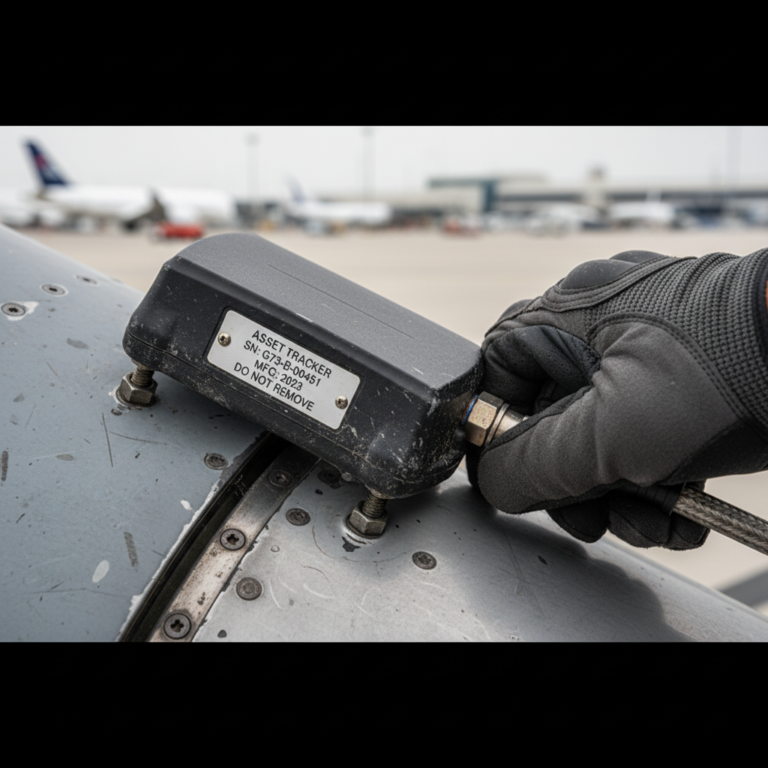
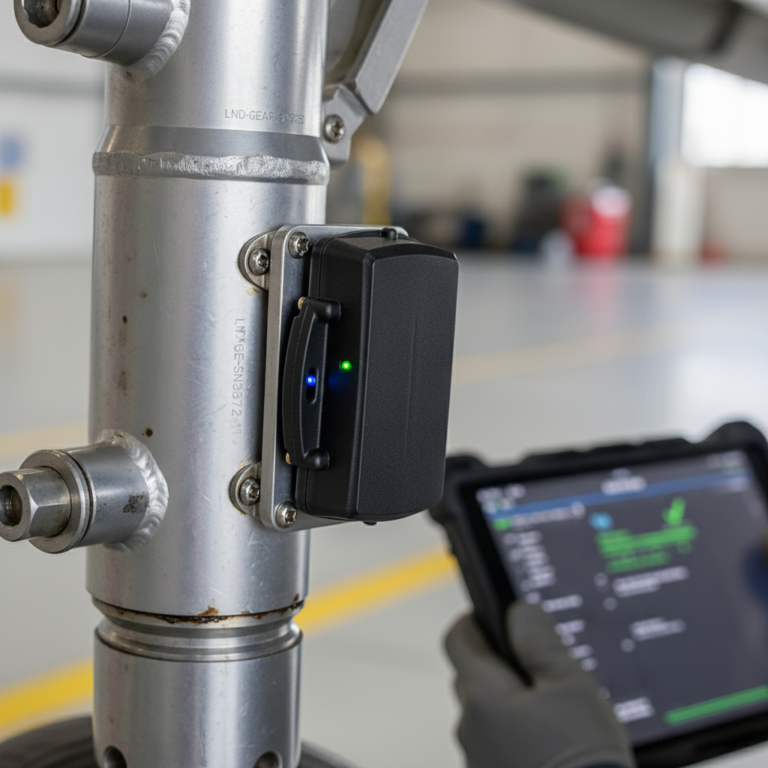
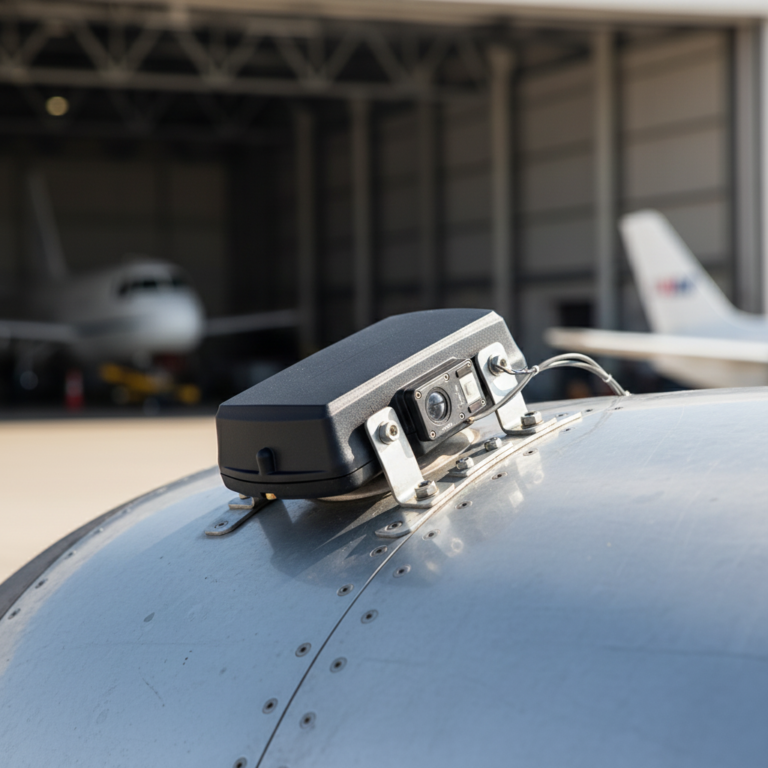
Modern devices using LTE-M or NB-IoT with GNSS deliver 3-5 meter outdoor accuracy, multi-year battery life (some exceed 10 years on standard batteries through adaptive duty cycling), and mature cloud APIs for integration with MRO/ERP systems like AMOS, TRAX, or IBM Maximo. These are ideal for high-value, mobile assets: engine transport stands, GSE, reusable shipping containers, and high-value consignments in transit.
RFID for Fixed-Location Inventory
Passive RFID excels in controlled environments — tool cribs, parts warehouses, hangar staging areas — where assets pass through defined chokepoints. Low per-unit cost makes it practical for tagging thousands of components.
Air-Certified Devices for In-Transit Cargo
Tracking assets during air transport requires hardware that meets aviation environmental standards like DO-160. Not every tracker qualifies. Devices specifically designed and tested for the airfreight environment — vibration, altitude, temperature, EMI — ensure you don’t lose visibility between origin and destination.
Integration, Not Just Hardware
The real value unlock isn’t the tracker. It’s the data flowing into your operational systems. When a cellular tracker’s position update automatically triggers a receiving event in your ERP, or flags an asset that’s been dwelling for 30+ days, that’s when tracking becomes operational intelligence. Modern aviation asset visibility solutions integrate these position feeds with enterprise systems to transform raw location data into actionable insights.
The GNSS Threat You Can’t Ignore
Even the best GNSS-based tracking faces a growing challenge: signal interference. Between 2024 and 2026, GNSS jamming and spoofing incidents surged — a 65% increase in the rate of GNSS signal loss per 1,000 flights was reported in the first half of 2024 versus the same period in 2023. Hotspots include the Eastern Mediterranean, Black Sea, Baltic, and parts of South Asia.
For in-flight tracking, this means ADS-B positions can be corrupted — creating phantom aircraft or displacing real ones on ATC screens. For ground logistics, it means location data from trackers in affected regions may be unreliable during interference events.
Mitigation is multi-layered: multi-constellation GNSS receivers (GPS + Galileo + GLONASS + BeiDou), dual-frequency receivers, inertial backup, and cross-validation against other data sources. For ground-side tracking, the practical answer is choosing hardware that gracefully degrades — falling back to cell-tower triangulation or Wi-Fi positioning when GNSS is compromised — rather than going dark entirely.
What Measurable Outcomes Look Like
When aviation operators move from shipment tracking to true asset tracking, three things happen:
- Cycle times compress. Knowing where every asset is — in transit, in dwell, in maintenance — exposes idle time. Operators routinely find 15-25% of their asset pool sitting in logistics limbo. Eliminating that dead time means fewer assets needed to serve the same operations.
- Theft and diversion risk drops. Continuous custody visibility creates an auditable trail. Anomalies — unexpected stops, route deviations, prolonged dwell at unauthorized locations — trigger alerts before losses materialize.
- Compliance becomes automatic. As regulators push toward digital provenance (electronic Authorized Release Certificates, serial number verification), having a real-time digital record of every handoff positions your operation ahead of mandates rather than scrambling to catch up.
The Regulatory Landscape: EU vs. US Divergence
A practical note for operators spanning both sides of the Atlantic: EASA and the FAA aren’t aligned on implementation timelines.
EASA has transposed ICAO’s GADSS standards into binding EU law, with specific mandates for new aircraft. The FAA has filed differences, arguing its existing surveillance infrastructure — radar, ground-based ADS-B, and space-based ADS-B feeds — already provides adequate coverage. The FAA is still in formal rulemaking but has signaled it will accept EASA-approved installations as an acceptable means of compliance.
For ground-side asset tracking, there’s no equivalent regulatory mandate yet. But the direction is clear: between the AOG Technics fallout, the Spain theft, and the broader push toward digital supply chains, the industry is moving toward mandatory digital provenance and continuous custody tracking. The operators who build that capability now won’t be retrofitting under pressure later.
Reality Check: What the Top-Ranked Articles Miss
Most content on this topic falls into one of two traps. It either focuses narrowly on in-facility RTLS (real-time location systems for hangars and MRO floors) or it covers in-flight surveillance without connecting it to the ground logistics problem. Neither addresses the full lifecycle.
The reality is that a high-value engine doesn’t live in one environment. It flies, lands, gets pulled, ships across an ocean on a transport stand, sits in an MRO queue, gets overhauled, ships back, and re-enters service. Any tracking strategy that only covers one phase of that cycle is, by definition, incomplete. And incomplete visibility is where losses — financial, operational, and safety-related — happen.
Making It Work Without Disruption
The biggest objection we hear isn’t about technology or cost. It’s about disruption. Operations leaders managing hundreds of high-value assets across multiple geographies don’t want a 12-month IT integration project.
The practical path: start with the highest-value, highest-risk assets (engines, APUs, critical rotables). Deploy cellular IoT trackers with DO-160-rated options for air transit segments. Connect to your existing MRO/ERP through standard APIs. Scale from there. A well-scoped implementation can be operational in weeks, not quarters.
That’s the approach we take at Datanet IoT. We’re integrators — our job is matching the right hardware (Digital Matter, Thingfox T2 for airfreight-certified tracking, ePlant for environmental monitoring) to your operational reality, connecting it to your systems, and making it invisible to your workflows. No rip-and-replace. No science project.
If you’re managing a pool of aviation assets and your visibility ends at the delivery receipt, we should talk: info@datanetiot.com

Frequently Asked Questions
What qualifies as a “high-value aviation asset” for tracking purposes?
High-value aviation assets include complete aircraft, engines, APUs, landing gear, avionics, line-replaceable units (LRUs), ground support equipment (GSE), flight recorders, and high-value cargo consignments like spare engines or pharmaceuticals in transit. Essentially, any item whose loss, theft, or misplacement creates significant financial or safety exposure.
What is GADSS and how does it affect tracking requirements?
GADSS (Global Aeronautical Distress & Safety System) is an ICAO framework developed after the MH370 disappearance. Since January 2025, newly manufactured large aircraft must autonomously transmit position at least once per minute during distress. It addresses in-flight tracking but does not cover ground-side logistics tracking of components and equipment.
What’s the difference between shipment tracking and asset tracking in aviation?
Shipment tracking confirms a package moved from A to B. Asset tracking follows the physical asset through its entire lifecycle — transit, dwell, maintenance, return, and reuse. Asset tracking measures cycle times, builds chain-of-custody records, and identifies idle inventory. The distinction directly impacts operational costs and theft prevention.
How does GNSS jamming affect aviation asset tracking?
GNSS jamming and spoofing can corrupt position data from both aircraft transponders and ground-based IoT trackers. Incidents rose 65% in early 2024 versus 2023. Mitigation includes multi-constellation receivers, inertial backup, and devices that fall back to cell-tower or Wi-Fi positioning when satellite signals are compromised.
What tracking technology works for assets being transported by air?
Air-transported assets require trackers certified to aviation environmental standards like DO-160, which tests for vibration, altitude, temperature, and electromagnetic interference. Standard commercial IoT devices are not designed for these conditions. Purpose-built airfreight trackers maintain visibility throughout the flight segment without regulatory issues.
How quickly can an aviation asset tracking system be deployed?
A well-scoped deployment targeting high-value assets (engines, APUs, critical rotables) using cellular IoT trackers with cloud-based platforms and standard API integration can be operational in weeks. Starting with the highest-risk asset class and scaling outward minimizes disruption while delivering immediate visibility gains.




 +1 508 292 2210