

In 2022, six aircraft leasing firms watched $4.7 billion in assets vanish. Not from the sky. From their legal grip. After Western sanctions hit Russia, 147 leased aircraft and 16 engines were seized, re-registered under domestic identifiers, and kept flying. The lessors had ADS-B feeds. They had flight tracking. What they lacked was asset tracking that could flag registration changes, route anomalies, and custody shifts before possession slipped away for good. (See also: airfreight cargo tracking.) (See also: how asset tracking works in aviation.) (See also: global airfreight tracking with griffin air.)
Tracking high-value aviation assets means more than watching a blip cross a screen. It means continuous visibility over aircraft, engines, rotable components, and ground equipment across every lifecycle stage: active service, MRO, lease transitions, storage, retirement. If you manage a fleet, run MRO logistics, or carry aviation assets on a balance sheet, the question that matters isn’t whether your planes appear on FlightAware. It’s whether you know where your $15 million engine is right now, who has custody of it, and what condition it’s in.
Flight Tracking Stops at the Gate. The Risk Doesn’t.
The aviation industry has world-class in-flight surveillance. As of April 2026, 172,624 U.S. civil aircraft carry ADS-B Out transponders, with 95.6% classified as good installs. Air carriers exceed 99.9% compliance. For aircraft in the air, inside controlled airspace, visibility is effectively solved.
The problem starts the moment wheels touch the ground.
An engine worth $15 to $30 million enters an MRO facility in Singapore. It gets disassembled. Components ship to specialized shops in three countries. Some parts wait weeks in bonded warehouses. Others sit on shelves in pooling agreements. At every handoff, custody changes. At every custody change, there’s a window where nobody can confirm exactly where that asset is, who’s responsible for it, or whether it’s been exposed to conditions outside spec.
Flight tracking tells you where the aircraft flew today. Asset tracking tells you where the engine has been for the last 18 months: through every shop visit, every lease transition, every customs hold. That distinction isn’t semantic. It’s financial.
The global aviation asset management market is valued at approximately $290 billion in 2026, projected to reach $465 billion by 2034. The narrower tracking-specific segment was valued at $356 million in 2023, growing at 14.8% CAGR toward $900 million by 2032. That growth rate reflects an industry waking up to a simple fact: the costliest blind spots aren’t at FL350. They’re on the ground, in the warehouse, and between facilities.
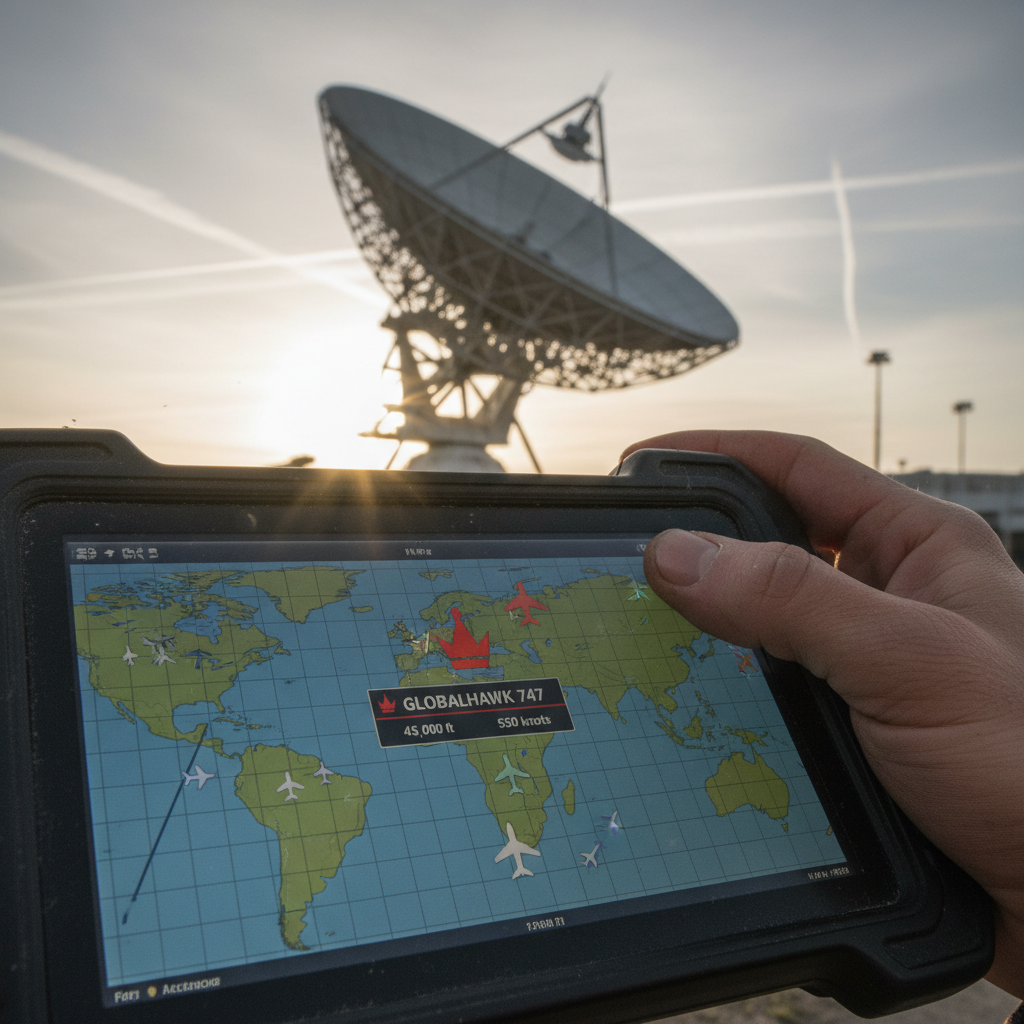
From Satellites to Sensors: How the Stack Works
No single technology covers the full aviation asset lifecycle. Effective tracking requires layers, each handling a different stage of an asset’s journey.
In the air, ADS-B is the backbone. Equipped aircraft broadcast GPS-derived position, altitude, and velocity once per second. Two link variants handle different segments: 1090 MHz Extended Squitter (1090ES) for commercial and international operations, and Universal Access Transceiver (UAT) for general aviation below 18,000 feet. As of April 2026, 134,590 U.S. aircraft use 1090ES and 36,706 use UAT. Coverage is mature. Compliance is high.
But ADS-B has a geographic limit. Ground-based receivers can’t cover oceans, polar routes, or remote terrain. That’s where space-based ADS-B enters. Aireon’s receiver network, hosted on Iridium’s 66-satellite LEO constellation, provides the first truly global real-time flight tracking coverage, eliminating the surveillance dead zones that made MH370 untraceable. With Iridium’s announced acquisition of Aireon for approximately $450 million, this infrastructure is consolidating under a single entity. For operators and lessors evaluating data contracts, that consolidation carries pricing implications worth monitoring now.
On the ground and through MRO, the technology shifts entirely. IoT sensors and RFID tags pick up where ADS-B leaves off. RFID tagging of rotable parts (engines, landing gear, avionics modules) enables full lifecycle traceability through every shop visit. IoT sensors layer on condition monitoring: temperature, humidity, vibration, shock. For a $30 million engine in transit between facilities, the difference between “we think it arrived” and “we know it arrived within spec” can be worth the cost of the entire tracking deployment.
IoT is already enabling predictive maintenance, real-time logistics visibility, optimized inventory pooling, and full lifecycle traceability across the aviation parts ecosystem. The shift from tracking shipments to tracking assets, individually and continuously, is underway.
Geofencing ties the operational layer together. Virtual boundaries trigger alerts when assets cross zones, when custody transfers, or when environmental thresholds are breached. For a lessor monitoring engines across four MRO shops on three continents, geofencing converts passive location pings into operational intelligence.
Above all of this sits the regulatory framework. After MH370, ICAO’s GADSS mandated 15-minute position reporting for oceanic and remote operations, with automatic distress tracking at one-minute intervals. A U.S. Senate bill advanced in October 2025 would extend the ADS-B Out mandate to the end of 2031, pushing coverage beyond current controlled-airspace requirements. The regulatory floor is rising. Operators building layered tracking strategies now will be ready. Those who aren’t will be buying under deadline pressure.
What $4.7 Billion in Seized Aircraft Taught the Industry
The Russia seizure is the most consequential case study in aviation asset tracking this decade. Western sanctions required lessors to terminate Russian airline contracts by March 28, 2022. Russia preempted this on March 10, banning aircraft exports and trapping the fleet. AerCap, the world’s largest aircraft lessor, claimed 116 aircraft and 15 engines. In June 2025, the London High Court awarded AerCap $1.035 billion, ruling the loss was caused by an act of the Russian government.
Here’s what makes this a tracking story, not just a geopolitical one. The lessors could see their aircraft on ADS-B. They could see them flying. What they couldn’t detect, fast enough, was the combination of signals that meant possession was gone: re-registration under new identifiers, removal from international surveillance networks, operations on routes that violated lease terms. By the time legal teams mobilized, the assets were functionally unrecoverable.
The lesson: tracking high-value aviation assets requires anomaly detection beyond position. Registration changes, unexpected route patterns, maintenance schedule deviations, custody transfers that don’t match contractual terms. These are the early warnings. Most flight tracking platforms don’t monitor them.
Seven years before Russia, MH370 exposed a different gap. The aircraft’s transponder was deactivated, and the last ADS-B position report was received at 17:21 UTC on March 8, 2014. The subsequent search relied on Inmarsat satellite “handshakes,” a far less precise method. MH370 directly accelerated GADSS and space-based ADS-B. For in-flight surveillance, that gap is now largely closed.
But the persistent, quieter bleed happens inside MRO operations. Components lost between facilities. Custody records that lag reality by days. Engines sitting in storage without condition monitoring, accumulating undocumented risk. One airport deploying a CMMS platform for ground equipment reduced equipment downtime by 35%. That will never make a BBC headline. It’s also the kind of operational dollar most aviation organizations are hemorrhaging daily and calling normal.
The Integration Problem Most Operators Ignore
Here’s what I see in the field, repeatedly. An airline or MRO provider has ADS-B data from one source, IoT sensors from a different vendor, a CMMS for ground equipment maintenance, and spreadsheets bridging the gaps between them. Three dashboards. Four logins. Zero unified picture of where their assets are across the lifecycle. Effective aviation equipment tracking software consolidates these disparate data streams into a single operational view.
The market is full of companies selling one layer of the tracking stack. Satellite data providers pitch global ADS-B coverage. Hardware vendors pitch rugged devices. Software companies pitch dashboards. Each layer solves a real problem. None of them, on its own, solves the whole problem.
The integration challenge compounds as fleets grow and supply chains extend. When your tracking hardware comes from multiple manufacturers, each with its own protocol, battery profile, and reporting format, the operational burden doesn’t sit with the technology. It sits with the people managing it. And those people already have full calendars.
There’s another angle the aviation tracking conversation consistently avoids: data security. The location data for a fleet of aircraft, the custody chain of engines worth hundreds of millions, the condition records that affect insurance valuations. This is high-value intelligence. Tracking data is itself a high-value asset.
Who stores it? Who can access it? What happens when the platform provider gets acquired? That question became concrete when JETNET bought ADS-B Exchange in January 2023, and the community that had built the platform on an unfiltered, open-data philosophy suddenly found itself under new ownership with different priorities. For operators relying on third-party tracking platforms for asset intelligence, the ownership and governance of that data is a risk factor worth evaluating before deployment, not after.
What a Full Lifecycle Tracking Strategy Looks Like
A complete aviation asset tracking strategy covers four stages: in-flight, on-ground (ramp and facility), in-transit (between MRO shops, lessors, or operators), and in-storage. Each stage demands different technology, different reporting cadences, and different alert thresholds.
For in-flight surveillance, the infrastructure exists. ADS-B Out, space-based ADS-B, and MLAT provide near-total coverage for equipped commercial aircraft. The immediate action for operators who haven’t evaluated space-based data is to do so before the expected mandate expansion hits in 2031 and prices tighten.
For ground equipment and components in MRO, IoT sensors and RFID are the practical layer. The hardware decision matters more than most operators realize. Devices operating in airfreight environments need DO-160 qualification. Devices on ground support equipment need IP67+ protection and multi-year battery life to avoid constant maintenance interventions. This is where DO-160 approved trackers separate reliable deployments from pilot projects that stall after six months.
For assets in transit between facilities, condition monitoring becomes as important as location. Knowing an engine arrived is baseline. Knowing it arrived within temperature, humidity, and vibration thresholds is what protects the asset’s value and your insurance position. This is where asset tracking diverges most sharply from shipment tracking. Shipment tracking ends at delivery confirmation. Asset tracking follows the component through its next cycle, its next handoff, its next return to service.
For stored assets, the economics are different but the visibility requirement is the same. Idle engines, parked aircraft, and pooled components all carry costs that compound when custody records aren’t current. The MRO market is projected to reach $97 billion in 2026. A meaningful share of that spend traces back to delays, rework, and lost components that better tracking would prevent.
One angle the industry consistently undervalues: insurance. Real-time tracking data, condition monitoring records, and custody chain documentation directly affect how underwriters assess risk on aviation assets. The Russia case was decided on insurance claims. The lessors with the most complete documentation held the strongest legal position. That documentation came from tracking data.
If your aviation assets go dark between flights, between facilities, or between lease terms, that’s the gap a lifecycle tracking approach closes. We work with airlines, MRO providers, and freight operators to build end-to-end tracking solutions that connect the in-flight layer to the ground layer to the MRO layer, on a single pane. If that’s a conversation worth having, let’s talk.

Frequently Asked Questions
What does “tracking high-value aviation assets” actually cover?
It means monitoring the location, custody, and condition of aircraft, engines, rotable components (landing gear, avionics, APUs), and ground support equipment across their full lifecycle. That includes in-flight surveillance via ADS-B, ground-level tracking through IoT and RFID, and condition monitoring during MRO operations and transit between facilities.
How is asset tracking different from flight tracking?
Flight tracking monitors an aircraft’s position while airborne. Asset tracking extends across the entire lifecycle: MRO shop visits, lease transitions, transit between facilities, storage. Flight tracking ends when the plane lands. Asset tracking follows the component through every handoff, every cycle, every return to service.
What is GADSS and why does it matter?
GADSS (Global Aeronautical Distress and Safety System) is an ICAO framework developed after MH370’s disappearance. It requires 15-minute position reporting over oceanic and remote regions during normal operations, and one-minute automatic reporting during distress scenarios. It sets the global regulatory baseline for in-flight aircraft tracking.
What technology tracks aviation assets on the ground?
IoT sensors and RFID tags are the primary tools. RFID enables individual component traceability through MRO operations. IoT sensors add condition data (temperature, humidity, vibration, shock). Geofencing provides automated alerts when assets move outside designated zones or when custody changes without authorization.
Can tracking data be used in legal disputes over seized aircraft?
Yes. In the Russia aircraft seizure case, lessors used flight tracking records and asset documentation as evidence in multibillion-dollar insurance claims. AerCap’s $1.035 billion London High Court judgment relied partly on demonstrating loss of control through tracking data. Archiving tracking records is now considered essential risk mitigation for lessors operating in geopolitically exposed regions.
What certifications should aviation asset tracking devices have?
Devices used in airfreight environments should meet DO-160 (environmental test procedures for airborne equipment). Ground support equipment trackers need at least IP67 ingress protection. Global cellular or satellite connectivity and battery life exceeding two years are practical minimums. Without these, deployments tend to fail operationally even when they work technically.








 +1 508 292 2210

10 Responses