

A metal strip falls off a departing DC-10. Five minutes later, a Concorde tire strikes it at takeoff speed. Fragments puncture a fuel tank. Fire erupts. All 109 people on board and four on the ground are killed. The debris that started it weighed less than a kilogram.
That was July 2000. In 2026, foreign object debris still costs the global aerospace industry an estimated $22.7 billion per year. If you need to know how to prevent FOD in aviation, here is the uncomfortable starting point: there is no single fix. FOD comes from runways, cargo aprons, maintenance bays, construction zones, and manufacturing floors. Preventing it requires layered controls, not a single radar purchase and a laminated poster.
I have spent 15+ years deploying IoT tracking systems for airlines, MROs, and ground operators. The pattern I see repeatedly is that organizations invest in runway detection while leaving enormous blind spots inside the hangar and across the equipment pool. This article covers what a complete FOD prevention program actually looks like, where the evidence supports technology investment, and where most programs still leak.
Debris vs. Damage: Why the Distinction Matters
FOD is used for two different things in aviation: foreign object debris (the object) and foreign object damage (the result). The FAA defines the debris as any object in an inappropriate airport location that can injure people or damage aircraft. Damage is the potential consequence.
This is not a semantic game. If your program logs “FOD incidents” without distinguishing a bolt found on a taxiway from a compressor blade failure caused by ingestion, you cannot tell whether prevention is improving. A higher detection count might mean better surveillance, not more debris. Separate the hazard from its outcome in every record, and you gain a program you can actually measure.
What FOD Actually Costs Beyond the Repair Bill
The $22.7 billion figure is an FAA-attributed global estimate, not an annual audit. Even as an estimate, it understates the problem. The FAA’s own cost-benefit analysis notes that indirect costs can run 10 to 12 times direct repair costs. Indirect costs include schedule disruption, fleet reassignment, passenger compensation, regulatory investigation, and reputational damage.
Consider Boeing’s KC-46 tanker. In February 2019, Boeing grounded the entire fleet after eight tools were found inside delivered aircraft, with two more discovered in tankers already handed to the U.S. Air Force. The aircraft were out of training for about a week. Removing a few wrenches costs almost nothing. Grounding a military fleet, halting production, and rebuilding confidence in your quality program costs something else entirely.
Most estimates focus on engine overhauls and tire replacements. They miss delays cascading through a hub’s daily schedule. They miss the insurance premium spike after a strike event. They miss the MRO hours burned reinspecting an engine that swallowed a shop towel. These costs are real even when no single line item captures them.
The Four-Pillar Framework That Works
The FAA’s Advisory Circular 150/5210-24A, updated in 2024, organizes FOD management into four connected functions:
- Prevention: training, pavement maintenance, construction controls, cargo containment, tool accountability.
- Detection: visual inspections, FOD walks, vehicle patrols, automated sensor systems.
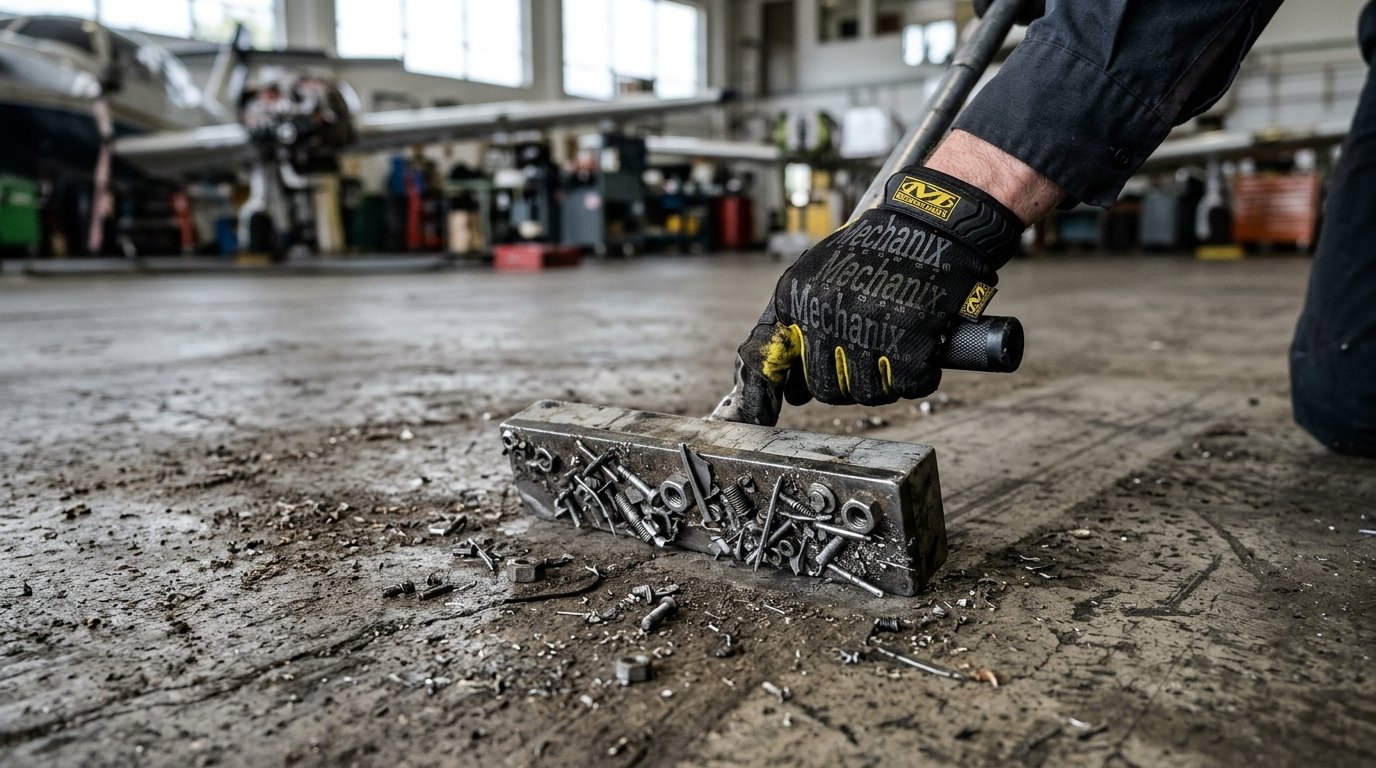
- Removal: mechanical sweepers, magnetic bars, vacuum systems, manual pickup. Blowers only with collection, never alone (you relocate the hazard, not remove it).
- Evaluation: data on every find (type, time, location, likely source, weather, detection method), trend analysis, damage investigation, corrective action.
In practice, most programs are heavy on detection and light on evaluation. That is a problem. If you find 200 cable ties per month on Taxiway C but never trace them to the cargo handler whose strapping process is broken, you will find 200 more next month.
For U.S. Part 139 certificate holders, the regulatory baseline is clear: 14 CFR 139.327 requires daily self-inspection plus additional checks after unusual conditions and after accidents or incidents. 14 CFR 139.305 requires prompt removal of debris from applicable paved areas. These are requirements. The advisory circulars that describe detection equipment and program structure are guidance, mandatory only when equipment is purchased through the Airport Improvement Program or Passenger Facility Charge funds. Know the difference before building your budget.
Source Control: Stop Debris Before It Exists
The cheapest FOD to remove is the FOD that never appears. Upstream source control is low-tech and addresses root causes rather than symptoms.
Pavement itself generates debris when it cracks or spalls. The FAA identifies pavement maintenance as a prevention priority because the surface can become the hazard. Repair defects promptly. After construction, clean haul routes and inspect vehicle tires before they return from unpaved areas. A single uncovered gravel truck can seed a runway with hundreds of potential projectiles.
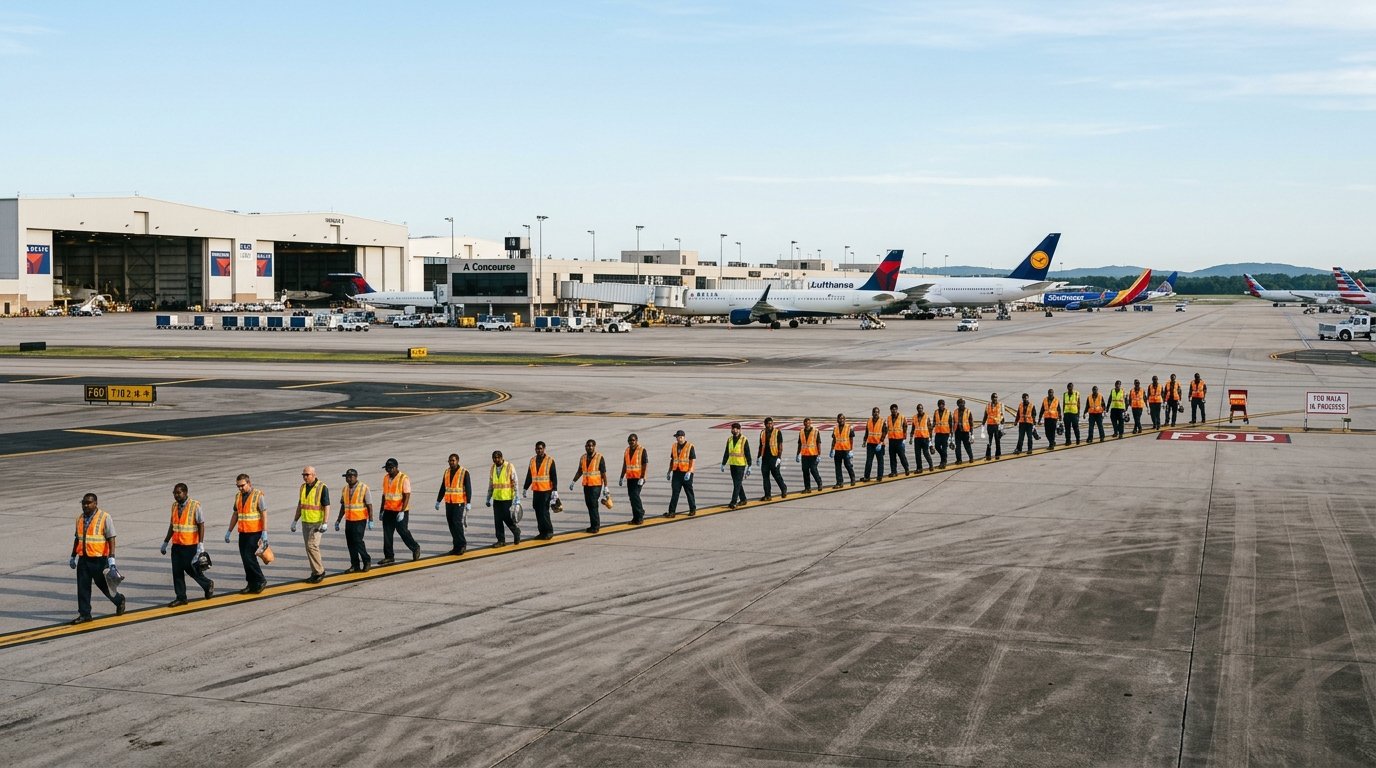
Cargo and baggage operations are among the most persistent sources on the apron. Loose strapping, plastic sheeting, luggage tags, fasteners. Assign cleaning responsibilities to specific teams at every loading position. Provide waste containers. Do not rely on a general cleanup crew to catch what a ground handler left behind.
Jet blast and rotor wash turn loose items into high-speed projectiles. This is physics, not negligence. Contain materials before engines spool up. Position barriers, anchor lightweight items, control exposure zones. Sweeping after the blast has scattered debris across an apron does not count as prevention.
Construction sites near movement areas need daily boundary inspections, covered loads, secured staging zones, and haul-route sweeping. Every one of these measures is simple. The hard part is enforcing them consistently when multiple tenants, contractors, and shift changes are involved.
Tool Accountability: The FOD Gap No Runway Sensor Covers
Here is a reality check that I bring up with nearly every airline and MRO client I talk to. A runway FOD detector will not find a wrench left inside an engine nacelle. A magnetic sweeper will not pick up a shop towel draped over a hydraulic line. The FOD risk inside aircraft, engines, and production bays requires a fundamentally different control: tool accountability.
NASA’s Marshall Space Flight Center runs one of the most rigorous models in existence. MSFC-STD-3598 defines Critical Zones where every item and consumable is counted, kitted, logged, inspected, and tethered. Tools are checked in and out. Protective covers and caps are verified after any authorized removal. Even packaging materials must be evaluated for the particles they shed.
That discipline works at NASA because the hardware is irreplaceable and the consequences of failure are absolute. In commercial MRO, the pressure is different: speed. A technician working the night shift to return an aircraft to service by 0600 is the person most likely to leave a flashlight behind. Not from negligence, but from fatigue, time pressure, and a process that depends on memory rather than verification.
Shadow boards (outlined tool storage where a missing tool is visually obvious) are the traditional answer. They work for fixed stations. Digital tool-control systems add tracked access, automated checkout, and a digital audit trail that flags unreturned items before a panel closes. But neither approach covers mobile assets: the calibrated torque wrench that travels between bays, the ground power unit that moves across the apron, the container of consumables that shifts between hangars.
This is where IoT-based asset tracking closes a gap that manual systems cannot. When a torque wrench leaves Bay 3 and never checks back in, the system flags it in real time. When a ground support cart parks in a blast zone, the geofence triggers an alert. The principle is identical to NASA’s logged-and-tethered approach, extended by wireless connectivity to cover anything that moves.
For aviation environments specifically, the hardware needs to survive the operating conditions. Devices like the Thingfox T2, which carries DO-160 airfreight certification, or the ruggedized cellular trackers in the Digital Matter range are designed for exactly this: harsh, regulated environments with zero tolerance for unaccounted items. This is not shipment tracking that ends at the delivery dock. It is asset tracking that follows every tool and piece of equipment through its entire operational cycle, return and reuse included.
Detection Technology: What the Field Data Shows
Automated FOD detection is a growing market. Published forecasts range from $190 million to over $600 million depending on the source, scope, and methodology. Those numbers are useful for market context, not for procurement decisions. What matters is operational evidence. Here is what we know from three airports that have published real data.
Changi: continuous surveillance vs. periodic walks
Changi Airport developed its iFerret system starting in 2006 and deployed it across both runways by 2022. The airport’s ICAO presentation reports that continuous automated surveillance detected seven times more FOD in real time than four daily physical inspections. Response within five minutes improved from 32% to 80% of events.
The counterintuitive lesson: seven times more detections does not mean seven times more debris appeared. It means the system found objects that periodic walks missed. Your detection count will spike when you first deploy continuous monitoring. Do not confuse improved visibility with a worsening problem. This is the same pattern I see in asset tracking deployments. The moment you gain real-time visibility, you discover losses that were always there but never measured.
Haneda: size and material define real-world accuracy
Japan’s National Institute of Maritime, Port and Aviation Technology published a 2025 evaluation of Haneda’s runway system, which combines millimeter-wave radar, an HD camera, and a weather sensor. Full-size reference objects were detected at 95%+ within the 350-meter design range. Small M10 bolt-and-nut targets varied from 68.4% to 99.1% depending on test position. Detection times ranged from 28 to 49 seconds. Location error was 0.46 to 2.40 meters.
The takeaway for procurement: a system that detects 95% of soda cans but misses 30% of small bolts has a very different risk profile than the headline number suggests. Always ask about performance by target size, material, weather, and lighting.
AI-augmented inspection: promising, not yet proven
In 2026, Skylark Labs reported fixed AI detection deployments at major Indian airports, and Pittsburgh International tested Illuminex AI’s system mounted in an inspection vehicle. Neither report provides measured detection rates or documented safety-outcome improvements. AI can classify objects, prioritize alerts, and reduce manual review burden. But academic reviews note that models trained on limited datasets can struggle with unfamiliar lighting, weather, background clutter, and rare debris types.
The FAA’s equipment advisory circular sets minimum test objects including a 1.2-inch metal cylinder and a 1.7-inch sphere, plus requirements for update intervals under four minutes, adverse-weather performance, and false-alarm limits averaged over 90 days. Before buying any system, test it against those standards on your runway, in your weather, at the target sizes that actually threaten your operation.
Culture Eats Checklists: The Human Factor
Every FOD article says “it’s everyone’s responsibility.” The phrase appears so often it has become wallpaper. The real question is whether your organization makes it safe and easy to report FOD, or whether it punishes the messenger.
A technician who finds a loose bolt on a taxiway but does not report it because the form takes 20 minutes is not the problem. The process is. A mechanic who discovers a missing tool after a panel is closed but stays quiet because reporting means a shift extension and a difficult conversation with a supervisor is not the problem. The reporting culture is.
Three changes that move the needle in practice:
Simplify reporting to the point of zero friction. A phone-based form with a photo, GPS pin, category dropdown, and submit button. Ten seconds, not ten minutes. If reporting a found object takes longer than picking it up, objects get pocketed and forgotten.
Track finds as positive indicators. A team that reports 50 items per month is not worse than a team reporting five. They are more vigilant. Reward detection. Investigate absence of reports as a potential warning sign, because zero finds rarely means zero debris.
Close the loop visibly. When a cable-tie report leads to a cargo handler retraining their strapping process, tell the person who reported it. Feedback converts compliance into ownership. Without it, reporting feels like shouting into a void.
After the KC-46 tool incidents in 2019, Boeing reportedly implemented a 48-minute pre-shift-end cleanup and inspection period on the production line. Simple. Low-cost. Directly addresses the fatigue and time-pressure factors that the NTSB’s “Dirty Dozen” human-factors list calls out. A tired technician at 3 AM is statistically the highest-risk moment in your FOD program. Build the process around that reality, not around the assumption of perfect human attention.
Building a Closed-Loop FOD Program
Prevention programs fail when each element operates in isolation: one team sweeps the runway, another tracks tools, a third manages tenants, and nobody connects the data. The program works when it is a loop. Prevent, detect, remove, evaluate, improve, prevent better.
Start by mapping your FOD pathways. Walk the operation. Where does debris enter the movement area? Which tenants generate the most waste? Where are tools used on or near aircraft? Which pavement sections are deteriorating? Each pathway needs its own control because a single countermeasure cannot cover them all.
Assign real ownership. “Everyone’s responsibility” without designated accountability is nobody’s job. Name a FOD program manager. Assign area owners. Include tenants, contractors, and ground handlers with written expectations and audit rights. If a third-party cargo operator generates 60% of your apron debris, they need to be inside your program, not adjacent to it.
Layer your controls so no single failure creates a hazard. Source prevention (housekeeping, tool accountability, pavement repair) handles the upstream. Inspection and sensor technology handles what slips through. Removal equipment handles the physical response. Data evaluation drives the feedback.
Measure outcomes, not just activity. The FAA’s cost-benefit research found that at Boston Logan, only about 25% of automated detections were classified as critical. Detection data were being used as a safety proxy because the airport did not track actual strike or damage-cost data. If “items found” is your only metric, you cannot calculate ROI or demonstrate that your program is reducing risk. Track debris volume, source attribution, response time, repeat hotspots, and confirmed damage events separately.
Use technology to connect the dots across domains. A sensor on the runway, a digital tool-control cabinet in the hangar, and asset trackers on ground support equipment are three different systems covering three different FOD pathways. When they feed into the same data layer, patterns emerge. The wrench missing from Bay 4 is the same wrench that appears on Taxiway B. The GSE cart in the blast zone moved there at 2:14 AM when the night shift began. That kind of cross-domain visibility is what turns reactive cleanup into proactive prevention. This integrated approach aligns with broader Industry 4.0 implementation strategies that connect disparate operational systems into unified data platforms.
If your FOD program has blind spots between the hangar and the flight line, or if your ground equipment and tools go invisible the moment they leave a fixed station, that is the gap asset tracking closes. Our team works with airlines, MROs, and airport operators on exactly this problem. Reach out at datanetiot.com/contact-us or email info@datanetiot.com.
Frequently Asked Questions
What does FOD stand for in aviation?
FOD refers to both foreign object debris (an object in an inappropriate location that can cause harm) and foreign object damage (the resulting harm to aircraft or equipment). The FAA defines debris as the hazard and damage as the potential consequence. Effective programs track both separately to distinguish improved detection from actual safety degradation.
How often must U.S. airports inspect for FOD?
Part 139 certificate holders must conduct daily self-inspection, with additional inspections after unusual conditions affecting safety and immediately after any accident or incident. FAA advisory guidance recommends daylight inspection of aircraft operating areas at least once daily, with extra attention to construction zones and post-incident conditions.
Are automated FOD detection systems required at airports?
No. Part 139 requires inspection and prompt removal of debris but does not mandate a specific detection technology. The FAA’s equipment advisory circular sets performance specifications that become mandatory only for systems purchased through the Airport Improvement Program or Passenger Facility Charge funds.
Can radar or AI replace manual FOD walks?
Not as a standalone replacement. Automated systems add continuous coverage, faster detection, and objective records. But they cannot close runways, physically remove debris, validate ambiguous alerts in real time, or investigate root causes. The FAA treats automated detection as a supplement to the inspection program, not a substitute for it.
What is the most cost-effective FOD prevention measure?
Source control: maintaining pavement, enforcing tool accountability, securing cargo, and containing construction materials. These measures prevent debris from entering the operating environment at a fraction of the cost of detection systems. Detection technology adds value where source control alone cannot eliminate the residual risk.
How does asset tracking help prevent FOD in maintenance and manufacturing?
IoT-based asset trackers provide real-time location data for tools, ground support equipment, and consumable kits. When a tool leaves a maintenance bay and does not return, the system flags it before panels close or aircraft move. This extends traditional shadow-board accountability to mobile assets that travel across hangars, aprons, and flight lines.





 +1 508 292 2210