

Most companies discover enterprise asset tracking the hard way. They buy an EAM platform, integrate it with their ERP, build beautiful dashboards, and their maintenance crew still can’t find the infusion pump on the third floor. Or the ULD that left Frankfurt two cycles ago. Or the compressor that was “definitely at the east yard” last Tuesday.
The disconnect is always the same. The software assumes your assets report their own location. They don’t. Not unless you build the physical layer that makes it happen: the right tags, the right connectivity, the right architecture matched to each asset class and environment.
The global asset tracking market hit $24.14 billion in 2024 and is projected to reach $51.59 billion by 2030, growing at 14.9% CAGR. Most of that spend flows into platforms and licenses. The companies that actually see ROI are the ones who start with what goes ON the asset, not what goes on the screen.
This guide covers enterprise asset tracking from the physical layer up: what it is, which technology fits which environment, where the real returns come from, and how to deploy without building a white elephant.
What Enterprise Asset Tracking Actually Means
Enterprise asset tracking is the practice of identifying, locating, and monitoring physical assets across their full lifecycle using tags, sensors, readers, and software. “Physical assets” means anything a company owns and reuses: vehicles, containers, medical equipment, ground support equipment, tooling, IT hardware, trailers, ULDs, reusable packaging.
The word “enterprise” separates large-scale, multi-site, multi-asset-class deployments from tracking a handful of laptops on a spreadsheet. Enterprise means thousands (or millions) of tagged items reporting through a layered stack:
- Tags or sensors attached to the asset (RFID, BLE, UWB, GPS/cellular, or a combination)
- Readers, gateways, or anchors that detect those tags
- A location engine that converts raw signals into coordinates or zones
- A software platform that visualizes, alerts, and logs
- Integration into EAM, ERP, WMS, or supply chain systems
This is not the same as buying an EAM suite. IBM Maximo, SAP S/4HANA, and MaintainX are powerful tools for managing work orders, maintenance schedules, and asset records. But they are record-keeping systems. They tell you what SHOULD be where. Asset tracking tells you what IS where, right now, based on a signal from the asset itself.
The confusion is common. A company invests six figures in EAM software, imports 40,000 asset records, trains staff on work orders, then discovers that the “location” field only updates when someone manually scans a barcode. That’s not tracking. That’s periodic auditing with extra steps.
Shipment Tracking Ends at the Dock. Asset Tracking Doesn’t.
This is the distinction I find myself explaining most often.
Shipment tracking follows a consignment from origin to destination. Its job ends at delivery. The moment the freight hits the receiving dock, the tracking event closes. The carrier’s system stops caring.
Asset tracking follows the ASSET, not the shipment. After delivery, the asset enters a facility. Gets used. Gets maintained. Gets returned. Gets reused. Gets misplaced between the maintenance hangar and the ramp. That entire cycle, from procurement through disposal, is where enterprise asset tracking lives.
Here’s where this gets expensive. A hospital in the U.S. loses roughly $4,000 worth of equipment per bed per year. For a 400-bed facility, that’s $1.6 million annually in avoidable loss. The equipment wasn’t stolen at the loading dock. It was misplaced AFTER delivery: moved between floors, borrowed by another department, sitting in a closet nobody checks.
In aviation, the same pattern plays out with ULDs, GSE, and rotable parts. You know the ULD arrived at CDG. You don’t know which handler has it, whether it’s been damaged, or when it’ll cycle back. Shipment tracking gave you a delivered timestamp. Asset tracking gives you the full picture.
If your container pool feels invisible after delivery, that’s exactly the gap asset tracking closes.
Five Technologies, One Decision Framework
The technology choice shapes cost, accuracy, battery life, and infrastructure requirements for the entire life of the deployment. Get it wrong and you’ll rip it out in 18 months. Get it right and the hardware runs for years with minimal intervention.
Here’s the comparison drawn from field deployments, not vendor slide decks:
| Technology | Accuracy | Range | Tag Cost | Best Fit | Key Limitation |
|---|---|---|---|---|---|
| Passive RFID | Choke point / door level | <5 m | $0.10 – $0.30 | Receiving, cycle counts, bulk ID | Metal/liquid interference; no real-time |
| Active RFID | Room / zone | Up to 100 m | $5 – $30 | Containers, pallets, high-value assets | Battery replacement cycles |
| BLE (Angle of Arrival) | 0.1 – 1 m | 10 – 40 m indoor | $3 – $15 | Indoor RTLS, healthcare, offices | Limited outdoor / cross-site coverage |
| UWB (Time of Flight) | 10 – 30 cm | 1 – 50 m | $10 – $50 | Precision manufacturing, AMR/AGV | Highest infrastructure cost per sq ft |
| GPS / Cellular | 2 – 5 m outdoor | Global | $20 – $100 | Fleets, trailers, remote equipment | Indoor dead zones; higher power draw |
Sources: Sentrax RTLS technology comparison, AlignOps 2026 technology guide.
The mechanism behind each matters for planning. BLE Angle of Arrival uses the phase difference of incoming signals across an antenna array to compute direction, which delivers sub-meter accuracy without UWB’s infrastructure cost. UWB uses Time-of-Flight, measuring how long a pulse takes to travel between tag and anchor, which resists multipath interference inside factories with metal walls and moving machinery. Passive RFID works by inductively powering a tag as it passes through a reader’s electromagnetic field: no battery needed, but you only get a location event at the scan point.
The trend right now is multi-modal. A single tag carrying an RFID inlay for inventory scans, a BLE beacon for continuous indoor location, and cellular for assets that leave the site. This is exactly how we approach deployments at Datanet. A reusable container that travels between an airline’s hub and three outstations needs GPS/cellular for the transit legs and BLE or RFID at each station for yard management. One technology alone leaves blind spots.
The decision framework is simpler than vendors make it sound. Ask three questions:
- Does the asset stay indoors, go outdoors, or both?
- Do I need continuous real-time position or periodic check-in?
- How many assets, and what’s the per-unit budget ceiling?
Those three answers eliminate most options immediately.
The ROI That Changes Budget Conversations
Vague promises of “visibility” don’t survive a CFO’s first question. Hard numbers do. Building a solid asset tracking business case requires quantifiable KPIs that finance teams already monitor.
In healthcare, the evidence is unusually concrete. U.S. hospitals track approximately 1,700 different types of medical devices, from ventilators and infusion pumps to wheelchairs and diagnostic laptops. RTLS deployments across these facilities are reported to deliver 10x ROI, a 30% increase in asset utilization, and $5 million in annual supply savings. A systematic review of 42 peer-reviewed articles in the Journal of the American Medical Informatics Association confirmed that RTLS is an effective methodology for patient safety, workflow improvement, and process optimization.
In logistics, the numbers are just as direct. A full-scale RFID deployment at a leading logistics company cut order fulfillment time by 30% and lifted inventory accuracy from 85% to 99.9%. The mechanism: bulk scanning without line-of-sight eliminated the per-item barcode scans that caused the 15% accuracy gap.
In aviation manufacturing, GE Aviation reported a 15% capacity increase and 12x improvement in production-control productivity after deploying a real-time location platform. ROI hit in three months. That deployment wasn’t a pure inventory play. It was integrated with production scheduling and takt-time management, which is where location data compounds in value.
Across industrial verticals broadly, connected assets are reported to raise productivity by 28% and reduce equipment downtime by 20%.
The pattern is consistent. The business case should be built on KPIs the CFO already tracks: fulfillment time, accuracy rate, utilization percentage, downtime hours, container dwell days. When you walk in with “our container dwell time is 17 days and could be 9,” you get budget. When you walk in with “we need better visibility,” you get a follow-up meeting in Q3.
What Five Industries Get Wrong (and Right)
Same technology stack. Different failure modes.
Healthcare
Most hospital RTLS projects start with equipment location, which is the right call. Where they underinvest is environmental monitoring: vaccine refrigerators, blood storage, medication temperature. Houston Methodist deployed a unified RTLS platform across its flagship hospital and The Woodlands campus to track thousands of patient tablets AND monitor humidity, freezers, and vaccine storage. The installations took weeks, not months. ROI came from consolidating multiple legacy monitoring systems into one, reducing software costs and IT support load simultaneously. That dual-use model (physical location + environmental sensing) is what separates a good deployment from a great one.
Aviation and MRO
Standard commercial trackers fail airfreight certification. Anything entering an aircraft cargo hold or riding a ULD needs to meet DO-160 environmental testing standards for temperature extremes, vibration, altitude cycling, and electromagnetic interference. This eliminates most consumer and general-purpose devices outright. The Thingfox T2 exists specifically for this gap: DO-160 approved and purpose-built for the environment airfreight actually presents. If your MRO team is tracking rotables with a device not rated for the environment, you’re collecting unreliable data at best.
Logistics and Freight
The number one mistake: confusing shipment tracking with asset tracking. A freight forwarder knows where the consignment is. Nobody knows where the reusable container went after the consignment was unpacked. Pool management for returnable transport items (RTIs) is the single highest-value application in logistics, because dwell time, loss rate, and cycle count directly determine how much capital stays tied up in your container fleet.
Construction and Heavy Equipment
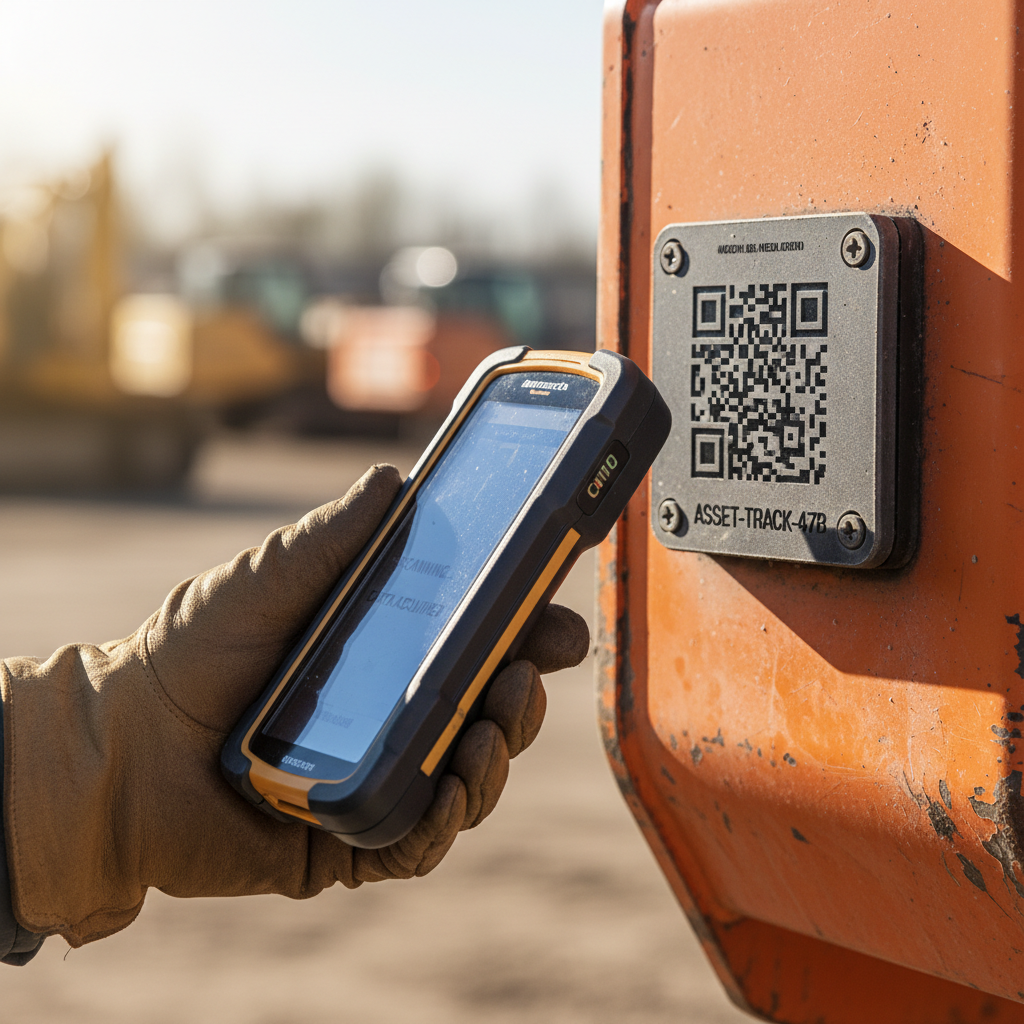
Contractors track powered equipment (excavators, loaders) through factory-installed telematics. They ignore non-powered assets: generators, compressors, scaffolding, temporary fencing. Those assets move between job sites on flatbeds, and without an independent GPS tracker, they vanish. A rugged cellular device like the Oyster3 or Oyster Edge solves this for a fraction of the asset’s replacement cost and runs for years on a single battery.
Oil and Gas
High-value assets in remote locations with inconsistent cellular coverage. Tubular goods, valves, and consumables distributed across laydown yards that span hundreds of acres. Misplacing a single high-value component can stall drilling operations for days. The technology choice leans toward long-battery cellular devices with satellite fallback, and the business case almost always justifies itself on a single prevented delay.
What Changes in 2026: AI, Digital Twins, and UWB on Wi-Fi
Three shifts are reshaping enterprise asset tracking deployments right now.
AI has moved from pilot to production. Predictive maintenance, anomaly detection, and computer vision inspections are now standard procurement requirements, not R&D experiments. AI on top of location data answers not just “where is this asset” but “when will this asset fail” and “is this asset behaving abnormally compared to its cohort.” If you’re writing an RFP today, require an AI/ML integration path. You may not activate it on day one, but you need the platform to support it without re-architecture.
Digital twins have reached mid-market. The digital twin market was valued at $12.9 billion in 2022 and is projected to grow at 36.3% CAGR through 2030, faster than asset tracking itself. Sund & Bælt monitors bridges and tunnels through digital replicas. Downer Group runs TrainDNA across 200+ Australian trains. Boston Dynamics robots integrate with IBM Maximo for factory-floor digital twins. The shift is fundamental: location data alone answers “where.” A digital twin answers “what happens next” by combining location with operational, environmental, and sensor data.
UWB is leaving the access-card niche. Qorvo is embedding standards-based UWB into enterprise Wi-Fi access points, allowing precise indoor location to ride on existing network infrastructure rather than requiring a dedicated RTLS anchor overlay. This is the most consequential indoor-tracking development since BLE Angle of Arrival, because it eliminates the biggest objection enterprises have raised against UWB for a decade: the cost-per-square-foot of dedicated anchors.
One trend that often gets overlooked: privacy regulations around workplace tracking are tightening fast. BIPA settlements, unauthorized GPS tracking lawsuits, and employee surveillance backlash are producing real legal exposure. Build transparency, consent, and data-retention policies into your deployment plan BEFORE the first tag goes live. Vendors without audit-log and consent management features will be excluded from large enterprise RFPs regardless of hardware quality.
How to Deploy Without Building a White Elephant
Here’s the uncomfortable pattern in enterprise asset tracking: a company procures 10,000 tags, installs readers across four sites, launches the platform, and 14 months later only 30% of the tags are active because field teams rejected the workflow.
The software vendor won’t tell you this. The hardware vendor won’t tell you this. But deployment success depends more on adoption design than technology selection.
This is the sequence that works:
Start with dollars, not devices. Quantify the problem in terms the finance team already uses: lost equipment cost, downtime hours, fulfillment cycle time, container dwell days. “We lose $1.6M per year in misplaced equipment” gets executive buy-in. “We need asset visibility” gets a polite email that goes nowhere.
Match technology to environment using the framework above. Indoor-only assets get BLE or RFID. Multi-site mobile assets get GPS/cellular. Mixed environments get multi-modal. Don’t let a single vendor sell you their entire product line when you need one tier.
Require EAM and ERP integration in the RFP. A tracking system that doesn’t feed your existing asset master record creates a second silo. APIs, not CSV exports. Real-time sync, not nightly batch.
Design for the field technician, not the IT architect. If the person attaching or scanning the tag finds the process annoying, they will stop doing it. Every single time. The best RTLS in the world produces nothing if the tags sit in a box in the storeroom. This is why fast implementation and low-disruption onboarding matter more than feature count.
Tag by value and risk, not by category. You don’t need real-time location on every cable tester. You do need it on every ventilator, every generator, every ULD. Start with the assets that cost you money when they go missing. Expand from there once the system proves itself.
Bake privacy in from day one. Publish a clear policy. Obtain written consent where required. Limit tracking to business assets during working hours. Audit data retention. Unauthorized tracking lawsuits are not hypothetical; they are producing costly settlements right now.
The companies I’ve seen deploy successfully share one trait: they treat the project as an operational change, not a technology purchase. The tag is a means. The outcome is a shorter cycle time, a lower loss rate, a faster fulfillment window.
If you’re scoping an enterprise asset tracking deployment and want to talk through hardware selection, integration architecture, or phased rollout, reach out to our team. Or browse our full range of asset tracking devices to see what fits your environment.

Frequently Asked Questions
What is enterprise asset tracking?
Enterprise asset tracking is the practice of identifying, locating, and monitoring physical assets (equipment, vehicles, containers, medical devices, tooling) across their full lifecycle using tags, sensors, and software. It provides real-time or near-real-time visibility that supports loss prevention, utilization optimization, maintenance scheduling, and regulatory compliance across multiple sites and asset classes.
What is the difference between asset tracking and enterprise asset management?
Asset tracking provides real-time location and status data from physical tags and sensors on the asset itself. Enterprise asset management (EAM) is a software category that manages work orders, maintenance schedules, lifecycle records, and compliance documentation. EAM platforms rely on accurate tracking data to function well, but purchasing EAM software does not automatically provide physical tracking capability. They are complementary layers, not substitutes.
Which tracking technology is best for enterprise use?
It depends on environment and precision needs. Passive RFID is cheapest per tag and ideal for bulk inventory scans. BLE Angle of Arrival offers sub-meter indoor accuracy at moderate cost. UWB delivers centimeter-level precision for manufacturing and AGV/AMR environments but has the highest infrastructure cost. GPS/cellular is the only practical option for assets that move outdoors across long distances. Most enterprise deployments combine two or more technologies to cover different environments.
How much does enterprise asset tracking cost?
Tag costs range from under $0.10 per passive RFID inlay to $100+ per GPS/cellular device. Infrastructure (readers, gateways, anchors) is typically the larger expense. Software pricing varies by tag count, asset count, or user seats. Published case studies report 10x ROI and payback periods as short as three months in healthcare and manufacturing verticals.
What industries benefit most from asset tracking?
Healthcare, aviation, manufacturing, logistics, construction, oil and gas, and mining all have strong documented ROI. Healthcare leads because the baseline loss rate (approximately $4,000 per hospital bed per year) and patient-safety implications create unusually high return potential. Aviation follows closely due to the cost of Aircraft-on-Ground delays and the complexity of ULD and GSE pool management.
What are the main privacy risks of tracking enterprise assets?
The primary risks involve unauthorized employee tracking, biometric data collection without consent (particularly under Illinois’ BIPA), and surveillance that exceeds the stated business purpose. Best practice includes publishing a clear tracking policy, obtaining written consent where legally required, restricting tracking to business assets during working hours, and maintaining auditable data-retention and deletion workflows.








 +1 508 292 2210

2 Responses